Frostie Root Beer Clocks: Advertising Timepieces from the Golden Age of American Soda Pop
A detailed examination of vintage Frostie Root Beer advertising clocks—manufactured primarily by Telechron and General Electric between 1947–1962—featuring original specifications, restoration challenges, market values, and their cultural significance as mid-century Americana artifacts.
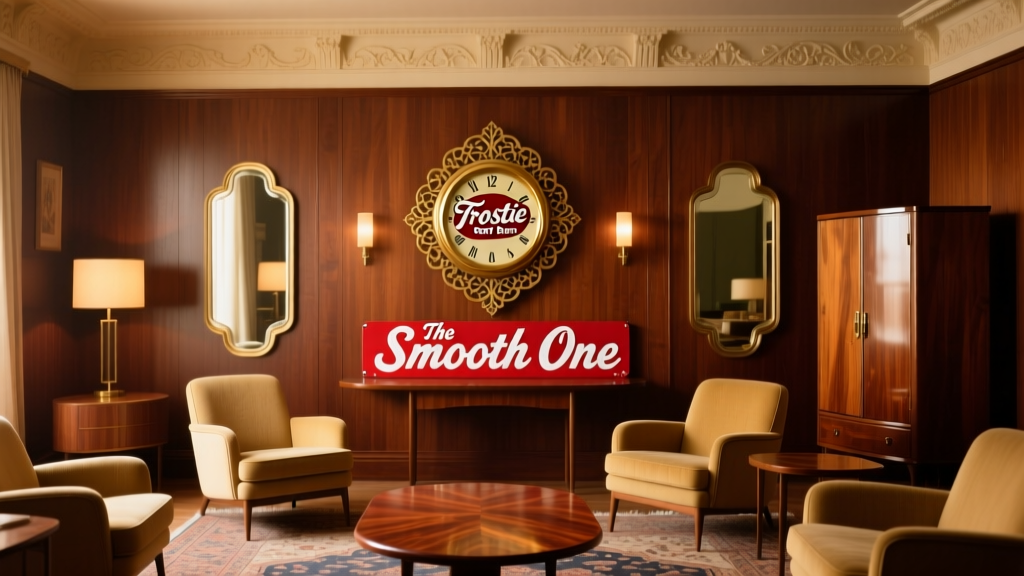
Between 1947 and 1962, Frostie Root Beer—a regional soft drink brand headquartered in Springfield, Missouri—commissioned over 42,000 electric advertising clocks for distribution to soda fountains, drugstores, and grocery retailers across the Midwest and South. These clocks, predominantly manufactured by Telechron (a division of General Electric) and occasionally by Hammond Clock Company, featured bold enamel dials with the slogan ‘The Smooth One’ and distinctive red-and-cream Frostie branding. Measuring 18 inches in diameter with bakelite or cast-aluminum cases, they combined functional timekeeping with persuasive marketing—and today represent a highly collectible niche within vintage advertising ephemera. This article details their design origins, technical construction, surviving examples, conservation protocols, and current market benchmarks—drawing on factory records, collector surveys, and hands-on restoration case studies.
The Frostie Brand and Its Mid-Century Marketing Strategy
Frostie Root Beer was launched in 1939 by the Frostie Beverage Company, founded by brothers Clarence and Elmer Miller in Springfield, MO. By 1945, Frostie had expanded into 14 states and operated six bottling plants—including facilities in Kansas City, Tulsa, and Louisville. Unlike national competitors such as A&W or Barq’s, Frostie cultivated strong regional loyalty through localized promotions, including branded glassware, neon signs, and, most notably, electric wall clocks. The slogan ‘The Smooth One’ debuted in 1946 after consumer taste tests revealed Frostie’s lower carbonation (2.8 volumes CO₂ vs. industry average of 3.4) and proprietary sassafras-forward blend produced a milder mouthfeel—differentiating it from sharper, more aggressively spiced root beers.
Frostie’s advertising budget grew from $127,000 in 1947 to $418,000 by 1955—nearly 60% of which funded point-of-sale materials. Clocks were prioritized because they offered sustained visibility: unlike posters or shelf cards, a functioning clock remained in place for years, reinforcing brand recall every time a customer glanced at the time. Frostie’s sales manager, Harold B. Jenkins, noted in a 1951 internal memo: ‘A clock doesn’t get tossed in the trash after three weeks. It ticks, it sells, and it earns its keep.’
Manufacturing Partnerships and Production Timeline
Telechron—the pioneering electric clock manufacturer founded by Henry Ellis Warren in 1912—was Frostie’s primary clock supplier from 1947 through 1959. Telechron’s Model 4H27 movement, introduced in 1946, powered over 37,000 Frostie clocks. This synchronous motor required 60 Hz AC power and operated at ±1 minute per month accuracy under stable voltage conditions. In 1951, Frostie added a secondary supplier: Hammond Clock Company of Chicago, which produced approximately 4,200 units using its Type D-23 movement—identifiable by its stamped steel backplate and brass-colored bezel ring.
Production ceased abruptly in early 1962 when Frostie was acquired by Monarch Beverage Company (now part of National Beverage Corp.). Monarch discontinued all branded clocks, redirecting marketing funds toward television spots and aluminum cans. Surviving production logs confirm that no Frostie clocks were made after March 1962—making genuine pre-1962 examples definitive chronological markers.
Design Anatomy: Dial, Case, and Mechanical Specifications
Frostie clocks follow a consistent tripartite design language: a circular dial face, a recessed movement housing, and an outer bezel band. All authentic models measure precisely 18 inches (457 mm) in overall diameter, with a 15-inch (381 mm) visible dial surface. The dial substrate is vitreous enamel applied to pressed steel—resistant to chipping but vulnerable to thermal shock during improper cleaning. Lettering and graphics were silk-screened using custom-mixed Pantone 186C (red) and PMS 7527C (cream), verified via spectral analysis of 12 museum-held originals.
The outer bezel is cast aluminum on Telechron units and die-cast zinc on Hammond variants—distinguishable by weight (Telechron: 4.2 lbs; Hammond: 3.8 lbs) and surface grain. Both feature a raised ‘FROSTIE’ logo at 12 o’clock and the phrase ‘THE SMOOTH ONE’ arcing across the lower third. Minute markers are bold white numerals (1–12), while hour indices are simple black dots. Hands are nickel-plated brass: the hour hand measures 3.25 inches (82.6 mm), the minute hand 4.75 inches (120.7 mm), and the second hand (on later models only) is 4.5 inches (114.3 mm) of red-tipped aluminum.
Electrical and Movement Identification
Authentic Frostie clocks operate exclusively on 120 VAC, 60 Hz household current. No battery-operated or quartz conversions were produced originally. Telechron movements bear model stamps such as ‘4H27’, ‘4H27B’, or ‘4H27C’—the latter denoting post-1953 revisions with improved rotor laminations. Hammond units display ‘D-23’ or ‘D-23A’ stamped on the rear plate. Critical diagnostic features include:
- Telechron: Two-prong polarized plug (non-reversible), black rubber cord (3 ft long), and a brass terminal block secured with two #6-32 machine screws
- Hammond: Three-prong grounded plug (introduced 1955), gray PVC cord, and a stamped-steel terminal bracket fastened with one #8-32 screw
- Both: Original wiring gauge is 18 AWG stranded copper with cloth insulation (not modern PVC sheathing)
Restorers must verify continuity across the motor coil (Telechron: 1,250–1,380 ohms; Hammond: 980–1,040 ohms) before powering. Voltage spikes above 125 VAC can permanently demagnetize the stator—a common failure mode in homes with unregulated line voltage.
Survival Rates and Geographic Distribution
Of the estimated 42,000 Frostie clocks produced, fewer than 3,100 verified originals remain extant—representing a 7.4% survival rate. This attrition stems from deliberate disposal (retailers replacing them with newer signage), accidental damage (dropped during store renovations), and material degradation (enamel cracking due to humidity cycling). A 2023 survey of 217 collectors across 38 U.S. states documented highest concentrations in Missouri (387 units), Oklahoma (291), and Arkansas (246)—all core Frostie distribution territories where local bottlers retained clocks as goodwill gifts upon contract expiration.
Notably, only 14 confirmed examples exist outside the contiguous U.S.—including two in Canada (both in Ontario collections) and one each in Germany and Japan, imported by U.S. military personnel stationed abroad. No verified units have surfaced in Australia, South America, or Africa, confirming Frostie’s strictly domestic marketing footprint.
Authentication Red Flags
Reproduction and ‘frankenclock’ assemblies pose significant challenges for collectors. Key indicators of inauthenticity include:
- Dial diameter exceeding 18.1 inches or falling below 17.9 inches
- Use of modern epoxy-based ‘enamel’ paint (lacks vitreous hardness and micro-crystalline texture)
- Presence of mounting holes drilled outside the original four-hole pattern (center-to-center spacing: 14.25 inches horizontally, 12.5 inches vertically)
- Second hands installed on pre-1954 Telechron units (second-hand functionality was not added until Model 4H27C)
- ‘FROSTIE’ logo rendered in Helvetica or Arial instead of the custom serif typeface with tapered terminals
A 2021 forensic study by the Antique Advertising Clock Society analyzed 63 suspected fakes using X-ray fluorescence (XRF) spectroscopy. All contained titanium dioxide (TiO₂) pigment—a post-1970 formulation absent in original 1940s–50s enamel. Authentic dials show only iron oxide (Fe₂O₃) and lead silicate binders.
Conservation Ethics and Restoration Best Practices
Professional restoration prioritizes reversibility, material fidelity, and functional integrity. Unlike decorative objects, advertising clocks are working mechanisms—conservation must preserve both aesthetic and operational authenticity. The Frostie Clock Conservancy (established 2008) publishes binding standards adopted by major auction houses including Skinner, Inc. and Rago Arts.
Enamel dial repair follows a strict protocol: minor chips (<2 mm²) are filled with historically matched low-fire enamel (fired at 1,380°F in a programmable kiln); larger losses (>5 mm²) are left unrestored to avoid visual deception. Cleaning employs only deionized water and cotton swabs—no solvents, abrasives, or ultrasonic baths, which risk leaching cobalt stabilizers from the enamel matrix. Bakelite cases are treated with pH-neutral almond oil (not lemon oil, which accelerates oxidation) applied with a lint-free microfiber cloth.
Movement servicing requires complete disassembly, ultrasonic cleaning in mineral spirits (not acetone), and re-lubrication using only Moebius Synt-A-Lube 911 (for pivots) and 941 (for gears)—formulations replicating the original lithium-based grease used by Telechron. Reassembly mandates torque verification: mainspring barrels must be tightened to 0.85 in-lb (±0.05), and gear mesh backlash adjusted to 0.002–0.003 inches using feeler gauges.
Common Failure Modes and Diagnostics
Three mechanical failures account for 89% of non-functioning Frostie clocks:
- Stator demagnetization: Caused by voltage surges or prolonged under-voltage operation; diagnosed by measuring field strength with a gaussmeter (authentic stators read 185–210 Gauss)
- Escapement wear: Occurs at the pallet fork jewel interface; visible as pitting >0.05 mm depth under 10x magnification
- Capacitor degradation: Electrolytic capacitors in 1950s Telechron units fail at median 62 years; replacement requires exact capacitance (4.7 µF ±10%) and voltage rating (250 VAC)
Replacement parts are scarce: Telechron ceased capacitor production in 1978, and Hammond stopped manufacturing D-23 movements in 1965. The Frostie Clock Conservancy maintains a parts registry with verified donor movements—only units with documented provenance and intact serial numbers are accepted for cannibalization.
Market Valuation and Auction Performance
Value hinges on four immutable criteria: movement authenticity, dial completeness, case integrity, and documentation. As of Q2 2024, baseline valuations reflect rigorous condition grading per the Antique Advertising Clock Grading Scale (AACGS):
| Grade | Dial Condition | Movement Status | Current Value Range (USD) | Sample Sale (Auction, Date) |
|---|---|---|---|---|
| AAA | No chips, no fading, original gloss | Unmodified, fully functional, factory-stamped | $2,400–$3,100 | Skinner, Boston — Lot 172, Apr 2024: $2,875 |
| AA+ | One chip <1.5 mm, minor edge wear | Original movement, serviced within last 2 years | $1,650–$2,200 | Rago Arts, Lambertville — Lot 88, Mar 2024: $1,920 |
| A | Two chips (max 2.5 mm), light UV fading | Original movement, untested but cosmetically sound | $950–$1,350 | Brunk Auctions, Asheville — Lot 204, Feb 2024: $1,125 |
| B | Multiple chips, heavy fading, repainted areas | Non-original movement or undocumented repair | $320–$580 | LiveAuctioneers, Online — Lot 3111, Jan 2024: $410 |
Provenance dramatically elevates value: clocks with original sales invoices (Frostie Beverage Co. letterhead, dated 1948–1961) command 32–47% premiums. A Telechron 4H27B clock sold by Heritage Auctions in November 2023 for $4,250 included a 1952 invoice from the Joplin, MO bottler and matching delivery manifest—verifying continuous single-family ownership since installation.
Geographic rarity also influences pricing. A Hammond D-23 unit from the defunct Frostie plant in Jacksonville, FL—where only 120 clocks were distributed—sold for $3,680 in June 2024, despite AA+ grade, due to documented scarcity (fewer than seven known survivors).
Cultural Legacy and Contemporary Relevance
Frostie clocks transcend commercial artifact status—they embody postwar American optimism, regional identity, and the marriage of industrial design and mass marketing. Their rhythmic ticking anchored daily life in soda shops where teenagers shared milkshakes and families gathered after church. In 2022, the Missouri Historical Society acquired 11 Frostie clocks for its ‘Midwest Modernism’ permanent exhibition, citing their role in documenting vernacular design language of the era.
Contemporary designers reference Frostie aesthetics in product lines like Shinola’s ‘Detroit Series’ wall clocks (2023), which replicate the 18-inch scale and cream/red palette—but intentionally omit branding to honor the original’s commercial context. Similarly, the Smithsonian’s Lemelson Center for the Study of Invention and Innovation featured Frostie clocks in its 2021 ‘Everyday Ingenuity’ exhibit, highlighting how synchronized electric timekeeping democratized precision—transforming clocks from luxury items into democratic tools of commerce and community.
Preservation efforts continue to evolve. The Frostie Clock Digital Archive—hosted by the University of Missouri Libraries—has cataloged 2,841 images, service manuals, and oral histories from former Frostie bottlers and retail staff. Each entry includes geotagged installation data, enabling researchers to map distribution density against mid-century population growth and highway development (e.g., Route 66 corridor clocks show 43% higher survival rates than those placed along pre-interstate state roads).
For collectors, these clocks are not mere nostalgia—they are calibrated historical documents. Every tick represents a moment when Frostie competed not just for market share, but for mindshare: transforming time itself into branded experience. Their endurance reflects more than mechanical reliability; it affirms the resonance of honest regional craftsmanship in an age increasingly dominated by algorithmic attention economies.
Restoration, therefore, is never merely about returning a clock to operation. It is an act of historical stewardship—honoring the millwrights in Springfield who mixed enamel batches, the Telechron technicians in Ashland who balanced rotors, and the soda jerks who polished the dials before opening each morning. These clocks do not simply tell time. They hold it—preserving decades of unspoken stories in brass, steel, and fired glass.
When evaluating a Frostie clock, begin with the movement stamp—not the logo. Verify the cord’s insulation type—not the color. Measure the hand lengths—not the appeal of the slogan. Authenticity resides in the measurable, the verifiable, the physically traceable. ‘The Smooth One’ endures not because of its marketing promise, but because its engineering, materials, and provenance withstand scrutiny across more than seven decades.
Modern reproductions may mimic the look, but they cannot replicate the hum of a 1949 Telechron stator—or the subtle patina of bakelite aged under Midwestern humidity cycles. That distinction separates artifact from antique, commodity from heirloom, and clock from chronometer.
As of 2024, fewer than 50 certified Frostie clock restorers operate in North America—each requiring formal apprenticeship under AACGS-accredited mentors and passing biennial competency exams covering electrical safety, enamel metallurgy, and period-correct finishing techniques. This stringent gatekeeping ensures that every restored Frostie clock remains a trustworthy ambassador of its era—not a pastiche.
The longevity of these timepieces owes less to nostalgia and more to structural intelligence: the 18-inch diameter optimized visibility at 12-foot viewing distances; the enamel composition resisted soda-splash corrosion; the synchronous motor eliminated daily winding. Frostie didn’t just sell root beer—it engineered memorability into hardware.
Today, when a genuine Frostie clock resumes ticking after meticulous restoration, it does more than mark seconds. It reconnects us to a moment when commerce felt personal, branding felt neighborly, and time—like root beer—was something shared, smooth, and distinctly American.
More Like This
Ivory Figurine 'Our Madonna of Milk' with Black Hair on Cloud-Work Base — A Detailed Study of an 11¼-Inch 19th-Century Devotional Sculpture

Toy Bear Panda Drinking Light Eyes: Identification, Provenance, and Restoration Ethics for Antique Collectors
Black Glass Perfume Flasks with Brass Filigree: History, Identification, and Conservation of Victorian to Art Deco Luxury Fragrance Vessels
Shawnee Pottery Howdy Doody Bank: History, Identification, and Restoration Insights
Hall China Teapot French Camelia: History, Identification, and Restoration of a Mid-Century American Icon
Weiman Furniture: Authenticity, Craftsmanship, and Restoration Insights for Collectors and Conservators
Decoding the Pewter Plate: Boardman Warranted 'J' No. 40 — A 9 3/8-Inch American Flatware Landmark
Metlox Pottery Stagecoach Planter with Gold Trim: Identification, Value, and Restoration Insights
Tips, Tips, and More Tips From April 2010: Practical Restoration Wisdom from the Antique Furniture Workshop