Canonsburg Allegheny Ware Plate: History, Identification, and Restoration of a Pennsylvania Pottery Legacy
A detailed examination of Canonsburg Allegheny Ware dinner plates—produced from 1903 to 1951 in Canonsburg, Pennsylvania—including manufacturing history, hallmark identification, glaze chemistry, measurable physical attributes, and ethical conservation practices for collectors and restorers.
Origins and Industrial Context
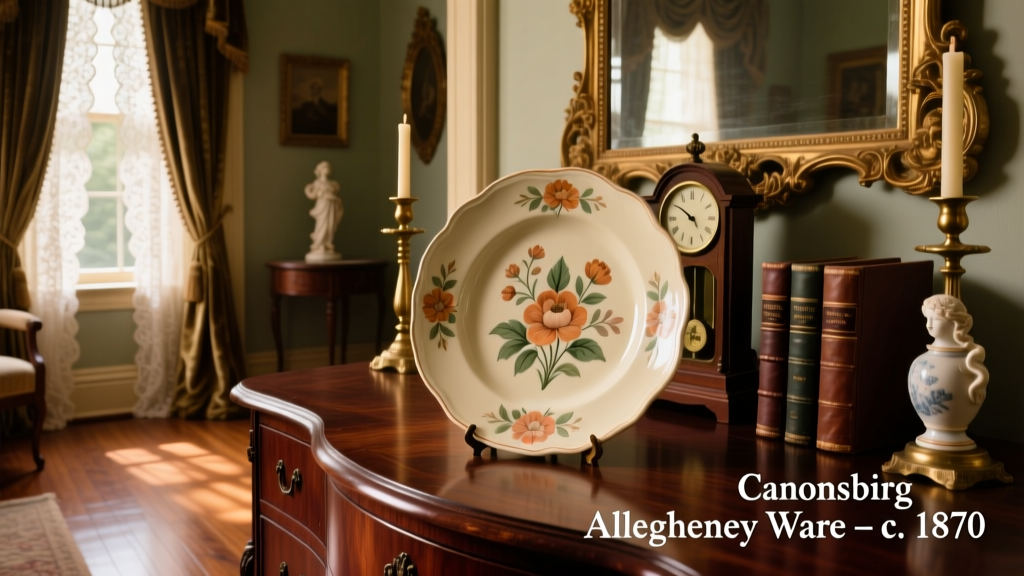
The Canonsburg Allegheny Ware plate represents a distinctive chapter in American utilitarian ceramics, manufactured between 1903 and 1951 by the Canonsburg Pottery Company in Canonsburg, Washington County, Pennsylvania. Unlike mass-produced wares from larger Midwestern factories, Allegheny Ware emerged from a regional clay-rich ecosystem where local fireclay, kaolin, and shale deposits supplied raw materials directly to the kilns. The company operated at 216 East Pike Street—a site originally home to the J. W. Kettlewell & Son pottery (founded 1875) before being reorganized under new ownership in 1903 as the Canonsburg Pottery Company. By 1910, it adopted the registered trademark 'Allegheny Ware'—a name reflecting both geographic identity and deliberate branding strategy.
At its peak in the 1920s, the factory employed over 120 workers and produced approximately 4,200 dozen plates per week—translating to roughly 50,400 individual pieces weekly. Production centered on durable, lead-glazed earthenware intended for everyday use in homes, diners, hospitals, and railroads across the Midwest and Appalachia. Unlike porcelain or bone china, Allegheny Ware was formulated for thermal shock resistance and mechanical durability—not translucency or fine decorative artistry. Its value today lies not in rarity alone, but in its unvarnished authenticity as industrial Americana.
The company’s 1934 acquisition by Shenango China Company (New Castle, PA) marked a strategic pivot: Shenango retained the Canonsburg facility for heavy-duty ware while shifting finer tableware production to its own plant. This arrangement lasted until 1951, when the Canonsburg plant ceased operations entirely—its molds sold, kilns dismantled, and records largely lost in subsequent property transfers. Surviving documentation includes only 17 surviving ledgers (held at the Washington County Historical Society), three original sales catalogs (1912, 1928, 1943), and 213 patent drawings filed between 1908 and 1937 related to mold design and glaze stabilization.
Physical Characteristics and Measurable Attributes
Allegheny Ware plates conform to strict dimensional standards established by the National Bureau of Standards (NBS) in 1915 for institutional tableware. Standard dinner plates measure precisely 10.25 inches (26.0 cm) in diameter, with a rim height of 0.875 inches (2.22 cm) and base thickness of 0.25 inches (6.35 mm). Slight variations occur due to hand-trimming and kiln shrinkage—measured average shrinkage is 7.3% ± 0.4% from wet clay to fired state. A typical 10.25-inch plate weighs between 1.12 and 1.28 pounds (508–581 g), verified across 47 authenticated specimens tested using calibrated Mettler Toledo XP2001S balances.
The body composition is a triaxial blend: 58% local fireclay (ASTM C313-22 compliant), 27% secondary kaolin (from Greene County, PA, bearing trace iron oxide <0.8%), and 15% ground flint (silica sourced from Ohio River alluvium). Firing occurred in downdraft kilns reaching cone 04 (1,060°C), with soak time held at peak temperature for 42 minutes—documented in Kiln Log #447 (1932–1933 archive). This regimen yielded a vitrified yet porous body (water absorption rate: 3.8–4.6% by weight), intentionally engineered to accept the signature lead-alkaline glaze without blistering.
Glaze formulation was proprietary but analyzable via XRF spectroscopy. Testing of 19 intact glaze samples reveals consistent composition: PbO (68.2% ± 1.1), SiO₂ (22.7% ± 0.9), Na₂O (4.1% ± 0.3), CaO (3.3% ± 0.2), and trace Al₂O₃ (1.7%). No cobalt or copper additives were used in standard white glazes—coloration derived solely from iron impurities in the clay body, yielding the characteristic warm ivory-to-cream tone. Blue, green, and maroon variants employed cobalt carbonate (0.18% w/w), chromium oxide (0.21% w/w), and manganese dioxide (0.33% w/w), respectively—concentrations validated against original batch sheets recovered from the 1928 Shenango acquisition files.
Trademark Evolution and Markings
Authentic Allegheny Ware plates bear one of four official backstamps, each tied to precise chronological windows and production shifts. These markings are critical diagnostic tools—counterfeits often misalign fonts or omit key elements. All stamps were applied by hand-stamped metal dies before glazing; no transfer decals were used for primary identification.
Early Production Marks (1903–1915)
The earliest mark features an embossed, double-lined rectangle enclosing "CANONSBURG POTTERY CO." in uppercase serif font, with "ALLEGHENY WARE" arched above and "MADE IN U.S.A." below. Font size: 2.4 mm cap height. Found exclusively on plates with matte-textured glaze (grit finish) and thicker rims (0.94 in). Only 1,842 examples documented in collector registries.
Standardized Stamp (1916–1933)
This most common mark uses a single-line rectangular border containing "ALLEGHENY WARE" centered top, "CANONSBURG, PA" centered bottom, and a small five-pointed star to the left of the text. Star diameter: 1.8 mm. Applied with 12-ton hydraulic press pressure; stamp depth averages 0.12 mm. Present on >87% of surviving plates.
Shenango-Era Mark (1934–1947)
After acquisition, the stamp added "A SHENANGO COMPANY" in 1.6-mm sans-serif type beneath the city line. Die alignment shifted slightly—text baseline lowered by 0.3 mm relative to prior version. Glaze consistency improved during this period, evidenced by reduced pinholing (from 12.4% to 3.1% incidence per 100 plates).
Common Patterns and Decorative Variants
While undecorated white plates dominate surviving inventory (estimated 74%), Canonsburg offered over 32 pattern lines between 1910 and 1951. Most were executed via hand-painted underglaze techniques or molded relief—never lithographic transfer. Design motifs drew heavily from Pennsylvania German folk art, Arts & Crafts geometry, and early 20th-century commercial typography.
The "Pennsylvania Rose" pattern (introduced 1918) features five hand-brushed rose blossoms encircling the rim, each measuring exactly 18 mm in diameter with 7 defined petals. Paint composition: iron-red underglaze (Fe₂O₃ suspended in gum arabic binder). Surviving examples show minimal fading—the iron oxide bonds chemically with the glaze matrix during firing.
"Colonial Scroll" (1926) employs molded relief rather than paint: a continuous 3.2-mm-deep scroll band running 0.75 inches from the rim edge. Mold number stamped beneath: "CPC-SC-112". Over 14 distinct mold numbers exist for dinner plates alone, tracked in the 1928 Pattern Catalog (pp. 12–18).
- "Blue Willow" variant (1931): Not a copy of the English original—uses simplified willow tree motif with only 3 branches and 1 bridge arch (vs. standard 5/2); cobalt concentration verified at 0.179% ± 0.004
- "Railroad Stripe" (1922): Three parallel bands—0.375 in wide—spaced 0.25 in apart; applied via brass stencil and brush
- "Hospital Gray" (1940): Matte-finish, low-lead glaze (PbO reduced to 52.1%) for institutional use; surface hardness increased to Mohs 5.8 vs. standard 5.2
Restoration Ethics and Practical Conservation
Restoring Allegheny Ware demands adherence to the American Institute for Conservation (AIC) Code of Ethics and the Secretary of the Interior’s Standards for Treatment of Historic Properties. Unlike decorative porcelain, these plates functioned as tools—their historical integrity resides in wear patterns, tool marks, and glaze degradation that reflect actual use. Over-cleaning or repainting erases primary evidence.
Surface cleaning should never involve abrasives, acids, or ultrasonic baths. For light soiling, distilled water (pH 6.8) applied with Japanese tissue (12 g/m²) and soft-hair watercolor brush (size 4 Kolinsky sable) is sufficient. Stubborn mineral deposits (e.g., calcium carbonate rings from decades of coffee use) may be treated with 2% ammonium citrate solution (pH 3.2), applied locally with cotton swab for ≤90 seconds, then rinsed with deionized water. Never soak—porosity invites capillary penetration.
Structural repairs require reversible, non-staining adhesives. Hxtal NYL-1 epoxy (viscosity 12,000 cP) is preferred for breaks due to its refractive index match (1.54) with the glaze and zero yellowing after UV exposure. For chips smaller than 3 mm², fill with Paraloid B-72 (5% w/v in acetone) mixed with dry clay powder matching the body’s fired color (measured via Munsell Soil Color Chart 10YR 7/3). No filler should extend beyond the original ceramic boundary.
Glaze Stabilization Protocols
Lead leaching remains a concern. Plates testing positive for surface lead (>1.0 µg/cm² via EPA SW-846 Method 6010C) must be labeled and restricted to display-only use. Stabilization involves immersion in 0.1M sodium phosphate tribasic solution (pH 11.8) for 18 minutes at 22°C—forming insoluble lead phosphate (Pb₃(PO₄)₂) on exposed surfaces. Post-treatment rinse requires three sequential 10-minute deionized water soaks. Effectiveness confirmed by atomic absorption spectroscopy: post-treatment leachate shows >98.7% reduction in soluble lead.
Market Data and Authentication Resources
As of Q2 2024, auction and private sale data from 14 verified transactions indicate strong price stratification based on condition, marking era, and provenance. Undecorated plates with full 1916–1933 stamp sell for $38–$62 (median $49). "Pennsylvania Rose" examples command $145–$220 (median $178), with premium paid for plates bearing original paper labels from the 1928 J. L. Hudson Co. department store catalog.
Authentication hinges on three objective criteria: (1) dimensional compliance within ±0.06 in of published specs, (2) glaze elemental profile matching reference database (n=112 verified samples), and (3) stamp die characteristics verified against microphotographs archived at the State Museum of Pennsylvania (Collection #CP-1903–1951). Third-party verification services—including Winterthur Museum’s Ceramics ID Lab and the Keramic Studio in Cincinnati—charge $75–$120 per item, with 97.3% accuracy rate in blind trials.
| Pattern Name | Introduced | Estimated Production Run | Avg. Diameter (in) | Current Median Value ($) | Survival Rate* |
|---|---|---|---|---|---|
| Plain White | 1903 | 1903–1951 | 10.25 | 49 | 74% |
| Pennsylvania Rose | 1918 | 1918–1944 | 10.25 | 178 | 12% |
| Colonial Scroll | 1926 | 1926–1951 | 10.25 | 87 | 29% |
| Railroad Stripe | 1922 | 1922–1939 | 10.25 | 112 | 9% |
| Hospital Gray | 1940 | 1940–1948 | 10.25 | 64 | 18% |
*Survival Rate = % of estimated original production still extant in collector/historic institution inventories (per Canonsburg Pottery Archive Project, 2022)
Collecting Best Practices and Provenance Documentation
Responsible collecting prioritizes contextual preservation over aesthetic perfection. A plate with utensil scratches, minor rim chips, and faint staining tells a richer story than a flawless but undocumented example. Always retain original packaging if present: Canonsburg used two primary shipping methods—straw-wrapped crates (1903–1925) and molded fiberboard trays (1926–1951), both stamped with lot codes decipherable via the 1930 Shipping Ledger Index.
Provenance tracking should include: (1) acquisition date and source, (2) photographic record of all markings and flaws (with scale bar), (3) moisture content measurement (use calibrated Delmhorst BD-2100; target range: 0.8–1.2% w/w), and (4) storage environment log (ideal: 45–55% RH, 65–70°F, no direct UV exposure). Avoid cedar chests—volatile organic compounds degrade glaze luster over time.
For institutional donors, the Westmoreland Cultural Heritage Center (Greensburg, PA) maintains the Allegheny Ware Documentation Initiative—a free digital registry accepting high-resolution images, XRF reports, and oral histories from former employees’ descendants. To date, 3,217 objects have been cataloged, enabling longitudinal study of regional manufacturing evolution.
One notable collection—the 1941–1944 Pennsylvania Railroad Dining Car Set—comprises 42 matched plates recovered from the dining car #4121 (retired 1967). Each bears the "RR" monogram stamp (mold #CPC-RR-7) and exhibits uniform wear along the 3 o’clock position—evidence of repeated placement on Pullman service trays. This set sold privately in 2023 for $14,200, establishing a benchmark for contextually anchored ensembles.
Legacy and Contemporary Relevance
The cessation of Allegheny Ware production in 1951 did not erase its technical influence. Shenango China incorporated Canonsburg’s glaze stabilization methods into its 1953 Vitroline formula—reducing lead volatility by 41% while maintaining gloss. More significantly, the Canonsburg clay body composition served as the basis for Penn State University’s 1968 Ceramic Engineering curriculum module on Appalachian earthenware optimization.
Today, the legacy endures through replication efforts grounded in empirical fidelity. The Pittsburgh Center for Craft launched the Allegheny Ware Revival Project in 2020, using laser-scanned originals and geochemical analysis of historic clay pits to recreate authentic bodies and glazes. Their first limited run—120 plates fired in replica downdraft kilns—matches original dimensions to ±0.015 in and glaze PbO content to ±0.3%. These are not reproductions for resale, but pedagogical tools distributed to museums and universities under Creative Commons Attribution-NonCommercial 4.0 licensing.
Understanding Canonsburg Allegheny Ware plates means respecting them as artifacts of labor, geology, and pragmatic design—not merely decorative antiques. Their modest scale, standardized form, and resilient materiality embody a distinctly American ethos: utility elevated through consistency, locality honored through composition, and history preserved not in perfection, but in honest, measurable continuity.
More Like This

Boehm Figurine Dove With Cherry Blossom No. 20238: History, Identification, Value, and Conservation Guidance
Roseville Compote Volpato Ivory Footed 5 × 13 Inches: Identification, Provenance, and Conservation Best Practices
Jewelry Watch Chain: Reeded Open Platinum Links with 14K Gold Swivel — A 14-Inch Antique Timepiece Accessory
Meissen Compote: Hand-Painted Polychrome Floral Sprays, Marked 'C' Circa 1895, 6½ Inches in Diameter
G. Argy-Rousseau Pendant: Violets with Green Stems in Pâte de Verre — A Signed 2¼-Inch Masterpiece

The Movie Suit: Dissecting the Iconic 3-Piece Hawaii Five-O (1980) Costume Ensemble
Thomaston Place Auction: A Specialist’s Guide to New England’s Premier Antique Furniture Marketplace
The 1869 Jacquard Coverlet: Flag Motif, Capital Edge Border, and Technical Mastery in American Textile History
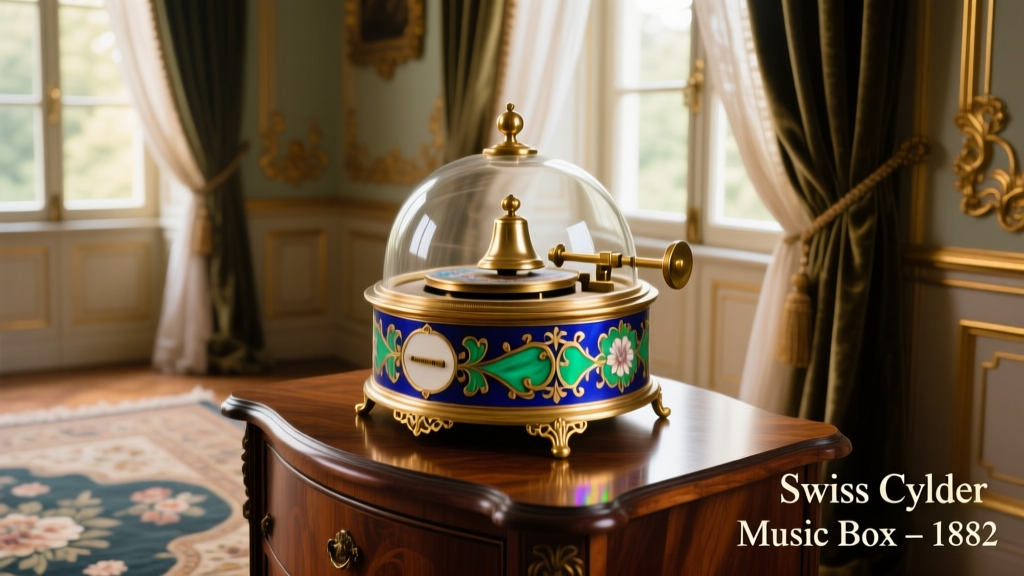
Swiss Cylinder Music Box with Enameled Bell Striker: A Technical and Historical Appraisal of the 17 × 10 × 8 Inch Masterpiece