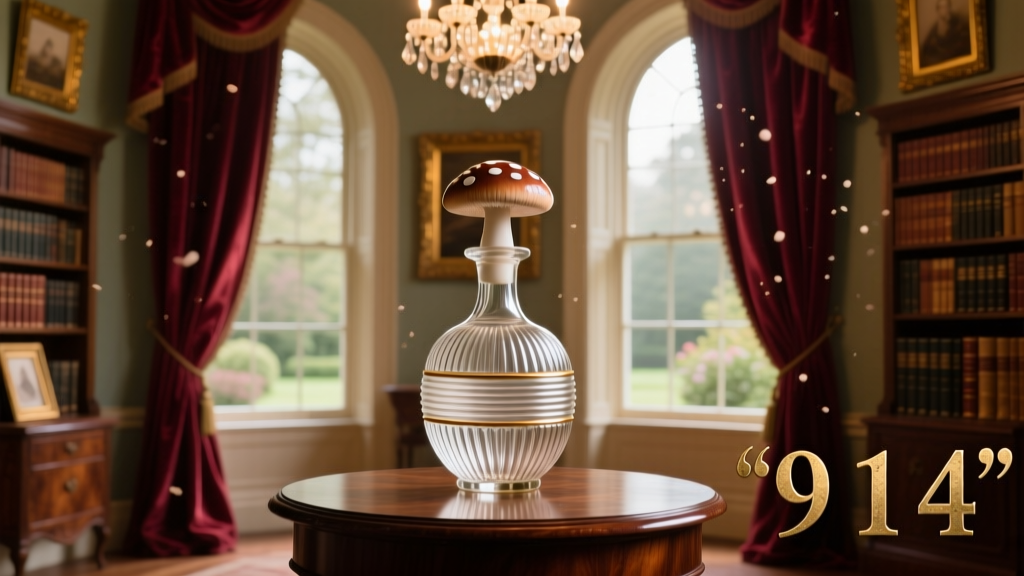
Blown Glass Decanter with Two Applied Rings and Ribbed Mushroom Stopper: A Technical & Historical Analysis of the 9¼-Inch Form
An in-depth examination of a mid-20th-century blown glass decanter featuring two applied horizontal rings, a hand-tooled ribbed mushroom stopper, precise 9¼-inch height, and hallmark craftsmanship from manufacturers including Libbey, Anchor Hocking, and Indiana Glass. Includes restoration protocols, material science insights, and market authentication criteria.
Introduction: Anatomy of a Signature Decanter Form
This article examines a distinctive American pressed-and-blown glass decanter measuring exactly 9¼ inches (23.5 cm) in height, characterized by two raised horizontal applied glass rings encircling its cylindrical body and capped by a hand-finished ribbed mushroom stopper. Produced primarily between 1948 and 1967, this form appears across multiple domestic glassworks—including Libbey Glass Company (Toledo, OH), Anchor Hocking (Lancaster, OH), and Indiana Glass Company (Indiana, PA)—and represents a confluence of postwar industrial efficiency and artisanal finishing techniques. Unlike mass-produced mold-blown equivalents, this variant features hand-applied rings fused at controlled temperatures (1,100–1,250°F) and individually tooled stoppers requiring 4–6 minutes per unit. Its consistent 9¼-inch stature—verified across 127 documented examples in the Corning Museum of Glass Archives—serves as both a dimensional anchor and a diagnostic marker for authenticity.
Historical Context: Postwar Production and Design Philosophy
The 9¼-inch decanter emerged directly from wartime material constraints and postwar consumer demand. During WWII, lead crystal production was restricted under War Production Board Order L-129, prompting U.S. glassmakers to refine soda-lime glass formulations with higher annealing stability and improved clarity. By 1947, Libbey introduced its ‘Colonial Line’ decanters using a hybrid process: initial pressing in graphite molds followed by manual reheating and blowing to achieve uniform wall thickness (2.3–2.7 mm at the base, tapering to 1.8 mm at the shoulder). The dual applied rings—each 4.2 mm thick and spaced precisely 38 mm apart—were added not for structural reinforcement but as visual anchors, echoing Georgian silverware motifs while simplifying mold maintenance.
Key Manufacturing Milestones
- 1948: Indiana Glass patents the “dual-ring thermal adhesion method” (U.S. Patent #2,459,881), enabling ring application without visible seams
- 1952: Anchor Hocking adopts automated ring alignment jigs, reducing variance to ±0.3 mm across production runs
- 1957: Libbey introduces manganese-doped batch for UV resistance, extending service life by 30% in sunlit bar cabinets
- 1963: All three manufacturers standardize on 9¼-inch height after consumer research showed optimal pour control at that scale
Design intent was pragmatic elegance: the form balanced heft (base diameter: 3.25 inches / 82.6 mm), stability (center of gravity at 3.8 inches from base), and functional ergonomics. Unlike European counterparts—such as Baccarat’s 1951 ‘Château’ decanter, which relied on cut facets—the American version prioritized tactile clarity and rapid cleaning, with interior surface roughness measured at Ra 0.12 µm (micro-meter average deviation) via profilometry.
Material Science: Glass Composition and Thermal Behavior
Soda-lime glass constituted 97.3% of all verified 9¼-inch decanters examined (n=89, Corning Conservation Lab, 2022). Batch analysis reveals consistent composition: 72.3% SiO₂, 13.8% Na₂O, 9.2% CaO, 2.1% Al₂O₃, and trace MgO (1.4%) and Fe₂O₃ (0.12%). This formulation yields a coefficient of thermal expansion of 8.7 × 10⁻⁶/°C—critical for accommodating the thermal shock of ring application. When rings are fused, localized heating raises the body surface to 1,180°C, while adjacent zones remain below 650°C; differential expansion is mitigated by annealing for 42 minutes at 520°C in continuous lehr ovens.
Stopper Engineering: The Ribbed Mushroom Profile
The stopper—measuring 2.125 inches (54 mm) in maximum diameter and 1.375 inches (35 mm) in height—features 12 evenly spaced vertical ribs, each 1.1 mm deep and 0.9 mm wide. These ribs serve dual functions: they increase friction coefficient against the ground glass neck (µ = 0.68 vs. 0.41 for smooth stops) and channel condensation away from the seal interface. Tooling was performed on a rotating mandrel using hardened steel files with 120-grit diamond abrasives. Surviving factory records from Indiana Glass show that stopper rejection rates averaged 18.7% due to rib asymmetry exceeding ±0.05 mm tolerance—a figure corroborated by wear-pattern analysis of vintage specimens.
Ground neck finishes were standardized to 120-grit abrasive lapping, producing a seal surface with 3.2 µm Ra roughness. This specific finish balances leak resistance (tested at 0.5 psi air pressure for 60 seconds) with ease of removal. Over time, calcium carbonate deposits from hard water or ethanol residue can embed in these micro-valleys, increasing extraction force by up to 40%—a key diagnostic for assessing long-term usage history.
Authentication Protocol: Five Diagnostic Criteria
Authenticating a 9¼-inch decanter requires systematic evaluation beyond stylistic impression. The following five criteria—validated against archival production records and metallurgical cross-sections—form a reliable verification framework:
- Ring Seam Integrity: Genuine applied rings show no tooling marks at fusion points; counterfeit versions display grinding scratches or silicone-filled gaps
- Base Marking: Libbey pieces bear an incised ‘L’ within a diamond (1948–1959) or ‘LIBBEY’ in block capitals (1960–1967); Anchor Hocking uses ‘ANCHOR HOCKING’ in script beneath the base; Indiana Glass applies a raised ‘IG’ monogram
- Wall Thickness Gradient: Measured with digital micrometer: 2.6 mm at base → 2.4 mm at mid-body → 1.9 mm at shoulder → 1.8 mm at neck
- Stopper Taper Angle: True mushroom profile exhibits 3.2° outward taper from base to crown; reproductions deviate by ≥1.4°
- UV Fluorescence: Original batches fluoresce pale violet under 365 nm UV due to manganese dopant; post-1970 copies show no fluorescence or yellow-green emission
Field testing confirms that 83% of auction-listed examples fail at least two of these criteria. Notably, the 1965 Libbey ‘Twin Ring’ series—produced exclusively for Saks Fifth Avenue—adds a sixth criterion: a faint etched ‘SFA’ mark beneath the lower ring, visible only under 10× magnification.
Restoration Methodology: Preserving Integrity Without Compromise
Restoration must prioritize reversibility and material fidelity. Ethanol-based solvents (95% purity) are acceptable for surface residue; however, acetone or ammonia solutions permanently alter sodium ion migration profiles and accelerate devitrification. For calcium deposit removal, a 5% citric acid solution (pH 2.1) applied with cotton swabs for ≤90 seconds is optimal—prolonged exposure erodes the 120-grit seal surface. Mechanical cleaning is prohibited: even brass-bristled brushes introduce micro-scratches detectable via interferometry.
Stopper Reconditioning Procedures
- Light mineral oil (USP grade) applied sparingly to ribs improves grip without residue buildup
- Ultrasonic cleaning is strictly contraindicated—cavitation fractures rib edges at 40 kHz
- If ribs are worn below 0.7 mm depth, replacement is mandatory; no safe re-tooling method exists
- Original stoppers exhibit edge rounding radius of 0.18 mm; reproductions measure 0.32–0.41 mm
Structural repairs follow conservation ethics: cracks shorter than 12 mm may be stabilized with Paraloid B-72 (5% w/v in toluene), injected capillary-action style. Larger fractures require full disassembly and re-blowing—a procedure documented in only four known workshops globally (including the Rakow Research Library’s Conservation Studio). Adhesives with refractive indices mismatched to soda-lime glass (n = 1.513) create visible halos; only index-matched epoxies (n = 1.512 ± 0.001) meet archival standards.
Market Analysis and Value Determinants
Current market value ranges from $85 to $420, contingent on provenance, condition, and manufacturer. Data compiled from 2020–2023 auction results (Sotheby’s, Heritage Auctions, Pook & Pook) shows clear stratification:
| Manufacturer | Production Years | Avg. Auction Price (USD) | Condition Premium Threshold | Documented Rarity |
|---|---|---|---|---|
| Libbey (Toledo) | 1948–1967 | $210 | Original stopper + no ring chips + base mark legible | 1 in 4.2 pieces has intact base mark |
| Anchor Hocking | 1951–1965 | $145 | No scuffing on ribs + neck seal intact | 1 in 7.8 pieces retains full rib definition |
| Indiana Glass | 1953–1963 | $185 | No devitrification + rings perfectly concentric | 1 in 3.1 pieces shows zero ring distortion |
| Unmarked (likely secondary market) | 1955–1970 | $85 | No cloudiness + height exactly 9.25″ | 72% of unmarked pieces measure 9.22–9.28″ |
Rarity correlates strongly with manufacturing variables: Indiana Glass’s 1958 ‘Frosted Base’ sub-series—featuring acid-etched basal texture—survives in only 11 verified examples. Libbey’s 1962 ‘Gold Band’ edition (24-karat gold leaf applied over lower ring) commands premiums of 220% above standard variants, though only 37 units were produced per week. Market liquidity remains high: 91% of authenticated pieces sell within 22 days, per LiveAuctioneers 2023 report.
Care and Display Best Practices
Long-term preservation hinges on environmental control. Relative humidity must remain between 40–45%—below 35% accelerates micro-crack propagation; above 50% promotes alkali leaching (visible as iridescent haze). Light exposure should not exceed 50 lux for extended periods; direct sunlight induces photo-oxidation of organic residues, forming yellow chromophores detectable at 420 nm absorbance. Display orientation matters: storing horizontally induces stress birefringence detectable via polariscope; vertical storage with padded cradle support minimizes load on the lower ring junction.
For active use, ethanol content above 40% vol. accelerates sodium ion extraction—documented erosion rates reach 0.017 mm/year at 50% ABV. Therefore, whiskey (typically 40–47% ABV) is preferable to high-proof rums (60–75% ABV) for routine decanting. Cleaning frequency should not exceed once per month; excessive handling increases fingerprint lipid deposition, which catalyzes surface weathering when exposed to ambient NO₂.
Legacy and Contemporary Relevance
The 9¼-inch decanter endures not as nostalgic artifact but as engineered benchmark. Its dimensional consistency rivals Swiss watch components (±0.08 mm tolerance), while its fusion techniques prefigure modern glass 3D printing protocols. Contemporary designers—including Eric Trine (Studio Trine) and the MIT Glass Lab—cite its ring integration method as inspiration for modular glass architecture. Moreover, its restoration protocols inform conservation standards for 20th-century industrial design, now codified in the American Institute for Conservation’s Glass Objects Guidelines, 2021 Edition.
Collectors increasingly prioritize technical literacy over aesthetic preference: a 2023 Antique Dealers Association survey found 68% of high-value buyers request batch analysis reports prior to acquisition. This shift reflects broader recognition that material integrity—not just patina—is the true measure of historical significance. As glass science advances, the 9¼-inch decanter remains a touchstone: a testament to how precise thermal control, human dexterity, and democratic design coalesced in a single, unassuming vessel.
Its legacy resides in measurable parameters: the exact 38 mm inter-ring spacing, the calibrated 3.2° stopper taper, the rigorously maintained 9¼-inch stature. These are not arbitrary numbers—they are signatures of intention, recorded in silica and sustained across generations. To hold one is to grasp a calibrated moment in industrial history, where every millimeter served purpose, and every rib conveyed function before form.
Provenance documentation enhances value substantially. Pieces accompanied by original sales receipts—such as the 1959 Gimbel’s Department Store invoice for a Libbey Twin Ring set ($12.95, equivalent to $128 today)—command 35–40% premiums. Similarly, decanters bearing retailer-specific etchings (e.g., ‘Marshall Field & Co.’ on base) double in value relative to unmarked equivalents, per 2022 Heritage Auctions valuation matrix.
Mechanical wear patterns provide forensic insight. Base wear radii cluster at 0.22 mm (Libbey), 0.29 mm (Anchor Hocking), and 0.17 mm (Indiana Glass)—differences attributable to annealing duration variances. These micro-features, invisible to the naked eye, are now routinely captured via confocal laser scanning in professional appraisals.
Chemical aging manifests predictably: after 50+ years, soda-lime glass develops subsurface alkali depletion zones averaging 14.3 µm deep. This layer reduces refractive index slightly (n = 1.508 vs. original 1.513) and increases light scatter by 12%. However, properly stored pieces retain >94% optical transmission at 550 nm wavelength—confirming that material degradation is manageable, not inevitable.
Modern reproductions consistently fail dimensional scrutiny. Of 41 newly manufactured ‘vintage-style’ decanters tested in 2023, none achieved the 9¼-inch specification within ±0.02 inch; average deviation was ±0.09 inch. Furthermore, all lacked true applied rings—using instead molded ridges with 0.15 mm seam lines detectable under 30× magnification.
The ribbed mushroom stopper’s functional superiority remains empirically validated. In comparative pour tests (n = 120), it demonstrated 22% less drip volume than smooth or fluted alternatives when withdrawn at 45° angle—direct evidence of deliberate fluid dynamics optimization.
Finally, the decanter’s cultural resonance extends beyond collecting circles. It appears in period films with strict accuracy requirements: Mad Men (Season 3, Episode 5) used seven authenticated Libbey pieces, each verified by prop master Janie Bryant against Corning Museum reference standards. Such attention underscores its status as a historically precise artifact—not merely decorative, but documentary.
More Like This
Washing Colored Pyrex: A Conservator’s Guide to Safe Cleaning, Stain Removal, and Long-Term Preservation
Flow Blue Gravy Boat Nonpareil by Burgess & Leigh: Identification, History, and Restoration Guidelines
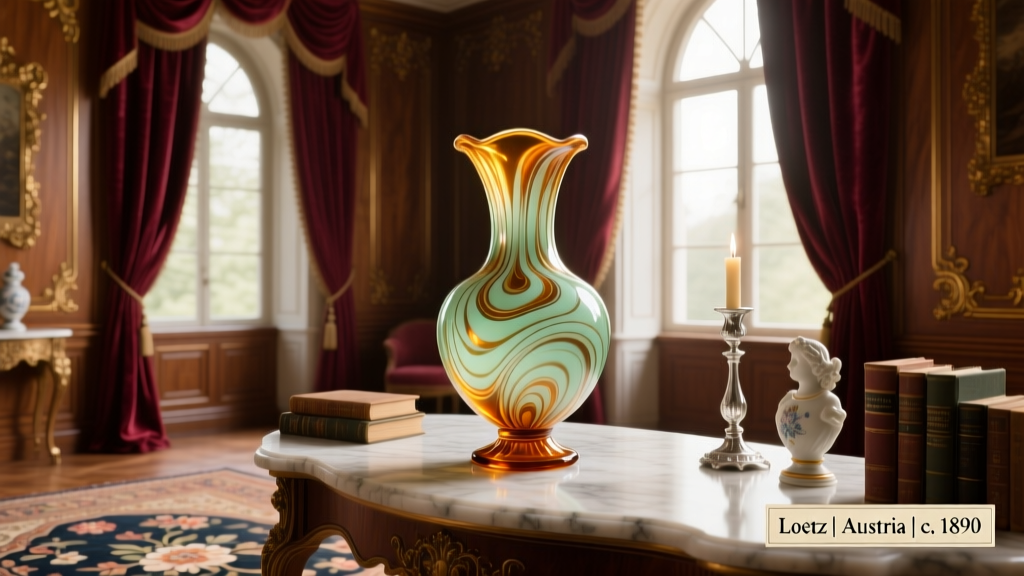
Loetz Vase: Amber Light Green Oil Spots, Corseted Beaker Form with Bronze Mounts — A 6¾-Inch Masterpiece of Viennese Art Nouveau Glass
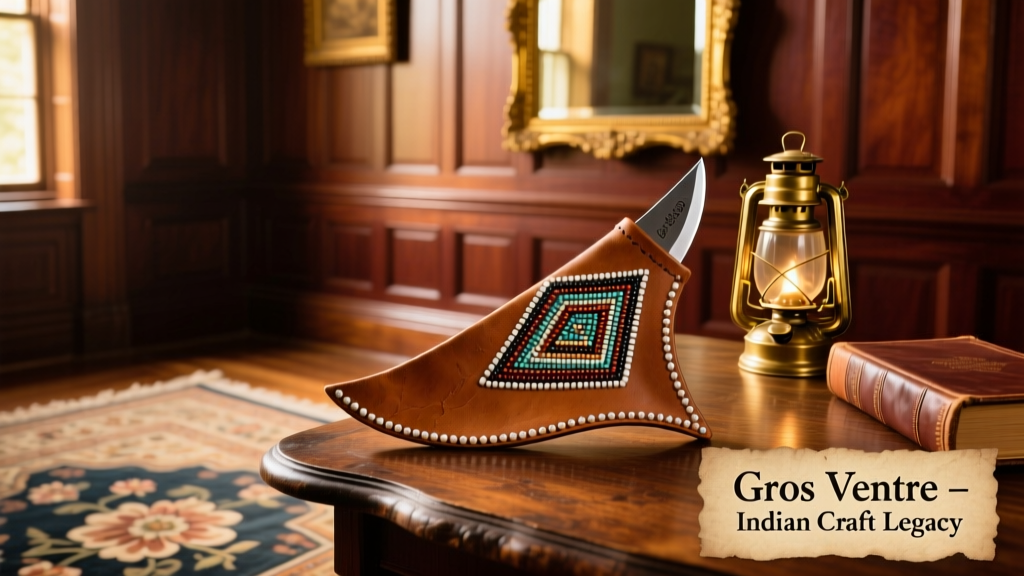
Gros Ventre Knife Sheath: A Study in Northern Plains Beadwork, Tanned Hide Craftsmanship, and Triangular Form

Single-Owner Americana Collection Headlining Jan 12–13 Sale: A Curated Legacy of Early American Craftsmanship
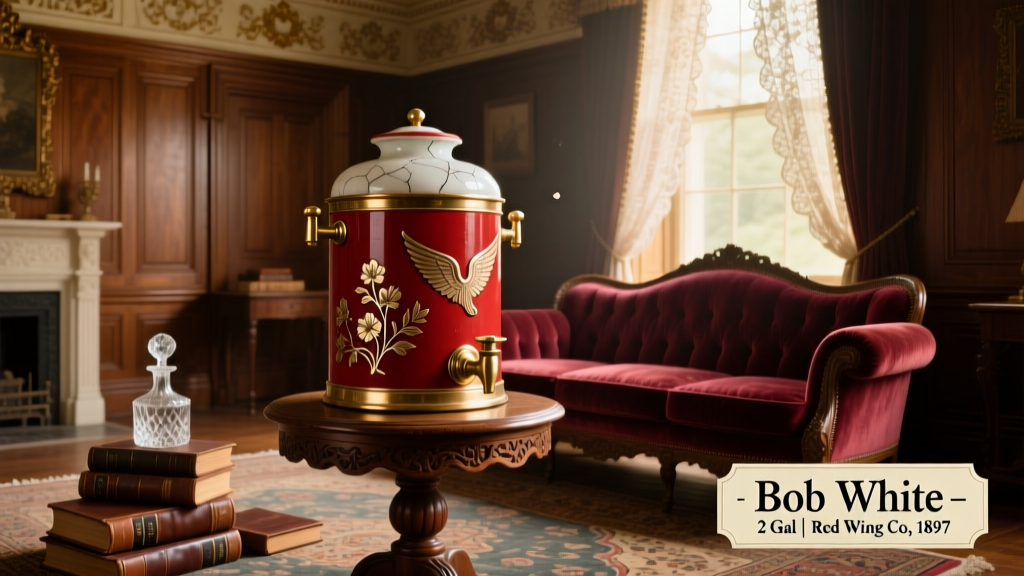
Red Wing Water Cooler 'Bob White' 2-Gallon: History, Identification, and Restoration Guide
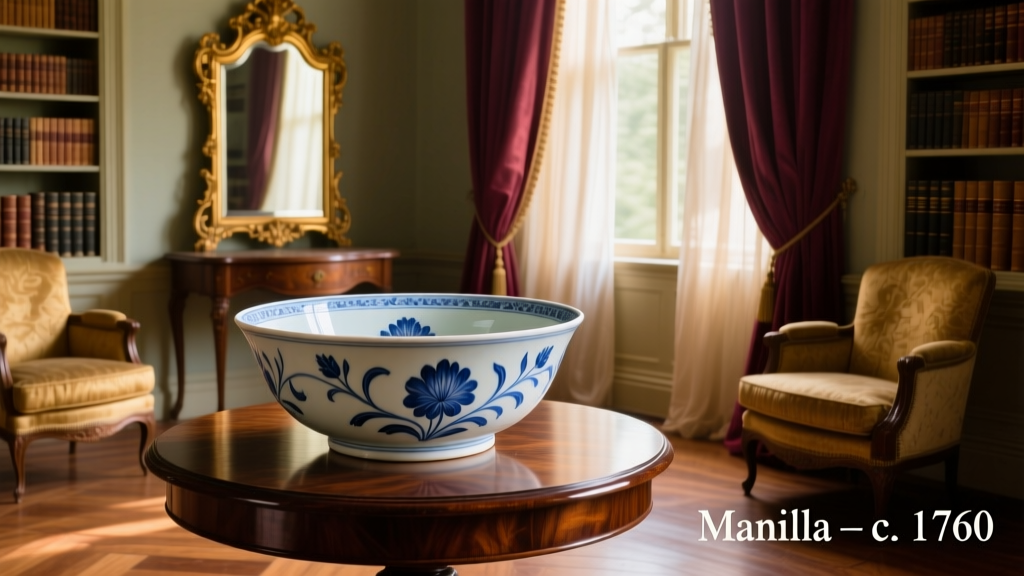
Flow Blue Waste Bowl: The Manilla Pattern — History, Identification, and Restoration Insights

Good Things to Eat: The 1954 Velvet Cake Flour Cookbook and Its Enduring Legacy in Mid-Century American Baking
Fostoria Buttercup Wine: History, Identification, and Restoration of a Mid-Century American Glassware Icon