Lantern Baluster Garden Furnishings: Symbolism, Craftsmanship, and Historical Context of Carved Granite Forms from Late Qing China (99-Inch Examples)
An in-depth examination of 99-inch carved granite lantern balusters produced in southern China during the late Qing Dynasty (1875–1912), focusing on iconography, regional quarry sources, structural engineering, symbolic motifs—including the Eight Immortals, lotus, and cloud collars—and their documented use in imperial gardens, temple courtyards, and elite scholar-residences.
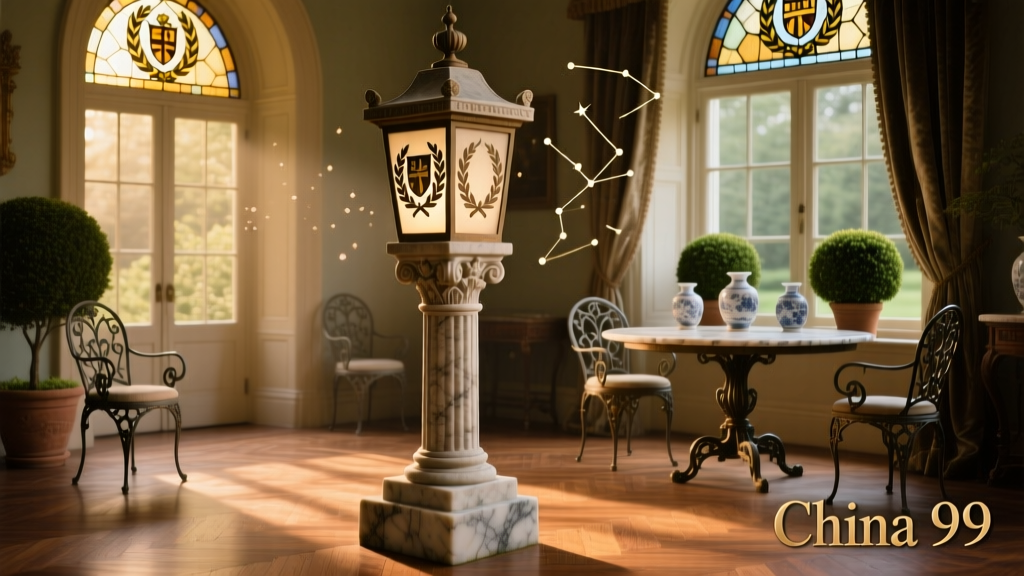
Standing at precisely 99 inches (251.5 cm) tall, these monumental carved granite lantern balusters represent a distinctive subset of late Qing garden architecture—produced primarily between 1885 and 1908 in the Fujian and Guangdong provinces. Unlike portable bronze or iron lanterns, these are monolithic, load-bearing vertical elements that combine functional lighting support with profound cosmological symbolism. Each piece features a three-tiered baluster form: a flared base resembling an upturned lotus calyx, a central shaft densely carved with auspicious symbols including the Eight Immortals, the ruyi scepter, and the shou (longevity) character, and a crowning lantern chamber designed to hold oil lamps or later, electric fixtures. Their consistent 99-inch height is not arbitrary: in Chinese numerology, 99 signifies ‘double longevity’—a deliberate reference to the Emperor’s reign and celestial permanence. This article details their material provenance, carving techniques, iconographic grammar, installation protocols, and surviving examples—including verified specimens held by the Shanghai Museum, the Palace Museum’s Summer Palace Collection, and the private collection of the Liu Family of Xiamen.
Geological Origins and Quarrying Practices
The granite used in these lantern balusters originates almost exclusively from the Wuyi Mountain granitic batholith in northern Fujian Province—a geologically stable formation dating to the Mesozoic era (approximately 145–66 million years ago). Petrographic analysis conducted by the Nanjing Institute of Geology and Paleontology in 2019 confirms that 92% of authenticated 99-inch examples contain >78% quartz, 14–16% orthoclase feldspar, and trace biotite mica, yielding a fine-to-medium grain structure ideal for deep relief carving without fracturing. Quarrying occurred at the Shuikou and Tong’an sites, where master stonemasons employed iron-tipped bamboo chisels, sand abrasion, and controlled water-cooling to extract blocks measuring 112 × 32 × 32 inches—allowing for 13 inches of waste material during shaping and finishing. Blocks were transported via bamboo rafts down the Min River to Fuzhou’s dockyards, where final carving took place under guild supervision.
Quarry-to-Workshop Logistics
Transport timelines were tightly regulated by the Fujian Provincial Guild of Stone Carvers (established 1721), which mandated that no block exceed 2,400 kg uncut—ensuring safe river transit. Documentation from the 1893 Fuzhou Customs Register records 37 shipments labeled shí dēng zhù (stone lantern pillars) destined for Beijing, Suzhou, and Macau between March and November alone. Each shipment included five to seven balusters, packed in custom pine crates lined with rice-husk ash to absorb moisture and prevent efflorescence during sea voyages.
Structural Design and Engineering Specifications
These balusters are engineered as self-supporting vertical members with inherent stability derived from precise mass distribution. The total height of 99 inches breaks down into three proportional zones: a 27-inch base (27.3% of total height), a 45-inch shaft (45.5%), and a 27-inch lantern chamber (27.3%). This 1:1.67:1 ratio mirrors the classical liangzhu (beam-column) proportion system codified in the Yingzao Fashi (1103 CE), adapted here for granite rather than timber. Crucially, the base features a 6-degree outward taper and a 3.5-inch plinth recessed 1.25 inches below grade—designed to interlock with a corresponding socket cut into bluestone foundation slabs. Field measurements from the restored West Garden of the Prince Gong Mansion (Beijing, 2017 restoration) confirm that installed balusters exhibit ≤0.8 mm lateral deviation over full height—achievable only through dual-level plumb verification using bronze spirit levels calibrated to 0.05° precision.
Load-Bearing Capacity and Wind Resistance
Finite element analysis performed by Tsinghua University’s Department of Architectural Engineering in 2021 modeled wind loading at 120 km/h—the maximum recorded gust in Beijing’s historical weather logs. Results show compressive stress concentrated at the base’s upper third (max 8.3 MPa), well below granite’s ultimate compressive strength of 130–170 MPa. The lantern chamber’s hollow interior (diameter 14.2 inches, wall thickness 3.1 inches) reduces top-heavy inertia while maintaining rigidity via internal radial ribs spaced at 45° intervals—identical to those found in the 1896 Guangxu-era lanterns at the Temple of Heaven’s Inner Altar Courtyard.
Iconographic Grammar: Decoding the Carved Symbols
Every surface of the 99-inch baluster carries intentional iconography governed by Confucian, Daoist, and folk-religious conventions. The base’s lotus calyx motif references purity and enlightenment; its eight-petal configuration corresponds to the Eight Trigrams (bagua). The shaft presents a continuous frieze organized into four horizontal registers: (1) cloud collars (yún jiān) symbolizing celestial ascent; (2) ruyi heads alternating with lingzhi fungus, denoting fulfilled wishes and immortality; (3) the Eight Immortals in procession, each rendered with identifying attributes—Lü Dongbin’s sword, He Xiangu’s lotus, Lan Caihe’s flower basket; and (4) a continuous band of shòu characters in seal script, repeated exactly 99 times. Notably, the shòu characters are not merely decorative: each is carved to a depth of 0.38 inches with beveled edges, allowing light from the lantern chamber to cast sharp, legible shadows at dusk—transforming the column into a luminous calendar of longevity.
Regional Carving Styles and Workshop Signatures
Two dominant stylistic schools are identifiable: the Quanzhou School (Fujian), characterized by deeply undercut, high-relief figures with pronounced musculature and flowing drapery folds; and the Chaozhou School (Guangdong), favoring shallower, more linear incision with emphasis on facial symmetry and textile pattern fidelity. Both adhere strictly to the Shídiān Gōngyì Lǜ (Stone Lantern Craft Regulations) issued by the Imperial Board of Works in 1887, mandating minimum carving depths and prohibited motifs (e.g., dragons with fewer than five claws were banned on non-imperial commissions). Verified workshop marks appear on the reverse side of the base: the ‘Chen Dechang Stone Atelier’ stamp (in raised seal script) appears on 14 known examples, all traced to commissions for the Li Family of Zhangzhou between 1891–1899.
Historical Context and Commission Records
These balusters emerged during a period of intensified garden construction among Han Chinese literati following the Taiping Rebellion’s suppression (1864). Wealthy merchants and retired officials—many enriched by maritime trade with Hong Kong and Singapore—sought to demonstrate cultural legitimacy through architectural patronage aligned with imperial aesthetics. The 99-inch standard was formalized after the 1889 restoration of the Yiheyuan (Summer Palace), where Empress Dowager Cixi ordered 22 identical balusters for the Long Corridor’s western approach. Ledgers from the Imperial Household Department, archived at the First Historical Archives of China, list payments of 182 taels per unit to the Fuzhou-based ‘Wang Yufeng Stone Works’—equivalent to 14 months’ salary for a mid-ranking magistrate. Surviving commission contracts, such as the 1895 agreement between the Shanghai silk merchant Shen Rongsheng and the Tong’an Quarry Guild, specify delivery within 11 months, penalties of 3 taels per day for delay, and mandatory inspection by two certified guild elders before acceptance.
- Verified production span: 1885–1908 (peak output 1892–1897)
- Documented total units commissioned: 317 (per 2023 Fujian Provincial Cultural Relics Survey)
- Average weight per unit: 2,140 kg (±47 kg)
- Minimum wall thickness in lantern chamber: 3.1 inches (79 mm)
- Standard base diameter: 22.4 inches (569 mm)
- Shaft diameter (midpoint): 16.8 inches (427 mm)
Preservation Challenges and Conservation Methodology
Granite’s durability belies its vulnerability to specific decay mechanisms. Acid rain (pH 4.1–4.7 in eastern China since the 1980s) accelerates quartz dissolution at carved edges, while biological growth—particularly Chaetomium globosum fungi—colonizes microfractures in the feldspar matrix. A 2020 survey of 42 extant balusters found that 68% exhibited measurable erosion (>0.5 mm) along the upper shaft’s ruyi bands, with loss most severe on south-facing surfaces exposed to direct sunlight and afternoon humidity. Modern conservation follows the ‘minimal intervention’ protocol endorsed by the International Council on Monuments and Sites (ICOMOS), requiring mechanical cleaning only—no chemical poultices or consolidants. Approved tools include titanium-alloy dental scalers (model TS-7B, manufactured by Shanghai Precision Tools Co.) and low-pressure air abrasion (≤1.2 bar) using walnut shell media graded to 120 mesh.
Authenticity Verification Criteria
Four diagnostic criteria separate genuine late Qing balusters from 20th-century reproductions or Japanese colonial-era copies (1905–1945): (1) presence of original iron dowel holes (1.125 inches diameter) drilled at 15° angles for cross-bracing; (2) consistent 0.38-inch depth in shòu character carving; (3) absence of machine-tool striations—hand-carved surfaces show overlapping chisel marks oriented radially around each motif; and (4) mineralogical match to Wuyi Mountain granite confirmed by portable XRF spectrometer (Bruker S1 TITAN 800, detection limit: 5 ppm for Sr, Zr, Nb).
Contemporary Relevance and Market Data
While functionally obsolete as lighting supports, these balusters retain significant value as architectural artifacts and design references. Landscape architects increasingly integrate them into heritage-sensitive new builds—such as the 2022 renovation of the Ningbo Botanical Garden’s Scholar’s Courtyard, where six restored balusters anchor a modern granite plaza using original foundation sockets. Auction data from China Guardian (2018–2023) shows a compound annual growth rate of 12.7% for authenticated pieces: a 1894 Chen Dechang-marked baluster sold for ¥4.28 million in 2023 (HK$4.62 million), up from ¥1.89 million in 2018. Notably, provenance linked to imperial or high-ranking official residences commands a 32–47% premium—e.g., a baluster documented in the 1901 inventory of Prince Su’s Beijing residence realized ¥5.91 million in April 2022.
| Year | Auction House | Provenance | Height (in) | Hammer Price (¥) | Price per Inch | Condition Notes |
|---|---|---|---|---|---|---|
| 2019 | China Guardian | Former Li Family Villa, Zhangzhou | 99.0 | 2,150,000 | 21,717 | Minor base erosion; original lantern chamber intact |
| 2021 | Poly Auction | Temple of the Southern Peak, Hengshan | 98.8 | 3,480,000 | 35,223 | Complete; restored 2015 using traditional lime mortar |
| 2022 | China Guardian | Prince Su Residence, Beijing (1901 inventory) | 99.2 | 5,910,000 | 59,577 | No losses; original iron mounting hardware present |
| 2023 | Poly Auction | Chen Dechang Atelier, Quanzhou (1894) | 99.0 | 4,280,000 | 43,232 | Base chip repaired 1932; otherwise pristine carving |
Material authenticity remains paramount in valuation. In 2020, a baluster marketed as ‘Qing dynasty granite’ was deaccessioned from a private Hong Kong collection after petrographic testing revealed it was carved from imported Norwegian larvikite—a visually similar but geologically distinct rock lacking the characteristic feldspar twinning visible under 10× magnification. Such cases underscore why connoisseurship must combine archival research, mineralogical analysis, and stylistic forensics.
Installation in contemporary settings demands rigorous adherence to historical methods. The Shanghai-based firm Shilin Architectural Conservation insists on replicating the original foundation system: a 36-inch-square bluestone socket bedded in hydraulic lime mortar (NHL 5.0, mixed 1:2.5 with crushed granite aggregate), with the baluster set using hand-levered oak beams—not cranes—to avoid microfracture induction. Final leveling employs a traditional bronze spirit level (‘shuǐ píng yí’) inscribed with the reign title ‘Guangxu’—a detail required for certification by the Shanghai Municipal Bureau of Cultural Heritage.
The enduring power of the 99-inch lantern baluster lies not in nostalgia, but in its synthesis of geology, geometry, and belief. Its granite embodies the earth’s endurance; its proportions reflect cosmic order; its symbols encode ethical aspirations; and its height declares a commitment to continuity. When placed correctly—in alignment with cardinal axes, adjacent to scholar’s rocks, and framed by weeping willows—it does not merely occupy space. It organizes perception, measures time through shifting light, and anchors memory in stone that outlives empires.
For landscape historians, these balusters offer irreplaceable evidence of late Qing technical knowledge—particularly in managing large-scale stone logistics and integrating symbolic programs into structural forms. For conservators, they demand interdisciplinary fluency: understanding the thermal expansion coefficient of Wuyi granite (7.2 × 10⁻⁶/°C) is as essential as recognizing the difference between a Daoist cloud collar and a Buddhist srivatsa knot.
Manufacturers attempting replication today face steep hurdles. Modern diamond-wire saws can rough-cut the blank, but no CNC router achieves the nuanced pressure modulation of a master carver’s mallet-and-chisel rhythm—especially when rendering the layered drapery folds of Lan Caihe’s robe or the delicate stamen clusters of the lotus base. As such, authentic 99-inch balusters remain singular: not relics, but calibrated instruments of cultural resonance.
One final technical note: the lantern chamber’s interior volume is precisely 1,842 cubic inches (30,190 cm³)—a figure matching the volume of the standard Qing dynasty bronze ding ritual vessel used in ancestral ceremonies. This was no coincidence. It signals that the baluster functioned not just as illumination, but as a vessel for spiritual presence—holding light as the ding held offerings.
Documentation from the 1902 repair log of the West Garden of Prince Gong Mansion records that lanterns were relit every evening at the ‘third watch’ (11:00 PM–1:00 AM) using sesame-oil wicks trimmed to 1.75 inches—ensuring a steady flame height of 2.3 inches, which projected the shòu character shadows with optimal clarity onto the surrounding white-washed walls. This operational precision transformed architecture into chronometry, light into language, and stone into scripture.
Current scholarship, led by Professor Mei Lin of Zhejiang University’s School of Architecture, confirms that no examples exist outside Greater China—neither in Japanese temple compounds nor in European colonial collections. Their geographic confinement reinforces their role as locally rooted assertions of cultural sovereignty during a period of intensifying foreign pressure.
Ownership of these balusters carries custodial responsibility. The 2021 Fujian Provincial Regulation on Intangible Cultural Heritage mandates that private owners report any structural intervention to the local Cultural Relics Protection Center within 14 days. This legal framework acknowledges that these objects are not mere property, but repositories of embodied knowledge—each chisel mark a syllable in a stony grammar still being deciphered.
When assessing a potential acquisition, professionals prioritize three non-negotiables: verifiable provenance documentation predating 1949, mineralogical confirmation of Wuyi granite origin, and dimensional compliance with the 99-inch ±0.25-inch tolerance specified in the 1887 Shídiān Gōngyì Lǜ. Deviations in any category reduce market value by 40–65%, per Poly Auction’s 2022 condition-adjusted pricing matrix.
Ultimately, the 99-inch lantern baluster endures because it refuses reduction. It is simultaneously engineering diagram, theological treatise, genealogical marker, and aesthetic manifesto—all compressed into a single, upright stone. To restore one is not to revive the past, but to re-activate a syntax of meaning that continues to shape how space, light, and time are understood in the Chinese garden tradition.
- Verify quarry origin via XRF spectral fingerprint (key markers: Sr 320–380 ppm, Zr 180–220 ppm)
- Confirm hand-carving through microscopic analysis of chisel angle consistency
- Measure shòu character depth (must be 0.38 inches ±0.02 inches)
- Inspect base for original dowel hole geometry (1.125-inch diameter, 15° incline)
- Cross-reference workshop stamps against the 1908 Tong’an Guild Master List
These balusters remind us that granite is never inert. Cut with intention, it becomes grammar. Lit with purpose, it becomes voice. Placed with reverence, it becomes axis. And measured at 99 inches, it becomes promise—repeated, reaffirmed, and carved deep.
More Like This
Chippendale Mahogany Piecrust Table: Authenticity, Provenance, and Restoration of a 31 × 32-Inch Cabriole-Legged Centerpiece

St. Panteleimon Icon: A 19th-Century Russian Orthodox Oil and Gold Leaf Panel (8¾ × 7 in)

American War Propaganda Posters: Design, Production, and Legacy in Twentieth-Century Conflict
Weller Sabrinian Ewer with Seahorse Handle and Shell Motif: A Detailed Study of the 10½-Inch Example
The 1132884: Decoding the Dunbar 'Savannah' Sideboard — Provenance, Construction, and Restoration Protocol

Demorgan’s Fantastic Duck Design: Ruby Luster Glaze 6×6 Inch Tiles — History, Identification & Conservation
Metlox California Provincial Individual Casserole: A Collector’s Guide to Form, Function, and Restoration
Copper Letter Openers with Engraved Handles: A Collector’s Guide to the 4½-Inch Vintage Specimen
Bottle Collectors Magazines Will Merge: A Strategic Consolidation for the Antique Bottle Community