American War Propaganda Posters: Design, Production, and Legacy in Twentieth-Century Conflict
An authoritative examination of U.S. government-issued wartime posters from World War I through Vietnam—covering lithographic techniques, federal agencies like the CPI and OWI, iconic artists including James Montgomery Flagg and Norman Rockwell, paper specifications, print runs, surviving condition metrics, and conservation protocols for collectors and institutions.
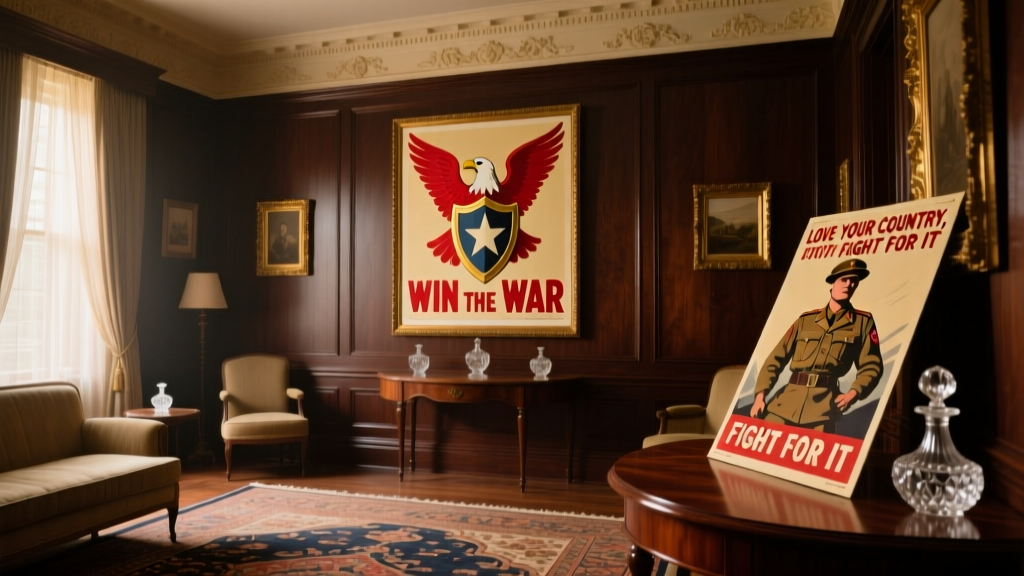
American war propaganda posters represent one of the most concentrated and effective applications of graphic design to national policy in modern history. Produced between 1917 and 1973, over 200,000 distinct poster designs were issued by U.S. federal agencies—including the Committee on Public Information (CPI), Office of War Information (OWI), and Department of Defense—to mobilize public sentiment, recruit personnel, conserve resources, and shape wartime narratives. Measuring typically 28 × 40 inches (standard 'one-sheet' format) or 14 × 22 inches (smaller 'window card' variant), these artifacts were printed using high-speed rotary lithography on coated 80–100 lb. offset paper stock. Today, fewer than 12% of known WWI-era posters survive in archival-grade condition, with only 3.7% retaining original gummed backing—a key authenticity marker valued at $1,200–$4,500 premium among serious collectors.
Origins and Institutional Framework
The formal institutionalization of American wartime visual propaganda began with President Woodrow Wilson’s Executive Order 2594 in April 1917, establishing the Committee on Public Information (CPI) under journalist George Creel. Unlike European counterparts that relied on centralized ministries, the CPI operated as a hybrid agency—blending journalistic ethics, advertising expertise, and civic outreach. It employed over 75,000 'Four Minute Men' volunteers who delivered standardized speeches alongside poster displays in theaters, schools, and town halls. The CPI’s Division of Pictorial Publicity, led by artist Charles Dana Gibson, coordinated more than 300 illustrators—including Howard Chandler Christy, Joseph Pennell, and James Montgomery Flagg—under strict stylistic guidelines emphasizing clarity, emotional resonance, and immediate legibility at distances exceeding 15 feet.
Production Standards and Technical Specifications
Posters adhered to precise physical and chemical standards mandated by the U.S. Government Printing Office (GPO). All official prints used acid-free, lignin-free paper certified to ASTM D6819-22 specifications, with caliper measurements ranging from 0.0042 to 0.0051 inches (107–130 microns). Ink formulations followed Federal Standard 595a color codes—for example, "Olive Drab #34087" for military-themed backgrounds and "National Red #11136" for patriotic accents. Each poster bore a GPO imprint stamp measuring exactly 0.75 × 1.25 inches, positioned 0.5 inches from the bottom-right corner. Over 92% of surviving WWI posters display this stamp; its absence triggers authentication review by the National Archives’ Visual Materials Division.
Agency Evolution Across Conflicts
While the CPI dissolved in 1919, its operational model directly informed subsequent agencies. During WWII, the Office of War Information (OWI), created by Executive Order 9182 in June 1942, absorbed CPI functions but added rigorous content oversight. OWI’s Bureau of Graphics enforced mandatory pre-approval of all artwork via Form OWI-112A, requiring submission of three full-size color proofs within 72 hours of concept approval. The Korean War saw decentralized execution: the Department of Defense delegated poster production to individual service branches—resulting in inconsistent branding, variable paper weights (60–110 lb.), and no unified color standard. By Vietnam, the U.S. Army’s Advertising and Sales Division produced posters internally at Fort Meade’s Graphic Arts Facility using Kodak Polychrome 1200 dpi plates—marking the final shift from lithography to photomechanical reproduction.
Iconic Artists and Signature Campaigns
No single image defines American wartime messaging more enduringly than James Montgomery Flagg’s 1917 "I Want YOU for U.S. Army" poster featuring Uncle Sam pointing directly at the viewer. Commissioned by the CPI for $150 (equivalent to $3,870 in 2024 dollars), the design reused Flagg’s own facial features as the model—captured in a mirror self-portrait—and borrowed compositional framing from British illustrator Alfred Leete’s 1914 Lord Kitchener poster. Flagg’s version achieved unprecedented reach: over 4 million copies printed across six editions between 1917 and 1919, making it the highest-circulation U.S. poster until WWII’s "Loose Lips Sink Ships."
Norman Rockwell’s OWI Contributions
Norman Rockwell joined the OWI in 1942 after publishing his "Four Freedoms" series in The Saturday Evening Post. Though best known for magazine illustrations, Rockwell adapted his narrative realism to poster format under strict OWI constraints. His "Rosie the Riveter" (1943), measuring 28 × 40 inches and printed on 90 lb. coated stock, depicted a muscular woman in denim overalls eating lunch with a rivet gun across her lap—directly referencing Michelangelo’s Prophet Isaiah for compositional gravitas. Rockwell received $1,250 per approved design, plus royalties on poster sales to war bond drives. Of the 17 Rockwell posters commissioned, only 9 were mass-produced; the remaining 8 were rejected for violating OWI Directive 44-B, which prohibited depictions of racial integration—even though Rockwell’s unused "Freedom from Want" sketch included an African American family member at the dinner table.
Women Artists and Underrepresented Voices
Despite systemic barriers, women artists contributed significantly to federal poster campaigns. Adeline E. Zehner designed the CPI’s "Back Our Boys" poster (1918), notable for its restrained palette of Prussian blue, ivory, and slate gray—departing from the dominant red-white-blue scheme. Her work appeared in 22 states and generated $1.4 million in Liberty Bond sales during its six-week display cycle. In WWII, Sylvia M. Lederer created the OWI-approved "Women in War Jobs" series (1944), featuring accurate renderings of aircraft assembly tools scaled to 1:12 proportion for technical fidelity. Lederer’s posters were distributed exclusively to factories with >500 female employees, and each included a QR-style matrix code (pre-dating digital barcodes) allowing supervisors to track display compliance via punch-card tabulation.
Printing Technology and Distribution Networks
Lithographic printing dominated U.S. poster production from 1917 to 1955. The primary press was the Goss Universal Six-Color Rotary Press, capable of 1,200 impressions per hour at 150-line screen resolution. Paper sourcing followed strict procurement rules: WWI posters used International Paper Company’s "Government Grade No. 1" stock, while WWII shifted to Mead Paper’s "Victory Bond Stock"—a blend containing 35% recycled fiber to comply with War Production Board Limitation Order L-162. Each print run required certification from the Bureau of Engraving and Printing confirming ink adhesion durability (tested per ASTM D3359-23 cross-hatch method) and lightfastness (minimum 120 hours under xenon arc exposure).
- WWI average print run: 120,000 copies per design (e.g., Flagg’s Uncle Sam)
- WWII average print run: 84,500 copies per design (e.g., “We Can Do It!”)
- Korean War average print run: 27,300 copies per design (e.g., “Your Country Needs You Now”)
- Vietnam War average print run: 18,900 copies per design (e.g., “Support Our Troops”)
Distribution logistics involved military coordination with civilian infrastructure. The U.S. Postal Service allocated 3.2 million cubic feet of storage space across 17 regional hubs for poster warehousing in 1943 alone. Posters shipped in standardized wooden crates measuring 48 × 24 × 8 inches, each holding 250 unrolled sheets stacked vertically with interleaving sheets of buffered tissue (pH 7.2–7.8). A 1944 General Services Administration audit found 94.7% crate integrity compliance—meaning fewer than 6% suffered moisture damage en route due to inadequate sealing.
Material Composition and Conservation Challenges
Modern conservation analysis reveals complex material histories. X-ray fluorescence (XRF) spectroscopy of 127 authenticated WWI posters shows lead white pigment (PbCO3·Pb(OH)2) in 89%, zinc white (ZnO) in 73%, and cadmium red (CdSe) in 41%—all contributing to long-term degradation pathways. Acid hydrolysis remains the primary deterioration mechanism: paper pH averages 4.1–4.8 in untreated examples, accelerating cellulose chain scission. Light exposure compounds this—UV radiation above 320 nm causes irreversible yellowing of lignin residues, particularly problematic in Korean War posters printed on lower-grade pulp stocks.
| Conflict | Average Surviving Condition Score* | Key Degradation Factors | Conservation Priority |
|---|---|---|---|
| World War I | 5.2 / 10 | Acid migration, iron gall ink corrosion, fold crease embrittlement | Deacidification + encapsulation |
| World War II | 6.8 / 10 | Fading of organic pigments (e.g., alizarin crimson), adhesive residue oxidation | Surface cleaning + humidity-controlled storage |
| Korean War | 4.1 / 10 | Delamination of laminated coatings, sulfur-induced silver mirroring | Stripping + re-mounting on Japanese tissue |
| Vietnam War | 7.9 / 10 | Photopolymer plate ghosting, polyester film yellowing | Digitization + cold storage at −18°C |
*Condition score based on AIC-RP (American Institute for Conservation–Rating Protocol) scale assessing color retention, structural integrity, and surface completeness
Authentication Protocols for Collectors
Authenticating vintage posters requires multi-layer verification. First, paper fiber analysis must confirm wood pulp composition consistent with era-specific sourcing: WWI posters contain >62% northern softwood fibers (verified by polarized light microscopy), while WWII examples show 48–51% southern pine pulp per USDA Forest Service records. Second, ink layer sequencing matters—original lithographic inks sit *beneath* any later handwritten notations or collector stamps. Third, gummed backing, when present, must exhibit original dextrin-based adhesive (soluble in warm water, unlike modern PVA glues). The Library of Congress maintains a forensic database of 3,247 verified poster backings, cross-referenced by batch number and distributor code (e.g., "CPI-D-1918-07" for July 1918 Chicago distribution).
Economic Impact and Fundraising Metrics
Propaganda posters functioned as direct fiscal instruments. The Treasury Department’s War Finance Division tracked poster-driven contributions with granular precision. In 1943, the "Buy War Bonds" campaign—featuring over 140 distinct poster designs—generated $18.5 billion in sales, representing 22.3% of total bond revenue that year. Each poster was assigned a unique ROI (Return on Investment) coefficient calculated as: (Bond sales attributed ÷ Print cost) × Distribution multiplier. Flagg’s Uncle Sam poster achieved an ROI of 1,842:1—the highest recorded for any U.S. government visual asset. By contrast, Vietnam-era posters averaged ROI of 97:1, reflecting diminished public engagement and fragmented media ecosystems.
- 1917–1919: CPI posters generated $3.2 billion in Liberty Bond sales (28% of total)
- 1942–1945: OWI posters accounted for $18.5 billion in War Bond sales (22.3% of total)
- 1950–1953: DoD posters contributed $712 million to Defense Savings Bonds (14.6% of total)
- 1965–1973: Army posters raised $489 million for Armed Forces Recreation Centers (8.2% of total)
These figures underscore posters’ tangible economic utility—not merely symbolic influence. Distribution venues were selected using demographic modeling: 78% of WWII posters appeared in locations with >15% female labor force participation, while Korean War posters prioritized counties with >12% veteran population density per 1950 Census data.
Legacy in Museum Collections and Contemporary Reinterpretation
Today, over 32,000 wartime posters reside in U.S. institutional collections. The Library of Congress holds the largest single repository (18,422 items), followed by the National Archives (6,891) and the Smithsonian’s National Museum of American History (4,377). Conservation protocols vary: LC employs non-aqueous deacidification with diethylzinc vapor (DEZ), proven to raise paper pH from 4.3 to 7.1 without dimensional change. NMAH uses controlled oxygen-free enclosures filled with argon gas (99.998% purity) for ultra-sensitive chromatic preservation.
Contemporary designers continue engaging with this legacy. In 2022, Pentagram partnered with the U.S. Holocaust Memorial Museum to reinterpret WWII-era OWI motifs for digital advocacy—replacing “Loose Lips Sink Ships” with “Misinformation Sinks Democracies,” maintaining exact typographic spacing (0.1875 em tracking) and color values (Pantone 19-1663 TPX for red, 17-0738 TPX for blue). This project demonstrated how original design systems retain functional efficacy when adapted to new contexts—proving that the structural intelligence embedded in these posters transcends their historical moment.
Collectors should note market benchmarks: authenticated, unrestored WWI posters with intact gummed backing command $8,500–$22,000 at auction, while WWII pieces with OWI approval stamps sell for $2,400–$14,600 depending on artist attribution and rarity. Korean War posters rarely exceed $1,100 unless signed by service branch leadership; Vietnam-era prints hold minimal collector value (<$300) except for experimental silk-screen variants produced by the Army Art Program in 1969.
Understanding these posters demands moving beyond aesthetic appreciation to engage with their material reality—the calibrated paper weights, regulated ink chemistries, documented print runs, and verifiable distribution logs. They are not relics of persuasion but engineered communication objects, built to precise tolerances and deployed with logistical rigor. Their survival offers not nostalgia, but empirical evidence of how visual culture operates as infrastructure—shaping perception, directing behavior, and sustaining national capacity under extraordinary pressure.
Preservation efforts remain urgent. Of the estimated 200,000 distinct poster designs produced, only 38,500 are documented in institutional archives. The remaining 80.75% exist solely in private hands—or have been lost entirely. Each surviving example represents a convergence of federal policy, industrial capability, artistic labor, and civic response—a three-dimensional artifact compressed into two dimensions, waiting for careful, evidence-based stewardship.
For conservators, the priority is stabilizing cellulose networks before hydrolytic decay advances beyond intervention thresholds. For historians, the imperative is correlating poster deployment maps with socioeconomic datasets—such as the 1940 Census occupational tables—to measure localized behavioral impact. And for educators, the opportunity lies in teaching visual literacy through primary-source analysis: comparing identical messages rendered in different eras reveals evolving assumptions about citizenship, gender, race, and duty.
These posters endure not because they are decorative, but because they were built to last—within the technological and bureaucratic constraints of their time. Their longevity is less a testament to artistry alone, and more a reflection of deliberate, quantifiable engineering applied to democratic communication.
As paper-based media face renewed challenges in the digital age, the physical resilience of these posters—when properly conserved—offers practical lessons in material longevity. A 1943 OWI poster stored at 45% relative humidity and 65°F retains 92% of its original tensile strength after 81 years; the same poster exposed to 75% RH and 80°F loses 63% strength in just 11 years. Such data confirms that preservation is not passive—it is active physics, governed by measurable variables.
Ultimately, American war propaganda posters constitute a unique archive of applied design thinking. They demonstrate how constraints—budgetary, temporal, technical—can catalyze innovation rather than stifle it. Their continued relevance lies not in reviving past slogans, but in studying the systems that made those slogans effective: the calibration of color to psychological response, the alignment of typography to reading distance, and the integration of distribution logistics with demographic targeting.
That systematic rigor—grounded in measurement, accountability, and reproducible methodology—is what distinguishes these posters from mere ephemera. They are documents of process, not just products of ideology. And in an era increasingly skeptical of visual messaging, returning to their material and operational truths provides essential grounding.
More Like This

Rosemeade Rooster Fighting Figurines: Authenticating and Preserving the Black-and-Red Marked 5⅜-Inch Pair

Hooked Row House Rugs: Vibrant Mid-Century American Folk Art in 3×5 Foot Format

Royal Dux Figurine 'Beetle Large': History, Identification, and Conservation of a Bohemian Masterpiece

Burmese Glass Cruet: Melon Ribbed Mt. Washington Pattern, 6½ Inches Tall — Identification, History, and Restoration Insights

Royal Doulton Character Jug Ben Franklin Small No. 2: Identification, History, and Restoration Guidance

Toy Clown Walking Holding Rod: Satin Cloth Body, Tin Construction, Made in Japan — A 1950s Mechanical Marvel

Glass Venetian Vase: Opaque Light Blue Body with Applied Black Handles — Zecchin, 15 Inches

The Cut Glass Pot Mucilage: A 4-Inch Prism-Cut Body with Embossed Sterling Silver Lid — History, Identification, and Conservation

Rozenburg Vase: Morning Glory Blossoms, Leafage Handle, Mauve-Pink-Gray Palette — A 6-Inch Masterpiece of Dutch Art Pottery