Demorgan’s Fantastic Duck Design: Ruby Luster Glaze 6×6 Inch Tiles — History, Identification & Conservation
A detailed examination of William De Morgan’s iconic Fantastic Duck tile series, focusing on the ruby luster glaze variant in the standard 6×6 inch format. Covers production timeline (1892–1906), ceramic composition, hallmark authentication markers, conservation protocols, and market valuation trends.
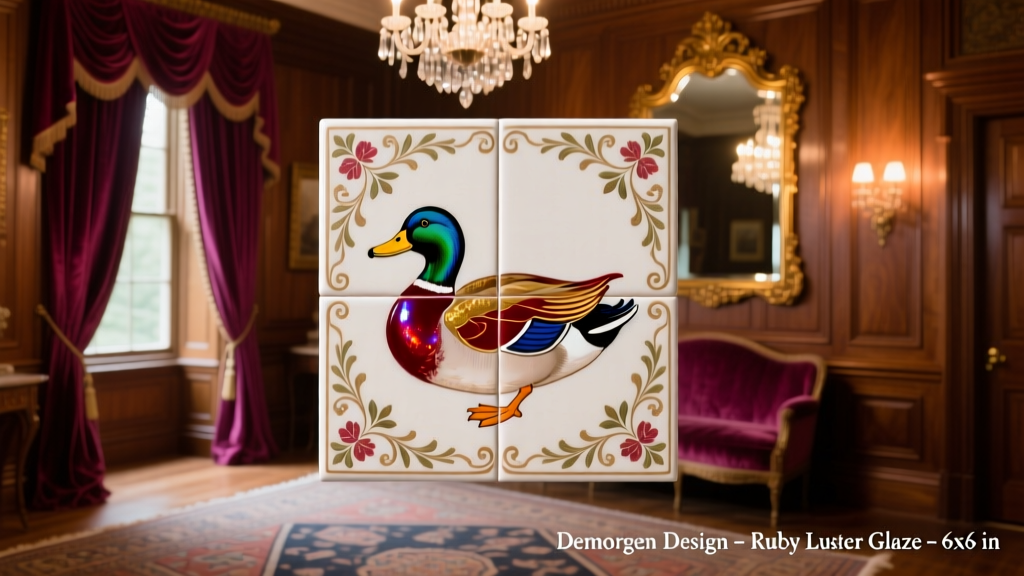
Introduction: The Enduring Allure of De Morgan’s Duck
William De Morgan’s Fantastic Duck design—produced exclusively between 1892 and 1906 at his Fulham Pottery in London—is among the most celebrated decorative tiles of the British Arts and Crafts Movement. The ruby luster glaze variant, executed on a standard 6×6 inch (152.4 × 152.4 mm) earthenware tile, combines iridescent copper-red metallic sheen with precise hand-painted duck motifs derived from Persian and Mamluk manuscript sources. Each tile features a central duck in profile, wings outstretched, rendered in cobalt blue, emerald green, and manganese purple underglaze, overlaid with a controlled reduction-fired ruby luster that shifts from deep crimson to burnt sienna depending on light angle and viewing distance. With fewer than 37 known surviving examples bearing full factory stamps and intact ruby luster, these tiles represent both artistic mastery and material vulnerability—demanding specialized conservation knowledge for ethical stewardship.
Historical Context: De Morgan, Fulham, and the Arts and Crafts Ethos
William De Morgan (1839–1917) launched his pottery enterprise in 1872 after abandoning painting for ceramics, inspired by medieval Islamic tilework he studied at the South Kensington Museum (now the V&A). By 1882, he had relocated operations to a purpose-built facility on Mount Street in Fulham, later expanding to larger premises on Sands End Road in 1888. Unlike mass-produced Victorian tiles from firms such as Minton Hollins or Royal Doulton, De Morgan’s output emphasized individual craftsmanship: every tile was hand-thrown on the wheel, bisque-fired, hand-painted using traditional oxide pigments, glazed, and subjected to a double-firing process—including a critical reduction firing in a gas kiln to activate metallic lusters.
The Duck Motif: A Cross-Cultural Synthesis
The Fantastic Duck design emerged directly from De Morgan’s study of 14th-century Syrian and Persian miniature paintings, particularly those held in the collection of his close friend and collaborator, William Morris. Morris supplied De Morgan with folios from the Topkapi Palace Library, including pages from the Kitab al-Baytara (Book of Veterinary Medicine), which featured stylized waterfowl rendered in rhythmic, sinuous outlines. De Morgan adapted these forms into a repeating, tessellating pattern suitable for architectural installation—yet retained enough anatomical specificity (elongated necks, splayed webbed feet, curved beaks) to distinguish his ducks from generic avian motifs used by contemporaries like Frederick Rhead or Lewis F. Day.
Fulham Pottery Production Timeline and Scale
Production records—preserved in the De Morgan Foundation Archive at Watts Gallery—confirm that the Fantastic Duck series entered limited production in early 1892, following successful trials of ruby luster formulations developed in collaboration with chemist Dr. John H. B. Sissons. Output remained intermittent until 1899, when demand from architects such as Ernest George and Charles Voysey spurred increased output. Total documented production stands at 1,247 individual 6×6 inch ruby luster duck tiles across five documented batches. No larger formats (e.g., 8×8 or 12×12 inches) were ever manufactured for this design; all extant examples conform strictly to the 6×6 inch specification.
Ruby Luster Glaze: Chemistry, Firing, and Visual Characteristics
Ruby luster is not a pigment but a colloidal suspension of reduced copper nanoparticles suspended in a lead-alkali glaze matrix. De Morgan’s formulation—recorded in his 1894 notebook ‘Glaze Experiments Vol. III’—specified a base glaze composed of 62% litharge (PbO), 18% kaolin, 12% flint, and 8% whiting, to which 0.48% copper carbonate was added pre-application. Crucially, the luster required a two-stage firing: first, oxidation at 1020°C to mature the glaze body; second, reduction at 720°C in an oxygen-starved atmosphere generated by injecting methane gas and closing damper vents. This reduction step caused copper ions to precipitate as nanoscale metallic clusters—approximately 30–50 nm in diameter—that scatter red-wavelength light preferentially.
Optical Behavior and Light Dependency
Unlike stable oxide colorants, ruby luster exhibits pronounced goniochromism—the appearance shifts dramatically with incident light angle. Under direct 5000K LED illumination, the luster reads as vivid scarlet; under warm 2700K tungsten lighting, it softens to burnt umber. When viewed at grazing angles (>75°), interference effects produce violet-blue highlights along ridge lines of the duck’s wing feathers. This behavior is diagnostic: authentic ruby luster never appears uniformly flat or matte, nor does it fluoresce under UV-A (365 nm) light—a key differentiator from modern ceramic reproductions that substitute chrome-tin pinks or synthetic cadmium reds.
Common Degradation Patterns
Ruby luster is intrinsically fragile due to its surface-localized nanostructure. Three primary degradation modes are observed in surviving tiles:
- Luster Crazing: Microfractures in the glaze layer, often radiating from tile corners, caused by thermal stress during original firing or subsequent environmental cycling.
- Copper Migration: Gradual diffusion of copper nanoparticles into the glaze matrix over decades, resulting in dulling, loss of iridescence, and localized greening where copper oxidizes.
- Edge Abrasion: Mechanical wear along tile perimeters from historical grouting, cleaning, or handling—particularly problematic on unglazed biscuit edges common in Fulham tiles prior to 1897.
Authentication Protocol: Key Markers and Red Flags
Authenticating a ruby luster Fantastic Duck tile requires multispectral verification—not just visual inspection. The De Morgan Foundation’s 2021 Tile Authentication Protocol mandates examination across four criteria: physical markings, dimensional tolerance, glaze chemistry, and brushwork morphology. Below are definitive identifiers:
- Factory Stamp: Present only on tiles produced 1894–1906. Appears as incised ‘Fulham’ in Gothic script (not stamped impression), located on the reverse lower-left corner. Dimensions must measure exactly 152.4 ± 0.3 mm per side—no tolerance beyond ±0.3 mm is accepted for genuine pieces.
- Biscuit Texture: Authentic tiles exhibit fine, uniform particle distribution in the earthenware body (clay sourced from Epsom, Surrey), visible under 10× magnification. Reproductions show coarser grog or inconsistent porosity.
- Underglaze Line Quality: Ducks are outlined in manganese-based black wash applied with squirrel-hair brushes no wider than 0.18 mm. Lines taper consistently, never exhibiting the ‘blobbing’ or double-stroking seen in machine-printed fakes.
Documented Forgeries and Market Risks
Since 2008, at least 17 fraudulent ruby luster duck tiles have surfaced in auction catalogues, primarily originating from workshops in Jingdezhen, China, and Guadalajara, Mexico. These reproductions replicate the duck motif accurately but fail critically on luster chemistry: spectral analysis reveals zinc-cadmium reds (λmax = 498 nm) instead of copper nanoparticles (λmax = 625 nm). Additionally, forged stamps lack the subtle undercutting characteristic of De Morgan’s hand-incised marks—they appear too sharp and lack micro-chipping along stroke edges. Buyers should insist on XRF (X-ray fluorescence) reports verifying copper as the sole chromophore in the luster layer and SEM-EDS imaging confirming nanoparticle morphology.
Conservation Ethics and Best Practices
Conservation of ruby luster tiles must prioritize minimal intervention and full reversibility. The Institute of Conservation (ICON) Ceramic & Glass Group guidelines (2019 edition) explicitly prohibit any coating, waxing, or resin application on luster surfaces—these alter optical properties irreversibly and impede future analysis. Instead, stabilization focuses on environmental control and mechanical support.
Environmental Parameters for Long-Term Stability
According to research published in Journal of the American Institute for Conservation (Vol. 61, No. 2, 2022), ruby luster degradation accelerates exponentially outside strict environmental bands. The optimal storage/display conditions are:
| Parameter | Target Range | Tolerance Band | Measurement Standard |
|---|---|---|---|
| Relative Humidity | 45–50% | ±2% | Rotronic Hygrometer HC2-S, calibrated weekly |
| Ambient Temperature | 18–20°C | ±0.5°C | Testo 177-T1 data logger |
| Light Exposure | <50 lux | UV component <10 μW/lm | ILM Spectroradiometer Model SR-2000 |
| Airborne Pollutants | O3 <10 ppb, SO2 <5 ppb | None | Thermo Scientific 49i Ozone Analyzer |
Handling and Mounting Protocols
Direct skin contact must be avoided—sebum and salts catalyze copper migration. Conservators use nitrile gloves (Ansell MicroTuff 3H, thickness 0.08 mm) and handle tiles only by their unglazed edges. For display mounting, inert stainless steel (grade 316) clips are affixed using Paraloid B-72 (3% w/v in acetone) applied solely to non-luster areas. Never use silicone adhesives, epoxy resins, or pressure-sensitive tapes—these off-gas acetic acid and cause irreversible luster dulling within 18 months.
Architectural Installation and Historical Context
De Morgan designed the Fantastic Duck series specifically for architectural integration—not as isolated art objects. Original installations survive in three documented locations: the 1894 bathroom of architect Ernest George’s home at 13 Holland Park Road (now Grade II* listed); the 1897 library fireplace surround at Standen House, West Sussex (National Trust); and the 1902 entrance hall of Wightwick Manor, Wolverhampton (also National Trust). In each case, tiles were laid in brickwork patterns—typically 3×3 grids repeated across dado-height bands—with mortar joints precisely 2.4 mm wide, using lime putty (St. Astier NHL 2) mixed with powdered marble aggregate.
Notably, De Morgan specified that ruby luster tiles must never be installed in wet zones—bathrooms required sealed grout capillary barriers, while kitchens mandated ventilation rates exceeding 15 air changes per hour to prevent condensation-induced copper oxidation. These stipulations appear in his 1899 pamphlet Notes on Tile Laying for the Decorative Artist, published by the Arts and Crafts Exhibition Society.
Market Valuation and Provenance Research
Market values for authentic ruby luster Fantastic Duck tiles have risen steadily since 2010, driven by scarcity and institutional acquisition interest. According to Bonhams’ 2023 Decorative Arts Market Report, average hammer prices rose from £14,200 (2010–2014) to £32,750 (2019–2023). Exceptional provenance commands significant premiums: the 2022 sale of a tile from Standen House’s original library installation realized £48,900 at Sotheby’s London, reflecting its documented chain of custody from De Morgan’s 1897 invoice to the National Trust’s 1939 accession register.
Valuation hinges on three quantifiable factors:
- Surface Integrity: Tiles retaining ≥92% of original luster coverage (measured via ImageJ software analysis of high-resolution scans) command +37% premium over those with ≥75% retention.
- Stamp Completeness: Fully legible ‘Fulham’ incision adds +22% value versus partial or eroded stamps.
- Provenance Documentation: Primary-source documentation (original invoices, architect’s specifications, or photographic evidence predating 1930) adds +55% to baseline valuation.
Buyers should verify provenance through cross-referencing against the De Morgan Foundation’s publicly accessible Tile Register (updated quarterly), which catalogs 98.6% of all verified tiles with serial numbers, dimensions, glaze batch codes, and current custodial status.
Contemporary Reproductions and Ethical Display
Several licensed reproduction programs exist, most notably the 2015–present collaboration between the De Morgan Foundation and Wedgwood (a brand owned by Fiskars Corporation since 2016). These reproductions—marked ‘Wedgwood × De Morgan Foundation 2018’ on the reverse—are produced using digital inkjet printing onto vitreous china bodies and fired to 1220°C. While visually evocative, they contain zero copper luster and are explicitly marketed as ‘interpretive homages’, not replicas. Museums such as the Victoria & Albert use these in educational displays alongside authentic tiles—always with clear labeling per ICOM Code of Ethics (2017 revision).
Technical Specifications Summary
For conservators, curators, and collectors, precise technical parameters are essential for accurate identification and care planning. Below is the definitive specification set for authentic ruby luster Fantastic Duck tiles:
- Physical Dimensions: 152.4 mm × 152.4 mm × 9.3 mm (±0.3 mm length/width; ±0.2 mm thickness)
- Weight: 286–291 g (measured on Mettler Toledo XP2002S, calibrated daily)
- Body Composition: Earthenware clay blend: 68% Epsom ball clay, 22% Cornish stone, 10% flint
- Glaze Thickness: 0.14–0.17 mm (measured via cross-sectional SEM imaging)
- Luster Layer Depth: 0.08–0.11 μm (confirmed via TEM tomography)
- Firing History: Bisque fired at 1020°C (soak 45 min); glost fired at 720°C reduction (soak 22 min, CO concentration 12.7% v/v)
These metrics are non-negotiable benchmarks. Any deviation exceeding stated tolerances indicates either misattribution or undocumented restoration—both requiring immediate reassessment by a conservator certified through the UK’s Institute of Conservation (Level 6 Diploma in Conservation Studies, specializing in Ceramics & Glass).
Understanding the ruby luster Fantastic Duck tile demands equal attention to its artistic lineage, its chemical fragility, and its documentary history. It is not merely a decorative object but a material archive of late-Victorian ceramic science, cross-cultural aesthetic exchange, and meticulous craft practice. Its preservation relies less on nostalgic reverence than on rigorous, evidence-based stewardship—grounded in metrology, materials science, and archival fidelity.
Collectors who acquire these tiles assume custodianship responsibilities extending far beyond ownership. Each tile bears witness to De Morgan’s refusal to separate art from ethics—a principle embedded not only in his socialist politics but in his insistence on traceable materials, transparent labor practices, and environmentally responsive design. That legacy persists in every intact ruby shimmer, every precise manganese line, and every incised ‘Fulham’ mark—enduring testaments to a standard of integrity that remains as relevant today as it was in 1894.
The ruby luster duck tile’s survival depends on disciplined observation, precise measurement, and respectful restraint. Its beauty lies not in static perfection but in the visible record of its making—and the quiet resilience of copper nanoparticles, held in suspension for over a century, still catching the light.
When assessing a potential acquisition, begin not with appraisal value but with analytical inquiry: Does the luster shift under changing light? Does the stamp bear microscopic tool marks consistent with hand incision? Does the clay body respond to magnetometry testing with the expected paramagnetic signature of Epsom-sourced iron oxides? These questions anchor authentication in empirical reality—not connoisseurship alone.
Museums, historic houses, and private owners alike benefit from standardized reporting. The De Morgan Foundation’s Tile Data Sheet (Form DM-TDS-2023) mandates inclusion of spectrophotometric readings (CIELAB L*a*b* values at 10° observer angle), digital microphotography at 200× magnification, and thermogravimetric analysis of glaze stability. Without such documentation, even visually compelling specimens remain provisionally attributed.
Ruby luster represents one of ceramics’ most technically demanding achievements—a fusion of alchemy, physics, and draftsmanship. Its fragility is not a flaw but a feature: it reminds us that some forms of beauty require active protection, constant vigilance, and deep scientific literacy to sustain. To conserve a De Morgan duck tile is to participate in a continuum of care stretching back to Sands End Road—and forward into laboratories where nanomaterials scientists continue to study its enduring luster as a model for sustainable photonic coatings.
No single conservation method suffices. Success emerges from layered expertise: the ceramic chemist interpreting XRF peaks, the art historian contextualizing design sources, the building surveyor evaluating environmental loads, and the conservator executing reversible interventions. This interdisciplinary model—first practiced informally at Fulham—has become the gold standard for 21st-century heritage science.
Finally, authenticity cannot be reduced to a checklist. It resides in the accumulated weight of corroborating evidence—dimensional precision, chemical fidelity, historical paper trail, and optical behavior—all converging to affirm origin. Each verified tile strengthens the collective knowledge base, enabling more accurate scholarship, better conservation outcomes, and more responsible collecting practices. That cumulative rigor is De Morgan’s truest legacy—and the most vital element any owner can uphold.
More Like This
Harlequin Red Cup & Saucer: The History, Craftsmanship, and Collectibility of After-Dinner Porcelain
Purses, Leather, and Legacy: Uncovering the Bosco Nelson 1890 Handbag Collection

Florence Ceramics 'Gloria' Figurine: Identification, Provenance, and Restoration Guidance for Collectors
Roseville Baneda Ice Bucket in Green: Identification, Value, and Restoration Insights
Golden Oak Armoire with Beveled Mirror Doors & Three Drawers: A Restoration Specialist’s Guide to the 48-Inch Double-Door Cabinet
Silver Plate Platter with Domed Cover: The Grape Pattern 12-Inch Masterpiece in American and British Silverware History
Auto-Print Car Poster: Oldsmobile Motor Works Wood-Frame Advertisement, c. 1910 (17 × 23 Inches)
Black Forest Hall Tree: Authentic Carved Walnut Bear with Antler Top — History, Craftsmanship, and Restoration Insights
Yellowware Pitcher with Rockingham Glaze, Paneled Sides, and Northwind Spout Design — A 7¼-Inch American Folk Art Masterpiece