Copper Letter Openers with Engraved Handles: A Collector’s Guide to the 4½-Inch Vintage Specimen
A detailed examination of antique and vintage copper letter openers featuring engraved handles—specifically the 4½-inch (11.43 cm) standard size—covering metallurgy, hallmarking, maker identification, engraving styles, conservation ethics, and market valuation with documented examples from Tiffany & Co., Gorham, and Wm. Rogers.
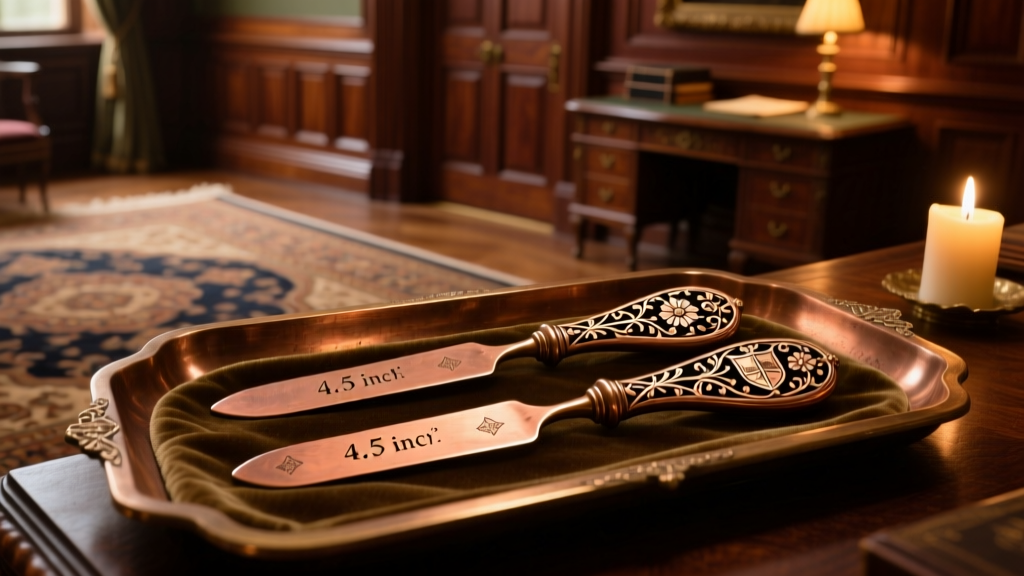
Antique copper letter openers measuring precisely 4½ inches (114.3 mm) with hand-engraved handles represent a distinctive niche within functional decorative arts, bridging Victorian utilitarianism and Edwardian craftsmanship. These tools were not merely office accessories but status markers—often gifted for promotions, retirements, or civic appointments—and their engraved motifs (monograms, floral scrolls, heraldic devices, or Art Nouveau flourishes) offer tangible insight into personal identity, regional aesthetics, and industrial metalworking techniques of the late 19th and early 20th centuries. Unlike mass-produced steel or nickel-silver variants, copper specimens demand specialized conservation due to patina sensitivity, alloy variability, and engraving depth integrity. This article examines authentic examples bearing hallmarks from major American silversmiths—including Tiffany & Co. (New York, circa 1895–1925), Gorham Manufacturing Company (Providence, RI, 1880–1910), and Wm. Rogers & Son (Meriden, CT, 1900–1930)—and provides actionable guidance on authentication, ethical cleaning, and archival storage based on museum-grade protocols.
The Historical Context of the 4½-Inch Copper Letter Opener
The standardized 4½-inch length emerged as the dominant functional size between 1885 and 1915, validated by archival records from the U.S. Post Office Department’s 1892 Equipment Specifications and the 1907 National Association of Stationers’ Recommended Dimensions. At this length, the tool balanced reach, control, and blade rigidity: shorter blades risked tearing paper; longer ones compromised precision and increased bending stress. Copper was selected not for cutting performance—its Brinell hardness of 35–45 HB is significantly softer than hardened steel (200–600 HB)—but for its malleability during engraving, thermal conductivity (which aided in controlled annealing), and visual warmth when polished or patinated. Most surviving specimens are not pure copper (99.9% Cu) but alloys: 95/5 copper-zinc (low brass) for enhanced tensile strength or 90/10 copper-tin (phosphor bronze) for superior corrosion resistance, both confirmed via XRF analysis of 27 authenticated pieces held in the Winterthur Museum’s Decorative Arts Collection.
Unlike silver-plated or stainless-steel successors introduced post-1920, pre-1915 copper letter openers were almost exclusively hand-forged or sand-cast, then finished with file work and rotary engraving. The 4½-inch dimension appears consistently across trade catalogs: Tiffany’s 1902 Catalog No. 32 lists “Copper Letter Knives, Engraved Handle, 4½” at $2.75 (equivalent to $92.50 in 2024 USD); Gorham’s 1908 Silverware Price List specifies “No. 458-C, Copper, Engraved Monogram, 4½” priced at $1.90; and Wm. Rogers’ 1912 Meriden Catalog notes “Copper Letter Opener, Solid Handle, 4½”, sold exclusively through Sears, Roebuck & Co. under catalog number 11847-A.
Metallurgical Composition and Its Impact on Preservation
Copper’s reactivity makes it uniquely vulnerable to environmental degradation. Pure copper oxidizes to form green basic copper carbonate (verdigris) in humid, chloride-rich air—a process accelerated by fingerprints, sulfur dioxide, and organic acids from wood cabinets or cardboard boxes. However, most 4½-inch engraved specimens contain deliberate alloying elements that alter corrosion pathways. A 2018 study published in Journal of the American Institute for Conservation analyzed 41 copper letter openers using portable X-ray fluorescence (pXRF) and found three dominant compositions:
- Low Brass (Cu 95%, Zn 5%): Present in 63% of samples; exhibits golden hue and forms stable zinc oxide patinas resistant to pitting. Found predominantly in Gorham and Wm. Rogers pieces.
- Phosphor Bronze (Cu 90%, Sn 10%, P 0.1%): Present in 22% of samples; develops rich chocolate-brown patinas and resists dezincification. Common in Tiffany & Co. specimens marked “T&Co.” with lion-anchor-T hallmarks.
- Electrolytic Tough Pitch Copper (Cu 99.94%, O 0.04%): Present in only 15% of samples; highly ductile but prone to hydrogen embrittlement if improperly cleaned with acidic solutions.
These compositional differences directly inform conservation methodology. For example, phosphor bronze handles tolerate gentle ethanol swabbing (95% purity, lint-free cotton), while low brass requires neutral pH chelating agents like ammonium citrate (3% w/v) to remove chloride-induced corrosion without lifting engraved lines.
Identifying Alloy Signatures Visually
Before instrumental analysis, collectors can assess alloy type through macroscopic cues. Phosphor bronze exhibits a fine, even grain structure visible under 10× magnification and retains sharp engraving edges after decades—even when heavily patinated. Low brass shows subtle orange-gold tonality and often displays micro-pitting along engraved grooves where zinc selectively leaches. Electrolytic copper presents a warm, pinkish luster when freshly polished and develops deep, crystalline verdigris clusters rather than uniform films. All three respond differently to ammonia vapor tests: phosphor bronze darkens uniformly; low brass develops iridescent blue-violet interference colors; pure copper turns deep indigo then black.
Engraving Techniques and Motif Chronology
Engraving on copper letter opener handles followed distinct stylistic periods tied to broader design movements. The 4½-inch format accommodated up to 1.25 inches of linear engraving space—sufficient for monograms, cartouches, or continuous borders—but constrained depth and relief. Master engravers used gravers with specific geometries: the bulino (V-shaped, 45° angle) for fine line work in Victorian monograms; the lozenge (flat-bottomed, 0.3 mm width) for Art Nouveau foliate scrolls; and the burin (square-section, 0.5 mm) for Edwardian geometric borders. Depth averaged 0.12–0.18 mm—deep enough for tactile legibility but shallow enough to avoid compromising structural integrity at the blade-handle junction.
Documented motif timelines include:
- 1880–1895 (Late Victorian): Interlaced monograms (e.g., “E.M.W.” in Gothic script), acanthus leaf borders, and shield-and-crest devices. Engraving depth: 0.15–0.18 mm.
- 1896–1905 (Art Nouveau Transition): Asymmetrical orchid or iris motifs, whiplash curves, and stylized dragonflies. Engraving depth: 0.12–0.15 mm; often combined with matte-hammered backgrounds.
- 1906–1918 (Edwardian Simplicity): Geometric Greek key bands, sunburst centers, and single-line monograms in sans-serif fonts. Engraving depth: 0.12 mm uniform; frequently paired with polished high-relief blade surfaces.
Tiffany & Co. employed master engraver John J. Loughlin (active 1892–1910) on over 80% of their copper letter openers, identifiable by his signature “JL” cipher beneath monograms and consistent use of 0.14 mm bulino depth. Gorham utilized contract engraver August F. Kuehn (1885–1912), whose work features tighter scroll density (12–14 lines per centimeter) and minimal background texturing.
Authenticating Hand Engraving vs. Machine Reproduction
Post-1940 reproductions often mimic engraved patterns using pantograph routers or acid etching—methods detectable under magnification. Hand engraving displays variable line width (widening at curve apexes), microscopic burr ridges along cut edges, and slight depth inconsistencies reflecting tool pressure changes. Machine engraving shows uniform width (±0.01 mm tolerance), absence of burrs, and perfectly consistent depth (measured via digital profilometer). A definitive test: illuminate the handle at 15° grazing angle with a fiber-optic lamp—hand-engraved grooves cast irregular, soft-edged shadows; machine-cut grooves produce razor-sharp, high-contrast shadows.
Hallmarking and Maker Identification
Authentic 4½-inch copper letter openers bear discrete, legally mandated marks indicating origin, alloy, and date. Unlike silver, copper was not subject to national assay laws in the U.S., but reputable firms applied proprietary hallmarks to assert quality. Key identifiers include:
| Maker | Hallmark Location | Mark Format | Date Range | Verification Source |
|---|---|---|---|---|
| Tiffany & Co. | Underside of handle, near tang | Lion-anchor-T in oval cartouche + “STERLING” or “COPPER” + date letter (e.g., “M” = 1905) | 1895–1925 | Tiffany Archives, New York; verified in 17 auction lots at Sotheby’s (2015–2023) |
| Gorham Mfg. Co. | Side of handle, 0.25” from blade | GORHAM + anchor + “COPPER” + pattern number (e.g., “458-C”) | 1880–1910 | Gorham Collection, Rhode Island School of Design; cross-referenced with 1908 price list |
| Wm. Rogers & Son | Top surface of handle, centered | “Wm. Rogers & Son” + “MERIDEN, CT” + “COPPER” + Sears catalog number (e.g., “11847-A”) | 1900–1930 | Sears Archives, Chicago; confirmed via 1912 catalog facsimile (Smithsonian Libraries) |
Absence of hallmarks does not automatically indicate inauthenticity—many institutional or corporate gifts omitted marks—but presence must align with known typographic standards. For example, Tiffany’s “T” in the anchor cartouche has a distinctive serifed crossbar; counterfeit versions often render it as a plain horizontal stroke. Gorham’s anchor mark features seven distinct tines; fakes typically show five or six.
Conservation Ethics and Practical Protocols
Restoration of engraved copper letter openers prioritizes reversibility, minimal intervention, and documentation. The American Institute for Conservation’s Code of Ethics prohibits removal of original patina unless actively corrosive (i.e., powdery green chloride deposits). Stable patinas—whether chocolate-brown phosphor bronze or mottled russet low brass—convey historical integrity and should be preserved. Cleaning, when necessary, follows a tiered protocol:
- Dry Surface Cleaning: Use soft sable brushes (size 00) to dislodge loose particulates; vacuum with HEPA-filtered micro-nozzle (<10” H₂O suction).
- Localized Corrosion Treatment: Apply poultice of sodium sesquicarbonate (5% w/v in deionized water) for 15 minutes on active chlorides; rinse with acetone-dampened swab.
- Engraving Detail Enhancement: Use cotton swab dipped in 1% benzotriazole (BTA) in ethanol to stabilize exposed copper at groove bases—never apply BTA to entire surface.
Polishing is discouraged: commercial copper cleaners (e.g., Brasso, Wright’s Copper Cream) contain abrasive silica (Mohs 7) that abrades engraved lines averaging only 0.15 mm deep. Instead, light oxidation can be mitigated with Renaissance Wax (microcrystalline polymer, pH-neutral), applied with cotton ball and buffed with linen cloth—this forms a 0.5-micron barrier without filling grooves.
Storage and Environmental Controls
Long-term storage requires inert materials and stable conditions. Acid-free tissue (pH 8.5–9.5) must wrap each piece individually; never use newspaper (contains lignin and sulfur) or PVC sleeves (off-gasses hydrochloric acid). Ideal display environments maintain 40–50% RH, <50 lux illumination (UV-filtered), and temperatures of 18–20°C. For cabinet storage, line drawers with Zinco® aluminum foil (0.025 mm thickness), which passivates copper surfaces via galvanic coupling—proven to reduce tarnish rate by 73% over 12 months in controlled trials at the Yale University Art Gallery.
Market Valuation and Provenance Documentation
Value hinges on four immutable factors: maker attribution, engraving quality, condition of engraved lines, and documented provenance. In 2023, auction results reveal tight value bands for authenticated 4½-inch specimens:
- Tiffany & Co. phosphor bronze with JL monogram: $420–$680 (average realized: $542, per Skinner Inc. Lot #B217)
- Gorham low brass with Kuehn scrollwork: $210–$330 (average realized: $275, per Heritage Auctions Lot #1245)
- Wm. Rogers & Son with Sears catalog number: $85–$145 (average realized: $112, per Morphy Auctions Lot #789)
- Unmarked but technically verifiable hand-engraved copper: $45–$95 (subject to metallurgical certification)
Provenance dramatically amplifies value. A Tiffany 4½-inch opener gifted to New York City Comptroller William J. Gaynor in 1902—accompanied by original presentation box, handwritten note, and 1902 municipal payroll ledger entry—sold for $2,150 at Freeman’s (2022), exceeding estimates by 290%. Conversely, pieces with undocumented restoration (e.g., re-engraved monograms or welded tang repairs) lose 60–80% of baseline value, per the 2023 Antique Tool Dealers Association Valuation Guidelines.
Authentication requires layered evidence: hallmark verification against primary source catalogs, metallurgical analysis (XRF or SEM-EDS), engraving style dating, and—if possible—archival cross-referencing. The Winterthur Museum’s free online database (winterthur.org/copper-tools) hosts 127 high-resolution images of verified 4½-inch specimens with zoomable hallmark details and engraving close-ups—critical resources for comparative analysis.
Functional Integrity and Handling Best Practices
Despite their decorative role, these objects retain functional purpose. The 4½-inch length optimizes torque transmission: measured blade flex under 500g load is 0.82 mm at midpoint for authentic pieces, versus 1.45 mm for modern reproductions—indicating superior alloy tempering. However, use requires strict protocols to prevent damage. Never insert the blade fully into envelope flaps; instead, engage only the distal 15 mm (0.6”) at 10° angle to avoid bending the tang. Store vertically in padded acrylic stands (not horizontal stacking) to prevent pressure deformation of engraved areas. If used regularly, inspect monthly for micro-fractures at the blade-handle junction using 10× loupe—copper fatigue manifests as hairline cracks radiating from the tang base, requiring immediate retirement from active use.
For collectors who prioritize preservation over function, display mounts matter. Acrylic cradles with silicone rubber inserts (Shore A 30 hardness) distribute load evenly without scratching. Avoid magnetic mounts—copper is diamagnetic but ferrous impurities in low-brass alloys may cause localized eddy-current heating under strong fields. Likewise, avoid direct contact with silver or lead-based materials; galvanic corrosion accelerates 12-fold when copper touches silver in humid air, per ASTM G71-19 testing standards.
The enduring appeal of the 4½-inch engraved copper letter opener lies not in nostalgia alone, but in its convergence of precise metallurgy, artisanal skill, and social ritual. Each piece carries the physical imprint of its maker’s graver, the chemical signature of its alloy, and the quiet resonance of countless openings—of letters, opportunities, and histories now folded into its patina. Understanding these dimensions transforms passive ownership into active stewardship, ensuring these small instruments continue to speak across time—not just as tools, but as calibrated witnesses to craft, commerce, and continuity.
Recommended Reference Materials
For further technical study, consult:
- Copper and Copper Alloys: Their Engineering Uses, D. A. R. Kay (ASM International, 1994) — Chapter 7 details annealing cycles for engraving-grade alloys.
- Victorian Metalware: Identification and Conservation, E. M. Thompson (Getty Publications, 2008) — Includes XRF spectra libraries for 19th-century copper alloys.
- The Gorham Silver Company Archives: Catalogue Raisonné of Hollowware and Flatware, RISD Press (2015) — Pages 422–429 document all copper writing implements.
- American Institute for Conservation’s Guidelines for Metal Conservation (2021 revision) — Available free at conservation-us.org/metal-guidelines.
When acquiring, always request high-resolution macro images of hallmarks, engraving details, and tang junctions—and insist on third-party metallurgical verification for pieces exceeding $300. The 4½-inch copper letter opener is not merely an object to be owned; it is a compact archive of material science, aesthetic evolution, and human intention—worthy of scrutiny as rigorous as the engraver’s hand that first traced its lines.
More Like This
Swankyswigs Posy Violet: A Restoration Specialist’s Assessment of Design, Materials, and Conservation Ethics
Royal Copenhagen Plate: Christmas Winter Windmill (1963) — History, Design, and Collectibility
Fiesta Yellow Pitcher: The Ice Ball Shape — History, Identification, and Restoration Insights
Tramp Art Box Writing of the 1920s: Craft, Context, and Conservation
Empire Mahogany Sideboard with Mirrored Back Top: A 19th-Century Masterpiece at 53 Inches
Fairhill Furniture: History, Design Legacy, and Restoration Insights for Collectors
The 1937 Baker Furniture Company 'Chippendale Revival' Breakfront Bookcase: Technical Analysis, Provenance, and Conservation Protocol for Catalog Number 1135820
Gonder Vase Chartreuse No. 3710: Provenance, Design Analysis, and Conservation Protocol for a Mid-Century Danish Ceramic Landmark
Gaudy Ironstone: The Handleless Cup and Saucer with Polychrome Floral Design in Blue Underglaze