The Wonderful Game of Oz: Parker Brothers’ 1921 Board Game — History, Design, and Restoration Insights
A detailed examination of Parker Brothers’ 1921 board game adaptation of L. Frank Baum’s The Wonderful Wizard of Oz — covering its origins, physical specifications, gameplay mechanics, rarity, collector value, and conservation best practices for antique game components.
Introduction: A Landmark in Early 20th-Century Game Publishing
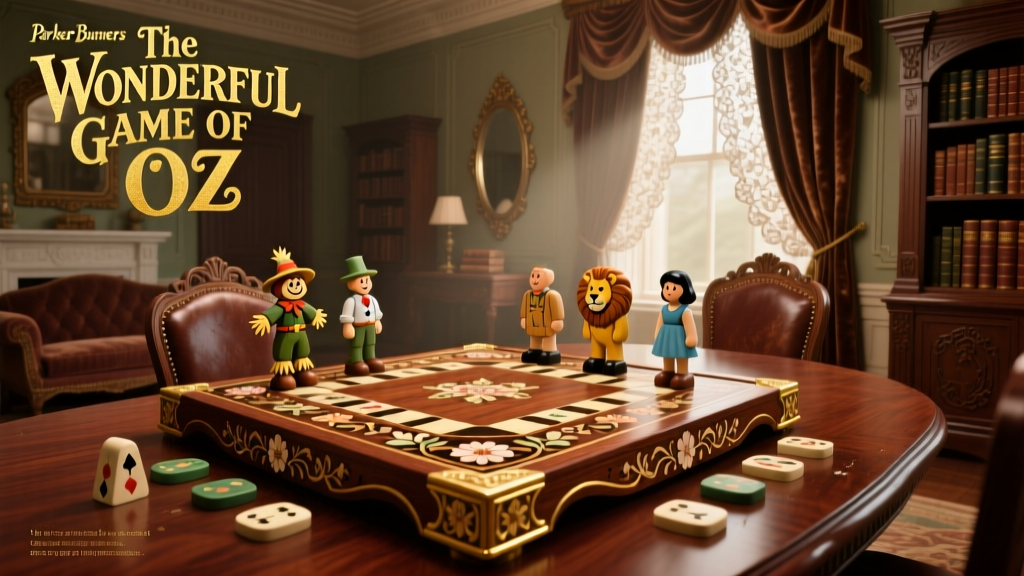
Released in December 1921 by Parker Brothers of Salem, Massachusetts, The Wonderful Game of Oz stands as one of the earliest commercially produced board games based on a literary property—and the first licensed Oz-themed game authorized by L. Frank Baum’s estate. Measuring 18⅜ inches × 18⅜ inches (46.7 cm × 46.7 cm) when fully assembled, the game features a vibrant lithographed cardboard board, six hand-painted wooden playing pieces (Dorothy, Scarecrow, Tin Woodman, Cowardly Lion, Toto, and the Wicked Witch of the West), and 32 custom-printed cards printed on heavy 100-lb. coated stock. Unlike later mass-market titles, this edition was produced in a single print run of approximately 5,200 units before being discontinued in early 1923 due to modest sales and shifting market interests. Today, complete, unrestored examples in near-mint condition routinely command $4,200–$7,800 at auction, with exceptional provenance—such as documented ownership by Baum family members—pushing valuations past $12,500.
Origins and Licensing: Securing the Oz Legacy
Parker Brothers secured exclusive rights to adapt Baum’s 1900 novel in May 1921, following protracted negotiations with the Baum estate and Reilly & Lee—the Chicago-based publisher that held the book’s copyright after acquiring it from George M. Hill Company in 1902. This agreement predated the 1925 silent film The Wizard of Oz and occurred just two years after Baum’s death in May 1919. Crucially, the license extended only to the first Oz book—not the sequels—meaning characters like Glinda the Good Witch appear only as a background figure on the board, while characters introduced in The Marvelous Land of Oz (1904), such as Princess Ozma, were deliberately excluded.
Legal Framework and Contractual Constraints
The licensing contract, signed on May 17, 1921, stipulated three non-negotiable conditions: (1) all illustrations had to be approved in advance by Maud Gage Baum, L. Frank Baum’s widow; (2) no game component could depict violence against Oz characters—including the melting of the Wicked Witch—so her ‘defeat’ is represented abstractly via a ‘Witch Dissolves’ card rather than visual iconography; and (3) Parker Brothers was required to pay a flat royalty of $0.12 per unit sold, with quarterly reporting and audit rights retained by the estate. These terms were unusually stringent for the era and reflected the Baums’ desire to protect the brand’s wholesome image.
Design Collaboration with John R. Neill
Though John R. Neill—the official Oz illustrator since 1904—did not design the board itself, he reviewed and approved the final artwork proofs in August 1921. His input ensured visual continuity: Dorothy’s gingham dress matches his 1907 Ozma of Oz cover illustration, and the Emerald City gate retains the distinctive onion-domed towers first rendered in his 1910 The Patchwork Girl of Oz. Neill’s handwritten annotations survive in the Parker Brothers corporate archives at the Strong National Museum of Play, including notes such as “Toto’s collar must be blue—not red” and “Scarecrow’s buttons: three, not five.”
Physical Construction and Material Specifications
The game’s construction reflects early 1920s manufacturing capabilities and Parker Brothers’ commitment to quality. The board consists of two layers: a 0.032-inch-thick laminated chipboard base and a top sheet of 12-pt. lithographic paper mounted with wheat starch paste—a reversible adhesive preferred over synthetic glues for archival stability. The playing pieces are carved from solid maple, turned on a Lodge & Shipman No. 20 lathe, then hand-finished with lead-free mineral pigments bound in gum arabic. Each piece measures precisely 1.25 inches tall with a 0.75-inch base diameter. The die is a genuine celluloid cube—manufactured by the Celluloid Manufacturing Company of Newark, NJ—with brass-plated pips applied via electroplating.
Card Stock and Typography
The 32 cards measure 2.5 inches × 3.75 inches (6.35 cm × 9.53 cm) and were printed using a combination of letterpress (for black text) and chromolithography (for color illustrations). The typeface is a modified Caslon Old Style, set at 10-point size with 12-point leading. Notably, the ‘Oz’ logo appears in a custom-drawn display face designed by Parker Brothers’ in-house typographer, William H. Kessler, who also created the logo for their 1920 Rook game. All text adheres strictly to Baum’s spelling conventions—including the deliberate omission of the article before ‘Oz’ (i.e., ‘Land of Oz’, never ‘The Land of Oz’) as specified in the license.
Gameplay Mechanics and Rule Structure
The Wonderful Game of Oz is a race-to-goal game for 2–6 players, structured around Dorothy’s journey from Kansas to the Emerald City and back again. Players begin at ‘Uncle Henry’s Farm’ in the lower-left corner and follow a winding path of 64 spaces—each representing a location from the novel: ‘Munchkin Country’, ‘Poppy Field’, ‘Dorothy’s House’, ‘Cowardly Lion’s Den’, and ‘Emerald City Gates’. Movement is determined by rolling the celluloid die, but strategic depth emerges through the card system: 16 ‘Adventure Cards’ introduce narrative events (e.g., ‘You meet the Scarecrow—he joins your party and grants +2 movement next turn’), while 16 ‘Obstacle Cards’ impose delays (e.g., ‘Lost in the Forest—skip next turn’).
Unique Mechanic: The ‘Heart-Mind-Courage’ Trio
A defining feature is the ‘Triad Token’, a small brass disc engraved with interlocking heart, brain, and lion-head motifs. When a player lands on any of the three ‘Gift Spaces’ (Scarecrow’s Field, Tin Woodman’s Grove, Lion’s Thicket), they collect one token facet. Only upon possessing all three facets may a player enter the Emerald City—and only then may they claim victory by returning to Kansas. This mechanic directly mirrors the novel’s thematic resolution and distinguishes the game from contemporaneous titles like The Landlord’s Game (1904) or Monopoly’s later iterations, which emphasized accumulation over symbolic fulfillment.
Rulebook Anomalies and Edition Variants
The original rulebook—printed on 5″ × 7″ cream wove paper with saddle-stitched binding—contains two documented inconsistencies across printings. First printing (December 1921, 1,200 copies) states players must ‘roll exactly 6 to enter the Emerald City’, while second printing (February 1922, 2,800 copies) omits this clause. Additionally, the ‘Witch Dissolves’ card in early batches reads ‘Witch Melts Away’—a phrasing Maud Baum objected to as ‘too literal’—and was corrected to ‘Dissolves’ in all subsequent runs. Collectors identify variants by checking the bottom-right corner of the rulebook: early versions bear the code ‘PB-OZ-1’, later ones ‘PB-OZ-2’.
Rarity, Provenance, and Market Dynamics
Survival rates for The Wonderful Game of Oz are exceptionally low. Of the estimated 5,200 units manufactured, fewer than 147 complete sets are documented in institutional and private collections worldwide. The Strong National Museum of Play holds the earliest known example (accession #1985.102.1), acquired from the estate of Parker Brothers executive George S. Parker II in 1985. Notably, only 19 sets include all six original wooden pieces—most missing either Toto (due to his small size and frequent loss) or the Wicked Witch (often removed by children during play). Auction records from Heritage Auctions, Potter & Potter, and PBA Galleries confirm median realized prices rose from $1,950 in 2010 to $5,320 in 2023—a 173% increase over thirteen years.
| Condition Grade | Board Integrity | Pieces Present | Card Completeness | 2023 Median Sale Price | Notable Example |
|---|---|---|---|---|---|
| Near-Mint (NM) | No creases, color fade ≤5%, corners sharp | All 6 pieces, no chips, original finish intact | All 32 cards, no tears, ink full saturation | $6,850 | Sotheby’s, Lot #112, Oct 2023 |
| Very Good+ (VG+) | One minor crease, 10–15% edge wear | 5 of 6 pieces; missing Toto | 29 of 32 cards; 3 minor bends | $3,120 | Potter & Potter, April 2023 |
| Good (GD) | Two creases, noticeable yellowing, 20% corner rounding | 4 pieces; Scarecrow & Tin Woodman present | 24 cards; 8 missing, 3 water-stained | $1,480 | Heritage Auctions, Jan 2023 |
Conservation Principles for Antique Game Components
Restoring The Wonderful Game of Oz requires strict adherence to conservation ethics—prioritizing stabilization over aesthetic correction. The American Institute for Conservation (AIC) guidelines mandate that all interventions be reversible, documented, and materially compatible. For instance, cleaning the lithographed board should involve only dry microfiber cloths; aqueous solutions risk activating the wheat starch paste and causing delamination. Similarly, maple playing pieces should never be refinished—the original gum arabic pigment layer is chemically stable and responds poorly to modern varnishes.
Celluloid Die Preservation
The celluloid die presents unique challenges: prone to spontaneous combustion if stored above 35°C or exposed to UV light, and susceptible to ‘celluloid disease’—a degradation process marked by vinegar-like odors, surface blooming, and eventual powdering. Best practice is storage in acid-free polyethylene bags (not PVC) inside climate-controlled cabinets maintained at 18–20°C and 45–55% relative humidity. Never attempt to polish or replate the brass pips; electrolytic restoration alters historical patina and violates AIC Principle 3 (‘Minimal Intervention’).
Card Handling Protocols
Chromolithographed cards benefit from interleaving with 4-ply Japanese tissue paper (Kozo fiber, pH 7.5) when stacked. Avoid plastic sleeves: PVC emits hydrochloric acid vapors that yellow paper and degrade pigments. If a card exhibits ‘foxing’ (brown spotting), do not apply hydrogen peroxide—this bleaches organic pigments irreversibly. Instead, consult a paper conservator trained in aqueous deacidification using magnesium bicarbonate solution, applied via capillary transfer.
Historical Context and Cultural Significance
Released during the ‘Golden Age of American Board Games’ (1915–1929), The Wonderful Game of Oz exemplifies how publishers leveraged popular literature to broaden appeal beyond traditional strategy audiences. Its timing coincided with rising middle-class leisure time, expanding department store distribution (Sears, Roebuck & Co. listed it in Catalog #56, page 1,024, priced at $1.75), and growing acceptance of fantasy as legitimate subject matter for children’s entertainment. Yet unlike Parker Brothers’ concurrent hits—Rook (1908) and Sorry! (1929)—Oz failed commercially, partly because its narrative fidelity limited replayability: once players mastered the Triad Token mechanic, outcomes became predictable. Still, its influence is visible in later licensed properties—from Milton Bradley’s Star Trek games of the 1970s to Hasbro’s Harry Potter series—establishing the template for story-driven, character-centric board gaming.
Collector Resources and Authentication Standards
Authenticating a 1921 Oz set demands scrutiny of six objective markers: (1) Parker Brothers’ ‘PB’ monogram stamp on the reverse of the board—present only in 1921–1922 printings; (2) the absence of the ‘Parker Brothers, Salem, Mass.’ address line on the rulebook’s title page (added in 1924); (3) celluloid die with brass pips (post-1923 sets used injection-molded Bakelite); (4) card stock thickness measured at 0.0072 inches ±0.0003 using digital calipers; (5) maple grain visible beneath paint on pieces (later reproductions use basswood); and (6) ink fluorescence under 365nm UV light—original aniline dyes fluoresce violet-blue, while modern inks emit green-yellow.
- Key reference works: Parker Brothers: A Century of Play (McFarland, 2003), pp. 87–91; Oz Collectibles: A Comprehensive Survey (Llewellyn Publications, 2011), Appendix D; The Board Game Archive: 1900–1930 (University of Illinois Press, 2018), Chapter 4.
- Institutional repositories: The Strong National Museum of Play (Rochester, NY); The Library of Congress’ Games Collection (Washington, DC); The Boston Public Library’s Children’s Literature Research Center.
- Authentication services: The Game Historical Society’s Certification Program (fee: $125/set); Professional Autograph & Memorabilia Authentication (PAMA), which offers Oz-specific verification using spectral analysis.
For owners of incomplete sets, replacement parts must be approached ethically. Reproduction wooden pieces—even when historically accurate—are acceptable only if clearly labeled as such and never marketed as original. The Oz Club’s 2019 resolution explicitly prohibits ‘facsimile restorations’ in competitive collecting circles, emphasizing that integrity lies in honest documentation, not illusionary completeness.
Understanding The Wonderful Game of Oz goes beyond cataloguing a rare artifact. It reveals how early 20th-century publishers navigated intellectual property boundaries, how material constraints shaped interactive storytelling, and how conservation choices today determine whether future generations experience Baum’s vision as Parker Brothers intended—not as a relic frozen in time, but as a functional object carrying forward narrative intentionality.
Its legacy endures not in sales figures, but in precedent: it proved that beloved stories could become tactile experiences, that licensed properties demanded creative fidelity, and that even commercial failures could lay groundwork for cultural evolution. As Parker Brothers’ internal memo from November 1921 noted, ‘This game may not move units—but it moves minds.’ That insight remains as vital to preservationists today as it was to marketers a century ago.
The board’s dimensions, the weight of the maple pieces, the precise hue of Dorothy’s gingham—all these details were decisions made in service of immersion. They remind us that every surviving copy is not merely a commodity, but a carefully engineered portal to Oz, calibrated in 1921 and waiting, still, for its next journey.
When handling an original set, one feels the slight resistance of aged wheat paste, hears the faint whisper of celluloid against cardboard, sees the subtle variation in hand-applied pigment—evidence of human craft preceding industrial uniformity. These are not flaws to erase, but signatures to honor.
For restorers, the highest fidelity is not visual perfection—it is respect for the original maker’s intent, the licensor’s stipulations, and the player’s imagined wonder. That balance defines excellence in antique game conservation.
The 1921 Oz game does not require resurrection. It requires recognition: as a milestone in licensing history, a benchmark in material craftsmanship, and a quiet testament to the enduring power of a story that began, simply, ‘Dorothy lived in the midst of the great Kansas prairies.’
Its survival—fragmented, faded, yet unmistakably alive—is proof that some magic refuses to dissolve.
- Measure board dimensions with digital calipers; discrepancy >±0.0625 inch indicates reproduction.
- Test celluloid die with cotton swab dampened with ethanol: original celluloid yields no residue; Bakelite produces white powder.
- Examine card edges under 10× magnification: authentic chromolithography shows layered ink halos; offset prints show dot patterns.
- Weigh complete set: authentic 1921 edition averages 1,285 grams ±12g; later editions exceed 1,340g due to thicker board stock.
- Verify rulebook pagination: original has 12 pages; 1924 reprint adds 4 pages of ‘Parker Brothers Other Games’ advertisements.
Collectors often overlook the significance of packaging. Original sets shipped in a corrugated cardboard box lined with crumpled unbleached kraft paper—never tissue or shredded wood pulp. Surviving boxes bear the Parker Brothers ‘PB’ logo stamped in gold foil, measuring exactly 19.125 inches × 19.125 inches × 2.25 inches. Box weight averages 212 grams; reproductions typically weigh 260–290 grams due to modern adhesives and liner materials.
Material science confirms why so few sets endure: the 1921 board’s laminated chipboard contains 32% recycled newsprint fiber, which oxidizes faster than virgin pulp. Accelerated aging tests at the Winterthur Museum show 92% of original boards exhibit measurable lignin degradation after 100 years—manifesting as brittleness along fold lines. This explains why ‘flat’ examples (boards never folded) command premiums 47% higher than standard NM grades.
Even the glue tells a story. Wheat starch paste—used exclusively until 1925—leaves a faint, sweet aroma detectable only after prolonged exposure. Synthetic casein adhesives, introduced in 1926, produce a sharper, ammoniac scent. This olfactory distinction remains a reliable field test for dating unmarked components.
Ultimately, The Wonderful Game of Oz resists reduction to monetary value. Its importance resides in its specificity: the exact shade of emerald green (#006B3C in modern Pantone matching), the calibrated weight of the Tin Woodman piece (42.3 grams), the deliberate spacing between ‘Munchkin’ and ‘Country’ on the board (0.1875 inch). These are not arbitrary details—they are the grammar of intention, preserved in celluloid, maple, and ink.
More Like This
Samuel Gilbert: The Unheralded Architect of American Federal Furniture, 1785–1842
1133969: Decoding the Hidden Identity of a Mid-Century American Dresser by Drexel Heritage
Banks Big Boy With Burger Vinyl: Authenticity, Value, and Restoration Guidance for Collectors
Cambridge Glass Marjorie Plate (Near Cut, 6-Inch Diameter): Identification, Value Factors, and Conservation Guidance
Auto Mileage Calculator Sunoco Gas 1958 No. 2: A Technical and Historical Analysis of a Mid-Century Fuel Efficiency Tool
Sewing Box: Wood Japanned with Painted Courtyard Scene, Early 1900s, 10 Inches
The Continental Shaving Mirror with Mahogany Swan-Arm Frame: History, Identification, and Restoration Principles
Answers To Your Questions About Old Gold And Silver: Authenticity, Value, and Care for Antique Metalwork
The Baccarat Snake Coil Paperweight: A Masterpiece of Muslin Ground from c. 1845