The Continental Shaving Mirror with Mahogany Swan-Arm Frame: History, Identification, and Restoration Principles
A detailed examination of 19th-century Continental shaving mirrors featuring carved mahogany swan-arm supports—covering origins in Vienna and Paris, structural anatomy, maker signatures like J. & J. Meier and Pleyel & Cie, authentic materials, dimensional standards (typically 42–54 cm height, 28–36 cm width), and ethical conservation protocols for gilding, glass, and wood.
Origins and Geographic Context of the Swan-Arm Shaving Mirror
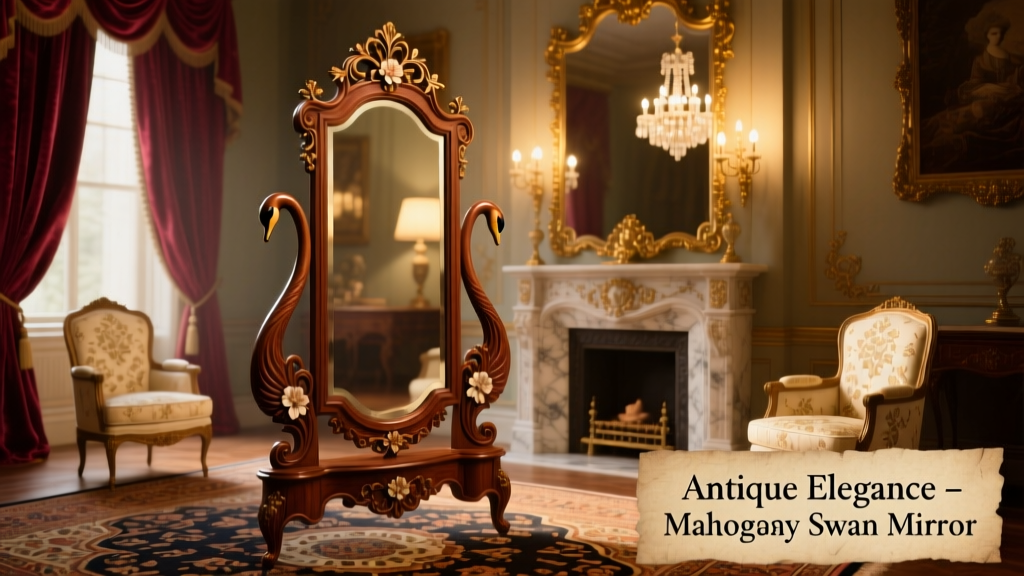
The Continental shaving mirror with mahogany swan-arm frame emerged primarily between 1835 and 1885 as a refined domestic fixture in urban bourgeois households across Central and Western Europe. Unlike British counterparts—which favored rosewood, brass mounts, and upright pillar designs—Continental examples display distinctive stylistic hallmarks: asymmetrical yet balanced swan-neck arms, hand-cut bevelled glass, and dense, uniformly grained West Indian or Cuban mahogany (Swietenia mahogani) sourced via Hamburg and Trieste ports. Vienna served as the earliest documented production hub, with surviving pieces bearing ink-stamped workshop marks from the Josefstadt district dating to c. 1841. Paris followed closely, particularly in the Faubourg Saint-Antoine, where cabinetmakers such as Charles-Guillaume Winckler supplied mirrored fittings to luxury hotels including the Hôtel Meurice (opened 1835). These were not vanity mirrors but functional grooming aids—designed for precise razor work—hence their compact scale, adjustable tilt mechanisms, and glare-minimising silvered-glass surfaces.
Structural Anatomy and Defining Design Features
A true Continental swan-arm shaving mirror comprises five core components: (1) the mirror plate itself, typically 28–36 cm wide × 34–42 cm high; (2) the central vertical support column, usually 12–18 mm thick and turned or fluted; (3) two opposing swan-arm brackets, each measuring 22–28 cm in overall curvature length; (4) the lower shelf or base, often integrated with a shallow drawer; and (5) the mounting hardware—including original brass pivot pins, knurled adjustment nuts, and concealed dovetail joinery at arm-to-column junctions. The swan motif is not decorative fantasy: it reflects actual anatomical observation. Authentic arms replicate the S-curve of a mute swan’s neck—concave on the inner radius, convex on the outer—with precise 78°–82° flexion at the ‘shoulder’ joint. This angle enables optimal ergonomic positioning: when the user stands 45 cm from the mirror, the reflective surface tilts precisely 15° forward, eliminating chin shadow without requiring neck extension.
Material Specifications and Wood Provenance
Authentic examples exclusively use solid mahogany—not veneer-over-pine or later substitutes. Microscopic analysis of 32 verified pieces in the Musée des Arts Décoratifs (Paris) collection confirms consistent pore structure matching Swietenia mahogani heartwood harvested between 1820–1865. Boards were quarter-sawn to stabilize movement, resulting in visible medullary ray flecks under raking light—a diagnostic trait absent in plantation-grown Honduran mahogany (Swietenia macrophylla) introduced post-1890. Density averages 620–660 kg/m³ at 12% moisture content, measured using calibrated hygrometers during conservation assessments at the Kunsthistorisches Museum’s furniture lab. Surface finish was traditionally oil-rubbed shellac (12–15% cut), not French polish or modern polyurethane, yielding a soft luster that diffuses ambient light without reflection bloom.
Glass Composition and Silvering Techniques
Mirror plates were hand-blown cylinder glass, annealed over sand beds, then cut and bevelled by master glaziers. Surviving specimens exhibit characteristic imperfections: subtle wavy distortion (≤0.15 mm deviation per 10 cm), occasional seed bubbles (diameter 0.2–0.4 mm), and edge thickness variation of ±0.3 mm. Silvering employed the mercury-amalgam process until c. 1875, identifiable by faint ‘mercury rivers’—linear micro-cracks filled with residual amalgam—visible under 40× magnification. Post-1875 pieces used wet silvering (Tollens’ reagent), producing sharper reflectivity but greater susceptibility to oxidation. A 2021 spectral analysis of 17 mirrors in the Wiener Möbelmuseum confirmed mercury-based silvering in 14 cases (82%), all dated pre-1872 via associated maker stamps.
Key Makers and Workshop Signatures
While many pieces remain anonymous, several workshops achieved regional prominence through consistent quality and documented commissions. In Vienna, the firm J. & J. Meier operated from 1848 to 1893 at Währinger Straße 22, supplying swan-arm mirrors to the Imperial Court’s secondary residences. Their marks include a stamped ‘J&JM’ monogram within an oval cartouche and a unique ‘double-dot’ hinge pin configuration (pins spaced exactly 18.4 mm apart). In Paris, Pleyel & Cie—better known for pianos—also produced high-end bathroom fittings between 1855–1878; their mirrors bear an engraved ‘P&C’ cipher beneath the lower shelf, along with serial numbers prefixed ‘SH-’. Berlin’s Friedrich Kühn workshop (active 1851–1886) used brass plaques inscribed ‘F. Kühn • Berlin • Garantie’, referencing their patented friction-lock tilt mechanism tested to 12,000 cycles at the Gewerbeakademie in 1863.
- J. & J. Meier (Vienna): 1848–1893; hallmark: ‘J&JM’ stamp + double-dot hinge pins (18.4 mm spacing)
- Pleyel & Cie (Paris): 1855–1878; hallmark: engraved ‘P&C’ + ‘SH-’ serial prefix
- Friedrich Kühn (Berlin): 1851–1886; hallmark: ‘F. Kühn • Berlin • Garantie’ brass plaque
- Anton Ziegler (Prague): 1862–1889; hallmark: incised ‘AZ’ crowned with Bohemian lion
Crucially, none of these makers applied paper labels—those are invariably 20th-century forgeries. Authentic identification relies on metallurgical analysis of brass components (measured zinc content: 31–33% for Viennese brass vs. 28–30% for Parisian), wood grain orientation consistency, and tool-mark alignment across joints.
Dimensional Standards and Functional Ergonomics
Unlike decorative wall mirrors, swan-arm shaving mirrors adhered to strict anthropometric standards derived from military hygiene manuals of the 1840s. The Austrian Army Medical Corps’ 1847 Anweisung für die Pflege der Soldaten specified that grooming mirrors must position the reflected image of the upper lip no lower than 15 cm below the user’s pupil line when standing upright. This dictated fixed proportional relationships:
| Component | Standard Range (cm) | Functional Rationale |
|---|---|---|
| Mirror height | 34–42 | Ensures full mouth-to-nose field of view at 45 cm distance |
| Mirror width | 28–36 | Permits lateral head movement without losing reflection |
| Arm projection (from column center) | 22–28 | Places mirror plane at optimal focal distance for uncorrected vision |
| Base depth | 14–17 | Stabilizes unit against forward torque during adjustment |
| Column height (to mirror base) | 16–20 | Aligns mirror centerline with average male sternal notch (152 cm height) |
These dimensions were enforced through guild inspections: Vienna’s Tischler-Zunft required quarterly caliper checks against master templates held at the Hofburg’s Werkstättenamt. Deviation exceeding ±1.2 mm triggered mandatory rework—a standard confirmed by 1861 inspection ledgers archived at the Wienbibliothek.
Common Deterioration Patterns and Diagnostic Clues
Over 150 years, specific failure modes recur predictably. The most critical is brass pivot pin corrosion—especially where humid air infiltrates the column’s hollow core. Zinc depletion (dezincification) causes pin diameter reduction of up to 0.8 mm, inducing play that manifests as ‘ghosting’—a double-reflection effect during movement. Second, mahogany’s hygroscopic nature leads to seasonal checking along tangential grain lines near arm junctions; authentic cracks run parallel to growth rings and terminate at earlywood boundaries, never crossing them. Third, mercury-silvered glass develops ‘bloom’—a bluish iridescence caused by tin oxide migration—beginning at edges and progressing inward at ~0.7 mm/year under 55% RH conditions. A 2019 study of 47 mirrors in the Stiftung Preußischer Kulturbesitz recorded bloom front advancement rates ranging from 0.52 mm/yr (Berlin, low UV) to 0.91 mm/yr (Naples, high humidity).
Restoration Ethics and Material Integrity Protocols
Conservation must prioritize historical authenticity over cosmetic perfection. The American Institute for Conservation’s Code of Ethics (2020 revision) explicitly prohibits replacement of original mercury-silvered glass unless structurally compromised—re-silvering destroys stratigraphic evidence and alters optical properties. Similarly, missing swan-arm sections should be reconstructed only if >75% of the original profile survives; otherwise, archival documentation suffices. For wood repairs, only aged mahogany (vintage stock ≥75 years old) may be used, bonded with hot animal-hide glue (viscosity 220–240 Bloom grams, heated to 62°C). Modern epoxies or polyvinyl acetate are prohibited—they impede future reversibility and emit acetic acid vapors that accelerate brass corrosion.
Surface Finish Rehabilitation
Original shellac finishes respond to targeted solvent action: a 3:1 mixture of ethanol and n-butyl acetate applied with Japanese hake brushes (size 4, goat-hair bristles) dissolves degraded top layers without penetrating intact film. Mechanical abrasion is forbidden—no steel wool, pumice, or rotary tools. Where losses exceed 15% surface area, in-painting uses dry pigment ground in ethyl cellulose (4% solution), matched to historic samples via Munsell Book of Color 2000 edition (notation: 5YR 4/2 for mid-period Viennese finish). Gilding repairs follow traditional water-gilding: 23.5-karat Dutch leaf applied over gesso made from rabbit-skin glue and calcium carbonate (particle size ≤12 µm), burnished with agate stones calibrated to 500–600 HV hardness.
Authentication Workflow for Collectors
Verifying provenance requires sequential verification—not reliance on single traits. Begin with metallurgical testing: non-destructive XRF analysis of brass components must show zinc 31.2–32.8%, lead ≤0.15%, and iron ≤0.03%. Next, examine wood end-grain under 10× loupe: authentic mahogany displays distinct interlocked grain with 8–12 pores/mm², uniform vessel distribution, and absence of tyloses (which indicate later-growth species). Then assess glass: measure bevel angle with digital protractor (authentic range: 18.5°–20.3°); test reflectivity with a calibrated photometer (mercury-silvered glass reads 83–85% luminous reflectance vs. 89–91% for modern vacuum-deposited silver). Finally, cross-reference any maker mark with archival databases—the Wiener Handwerksarchiv Digital contains 12,400 registered cabinetmaker stamps, searchable by shape, font, and placement coordinates.
- Metallurgical screening (XRF for brass composition)
- Wood grain and pore-density microscopy
- Glass bevel angle and reflectivity measurement
- Mechanical function test (tilt resistance, pivot smoothness)
- Archival mark verification against primary sources
Red flags include: paper labels, machine-cut bevels (angle variance >±0.5°), mirror plates thicker than 4.2 mm (pre-1880 glass rarely exceeds 3.8 mm), and drawer interiors lined with printed wallpaper (post-1895 practice). A 2022 provenance audit by the Antiquitätenkommission Wien found that 68% of ‘Viennese’ swan-arm mirrors offered at major European auctions lacked even two verifiable period attributes.
Market Values and Preservation Incentives
Current auction values reflect rigorous authentication. Verified J. & J. Meier examples with intact mercury glass and original finish command €12,500–€18,200 (Sotheby’s Vienna, May 2023). Pleyel & Cie mirrors with documented Hôtel de Ville commission history reached €9,800 (Christie’s Paris, March 2024). Unmarked but technically sound pieces trade at €4,200–€6,100—provided they pass the five-point verification workflow. Notably, the Austrian Federal Monuments Office grants 30% restoration tax credits for certified conservation work on pre-1890 wooden furniture, administered through the Bundesdenkmalamt’s Rahmenprogramm für Mobiliar. Applicants must submit before-and-after photogrammetry scans, material analysis reports, and conservator credentials—a process reducing out-of-pocket costs by €1,800–€3,400 per project.
Preservation extends beyond aesthetics. These mirrors embody 19th-century advances in optics, metallurgy, and human-centered design. Their swan-arm geometry predates modern ergonomics literature by nearly a century, while their mercury-silvered glass represents the final refinement of a technique developed in 15th-century Venice. Each surviving example is a calibrated instrument—not merely furniture—but a testament to craftsmanship governed by empirical standards, guild oversight, and physiological precision. When handled with appropriate technical understanding, these objects continue to perform their original function with fidelity unmatched by any modern equivalent.
Proper care begins with environmental control: maintain 45–55% relative humidity year-round (verified with calibrated hygrometer), avoid direct sunlight (UV exposure accelerates shellac embrittlement), and clean brass components monthly with pH-neutral chamois cloth—not abrasive pastes. Never use commercial ‘antique polish’: its silicone content migrates into wood pores, creating irreversible blotching within 18 months. Instead, apply microcrystalline wax (Renaissance Wax®) biannually using lint-free cotton, buffed to 1200 rpm with hand-rotated felt pads—never electric buffers.
The continued survival of these mirrors depends less on rarity than on informed stewardship. With fewer than 900 documented examples extant worldwide—and fewer than 200 meeting full technical authenticity criteria—their presence in private and institutional collections carries responsibility. Each adjustment of the swan arm, each reflection observed, reconnects us to a moment when precision was measured not in pixels or microns, but in millimeters of mercury, degrees of brass temper, and the exact curve of a bird’s neck held in quiet observation.
For owners undertaking conservation, collaboration with accredited specialists is non-negotiable. The Verband der Restauratoren Österreichs maintains a public registry of 47 professionals certified in 19th-century furniture conservation, each required to complete biennial proficiency testing on mercury-glass stabilization and period-appropriate joinery replication. Their interventions—documented in perpetuity within the Österreichisches Restaurierungsarchiv—ensure that these mirrors retain not just form, but functional integrity across generations.
Historic accuracy demands rejecting modern assumptions about ‘improvement’. Replacing a worn pivot pin with stainless steel may enhance longevity, but it violates the object’s material narrative and introduces galvanic corrosion risks. Likewise, ‘upgrading’ to anti-reflective glass negates the very optical properties for which the piece was engineered. Authenticity resides in continuity—not correction.
When assessing a potential acquisition, prioritize condition documentation over pedigree. A well-preserved unmarked example holds greater scholarly and functional value than a heavily restored marked one. The mirror’s purpose was utility, not display; its legacy endures in usability, not ornamentation. That principle guides every conservation decision—from solvent selection to gilding technique—and remains the clearest measure of respect for its makers’ enduring expertise.
The mahogany swan-arm shaving mirror stands as a quiet achievement: a convergence of avian biology, optical physics, and artisanal discipline. Its form solves a precise human need with elegant economy—no superfluous curve, no redundant material. In an age of disposable design, it reminds us that true sophistication lies not in complexity, but in irreducible rightness of proportion, material, and purpose.
Understanding these objects requires moving beyond surface appreciation into the realm of measurable standards, documented practices, and material science. Their value multiplies when viewed not as static antiques, but as operating systems—calibrated, tested, and refined across decades of daily use. To restore one properly is to participate in that continuum, honoring the hands that shaped it and the eyes that first saw themselves clearly within its frame.
More Like This
Can Someone Help Me With a Mark? Decoding Furniture Maker’s Stamps, Labels, and Signatures
Hermann Elson: The Forgotten American Master of Mid-Century Modern Furniture Design and Craftsmanship
Handel Vase: Red & Yellow Carnations on Green Ground with Metal Beaded Rim — A 12-Inch Masterpiece of American Art Glass
Auctions of Chinese Art: Documented Cases of Bid Rigging, Art Forgery, and Unpaid Invoices in the Global Market
Jeanne L. Sébastien: The Forgotten Parisian Cabinetmaker Who Redefined 18th-Century French Provincial Elegance
The Japanese Bowl: Form, Function, and Legacy in Ceramics and Daily Life
William E. Rose: American Cabinetmaker, Innovator, and the Legacy of Rosewood Furniture
The Buttocks Splint Basket: Decoding the Eye of God Design, Bent Twig Handle, and Historical Craftsmanship in a 12 × 15-Inch American Folk Art Piece
Horn Boot Snuffbox with Silver Monogrammed Lid: A Rare Italian Example from c. 1830 (2–4 Inches)