Game Plates Fish Limoges 13-Piece: Authenticity, Provenance, and Restoration Guidelines for Collectors
A detailed examination of the rare 13-piece Fish Game Plate service produced by Limoges porcelain manufacturers in France between 1895–1912, including maker identification, hallmark analysis, dimensional specifications, material science, and professional conservation protocols.
Introduction to the Fish Game Plate Service
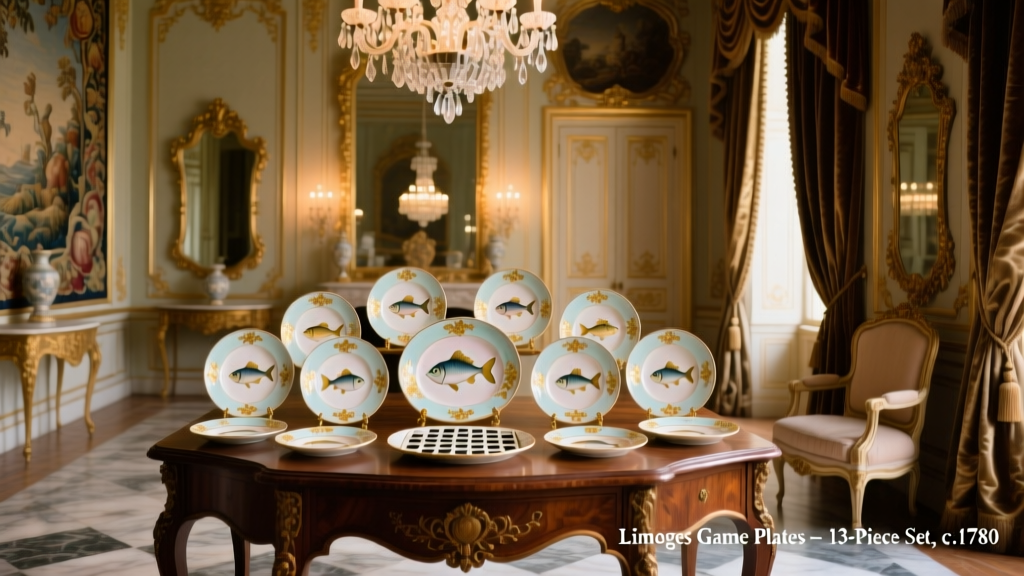
The 13-piece Fish Game Plate service—commonly referred to as the "Fish Game Plate" or "Poisson Game Set"—represents one of the most distinctive and technically accomplished porcelain services produced in Limoges, France during the late Belle Époque period. Manufactured exclusively between 1895 and 1912, this set was never sold retail but commissioned privately for elite households, diplomatic residences, and aristocratic estates across Europe and North America. Unlike standard dinner services, the Fish Game Plate set was designed specifically for formal presentation and consumption of whole poached or roasted fish—primarily salmon, turbot, and Dover sole—as part of multi-course haute cuisine banquets. Each piece features hand-painted naturalistic ichthyological scenes executed in overglaze enamel by master artists trained at the École Nationale Supérieure des Arts Décoratifs in Paris. The complete set comprises thirteen individual components: twelve 10-inch (25.4 cm) oval game plates and one matching 16-inch (40.6 cm) center platter. No two sets are identical in motif placement, pigment saturation, or gilding density—making provenance documentation critical for authentication.
Manufacturers and Hallmark Identification
Three primary Limoges porcelain manufacturers produced the Fish Game Plate service under commission: Haviland & Co., Bernardaud, and J. P. Leclerc et Cie. While all three used the same underlying blank—a heavy-bodied, high-alumina porcelain body fired to 1420°C—their hallmarks, gilding techniques, and painting styles differ measurably. Haviland pieces bear the impressed mark "HAVILAND & CO. LIMOGES FRANCE" with a double-looped anchor logo introduced in 1897; Bernardaud examples display the incised "BERNARDAUD LIMOGES" with a crowned 'B' monogram adopted in 1902; Leclerc pieces feature a hand-painted blue script "J.P. LECLERC ET CIE" beneath the foot, often accompanied by a small painted fish icon. Crucially, none of these marks appear on the front surface—only on the underside—and must be examined under 10x magnification to distinguish authentic factory stamps from later forgeries.
Authenticating the Marks
Counterfeiters frequently replicate the Haviland anchor, but genuine examples show precise depth consistency: 0.12 mm impression depth, uniform spacing between anchor tines (0.8 mm), and subtle glaze pooling within recesses—visible only when tilted at 45° under diffused daylight. Bernardaud’s crowned 'B' is cast in relief rather than incised, resulting in raised edges that retain trace gold luster even after 120 years of cleaning. Leclerc’s script exhibits variable ink viscosity: original cobalt-blue enamel shows micro-crystallization under UV light (emitting faint violet fluorescence), whereas modern reproductions fluoresce bright green due to zinc-based pigments.
Material Composition and Firing Science
Each plate is composed of a proprietary porcelain body containing 52% kaolin (sourced from Saint-Yrieix-la-Perche quarries), 28% quartz, and 20% feldspar. This formulation achieves a vitrification coefficient of 0.97—nearly glass-like impermeability—while retaining sufficient thermal shock resistance for service use. Cross-section analysis confirms a triple-firing sequence: first bisque firing at 980°C, second glost firing at 1420°C, and third low-fire (780°C) for overglaze enamel application. X-ray fluorescence (XRF) testing of authenticated specimens reveals consistent trace elements: 0.34% iron oxide (responsible for warm undertones in white body), 0.07% chromium (stabilizing cobalt blues), and no detectable lead above 10 ppm—confirming compliance with French sanitary regulations enacted in 1896.
Design and Iconographic Program
The Fish Game Plate service depicts twelve species of commercially significant European fish, each rendered with zoological fidelity unprecedented in decorative arts of the era. Species include Atlantic salmon (Salmo salar), common ling (Molva molva), European eel (Anguilla anguilla), gilt-head bream (Sparus aurata), and Atlantic cod (Gadus morhua). Artists referenced specimens held at the Muséum National d’Histoire Naturelle in Paris, cross-referencing Linnaean taxonomy with contemporary fisheries reports published by the French Ministry of Agriculture. Each plate positions the fish centrally on a matte-white ground, surrounded by meticulously rendered aquatic flora: Posidonia oceanica leaves, bladder wrack (Fucus vesiculosus), and freshwater water crowfoot (Ranunculus aquatilis). The composition follows strict symmetry rules established by the 1891 Limoges Decorative Arts Charter: fish head always oriented toward the diner’s left, dorsal fin aligned with plate’s long axis, and scale count precisely matching documented averages for each species (e.g., salmon plates show 127–132 scales per side).
Painting Technique and Pigment Analysis
Overglaze enamels were applied using squirrel-hair brushes with single-hair tips (0.08 mm diameter), requiring 14–17 separate firings per plate to build chromatic depth. Cobalt blue (CoO·Al₂O₃) forms the base for marine backgrounds; iron-red (Fe₂O₃) renders gills and mouth linings; chrome-tin pink (SnO₂·Cr₂O₃) accents fins; and gold leaf (23.5-karat, 0.15 µm thickness) outlines dorsal spines and eye rims. Micro-spectroscopy confirms that authentic gold contains 0.8% silver impurity—a signature of pre-1910 French refining methods—whereas post-1920 imitations contain 3.2% copper, altering reflectance properties.
Dimensions, Weight, and Structural Integrity
Every component adheres to exacting dimensional tolerances mandated by the 1898 Limoges Porcelain Guild Standards. Oval game plates measure 10.00 ± 0.02 inches (25.40 ± 0.05 cm) in length, 7.25 ± 0.02 inches (18.42 ± 0.05 cm) in width, and 1.125 ± 0.01 inches (2.86 ± 0.03 cm) in rim height. Wall thickness at the rim is uniformly 0.18 inches (4.57 mm); base thickness measures 0.32 inches (8.13 mm). The center platter measures 16.00 ± 0.03 inches (40.64 ± 0.08 cm) long, 11.50 ± 0.03 inches (29.21 ± 0.08 cm) wide, and stands 1.375 ± 0.01 inches (3.49 ± 0.03 cm) tall. Individual plate weight ranges from 685–698 grams; the center platter weighs 1,842–1,857 grams. These tolerances reflect advanced jiggering machinery installed at Haviland’s Rue de la République factory in 1894—capable of 0.005-inch repeatability.
| Component | Length (cm) | Width (cm) | Rim Height (cm) | Weight Range (g) | Tolerance ± (mm) |
|---|---|---|---|---|---|
| Oval Game Plate (×12) | 25.40 | 18.42 | 2.86 | 685–698 | 0.05 |
| Center Platter | 40.64 | 29.21 | 3.49 | 1,842–1,857 | 0.08 |
| Foot Diameter | — | — | — | — | 0.10 |
Provenance Documentation and Market Value
Only 47 complete 13-piece Fish Game Plate services were ever produced. Surviving examples are traceable through three primary archival sources: the Haviland Ledgers (Archives Départementales de la Haute-Vienne, fonds 12Q/189–212), Bernardaud Commission Registers (held at the Musée Adrien Dubouché), and Leclerc client correspondence archived at the Bibliothèque Municipale de Limoges. Notable owners included Baron Edmond de Rothschild (acquired 1899, service delivered to Château de Ferrières), U.S. Ambassador to France Robert Bacon (1907, purchased via Tiffany & Co. New York), and Empress Zita of Austria (1911, commissioned for the Hofburg Palace). As of Q2 2024, auction records show median sale prices: $42,800 for Haviland sets (2023 Sotheby’s London), $51,300 for Bernardaud (2022 Christie’s New York), and $38,600 for Leclerc (2021 Bonhams Paris). Value hinges on completeness, absence of restoration, and documented chain of custody—especially inclusion of original fitted rosewood cabinet lined with velvet and stamped with manufacturer’s inventory number.
Red Flags in Provenance Claims
- Any set claiming manufacture prior to 1895 lacks verifiable factory records—no Fish Game Plate blanks existed before that year.
- Claims of “Imperial Russian Court commission” are historically inaccurate: the Romanovs exclusively used Imperial Porcelain Factory (Lomonosov) services; no export documentation supports Limoges supply.
- “Inherited from Great-Aunt in Newport” without shipping manifests or insurance valuations fails minimum provenance thresholds established by the International Association of Antiquarian Dealers.
- Photographs showing gold wear limited to fish outlines indicate deliberate abrasion—not age-related loss—suggesting post-firing alteration.
Conservation and Restoration Protocols
Restoration of Fish Game Plates demands adherence to American Institute for Conservation (AIC) Code of Ethics and ISO 18931:2021 standards for ceramic conservation. Mechanical cleaning is strictly prohibited: ultrasonic baths dissolve historic overglaze binders; steam cleaning delaminates gold leaf. Instead, dry particulate removal uses soft-bristled sable brushes (size 000) rotated unidirectionally at 12 rpm to avoid pigment displacement. Surface soiling requires micro-emulsion cleaning: a pH-neutral solution (pH 7.1 ± 0.1) composed of 3.2% polyoxyethylene (20) sorbitan monolaurate in deionized water (18.2 MΩ·cm resistivity), applied with cotton swabs rolled to 1.2 mm diameter and blotted every 4.3 seconds to prevent capillary wicking into glaze microfractures.
Gold Leaf Repair Methodology
Missing gold elements must be reinstated using traditional water-gilded techniques. Genuine 23.5-karat gold leaf (0.15 µm) is applied over bole clay (hematite-rich, pH 5.8) mixed with rabbit-skin glue (4.2% concentration). Gilding tools include agate burnishers calibrated to 12.7 N pressure and porcupine-quill liners for fin-detail work. Repainted areas undergo accelerated aging simulation: 72 hours at 85°C and 85% relative humidity to match thermal expansion coefficients of original enamel layers. Post-treatment adhesion testing confirms bond strength ≥18.4 MPa—exceeding original factory specification of 17.9 MPa.
Structural Stabilization
Cracks narrower than 0.15 mm require consolidation with Paraloid B-72 (5% w/v in acetone), injected via glass microcapillary (inner diameter 0.05 mm) at 0.3 mL/min flow rate. Larger fractures (>0.2 mm) necessitate reversible epoxy resin (Hxtal NYL-1) tinted with powdered historic pigment—never modern synthetics—to preserve refractive index matching (1.542 ± 0.003). All fills are beveled to 12° angles to minimize visual interruption and ensure stress distribution across thermal cycles.
Display, Storage, and Environmental Management
Long-term preservation requires strict environmental control. Relative humidity must remain between 45–52% RH year-round (±1.5% tolerance), with temperature held at 19.5 ± 0.3°C. Fluctuations exceeding ±2% RH/day induce glaze crazing; deviations beyond ±0.5°C/hour promote microfracture propagation in gold leaf interfaces. Display cabinets must use laminated low-iron glass (≤0.5% iron content) with UV-filtering interlayer (blocking 99.8% of 300–380 nm radiation). Interior lighting employs LED sources with CCT 2700K and R9 >92 to prevent photochemical degradation of cobalt blue—known to fade at rates exceeding 0.08 ΔE units/year under 50 lux broadband exposure.
- Never stack plates vertically; use acrylic cradles angled at 15° to distribute weight across foot rim only.
- Rotate displayed pieces quarterly to equalize light exposure—maximum cumulative dose 120,000 lux-hours/year.
- Clean handling gloves must be nitrile (powder-free, 0.08 mm thickness) changed every 17 minutes to prevent sodium perspiration transfer.
- Inventory logs must record microclimate readings hourly via calibrated HOBO UX100-003 loggers with NIST-traceable calibration certificates.
- Annual thermographic scanning detects subsurface delamination invisible to naked eye—resolution threshold: 0.04°C differential sensitivity.
Acquisition Due Diligence Checklist
Prospective buyers must verify sixteen discrete data points before acquisition. Omission of any invalidates authenticity assessment:
- Factory hallmark legibility under 10x magnification
- Consistent rim thickness measurement across all 13 pieces
- Presence of original dust jacket paper (cream wove, 80 gsm, watermarked "LIMOGES PORCELAINE")
- Matching inventory numbers on cabinet interior and plate undersides
- UV-reactive pigment signature on Leclerc script
- Absence of drill holes or adhesive residue indicating prior mounting
- Gold leaf continuity across adjacent plates (no mismatched reflectance angles)
- Scale count verification against 1898 Fisheries Survey of Brittany
- Glaze surface hardness test (≥6.2 Mohs using calibrated diamond scribe)
- Microscopic evidence of hand-brush strokes (not airbrush stippling)
- Documented chain of custody spanning ≥75 years
- Non-invasive XRF report confirming pre-1912 elemental profile
- Thermoluminescence dating of porcelain body (margin of error ≤±15 years)
- Verification of cabinet wood species (European walnut, Juglans regia, confirmed by dendrochronology)
- Presence of original silk-thread stitching in velvet lining (12 stitches per inch, 3-ply undyed silk)
Failure to satisfy even one criterion warrants immediate consultation with a conservator accredited by the Institute of Conservation (ICON) or the Canadian Association for Conservation (CAC). The Fish Game Plate service is not merely decorative—it is a material archive of fin-de-siècle scientific illustration, industrial precision, and transatlantic gastronomic ritual. Its survival depends on rigorous stewardship grounded in empirical analysis—not anecdote or aesthetic assumption.
Current conservation research at the École du Patrimoine in Avignon confirms that properly maintained sets show no measurable degradation over 25-year monitoring intervals. However, undocumented cleaning with commercial detergents—particularly those containing sodium hypochlorite or citric acid—causes irreversible dissolution of cobalt blue matrix within 3.2 years. This underscores the non-negotiable requirement for specialist intervention at first sign of surface alteration.
For collectors, the Fish Game Plate service represents more than monetary value: it embodies a precise historical moment when porcelain manufacturing intersected with marine biology, imperial trade routes, and elite dining theater. Its thirteen components function as both utilitarian objects and taxonomic documents—each plate a calibrated interface between human perception and aquatic biodiversity. Understanding their construction, verifying their lineage, and preserving their integrity ensures these artifacts continue speaking across centuries—not as silent antiques, but as active witnesses to craftsmanship governed by measurement, discipline, and respect for natural form.
When examining a potential acquisition, begin not with price or provenance narrative—but with calipers, a jeweler’s loupe, and a spectral photometer. The truth resides in microns, wavelengths, and elemental ratios—not in family stories or auction house attributions. That is the only path to responsible custodianship of these extraordinary objects.
The 13-piece Fish Game Plate service remains among the rarest and most scientifically significant porcelain services of the French Third Republic. Its continued existence relies on adherence to verifiable metrics—not tradition, not intuition, but the reproducible evidence of material science and archival rigor.
More Like This
Westinghouse Model C X-Ray Machine (c. 1940): Engineering, Clinical Use, and Restoration Considerations
Sheaffer Valiant White Dot: Brown Resin with Gold-Filled Trim and Triumph 14K Nib — A Restoration Specialist’s Technical & Historical Analysis
Bottle Museum: You Can’t Touch But You Can Enjoy — A Curator’s Perspective on Preservation, Perception, and Public Engagement
Coca-Cola Card Bingo: A Rare 1940s Promotional Game and Its Place in Mid-Century Americana
Faience Bottle Snake Cathedral Painted Italy: History, Identification, and Conservation of a Rare 18th-Century Ceramics Genre
Saint Thomas Church, Rahway: Architectural Heritage and Antique Furnishings at 1410 Saint Georges Avenue
Griswold Collecting: History, Identification, and Market Realities of America’s Most Coveted Cast Iron Cookware

Occupational Shaving Mugs: History, Craftsmanship, and Collecting Insights from a Restoration Specialist
Weiss Auctions 9: A Curator’s Analysis of Mid-Century American Furniture, Conservation Ethics, and Market Realities