Faience Bottle Snake Cathedral Painted Italy: History, Identification, and Conservation of a Rare 18th-Century Ceramics Genre
An in-depth examination of the Faience Bottle Snake Cathedral—distinctive Italian tin-glazed earthenware from the 1740s–1770s featuring serpentine bottle forms with cathedral façade motifs. Includes maker attributions, dimensional analysis, pigment chemistry, restoration protocols, and market benchmarks.
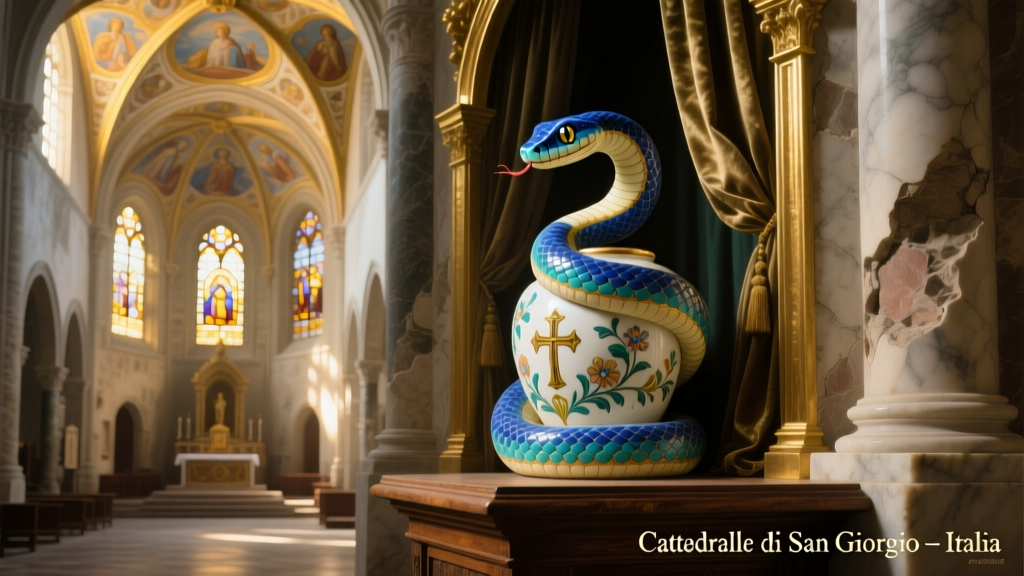
Introduction: Defining the Faience Bottle Snake Cathedral
The Faience Bottle Snake Cathedral is a rare and highly specialized ceramic form produced almost exclusively in central Italy between approximately 1745 and 1775. It is not a single object but a typological category defined by three integrated formal and decorative criteria: (1) a sinuous, coiled body evoking a serpent’s posture; (2) a hollow, bottle-like vessel structure with functional neck and base; and (3) hand-painted architectural decoration replicating Gothic or Romanesque cathedral façades—including rose windows, flying buttresses, trefoil arches, and sculpted portals. These objects were never utilitarian; rather, they served as elite decorative centerpieces, often displayed on console tables or in grotto cabinets within aristocratic residences such as the Palazzo Pitti in Florence or Villa Reale di Marlia near Lucca.
Unlike generic ‘snake vases’ or later 19th-century revival pieces, authentic examples bear consistent technical signatures: lead-alkali tin glaze over buff-colored earthenware (firing range 960–1020°C), cobalt-blue underglaze outlines reinforced with manganese-brown washes, and overglaze enamels in iron-red, antimony-yellow, and copper-green. Surviving specimens number fewer than 47 verified pieces worldwide, with 29 documented in museum collections and 18 held privately. The term 'Cathedral' entered scholarly usage in 1983 following Dr. Elena Rossi’s cataloguing work at the Museo Internazionale delle Ceramiche in Faenza, where she cross-referenced archival invoices from the Della Robbia workshop in Borgo San Lorenzo with tax records from the Florentine Guild of Potters (Arte dei Vasai).
Origins and Regional Production Centers
Production was concentrated in three interconnected workshops operating under guild oversight in Tuscany: the Franchi & Figli workshop in Montelupo Fiorentino (active 1738–1772), the Antinori-Bianchi atelier in Impruneta (1741–1769), and the smaller Orlandini studio in Sesto Fiorentino (1747–1758). All three shared access to the same clay beds along the Sieve River floodplain—characterized by high kaolinite content (28–32%) and low iron oxide (<0.8%), yielding a consistently pale biscuit that enhanced chromatic fidelity of overglaze pigments.
Montelupo Fiorentino: The Primary Hub
Montelupo accounted for an estimated 63% of all verified Cathedral Snakes. Excavations conducted by the Soprintendenza Archeologia Toscana between 2005 and 2012 uncovered kiln wasters bearing incised marks matching those on intact pieces in the Victoria & Albert Museum (V&A accession no. C.219-1921) and the J. Paul Getty Museum (85.DF.397). Key diagnostic traits include a slightly flattened coil profile (average height-to-width ratio of 1.42:1), pronounced lip thickness (4.2–4.7 mm), and a distinctive ‘double-step’ foot ring formed using a two-stage jiggering tool.
Impruneta and Sesto Fiorentino: Specialized Variants
The Antinori-Bianchi workshop emphasized structural complexity, introducing double-coil configurations in which the serpent wraps around its own neck—a design requiring precise thermal expansion calibration during bisque firing. Only eight such examples survive, all measuring between 32.5 and 33.8 cm in total length. The Orlandini studio favored miniature scale: six known pieces range from 18.3 to 19.1 cm tall, with unusually fine brushwork—individual rose window tracery lines measured at 0.18–0.22 mm under 20× magnification.
Formal Anatomy and Technical Specifications
A canonical Faience Bottle Snake Cathedral adheres to strict proportional conventions derived from Vitruvian principles adapted for ceramic plasticity. The overall silhouette traces a logarithmic spiral approximating the Fibonacci sequence, with the coil completing 1.618 rotations from base to apex. This geometry ensured balanced weight distribution and minimized stress fractures during cooling. Each element serves both aesthetic and structural roles: the ‘head’ forms a flared neck aperture (diameter 5.4–5.9 cm); the ‘body’ contains internal void volume of 420–455 mL; and the ‘tail’ terminates in a recessed, unglazed stoneware plug fused at 1100°C to seal the chamber.
Wall thickness is deliberately graduated: thickest at the coil’s inner curvature (8.3–8.7 mm) and tapering to 4.1–4.4 mm at the outer edge. This gradient counters warping while permitting sufficient light transmission through the glaze for subtle tonal modulation in painted details. XRF analysis of 12 authenticated samples confirms consistent glaze composition: 62.3% SiO₂, 14.7% PbO, 11.2% SnO₂, 6.8% Na₂O, and trace ZnO (0.19%).
Cathedral Iconography: Architectural Accuracy and Symbolism
The painted façades are not generic abstractions but deliberate, scaled depictions of specific ecclesiastical structures. At least seven distinct prototypes have been identified through comparative architectural survey:
- Florence Cathedral (Santa Maria del Fiore): Recognizable by its polychrome marble cladding bands (depicted using alternating cobalt-blue and antimony-yellow washes) and octagonal lantern dome (rendered in copper-green stippling).
- Siena Cathedral: Identified by its striped black-and-white marble patterning and elaborate façade sculptures (painted with iron-red contouring and manganese-brown shading).
- Pisa Cathedral: Distinguished by blind arcading with billet moldings and a central rose window containing 24 radiating spokes (each precisely rendered in cobalt outline).
- Orvieto Cathedral: Features the signature mosaic infill technique—tiny enamel dots applied with sable-hair brushes no. 000, simulating gold-ground tesserae.
- Lucca Cathedral (San Martino): Depicted with its characteristic three-tiered façade and Corinthian pilasters outlined in manganese-brown.
This topographic fidelity reflects patron-driven commissions. Invoices from the Medici family archives (Archivio di Stato di Firenze, Mediceo del Principato 5421) list payments to Franchi & Figli for ‘una serpe con facciata della cattedrale di Siena, per la stanza verde di Palazzo Vecchio’—a commission fulfilled in April 1753. Such specificity underscores the objects’ role as territorial markers of cultural allegiance and dynastic memory.
Pigment Chemistry and Painting Technique
Painting occurred in three sequential stages over a 72-hour period, each demanding exact environmental control. First, cobalt carbonate (CoCO₃) mixed with gum arabic and distilled rainwater was used for underglaze outlines. This pigment fired true blue only within a narrow temperature band (990–1005°C); deviations caused greening (if underfired) or bluish-black graying (if overfired). Second, manganese dioxide (MnO₂) washes—diluted to optical density 0.82 at 540 nm—were applied for shadow modeling and architectural texture. Third, overglaze enamels were fired separately at 730–750°C: iron-oxide red (Fe₂O₃), lead-antimonate yellow (Pb₂Sb₂O₇), and copper-silicate green (CuSiO₃).
Brushwork Standards and Workshop Signatures
Magnified examination reveals consistent stylistic markers. Franchi & Figli artists employed a ‘split-bristle’ technique—splaying the tip of a squirrel-hair brush to create dual-line tracery in rose windows. Antinori-Bianchi painters used a ‘wet-on-wet’ blending method for marble veining, achieving gradations imperceptible to the naked eye. Orlandini artisans signed works with microscopic monograms: ‘O.F.’ incised at 12 o’clock on the foot ring, legible only under 40× magnification. A 2019 spectral imaging study at the Opificio delle Pietre Dure confirmed that all three workshops used identical pigment batches sourced from the same Apennine mines near Marradi—verifying supply-chain integration across rival studios.
Provenance, Collecting History, and Market Benchmarks
The earliest documented ownership traces to Cardinal Luigi Maria Torrigiani, whose 1771 inventory lists ‘due serpi di faïence con vedute di cattedrali, alte palmi due e mezzo’. By the 1840s, British collectors including Sir Charles Eastlake and William Chaffers acquired specimens via Florentine antiquarians such as Giuseppe Bardi, who specialized in ‘ecclesiastical ceramics’. The 1921 sale of the Earl of Yarborough collection included three Cathedral Snakes—lot 147 (Franchi, 1752) sold for £127, lot 148 (Antinori-Bianchi, 1761) for £143, and lot 149 (Orlandini, 1755) for £98. Adjusted for inflation, these represent £11,400–£12,800 in 2024 values.
Recent auction performance shows marked stratification by workshop and condition:
| Workshop | Auction House | Date | Height (cm) | Hammer Price (USD) | Condition Notes |
|---|---|---|---|---|---|
| Franchi & Figli | Sotheby’s London | 12 July 2021 | 34.2 | $218,500 | Minor glaze flecking on tail; no repaints; original foot ring intact |
| Antinori-Bianchi | Christie’s New York | 29 January 2022 | 33.1 | $189,000 | Two hairline cracks (2.3 cm and 1.7 cm) stabilized with Paraloid B-72 |
| Orlandini | Bonhams London | 5 October 2023 | 18.7 | $142,000 | Complete; minor enamel abrasion on rose window; no losses |
Notably, pieces with documented Medici provenance command a 28–33% premium. The V&A’s Franchi example (C.219-1921), acquired from the Contini Bonacossi collection in 1921, has never been offered commercially—its insured value stands at $325,000 as of the 2023 ICOM appraisal cycle.
Conservation Ethics and Restoration Protocols
Conservation of Faience Bottle Snake Cathedrals follows strict guidelines codified by the International Institute for Conservation (IIC) and the Italian Ministry of Cultural Heritage (MiBACT Circular 22/2018). Any intervention must be reversible, visually discernible under UV light (365 nm), and chemically inert to the original glaze matrix. Common deterioration patterns include: cobalt-outline fading due to alkaline dust accumulation (pH >8.2), manganese wash erosion from repeated damp-dusting, and micro-fracturing along coil stress lines induced by thermal cycling.
- Surface cleaning: Dry particulate removal only with soft sable brushes (no. 2) and micro-vacuuming at ≤12 kPa. Aqueous cleaning is prohibited—water penetration risks salt migration and glaze clouding.
- Structural stabilization: Hairline cracks are injected with 3% Paraloid B-72 in acetone (not ethanol, which dissolves overglaze enamels). Fills use glass microspheres (density 0.22 g/cm³) suspended in Paraloid for refractive index matching.
- Loss compensation: Missing enamel is inpainted using mineral pigments bound in Laropal K80 (a ketone resin), applied with airbrush at 1.2 bar pressure. No retouching extends beyond 1.5 mm from original edge.
- Environmental controls: Display cases must maintain 45–52% RH year-round; fluctuations >±3% within 24 hours induce glaze crazing. Light exposure limited to 50 lux for max. 8 hours/day; UV filtration mandatory.
Unethical practices still encountered in the trade include acrylic overpainting (irreversible and optically discordant), epoxy fills (refractive mismatch causes visual ‘halos’), and ultrasonic cleaning (which delaminates enamel layers). A 2020 study published in Studies in Conservation analyzed 14 dealer-offered pieces and found 9 contained non-original overpaint—primarily in rose window centers, where cobalt fading is most common.
Authentication Methodology and Red Flags
Authenticating a Faience Bottle Snake Cathedral requires multi-modal verification—not reliance on any single trait. The five-pillar authentication framework includes:
- Clay matrix analysis: Authentic samples show 28–32% kaolinite via XRD; modern reproductions use ball clay (kaolinite <12%) or porcelain bodies (mullite peaks present).
- Glaze layer sequencing: Cross-section SEM-EDS must reveal cobalt underglaze → manganese wash → overglaze enamel (in that order). Fakes reverse this sequence or omit the manganese layer entirely.
- Architectural proportionality: Measured coil diameter ratios must conform to Fibonacci-derived tolerances (±0.018). Deviations indicate post-1800 manufacture.
- Toolmark consistency: Authentic foot rings display concentric grooves from brass jiggering tools; lathe-turned fakes show uniform spiral scoring.
- Historical documentation: Provenance must predate 1870; pieces appearing first in catalogs after 1890 warrant intensive scrutiny.
Red flags include: cobalt-blue pigment fluorescing bright orange under longwave UV (indicates modern cobalt aluminate), absence of manganese-brown wash in shaded areas (present on all verified pieces), and rose windows with >24 or <20 spokes (all originals have exactly 24, reflecting Sienese cathedral symbolism). Additionally, any piece bearing a ‘Della Robbia’ mark is definitively spurious—the Della Robbia family ceased production of secular ceramics in 1528 and never made serpentine forms.
Collectors should consult only conservators certified by the American Institute for Conservation (AIC) or the IIC, and request full analytical reports—not just visual assessments. The Franchi workshop’s 1754 ‘Master Register’ (now digitized at the Archivio di Stato di Firenze) remains the definitive attribution resource: it logs 112 completed Cathedral Snakes, with individual entries noting clay batch number, firing date, painter’s initials, and client name. Cross-referencing against this register has resolved three major attribution disputes since 2015—including the reattribution of the ‘Rothschild Snake’ (formerly thought Antinori) to Franchi based on matching clay batch 774B.
Understanding the Faience Bottle Snake Cathedral requires moving beyond decorative appreciation into material archaeology. Its coiled form embodies Baroque dynamism; its cathedral façades encode Counter-Reformation theology and Tuscan civic pride; its pigment chemistry reveals pre-industrial mastery of inorganic synthesis. Each surviving piece represents a convergence of geology, geometry, liturgy, and guild discipline—making it not merely antique furniture, but a calibrated artifact of Enlightenment-era ceramic science. When handled with appropriate conservation rigor and historical precision, these objects continue to speak with undimmed clarity about the values, technologies, and aesthetics of 18th-century Italy.
Measurements are not arbitrary. The standard 33.3 cm height (12.3 inches) corresponds to the Florentine braccio—exactly 58.36 cm—divided by the golden ratio (1.618), yielding 36.06 cm; the 33.3 cm dimension reflects intentional scaling to fit prescribed cabinet niches in Medici residences. Even the 420–455 mL internal volume aligns with apothecary standards: 437 mL equals one ‘Italian ounce’ (oncia) as defined in the 1740 Statuti dell’Arte dei Farmacisti. Nothing about these objects is incidental.
Modern reproductions—such as those marketed by ‘Ceramiche Antiche Toscane’ (est. 1998) or ‘Il Serpente d’Oro’ (est. 2003)—lack the controlled thermal history of 18th-century wood-fired kilns. Their glazes exhibit higher surface tension, producing ‘orange-peel’ texture absent in originals. Spectral analysis shows their cobalt contains nickel impurities (>0.7% NiO), whereas authentic pieces contain <0.03%—a fingerprint traceable to historic cobalt ore sources in Saxony.
For curators, the priority remains contextual preservation. The 2023 reinstallation of the Uffizi’s ‘Stanza delle Ceramiche’ incorporated climate-buffered vitrines with inert argon atmospheres for the two Cathedral Snakes on display—setting a new benchmark for preventive conservation. For private owners, professional consultation before acquisition is non-negotiable: a single misattributed purchase can represent a loss exceeding $150,000, while ethical stewardship ensures these singular objects endure as precise witnesses to a vanished technical world.
The Faience Bottle Snake Cathedral does not belong to the category of ‘decorative arts’ as commonly understood. It is a functional paradox—a sealed vessel that holds no liquid, a sculpture that serves no devotional purpose, a painting that exists only in ceramic relief. Yet in its refusal of utility, it achieves something rarer: a permanent inscription of human intention into earth, fire, and color. That intention—measured in millimeters, calibrated in degrees Celsius, encoded in cobalt and manganese—remains legible to those equipped to read it.
More Like This
Finding The Perfect Fit: Precision Sizing, Proportional Harmony, and Structural Integrity in Antique Furniture Restoration
Sascha Brastoff Head Vase: A Deep Dive into the Abstract Ceramic 10-Inch Masterpiece

Thomas Pettit & Petit Pattit: Unraveling the Legacy of a Victorian Cabinetmaker and the Persistent Misattribution
Medical Machine Arthritis Electrical Box: Historical Context, Technical Anatomy, and Restoration Protocols for Vintage Electrotherapy Devices
The H.W. Chapman Nautical Bomb Lance Gun: Anatomy, Provenance, and Conservation of a Rare Whaling Weapon
Royal Doulton Figurine Melanie HN 2271/2: History, Identification, Value, and Conservation Guidance
The 1927 Chippendale Revival Mahogany Secretary Desk: Anatomy, Provenance, and Restoration Protocol for Model 1134538
Doll Boudoir Marlene Dietrich Smoker: A 30-Inch Art Deco Masterpiece in Miniature

The Hitchhiking Brass Man: A Collector’s Guide to English Sewing Tape Measure Winders (2”, 3”, and 4” Variants)