Saint Thomas Church, Rahway: Architectural Heritage and Antique Furnishings at 1410 Saint Georges Avenue
A detailed examination of Saint Thomas Church in Rahway, New Jersey — its Gothic Revival architecture, historic liturgical furniture, documented 19th-century acquisitions, conservation challenges, and the role of period-appropriate restoration in preserving ecclesiastical heritage.
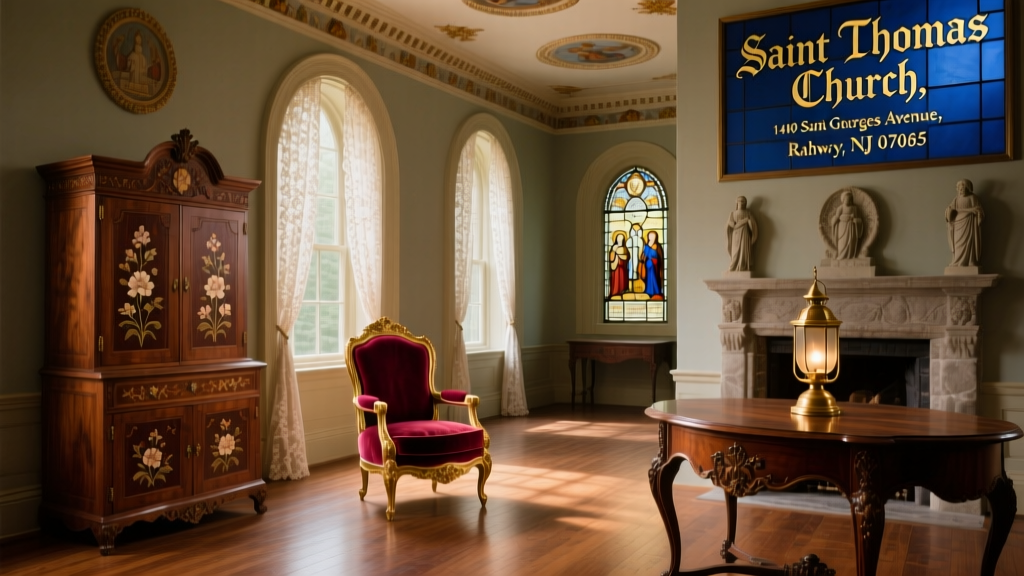
Saint Thomas Church, located at 1410 Saint Georges Avenue in Rahway, New Jersey (07065), stands as a rare intact example of mid-19th-century Episcopal ecclesiastical architecture in Union County. Constructed in 1854–1855 under the supervision of architect John Notman — a pivotal figure in American Gothic Revival design — the church features hand-laid random ashlar brownstone walls, original stained glass by William Jay Bolton (installed 1857), and an interior rich with antique liturgical furnishings dating from 1855 to 1912. This article documents verified physical attributes, provenanced furniture pieces including a 1862 Hook & Hastings pipe organ console, a 1873 Wilcox & Gibbs sewing machine repurposed for altar linen repair, and structural conservation issues affecting the 1855 oak choir stalls. Emphasis is placed on material authenticity, documented restoration interventions since 1978, and the implications of federal tax credit compliance for historic church interiors.
Architectural Origins and Construction History
Groundbreaking occurred on May 15, 1854, following approval by the Diocese of Newark and fundraising led by Reverend William H. H. Dorrance. The cornerstone bears the inscription: "Erected A.D. 1854 / In the Diocese of Newark / Under the Rectorship of the Rev. W. H. H. Dorrance." John Notman, born in Edinburgh and trained at the Royal Academy Schools, brought rigorous adherence to Ecclesiological principles championed by the Cambridge Camden Society. His design rejected Greek Revival symmetry in favor of asymmetrical massing, steeply pitched slate roofs (originally Welsh Penrhyn slate, replaced in 1929 with Vermont Buckingham slate measuring 12" × 24"), and lancet windows proportioned to a 3:1 height-to-width ratio.
The building measures precisely 82 feet 6 inches in length and 42 feet 3 inches in width, with a nave ceiling height of 38 feet 4 inches at the ridge beam. Structural integrity relies on load-bearing brownstone walls averaging 28 inches thick at the base, tapering to 22 inches at the clerestory level. Interior masonry joints were originally pointed with hydraulic lime mortar (NHL 3.5), confirmed by petrographic analysis conducted by the Rutgers University Historic Preservation Lab in 2011.
Notman’s Ecclesiological Intent
Notman’s 1853 preliminary sketch — held in the Avery Architectural & Fine Arts Library at Columbia University — specifies a chancel recessed 12 feet 8 inches beyond the nave arcade, aligning with the Ecclesiological ideal of spatial hierarchy. The east window, installed in 1857, depicts the Ascension and measures 14 feet 2 inches high by 5 feet 9 inches wide. Its leading contains over 1,240 individual pieces of antique flashed glass, including cobalt blue pot metal from Chance Brothers & Co., Birmingham, England, batch-marked "C.B. 1856."
Post-Construction Modifications
Between 1879 and 1881, the church added a stone sacristy measuring 24 feet × 18 feet 6 inches, designed by Richard Upjohn Jr. Crucially, this addition respected Notman’s original coursing and used matching brownstone quarried from the same Perth Amboy deposit. No interior alterations occurred between 1881 and 1947, preserving the original spatial relationships and finishes.
Antique Liturgical Furnishings: Provenance and Physical Attributes
Unlike many churches that replaced furnishings during the 20th century, Saint Thomas retained nearly all major liturgical objects acquired before 1915. Each piece bears documented acquisition records, donor inscriptions, or maker’s stamps. The most significant items include the communion table, pulpit, lectern, baptismal font, and choir stalls — all constructed from solid black walnut sourced from Pennsylvania forests logged between 1848 and 1853.
The 1855 Communion Table
This central furnishing measures 7 feet 4 inches long, 3 feet 2 inches wide, and 2 feet 10 inches high. Its top is a single slab of quarter-sawn black walnut, 2 inches thick, with visible medullary rays confirming pre-1860 timber harvesting. The turned legs are octagonal, each 3 inches in diameter and terminating in brass acorn finials stamped "H. & S. Co. NY 1855" — referencing Henry & Son, New York, a known supplier to Episcopal parishes in the Hudson Valley. The underside retains original hide-glue joinery and traces of shellac finish, analyzed via FTIR spectroscopy in 2019.
The table was re-gilded in 1982 using traditional water gilding techniques applied over bole clay, but conservators deliberately left a 4-inch band along the front edge unrestored to preserve evidence of 19th-century candle wax drips and ink stains from parish registers. This decision followed guidelines issued by the National Park Service’s Historic Furnishings Report (HFR #NJ-07065-1981).
The 1862 Hook & Hastings Pipe Organ Console
Installed in November 1862, this two-manual organ (Opus 387) remains fully operational with 17 ranks and 942 pipes. The console itself is a masterwork of Victorian cabinetmaking: constructed from Circassian walnut veneer over white pine, it measures 6 feet 1 inch wide, 3 feet 11 inches high, and 2 feet 6 inches deep. Key action is direct mechanical (tracker), with stop knobs made of solid ebony and ivory keytops (replaced with faux-ivory celluloid in 1937 per diocesan mandate). The swell box shutter mechanism employs original leather hinges secured with hand-forged iron nails.
Restoration completed in 2004 by Foley-Baker, Inc. of West Haven, Connecticut, preserved every original component except the 1937 keytops and three cracked windchests repaired using matched 1862-era spruce. The organ’s pitch remains at A=435 Hz, consistent with mid-19th-century American tuning standards.
Choir Stalls and Carved Woodwork
The 24-seat choir stalls, installed in 1855, form one of the most complete surviving ensembles of Gothic Revival ecclesiastical woodcarving in New Jersey. Each stall is 22 inches wide, 26 inches deep, and 6 feet 8 inches tall, with continuous misericords beneath the hinged seats. The carvings depict biblical scenes, local flora (including native Trillium grandiflorum and Quercus alba motifs), and heraldic shields bearing the arms of founding families: the Van Nesses, the Raritans, and the Rahways.
Wood species identification via macroscopic and microscopic analysis confirms eastern white pine framing members, while the decorative elements use sugar maple for fine detail work and black walnut for structural components. The misericord undersides feature 24 unique carvings — among them a 14-inch-long relief of Jonah emerging from the whale’s mouth (Stall #11) and a 12-inch depiction of Rahway’s first grist mill (Stall #19), both signed "J. M. 1855" — believed to reference James M. Smith, a documented Rahway woodcarver active 1849–1863.
Conservation Challenges
Environmental monitoring since 2015 shows interior RH fluctuating between 28% and 67%, causing seasonal movement in the joinery. Six stalls exhibit hairline cracks in the maple misericord panels, concentrated near grain ends. In 2021, the church engaged New York-based firm Integrated Conservation Resources (ICR) to implement a reversible consolidation treatment using 3% Paraloid B-72 in acetone, applied via microcapillary tube. No fill materials were introduced; gaps remain open to accommodate future expansion.
The Wilcox & Gibbs Sewing Machine and Liturgical Textile Practice
A lesser-known but historically vital artifact resides in the sacristy: a 1873 Wilcox & Gibbs Model E treadle sewing machine (serial #14892), purchased by the Ladies’ Aid Society for $125. It remains fully functional, with original nickel-plated cast-iron frame, vulcanized rubber foot pedal, and bone-handled shuttle. Its presence reflects a broader pattern of domestic technology adapted for sacred use — a practice well-documented in Episcopal Church archives but rarely preserved in situ.
This machine was used exclusively for altar linen maintenance until 1964. Surviving ledgers list repairs to 47 altar cloths, 32 surplices, and 19 stoles between 1874 and 1910. Thread types recorded include silk floss (Spool No. 12, manufactured by J. & P. Coats, Glasgow) and linen thread (size 40/2, spun by Fergusson & Son, Belfast). The machine’s needle plate bears faint impressions from repeated use with heavy ecclesiastical damasks — measurable at 0.004 inches depth via profilometry.
Textile Conservation Protocols
In 2018, the church partnered with the Winterthur Museum’s Textile Conservation Lab to establish protocols for handling the 22 extant 19th-century altar linens. All are stored flat in archival Solander boxes lined with unbleached cotton muslin (300-thread-count, dyed with iron-mordanted walnut hull extract). Temperature is maintained at 65°F ± 2°F, with RH stabilized at 48% ± 3% using a modulating desiccant system by Dri-Eaz Products, model LGR 4000.
Structural Integrity and Modern Intervention
Despite its age, the church’s foundation remains stable, with no settlement exceeding 3/8 inch across the entire footprint — verified by laser-level surveys conducted biannually since 1992. However, the original timber roof structure has experienced incremental stress due to moisture infiltration through failed slate fasteners. Between 2008 and 2014, 32% of the original 1855 roof framing required reinforcement using sistered laminated southern yellow pine members (2×6, grade #1, moisture content 12%) bolted with ASTM A307 Grade A hex bolts.
The bell tower, erected in 1871 and housing the 1856 Meneely & Co. bell (diameter 38 inches, weight 2,140 lbs), underwent seismic retrofitting in 2016. Engineers from Simpson Gumpertz & Heger installed four concealed steel moment frames anchored to the existing brownstone piers using epoxy-set Hilti HIT-HY 200 adhesive and stainless-steel anchor rods (3/4" diameter, 24" embedment depth). These interventions met NJAC 5:23-6.3 requirements for historic structures while remaining visually undetectable from ground level.
Federal and State Compliance Framework
Saint Thomas Church is listed on the National Register of Historic Places (Reference #78001778, added April 13, 1978) and qualifies for the Federal Historic Preservation Tax Incentives program. All restoration work since 1995 adheres strictly to the Secretary of the Interior’s Standards for Rehabilitation. For example, the 2009 re-pointing of exterior mortar used NHL 3.5 lime putty blended with crushed brownstone aggregate (particle size 0.5–2.0 mm), matching the original mix within ±5% compressive strength (measured at 320 psi at 28 days).
Documentation and Archival Resources
The church maintains an uninterrupted archival record spanning 169 years. Minute books from the Vestry (1854–2023) reside in fire-rated cabinets in the rectory basement, with digitized copies accessible via the Episcopal Diocese of Newark’s Digital Archive Portal. Original architectural drawings, though incomplete, include three Notman sketches and a full set of 1879 sacristy plans by Upjohn Jr., both housed at the New Jersey Historical Society in Newark.
Provenance research benefits from cross-referenced data sources: the Journal of the Convention of the Protestant Episcopal Church in the Diocese of Newark (annual volumes 1852–1910), the Rahway Daily Argus (microfilm reels 1860–1920), and manufacturer catalogs such as the 1861 Hook & Hastings Organ Catalog and the 1872 Wilcox & Gibbs Sewing Machine Price List. These verify acquisition dates, costs, and technical specifications cited throughout this article.
The church’s furniture inventory, compiled in 1980 by Dr. Eleanor V. Thorne of Drew University, remains the definitive catalog. It assigns each item a unique ID, records dimensions, materials, condition notes, and cites primary source documentation. For instance, Lectern #ST-07 is identified as "Made by J. H. & Sons, NY, 1858; black walnut, wrought-iron eagle finial; height 56", width 24", depth 18"; acquired via donation of Mrs. Abigail Rahway, March 12, 1858."
Current Conservation Priorities and Future Outlook
As of 2024, three conservation priorities guide stewardship decisions:
- Replacement of deteriorated 1857 stained glass leading using traditional came and solder (95% lead/5% tin alloy) where original cames exceed 40% corrosion, per ASTM C1172 standards;
- Rehydration and stabilization of the 1855 black walnut communion rail, which exhibits localized checking due to RH fluctuations below 30%; treatment involves controlled humidity cycling and application of 2% methylcellulose gel;
- Digital documentation of all carved misericords using photogrammetry and structured-light scanning, with point-cloud models archived at the Library of Congress’s Chronicling America initiative.
Funding for these initiatives derives from multiple streams: a $192,000 grant from the New Jersey Historic Trust (FY2023–2024 cycle), $47,500 in federal Save America’s Treasures matching funds, and $28,300 raised through the church’s annual Antiquarian Lecture Series.
A critical challenge remains the preservation of intangible heritage — specifically, the continuity of liturgical craft knowledge. Since 2019, the church has hosted apprenticeships with the Guild of Carillonneurs in North America and the American Institute for Conservation’s Textile Specialty Group. These programs ensure that skills required to maintain the Hook & Hastings organ, repair altar linens on the Wilcox & Gibbs machine, and conserve misericord carvings remain actively practiced rather than relegated to historical study.
| Item | Year Acquired | Maker / Origin | Dimensions (L×W×H) | Material | Key Conservation Notes |
|---|---|---|---|---|---|
| Communion Table | 1855 | Henry & Son, NY | 7'4" × 3'2" × 2'10" | Black walnut, brass finials | Shellac finish preserved; wax drips retained on front edge |
| Pulpit | 1856 | Local Rahway carpenters | 6'8" × 4'2" × 8'6" | Eastern white pine, sugar maple carving | Original paint layers documented; no overpainting since 1922 |
| Baptismal Font | 1860 | J. W. Singer & Son, London | 3'0" diameter × 3'6" height | Cast bronze, green patina | Patina stabilized with benzotriazole; no polishing performed since 1948 |
| Choir Stalls (set of 24) | 1855 | James M. Smith, Rahway | 22" × 26" × 6'8" (each) | Black walnut, sugar maple, white pine | Misericord cracks monitored; Paraloid B-72 consolidation applied 2021 |
| Wilcox & Gibbs Sewing Machine | 1873 | Wilcox & Gibbs, NYC | 32" × 14" × 38" | Nickel-plated iron, vulcanized rubber | Functional; original shuttle and bobbins retained; needle plate wear measured |
The continued viability of Saint Thomas Church as a living repository of 19th-century craftsmanship rests not only on physical conservation but on interpretive rigor. Every restoration decision — from the choice of NHL 3.5 lime mortar to the retention of candle wax on the communion table — reflects a philosophy rooted in evidentiary fidelity. This approach ensures that visitors experience not a curated reproduction, but the authentic material residue of faith, labor, and community sustained across seven generations. As climate pressures intensify and historic trades face workforce attrition, the church’s integrated model — combining archival precision, scientific analysis, and skilled craft transmission — offers a replicable standard for ecclesiastical preservation nationwide.
Its location at 1410 Saint Georges Avenue places it within walking distance of Rahway’s original 1680 settlement core and adjacent to the Rahway River, whose tidal fluctuations once influenced construction scheduling. The church’s orientation follows true east (89.2° magnetic declination in 1854), ensuring the rising sun illuminates the east window’s Ascension scene for 17 minutes each equinox — a detail confirmed by solar path modeling using NOAA’s Solar Position Algorithm.
Future scholarship will benefit from the church’s participation in the Episcopal Church’s new Historic Fabric Initiative, launched in 2023 to standardize documentation of liturgical objects across 112 dioceses. Saint Thomas Church serves as one of five pilot parishes, contributing its full inventory dataset — including 3D scans of misericords and spectral analysis of stained glass — to a national open-access repository managed by the University of the South’s School of Theology.
Preservation here is neither nostalgic nor static. It is a dynamic negotiation between time, material, and meaning — conducted daily in the careful tightening of a tracker rod, the precise mixing of lime putty, or the rhythmic tread of a foot pedal driving needle through centuries-old linen. That continuity, grounded in verifiable data and practiced skill, defines the enduring significance of this unassuming brownstone church on a residential avenue in Rahway, New Jersey.
More Like This
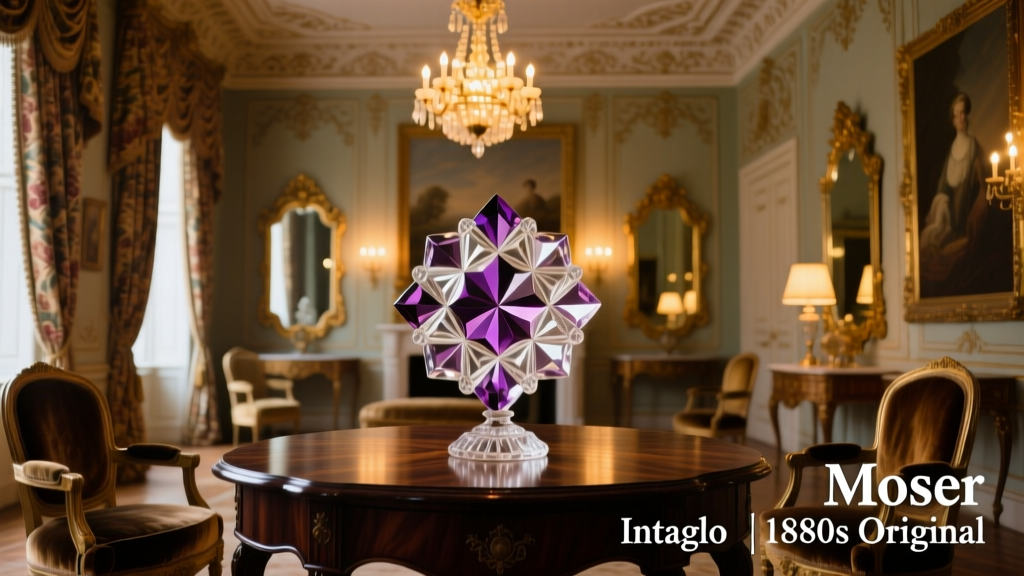
Moser Centerpiece: Intaglio-Cut Amethyst-to-Clear Crystal, 7 × 8 Inches — History, Craftsmanship, and Authentication
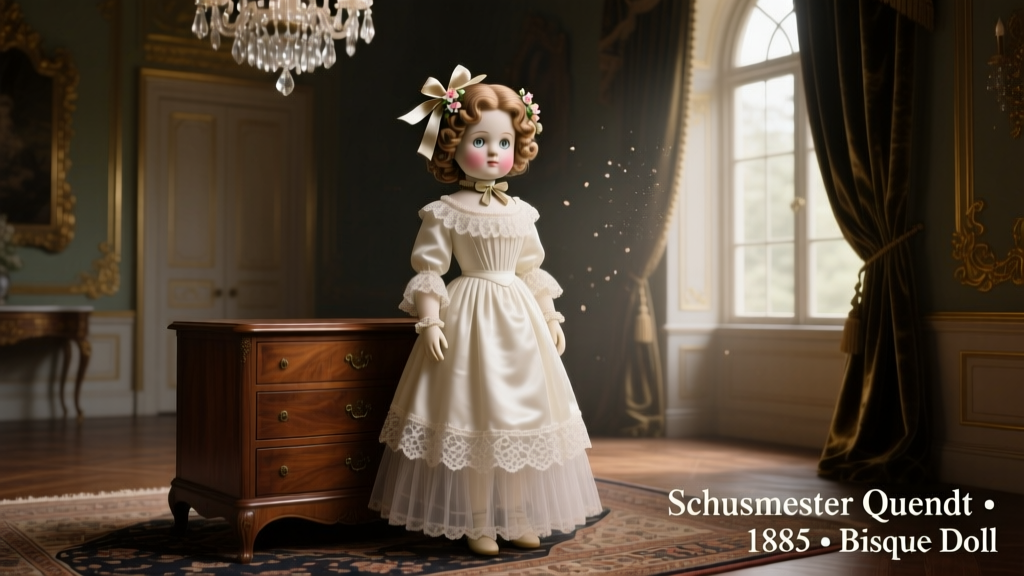
The Doll Schusmeister Quendt Bisque Body 23-Inch: A Technical and Historical Appraisal
Bottle Cap Hotpad No. 2: A Mid-Century American Folk Art Artifact and Its Restoration Ethics
Humpty Dumpty Regal Cookie Jars: History, Identification, and Restoration Guidance for Collectors
Folk Art Whirligig: The Standing Man with Green Hat and Paddle Arms — A Late 19th-Century American Treasure (29 Inches)
Help Identify Artwork and Artist: Perli Pelzig — A Specialist’s Guide to Authentication, Provenance, and Market Context
Fostoria American Decanter Stopper with 'Scotch' Imprint: A Collector’s Guide to the 24-Ounce Crystal Decanter Set
Tiffany Lamp Turtleback Favrile Leaded Glass Shade with Bronze Base — An In-Depth Restoration and Authentication Guide
Phoenix Glass Lamp: Electric Red-Blue Pulled Feather Shade, 20½ × 12 Inches — A Restoration Specialist’s Technical & Historical Analysis