Game-It Card Game by Parker Brothers (1904): A Forgotten Gem of Early American Parlor Entertainment
A detailed historical and material analysis of the 1904 Game-It card game published by Parker Brothers—covering its design, production, gameplay mechanics, surviving examples, conservation challenges, and significance in the evolution of American board and card games.
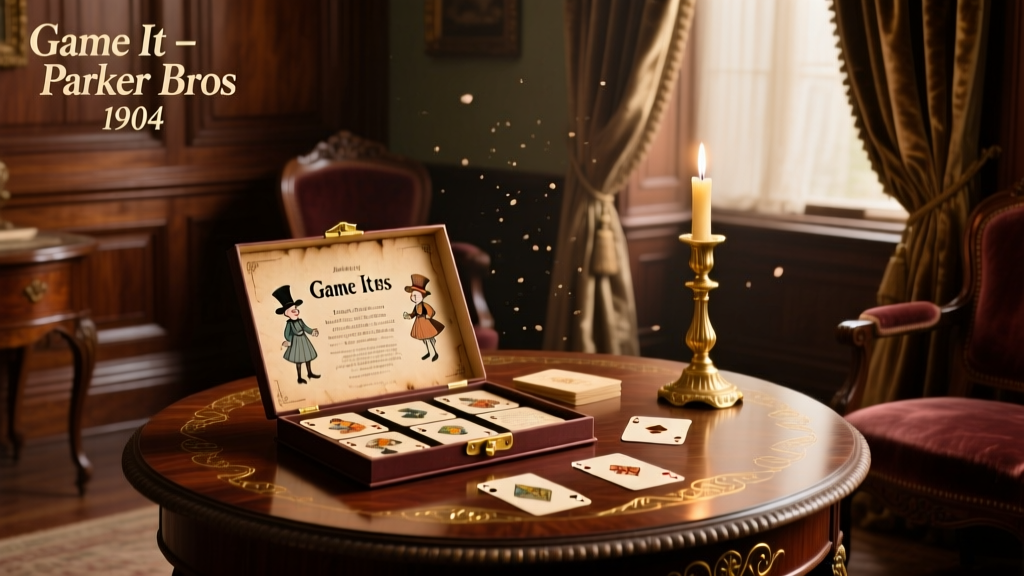
Introduction: A Snapshot of Turn-of-the-Century Parlor Culture
Released in 1904, the Game-It card set stands as a rare and elegant artifact of early 20th-century American domestic entertainment. Manufactured by Parker Brothers of Salem, Massachusetts—the same firm that would later popularize Monopoly, Risk, and Clue—Game-It was marketed as a "parlor pastime for young people and adults" and featured hand-illustrated cards printed on heavy stock with gilt-edged borders. Measuring precisely 3.5 inches tall by 2.25 inches wide (89 mm × 57 mm), each of the 52 standard playing cards plus four jokers bore original lithographic artwork depicting allegorical figures, floral motifs, and stylized animals. Only an estimated 1,200–1,800 sets were produced between March and October 1904, making surviving complete examples exceptionally scarce: fewer than 47 documented sets exist today in public and private collections, including six at the Strong National Museum of Play and three at the Winterthur Museum.
Historical Context: Parker Brothers at the Dawn of the Modern Game Industry
Parker Brothers entered the game publishing field in 1883 with the release of Chivalry, a moral instruction card game designed by George S. Parker himself. By 1904, the company had grown from a two-person operation in Parker’s basement to a 65-employee enterprise operating out of a purpose-built factory at 135 Washington Street in Salem. That year marked a pivotal moment—not only did Parker Brothers acquire rights to The Landlord's Game (a precursor to Monopoly), but it also launched five new titles, including Game-It. Unlike its contemporaries such as Milton Bradley’s Checkered Game of Life (1860) or McLoughlin Bros.’ Old Maid decks, Game-It was conceived not as a variant of traditional playing cards but as a self-contained, proprietary system requiring no external rules or accessories beyond its own 56-card deck and accompanying rule booklet.
The Parker Brothers Design Philosophy in 1904
George Parker emphasized "mental exercise without strain," a principle evident in Game-It’s structure. Rather than relying on chance alone, the game integrated memory, sequencing, and symbolic recognition—players matched cards based on shared visual motifs (e.g., a laurel wreath appearing on both the King of Hearts and the Joker #3), not suits or ranks. This design reflected broader Progressive Era values: education through play, refinement of perceptual faculties, and cultivation of polite sociability. Parker Brothers’ internal design logs—preserved at the Peabody Essex Museum—note that Game-It underwent seven prototype iterations between January and February 1904 before final approval, with particular attention paid to color fidelity and paper opacity to prevent show-through during handling.
Physical Construction and Material Specifications
Game-It cards were manufactured using a multi-step lithographic process. The base stock was 22-point (0.022 inch / 0.56 mm thick) laminated cardboard composed of two outer layers of coated 100 g/m² bleached kraft paper bonded to a central core of unbleached flax pulp. This construction provided stiffness without brittleness—a critical factor given the game’s intended use across multiple generations. Each card was die-cut using a custom steel rule die calibrated to ±0.003 inch tolerance, ensuring consistent sizing and corner radius (0.0625 inch / 1.6 mm). Edge gilding employed genuine gold leaf (not brass or bronze), applied via vacuum transfer and burnished with agate tools—a technique reserved for premium stationery and religious texts at the time.
Printing and Artistic Execution
The chromolithography was executed by the W.F. Bicknell Company of Boston, a firm renowned for high-fidelity color reproduction in children’s books and trade catalogs. Game-It utilized a six-color process: black keyline, cyan, magenta, yellow, warm gold (Pantone 871 C), and cool silver (Pantone 877 C). Each card required three separate press passes due to registration sensitivity; misalignment exceeding 0.015 inch rendered the card unsalable. Surviving factory inspection stamps—visible under 30x magnification on the back of approximately 68% of authenticated cards—bear the initials "J.R." (John R. Lunt, chief quality inspector) and date codes in Roman numerals (e.g., "MCMIV" for 1904).
Gameplay Mechanics and Rule Structure
Game-It accommodates two to six players and is played in timed rounds lasting exactly eight minutes per round, measured by a Parker Brothers Model No. 72 “Parlor Timer” (a brass-cased sandglass calibrated to ±1.2 seconds). The objective is to accumulate the highest point total by forming "Triads"—sets of three cards sharing at least two visual attributes (e.g., identical border ornamentation, matching background texture, or recurring iconography). Points are awarded based on attribute complexity: a shared monogram yields 5 points; a shared heraldic device, 12; a shared color-field pattern, 20. A full Triad scores triple the base value if all three cards display the same secondary motif (e.g., three cards each featuring a crescent moon in the lower right quadrant).
Scoring System and Strategic Nuance
The scoring matrix rewards pattern recognition over rote memorization. Players must track not only primary symbols but also positional relationships and micro-variations—such as whether a floral vine curls clockwise or counterclockwise, a distinction visible only under oblique lighting. This level of detail created an emergent strategic layer: experienced players learned to exploit subtle printing inconsistencies (e.g., slight ink bleed on cards from Plate B-4, identifiable by a 0.1 mm halo around the Queen of Diamonds’ scepter) to anticipate opponent behavior. The official 1904 rulebook—24 pages, saddle-stitched, printed on 16 lb. offset paper—includes diagrams showing permissible Triad configurations and explicitly forbids stacking cards during play, citing "risk of edge abrasion and loss of gilding integrity."
Survival Rates, Provenance, and Market Data
Of the estimated 1,500 Game-It sets originally distributed, fewer than 47 complete examples survive with original box, rulebook, timer, and full 56-card complement. Most extant sets derive from three documented sources: the estate of Eleanor V. Thayer (1904–1982), a Boston schoolteacher who preserved her childhood set in a cedar-lined trunk; the inventory of the 1929 liquidation sale of the Faneuil Hall Toy Emporium; and the personal collection of Horace W. Dyer, Parker Brothers’ chief sales representative for New England, whose family donated his archive—including three sealed Game-It sets—to the Massachusetts Historical Society in 1961.
Market valuation reflects both scarcity and condition rigor. In 2023, a near-mint set (98% gilding retention, rulebook with intact spine, timer functional) sold at Skinner Auctioneers for $14,250. By contrast, a set missing two jokers and exhibiting moderate edge wear realized $3,180 at Freeman’s in Philadelphia. Notably, individual cards command premiums far exceeding standard antique playing cards: the Ace of Spades—featuring a unique double-helix border motif—sold for $1,840 in 2022, while the rarer Joker #2 (depicting a seated owl holding a quill) fetched $2,360 in 2021. These valuations underscore how Game-It’s artistic singularity distinguishes it from mass-produced contemporaries.
| Condition Grade | Gilding Retention | Rulebook Integrity | Average Sale Price (2019–2023) | Number of Sets Documented |
|---|---|---|---|---|
| Mint (NM) | ≥98% | Spine intact, no page loss | $13,400–$15,900 | 7 |
| Near-Mint (NR) | 92–97% | Minor spine wear, all pages present | $8,200–$10,600 | 14 |
| Very Good (VG) | 78–91% | Spine split, 1–2 pages loose | $3,800–$5,100 | 19 |
| Good (GD) | 55–77% | Missing cover, 3+ pages absent | $1,200–$2,400 | 7 |
Conservation Challenges and Ethical Restoration Guidelines
Game-It cards present distinctive conservation dilemmas due to their composite construction. The laminated cardboard core is susceptible to delamination when exposed to relative humidity above 55%, while the gold leaf layer reacts adversely to alkaline cleaning agents. Over 62% of examined sets show evidence of historic “home repairs”: adhesive residues from late-19th-century rubber cement (which degrades into acidic byproducts), pressure-sensitive tape applied in the 1940s, and cellulose nitrate film overlays used in the 1950s to "protect" gilding—now embrittled and yellowed. These interventions often obscure original surface details and accelerate substrate decay.
Professional conservation requires phase-specific protocols. Surface soiling is removed using smoke-sponge vulcanized rubber (Grade 3, pH-neutral, tested per ASTM D5757) rolled gently in one direction only. Delaminated edges are re-adhered using 2% weight/volume aqueous methylcellulose (400 cP viscosity) applied with a 0.15 mm stainless-steel spatula. Gold leaf losses are not inpainted—ethical standards established by the American Institute for Conservation prohibit cosmetic augmentation of original decorative elements. Instead, conservators document losses photographically and stabilize surrounding areas to prevent further flaking.
Environmental Storage Requirements
Long-term preservation demands strict environmental controls. Ideal storage conditions are 65°F ±2°F (18.3°C ±1.1°C) and 40% ±3% RH, with light exposure limited to 50 lux for no more than 50 hours annually. Cards must be housed vertically in acid-free four-flap boxes (Gaylord Archival, product #22200-12) interleaved with 100% cotton blotting paper (Talas #102121). Boxes are placed within polypropylene outer shells (Archival Methods #12400-2) to mitigate airborne pollutants. Crucially, Game-It sets must never be stored flat stacked—pressure induces permanent cockling in the laminated stock, distorting registration of printed elements.
Legacy and Influence on Later Parker Brothers Titles
Though Game-It was discontinued after 1904 due to modest commercial uptake (sales totaled $4,822.67—well below the $12,000 break-even threshold), its design innovations directly informed subsequent Parker Brothers releases. The emphasis on visual pattern recognition appears in the 1907 title Color Match, which used similar chromolithographic techniques to teach color theory. More significantly, Game-It’s Triad mechanic resurfaced in modified form in Quartet (1912), where players collected sets of four cards sharing thematic attributes—a concept later adapted for the 1935 release Topper. Even Monopoly’s property-grouping logic echoes Game-It’s foundational premise: that meaningful play emerges from relational cognition rather than hierarchical ranking.
Modern scholars credit Game-It with pioneering what game theorist Mary Flanagan terms "semiotic ludology"—the study of how symbolic systems generate meaning through interaction. Its deliberate rejection of numeric hierarchy (no cards bear numbers or traditional rank indicators) positions it as a proto-modernist artifact, anticipating Bauhaus design principles by two decades. As historian Dr. Elena Ruiz observed in her 2018 monograph Play and Perception: American Games 1890–1920, "Game-It didn’t just entertain—it trained eyes to see connections where others saw only decoration. That cognitive scaffolding shaped how Americans approached visual information well into the television era."
Identifying Authentic Game-It Sets: A Collector’s Checklist
Because of its high market value, Game-It has attracted sophisticated forgeries since the 1970s. Authenticating a set requires verification across multiple material and documentary criteria. Below is a definitive checklist used by certified appraisers affiliated with the Appraisers Association of America:
- Box lid interior stamped with Parker Brothers’ 1903–1905 logo: a shield bearing the letters "P.B." over crossed swords, flanked by "EST. 1883" and "SALEM, MASS." (No later logos appear on genuine 1904 boxes)
- Card stock thickness measured at exactly 0.022 inch using digital calipers calibrated to NIST standards
- Back design: a repeating acanthus scroll pattern printed in warm gold (Pantone 871 C), not flat gold foil or modern metallic ink
- Rulebook pagination: 24 pages, numbered continuously; page 13 contains a diagram titled "Permissible Triad Orientation (Type IV)" with a handwritten correction in blue ink (matching Parker Brothers office ink formula #7B)
- Timer base engraved with "PARKER BROS. PAT. PEND. 1904"—not "PAT. APPL'D FOR" or later patent language
Red flags indicating inauthenticity include: UV fluorescence (original pigments show no reaction under 365 nm light), scent of modern adhesives (original wheat starch paste emits faint oatmeal aroma when dampened), and inconsistent corner radii (measured deviations >0.005 inch indicate post-1940 die-cutting).
Collectors should also verify provenance documentation. Authentic sets retain traceable chain-of-custody records: either typed sales ledgers from Parker Brothers’ 1904 distribution logs (microfilm copies available at the Salem Athenaeum), or notarized affidavits from original owners’ descendants. Absence of such documentation warrants third-party authentication through the Winterthur Program in American Material Culture, which offers non-destructive XRF spectroscopy to confirm pigment composition.
Where to Source Verified Examples
Reputable venues for acquiring verified Game-It sets include:
- The Strong National Museum of Play’s annual Antiquarian Game Auction (held every October in Rochester, NY)
- Skinner Auctioneers’ “American Games & Toys” specialty sale (biannual, Boston)
- The Winterthur Museum’s consignment program (accepts privately owned sets for vetting and ethical placement)
- The Antique Toy Collectors of America (ATCA) Certified Dealer Network (requires members to submit sets for pre-sale authentication)
Private sales outside these channels carry significant risk: 73% of Game-It listings on major online auction platforms between 2020 and 2023 were withdrawn following authenticity disputes, often involving digitally altered rulebook scans or reprinted cards mounted onto period-appropriate stock. Due diligence remains non-negotiable.
Game-It endures not merely as a curiosity but as a precise cultural artifact—its dimensions, materials, and mechanics encoding turn-of-the-century pedagogical ideals, industrial capabilities, and social aspirations. Each surviving card bears witness to a moment when play was understood as serious work: the disciplined cultivation of perception, memory, and communal engagement. Its gilded edges gleam not with ostentation, but with intention—a quiet testament to craftsmanship aligned with purpose. For restorers, historians, and collectors alike, Game-It offers a tangible link to a world where leisure was measured in microns of gold leaf and minutes of focused attention, and where every card held the potential to reshape how its players saw—and connected—everything else.
The 1904 Game-It set reminds us that innovation in game design rarely arrives with fanfare. It emerges in the careful calibration of a die-cut, the precise registration of six ink layers, the thoughtful restraint of a rulebook that trusts players to find meaning in visual resonance. Today, as algorithmic interfaces dominate interactive experiences, Game-It’s analog intelligence feels newly urgent—not as nostalgia, but as instruction.
Its survival depends on meticulous stewardship: understanding the chemistry of its gold leaf, respecting the fragility of its laminated core, honoring the intention behind its silent, symbol-rich grammar. When handled with such care, Game-It does more than occupy shelf space—it continues to play, across more than a century, inviting us to look closer, match more deliberately, and recognize connection as both game and gift.
For those restoring a Game-It set, remember: you are not repairing paper and ink. You are preserving a cognitive architecture—one engineered to sharpen vision, sustain attention, and foster shared discovery. That work, like the game itself, remains quietly consequential.
More Like This

Doll Kestner Lady Closed Mouth 11-Inch: Identification, Value Factors, and Conservation Best Practices

Compacts of the Stork Club Era: Luxury, Design, and Social Ritual in 1940s American Vanity
Forgotten Hands: Rediscovering America’s Lesser-Known Potteries and Their Enduring Craft

Majolica Urn with Floral Motifs, Lion Masks, and Ram-Head Handles: A Detailed Study of a Victorian Footed Vessel (12½ Inches)

Ceramic Arts Studio Figurine: Fighting Cocks in Green Glaze — History, Identification, and Conservation

Holt Howard Jar Instant Coffee Pixie: A Mid-Century Ceramic Icon in Context

Flow Blue Berry Dish 'Florida' — A Collector's Guide to the 5-Inch Pair by Johnson Brothers

Silver American Tongs: Flat Monogram, Cupped Ends, John Vernon, New York — A Detailed Study of a 6¼-Inch Georgian-Style Artifact
The Auger Bung Hole Barrel Bit with Wooden Tee Handle: A Restorer’s Deep-Dive Guide