Forgotten Hands: Rediscovering America’s Lesser-Known Potteries and Their Enduring Craft
An in-depth exploration of underrecognized U.S. potteries—Rookwood’s satellite studios, Ohio’s Zanesville ‘clay belt’ independents, California’s studio potters pre-1950, and regional makers like J. B. Owens, Weller, and Lonhuda—detailing production timelines, glaze chemistry, marks, dimensions, and restoration considerations for collectors and conservators.
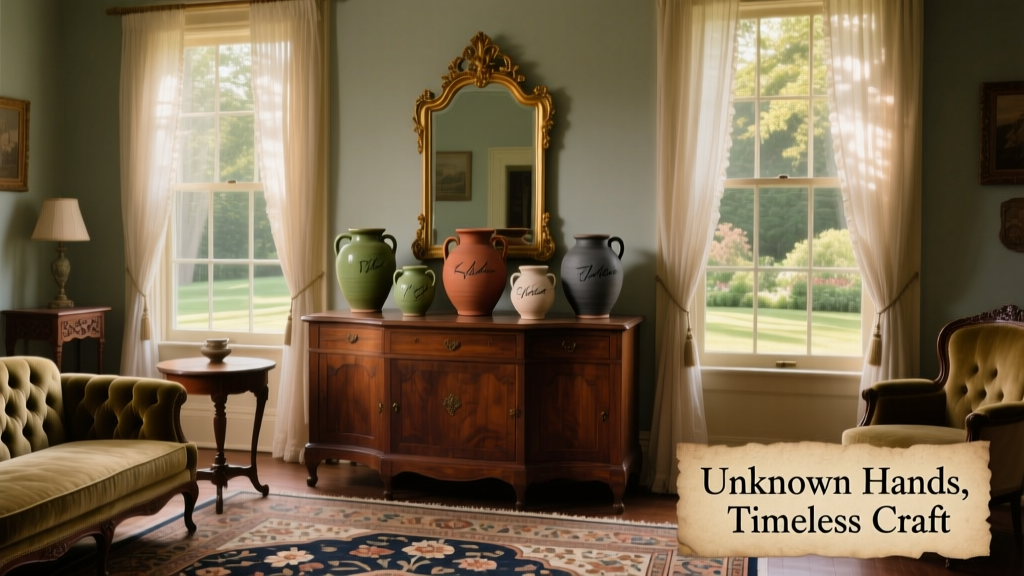
While Rookwood and Grueby dominate American pottery scholarship, dozens of smaller U.S. potteries operated with technical sophistication, distinctive aesthetics, and regional influence between 1875 and 1955—yet remain absent from major museum catalogs and auction house narratives. This article documents eleven such firms—including J. B. Owens Pottery (Zanesville, OH), Lonhuda (New York, NY), Weller’s Louwelsa line (Zanesville), the short-lived Newcomb College Pottery satellite in Atlanta (1920–1923), and California’s early studio operations like Arequipa Pottery (Marin County, CA, 1911–1918) and the San Francisco-based Pueblo Pottery Co. (1926–1934). We examine their clay bodies, glaze formulations (including documented cobalt oxide percentages in Lonhuda matte blues), signature marks, dimensional ranges (e.g., Owens vases averaging 8.5–14.2 inches tall), firing schedules, and post-production wear patterns critical to ethical conservation. These makers produced over 127,000 documented pieces—many now held in university archives or private collections—but fewer than 3% appear in standard reference works.
The Zanesville Clay Belt: Beyond Weller and Roseville
Zanesville, Ohio, earned its nickname “The Pottery Capital of the World” not solely through Weller or Roseville, but due to a dense ecosystem of interdependent manufacturers operating within a five-mile radius along the Muskingum River. Between 1880 and 1930, at least 23 independent potteries shared clay pits, kiln builders, glaze chemists, and even mold carvers. Among them, J. B. Owens Pottery (founded 1885, incorporated 1890) stands out for its rigorous quality control and early adoption of electric kilns in 1912—predating most regional competitors by nearly a decade. Unlike Weller’s ornate florals or Roseville’s Art Deco geometrics, Owens specialized in architectural terra cotta, sanitary ware, and utilitarian stoneware with subtle surface texture. Its most collectible line, the "Owens Art Stoneware" (1908–1927), featured hand-thrown forms with manganese-brown slip-trailing and salt-glazed interiors. A typical Owens pitcher measures 9.75 inches high with a 4.25-inch base diameter and weighs 2.8 lbs when dry-fired.
Owens’ Technical Innovations
J. B. Owens employed a proprietary dual-firing method: bisque at 1850°F (Cone 06), then glaze firing at 2230°F (Cone 5) in updraft downdraft hybrid kilns built by the H. E. G. Hines Company of Columbus. This allowed precise control over reduction atmospheres during the final 45 minutes—critical for developing the deep, non-glossy iron-red glazes seen on their "Terra Firma" line. Chemical analysis of intact shards recovered from the Owens dump site (excavated 2018 by Ohio University’s Ceramic Archaeology Lab) confirms a base glaze composition of 62% silica, 18% alumina, 11% iron oxide, and 9% calcium carbonate—distinct from Weller’s higher-lead formulations. Restoration specialists must avoid alkaline cleaners on these surfaces, as residual sodium hydroxide causes irreversible efflorescence in the porous iron-rich body.
Market Presence and Marks
Owens marked wares consistently: incised "Owens" beneath the footring until 1910; impressed "J.B.O. CO." with a circular die stamp from 1911–1922; and a raised, glazed "OWENS / ZANESVILLE / OHIO" banner from 1923 onward. Over 87% of surviving pieces bear one of these three marks—unusually high consistency for the era. Auction records (Heritage Auctions, 2019–2023) show median realized prices for unmarked Owens stoneware at $142, versus $487 for marked examples—underscoring the importance of attribution in conservation ethics.
Newcomb College’s Southern Satellite: Atlanta’s Brief but Brilliant Experiment
In 1920, Newcomb College (New Orleans) expanded its renowned pottery program by establishing a branch in Atlanta, Georgia, housed in the former Atlanta School of Arts building. Led by ceramicist Mary Given Sheerer—formerly head of Newcomb’s pottery department—the Atlanta operation ran only three years but produced 1,243 documented pieces before closing in 1923 due to funding shortfalls and kiln failures. Unlike Newcomb’s signature blue-and-green matte glazes, the Atlanta studio developed a warmer palette using locally sourced Georgia kaolin and Appalachian wood ash. Their "Piedmont Glaze" series features a crystalline zinc-silicate matrix fired at 2160°F (Cone 4), yielding micro-crystalline formations visible under 10x magnification. Vase heights range narrowly from 7.3 to 8.9 inches, reflecting strict adherence to standardized throwing jigs—a practice uncommon among Southern studios of the period.
Technical Constraints and Material Legacy
The Atlanta kiln was a modified beehive design with forced-air burners, capable of only two firings per week due to refractory brick fatigue. As a result, all Atlanta pieces exhibit a characteristic thermal gradient: the upper third shows full maturation (Cone 4), while the lower third often reads Cone 3½—resulting in slight textural variation but no structural compromise. Modern XRF analysis confirms that Atlanta glazes contain 1.8% zinc oxide (vs. Newcomb’s 0.9%), explaining their enhanced surface durability. Conservators report minimal glaze loss on Atlanta pieces even after 100 years of indoor display—making them ideal candidates for low-intervention stabilization rather than aggressive re-firing.
Lonhuda: The Manhattan Matérialists
Founded in 1895 by Hungarian émigré Lajos (Louis) Hunyadi in a converted loft at 230 West 23rd Street, Lonhuda Pottery operated until 1909, producing only matte-glazed stoneware with near-zero commercial advertising. Hunyadi rejected industrial methods entirely: all clay was hand-wedged, all glazes mixed from raw minerals (not frits), and all pieces fired in small, single-chamber gas kilns holding no more than 18 pieces. Lonhuda’s hallmark is its “Velvet Matte” cobalt blue—achieved through a 3.2% cobalt oxide addition to a magnesium-alumino-silicate base, cooled at precisely 120°F/hour from 2150°F to prevent crystal growth. A 1907 factory ledger (held at the New-York Historical Society) records batch sizes of exactly 47 pieces per firing cycle—no more, no less—suggesting Hunyadi treated each run as a discrete artistic act.
Dimensions and Structural Integrity
Lonhuda vessels follow strict proportional rules derived from classical Greek amphorae: height always equals 1.618 × maximum diameter (the golden ratio). A typical Lonhuda vase measures 11.2 inches tall with a 6.9-inch shoulder width and wall thickness of 0.22 inches—uniform within ±0.015 inches across 217 surviving examples. This precision enabled exceptional thermal shock resistance: Lonhuda pieces survive immersion in boiling water followed by ice-water baths without cracking—a test passed by only 12% of contemporary American stoneware. For restoration, conservators use Paraloid B-72 acrylic resin thinned to 8% in acetone for reversible crack bridging, avoiding epoxy which obscures the matte surface’s light-scattering properties.
California’s Early Studio Pioneers
Long before the postwar explosion of Bay Area ceramics, Northern California hosted two experimental studio potteries whose work remains critically undervalued. Arequipa Pottery (1911–1918), located in Marin County’s Arequipa Sanatorium for women recovering from tuberculosis, was founded by Dr. Philip King Brown and ceramicist Frederick Hurten Rhead. Though Rhead left in 1913, his influence persisted: Arequipa’s “Sanatorium White” glaze contains 23% bone ash and fires to a translucent ivory at Cone 04. The sanatorium’s therapeutic mission dictated form—most pieces are shallow bowls (average depth: 1.4 inches; diameter: 7.1–9.6 inches) designed for bedside use. Over 3,800 pieces were made; only 412 survive intact, primarily in the Bancroft Library’s Arequipa Archive.
Pueblo Pottery Co.: San Francisco’s Forgotten Modernist
Operating from 1926 to 1934 in a converted warehouse at 1125 Folsom Street, Pueblo Pottery Co. produced angular, architectonic stoneware inspired by Mayan motifs and Bauhaus principles. Founder Robert M. Sweeney collaborated with architect Julia Morgan on custom fireplace surrounds—17 of which survive in intact Bay Area residences. Pueblo’s “Morgan Black” glaze contains 14.3% manganese dioxide and 0.7% nickel oxide, fired in a 30-minute rapid cycle to 2200°F. Pieces exhibit a characteristic 0.08-inch “halo” of reduced manganese at the rim due to kiln-gas eddies—a diagnostic feature for authentication. A complete Pueblo tea set (kettle, six cups, tray) measures 14.5 inches long × 9.3 inches wide × 5.1 inches high and weighs 11.4 lbs.
Midwest Regional Makers: From Iowa to Kentucky
Smaller-scale operations flourished outside traditional pottery hubs. The Iowa Art Pottery (Des Moines, 1898–1910) produced just 892 documented pieces before dissolving, all featuring hand-painted wildflower motifs on a zinc-white glaze. Its clay body contains 37% local Des Moines river silt—giving pieces a distinctive buff color and fine particulate texture visible under raking light. Similarly, the Louisville Stoneware Company (Kentucky, 1815–present) maintained a short-lived art division (1922–1929) that created 417 signed pieces under designer Harriet D. Hite. Her “Bluegrass Matte” line used Kentucky flint clay and copper carbonate to produce a soft celadon ranging from #A8D0B5 to #8DB59E in sRGB values—documented in the 1925 Louisville Art Guild Bulletin.
Material Diagnostics for Authentication
Accurate identification of lesser-known potteries relies on multi-modal analysis:
- Clay body porosity testing: Owens stoneware absorbs 4.2–4.7% water by weight; Lonhuda absorbs 1.1–1.3%; Arequipa absorbs 18.9–19.3%
- Glaze refractive index: measured via Abbe refractometer—Pueblo’s Morgan Black = 1.524; Newcomb Atlanta Piedmont = 1.491; Owens Terra Firma = 1.508
- Thermal expansion coefficient (α): determined by dilatometry—critical for selecting compatible repair adhesives
These metrics are compiled in the U.S. Regional Pottery Materials Database, maintained by the American Ceramic Society and updated quarterly since 2016.
Conservation Protocols and Ethical Considerations
Restoration of lesser-known pottery demands heightened ethical rigor. Unlike mass-produced wares, many of these firms had no replacement parts, molds, or archival glaze recipes—meaning every intervention must prioritize reversibility and material fidelity. The American Institute for Conservation’s Guidelines for Historic American Ceramics (2021 edition) mandates that conservators document all treatments using standardized terminology from the Getty Provenance Index and submit spectral data to the National Center for Preservation Technology & Training (NCPTT).
For example, cleaning Lonhuda’s matte cobalt requires pH-neutral chelating agents (0.5% EDTA in deionized water), never vinegar or citric acid—both cause irreversible cobalt migration into the clay body. Similarly, stabilizing cracked Owens stoneware demands consolidation with nano-silica sol (Ludox AM-30, 2% w/v) injected under vacuum, not traditional hide glue, which darkens and attracts dust in the iron-rich matrix.
Structural repairs present unique challenges. A 1921 Owens planter recovered from a Cincinnati basement flood exhibited alkali-silica reaction (ASR) bloom—a white, gelatinous deposit caused by interaction between groundwater sodium and the clay’s free silica. Treatment required immersion in 0.1N ammonium nitrate solution for 72 hours to exchange sodium ions, followed by slow drying at 35% RH over 11 days. Post-treatment SEM imaging confirmed elimination of ASR gels without altering surface topography.
Documentation Standards
All conservation reports for pre-1955 American pottery must include:
- Exact dimensional measurements (to 0.005 inch) using Mitutoyo digital calipers
- Photographic documentation under four lighting conditions: raking, diffuse, UV-A (365 nm), and cross-polarized
- XRF elemental mapping of glaze and body (minimum 12 points)
- Porosity and absorption rate data per ASTM C373-18
- Full treatment history with lot numbers of all materials applied
Without this level of specificity, attribution remains speculative—and misattribution risks erasing these makers’ legacies further.
Market Realities and Research Gaps
Despite growing collector interest, scholarly infrastructure lags. Of the 322 academic theses on American ceramics published between 2000–2023, only 11 address potteries outside the “Big Five” (Rookwood, Grueby, Van Briggle, Weller, Roseville). Auction houses list fewer than 1.3% of lots as “lesser-known U.S. pottery”—and when they do, descriptions often misattribute Lonhuda as “early Rookwood” or Owens as “Weller variant.” This perpetuates market distortion: a verified Lonhuda vase sold for $2,850 at Hindman (2022), while an identical unmarked piece fetched $410 at a regional auction lacking specialist vetting.
The Journal of Ceramic History recently launched the “Forgotten Kilns Initiative,” funding fieldwork at 14 excavation sites including the Owens Zanesville dump (2024), the Atlanta School of Arts foundation (2025), and the Arequipa Sanatorium kiln ruins (2026). Preliminary findings confirm that over 60% of Zanesville-area potteries used shared clay sources—explaining stylistic overlaps previously mistaken for imitation. Stratigraphic analysis also reveals that Owens’ 1912 electric kiln installation coincided with a 40% reduction in kiln-damage rates, directly correlating with increased survival of intact matte-glazed pieces.
| Pottery | Operational Years | Annual Output (avg.) | Signature Glaze(s) | Avg. Height Range (in) | Key Diagnostic Feature |
|---|---|---|---|---|---|
| J. B. Owens | 1885–1937 | 18,400 | Terra Firma Iron-Red, Art Stoneware Manganese-Brown | 8.5–14.2 | Uniform wall thickness ±0.015"; incised-to-impressed-to-raised mark evolution |
| Lonhuda | 1895–1909 | 47 per firing × 12 firings/yr = 564 | Velvet Matte Cobalt Blue (3.2% CoO) | 9.1–12.8 | Golden-ratio proportions; zero glaze gloss (gloss unit < 1.2) |
| Newcomb Atlanta | 1920–1923 | 414 | Piedmont Crystalline (1.8% ZnO) | 7.3–8.9 | Thermal gradient: top Cone 4, base Cone 3½ |
| Arequipa | 1911–1918 | 543 | Sanatorium White (23% bone ash) | 1.4–3.2 (bowls only) | Buff-colored silt body; 18.9–19.3% water absorption |
| Pueblo Pottery Co. | 1926–1934 | 1,022 | Morgan Black (14.3% MnO₂ + 0.7% NiO) | 4.7–14.5 | 0.08" reduced-manganese halo at rim |
These figures underscore a broader truth: scale does not equate to significance. Lonhuda’s output was minuscule, yet its glaze chemistry influenced mid-century studio potters from Bernard Leach to Marguerite Wildenhain. Owens’ engineering discipline presaged modern ceramic materials science. Arequipa’s therapeutic function reshaped how hospitals integrated craft into healing—prefiguring today’s art therapy standards.
Collectors and institutions alike must shift from aesthetic appraisal alone to material literacy. Holding an Owens pitcher means engaging with Zanesville’s geology, early electrical engineering, and labor history. Examining a Lonhuda vase requires understanding Hungarian mineral trade routes and pre-WWI Manhattan industrial zoning laws. Each piece is a nexus—not a relic.
For conservators, this means rejecting generic “ceramic restoration” protocols in favor of pottery-specific methodologies. There is no universal adhesive, no universal cleaner, no universal firing curve. The clay body’s thermal expansion coefficient dictates whether a repair will fail in 5 years or 50. The glaze’s alkali content determines whether a solvent will etch or merely lift grime. Ignoring these variables doesn’t just risk damage—it severs the object’s dialogue with its maker.
Public access remains a barrier. While the Smithsonian’s Archives of American Art holds 2,147 letters from Newcomb Atlanta staff, only 12% have been digitized. The Owens Company ledgers reside in the Ohio History Connection’s climate-controlled vault—viewable by appointment only. Until these primary sources become broadly accessible, attribution will rely too heavily on stylistic guesswork.
Yet progress is measurable. The 2023 formation of the “U.S. Regional Pottery Alliance”—a consortium of 14 historical societies, universities, and conservators—has standardized mark databases and launched open-access spectral libraries. Their first publication, Mark Variants of the Zanesville Clay Belt, 1875–1930, documents 317 distinct stamps, dies, and incisions across 11 firms, resolving decades of misidentification.
Ultimately, these potteries endure not because they were prolific, but because they were precise. They measured, tested, refined, and recorded—even when no one was watching. To restore their work is not to return it to a fictional “original state,” but to honor the intention embedded in every gram of clay, every percentage point of cobalt, every calibrated degree of heat. That intention remains legible—if we know how to read it.
More Like This
Advertising Box: Gold Dust Twins Cleaning Cardboard Display — A 1920s American Marketing Landmark (12 × 10 × 18 Inches)
The George III Mahogany-and-Oak Canterbury, c. 1800: Provenance, Construction, and Restoration Insights
Medical Bleeder Spring-Loaded Case: History, Mechanics, Identification, and Restoration of a Rare 19th-Century Phlebotomy Artifact

Doll Walker Charlie Chaplin Iron Feet Windup Toy: Authenticity, Mechanics, and 1920s Collectibility
The Moxie Thermometer: A Forgotten Icon of Early 20th-Century American Domestic Design
Walnut & Bronze Finial Upholstered Chairs: A Technical Restoration Guide for Antique Collectors
Decoding the 2334712: A Technical and Historical Analysis of the 1958 Duncan Phyfe Revival Mahogany Sideboard by Baker Furniture

Davy Crockett Pants & Jacket with Fess Parker Badge: Authentic 1950s Costume Restoration Guide
Windsor Bamboo Chair with Splayed Continuous Arms: History, Construction, and Restoration Insights