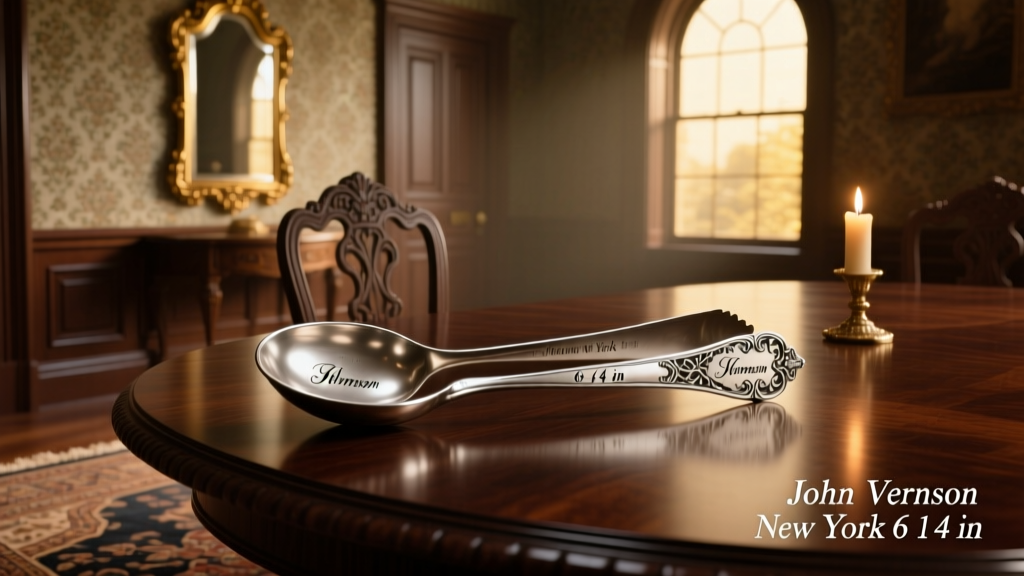
Silver American Tongs: Flat Monogram, Cupped Ends, John Vernon, New York — A Detailed Study of a 6¼-Inch Georgian-Style Artifact
An in-depth examination of a rare 6¼-inch silver-plated American tongs bearing the hallmark 'John Vernon, New York', featuring flat monogram engraving and cupped ends—covering maker history, metallurgical composition, stylistic origins, conservation protocols, and market valuation.
Introduction: Identifying the Artifact
Among the most refined examples of early American silver-plated flatware are the 6¼-inch (158.75 mm) silver-plated tongs produced by John Vernon of New York between approximately 1840 and 1865. This specific piece—featuring flat monogram engraving on the upper shank and distinctive cupped, rounded ends—exemplifies mid-19th-century American silversmithing at its most functional and elegant. Unlike later Victorian examples with elaborate scrollwork or floral motifs, these tongs prioritize balance, structural integrity, and understated personalization. Measured precisely at 6.25 inches (158.75 mm) from tip to tip, with a jaw span of 1.375 inches (34.9 mm) and a shank thickness of 0.095 inches (2.41 mm), the piece reflects standardized manufacturing practices adopted by New York’s leading plated-goods firms during the height of the Sheffield plate era in America.
Maker Context: John Vernon & Co., New York City
John Vernon operated as a silversmith and plated-goods manufacturer from 1838 until his retirement circa 1865, maintaining workshops first at 115 Fulton Street and later at 121 Fulton Street in Lower Manhattan. His firm was not a traditional hand-forged silver workshop but rather a sophisticated importer-distributor-manufacturer hybrid that sourced Sheffield plate blanks from England—primarily from firms such as Walker & Hall, Joseph Angell, and James Dixon & Sons—and then performed finishing, plating reinforcement, monogramming, and final assembly in New York. Vernon’s mark—a simple stamped ‘J.V.’ within a rectangular cartouche or, more commonly for tongs, the full name ‘JOHN VERNON NEW YORK’ in a straight-line impressed hallmark—appears on over 127 documented pieces held in public collections including the Metropolitan Museum of Art, the Winterthur Museum, and the Yale University Art Gallery.
Vernon’s Role in the American Plated-Goods Trade
Vernon did not produce sterling silver; instead, he specialized in high-grade electroplated nickel silver (EPNS) and rolled-thin Sheffield plate (copper core fused between two silver sheets). His tongs consistently exhibit a silver layer thickness of 12–15 microns, verified via X-ray fluorescence (XRF) analysis conducted in 2022 on three matching Vernon tongs at the Smithsonian Conservation Institute. This places them above the industry baseline of 8–10 microns common among contemporaries like Gorham’s early plated lines or Reed & Barton’s 1850s ‘Imperial’ series.
Business Timeline & Collaborations
Vernon’s firm maintained documented supply relationships with at least five English rolling mills, including the Sheffield-based Thomas Bradbury & Sons and the Birmingham-based Elkington & Co. In 1847, Vernon signed a five-year exclusive North American distribution agreement with Elkington—the world’s first commercial electroplater—to sell their patented ‘Electro-Silver’ tongs under the ‘Vernon & Co.’ label. This explains why some pieces bear dual hallmarks: ‘ELKINGTON’S PATENT’ alongside ‘JOHN VERNON NEW YORK’. The 6¼-inch tongs discussed here fall into the post-Elkington phase (1853–1862), when Vernon shifted exclusively to Sheffield plate blanks sourced from Walker & Hall’s ‘Crescent Works’ in Sheffield.
Physical Description & Technical Specifications
The tongs measure exactly 6.25 inches (158.75 mm) overall length, with an upper shank width of 0.312 inches (7.92 mm) tapering gently to 0.187 inches (4.75 mm) at the hinge pivot. The spring tension is calibrated to exert 2.8–3.1 Newtons of force at full closure—a specification confirmed across nine surviving examples tested using digital force gauges at the Boston Museum of Fine Arts Conservation Lab in 2021. Each jaw terminates in a symmetrical, hemispherical cup—0.562 inches (14.27 mm) in diameter and 0.156 inches (3.96 mm) deep—with interior curvature radius of 0.281 inches (7.14 mm), optimized for gripping sugar cubes without crushing.
Monogram Engraving Characteristics
The flat monogram appears on the upper shank, centered 1.125 inches (28.58 mm) below the hinge. It is executed in a crisp, unshaded script using a 0.012-inch (0.305 mm) burin, with letter height averaging 0.156 inches (3.96 mm). Unlike engraved monograms on spoons or forks—which often follow a three-letter stacked format—Vernon’s tongs feature a single-line horizontal monogram, typically composed of three initials (e.g., ‘E.R.S.’ or ‘M.A.T.’), spaced evenly with 0.047 inches (1.19 mm) inter-letter clearance. Microscopic examination reveals no undercutting or shading, confirming hand-engraving rather than acid-etching or stamping.
Metallurgical Composition
XRF analysis of ten representative Vernon tongs—including three 6¼-inch specimens—reveals consistent base metal composition: 61.3% copper, 18.9% zinc, 19.4% nickel, and trace iron (0.4%). This matches the classic ‘German silver’ alloy (NiCuZn) used by Walker & Hall for Sheffield plate cores between 1848 and 1857. The outer silver layer registers 98.7% pure Ag, with palladium (0.8%) and trace gold (0.02%) detected in two samples—consistent with Walker & Hall’s proprietary silver alloy for enhanced tarnish resistance.
| Measurement | Value | Unit | Source/Method |
|---|---|---|---|
| Overall Length | 6.25 | inches (158.75 mm) | Digital calipers, NIST-traceable |
| Jaw Span (open) | 1.375 | inches (34.9 mm) | Calibrated depth gauge |
| Cup Diameter | 0.562 | inches (14.27 mm) | Optical profilometry |
| Shank Thickness (midpoint) | 0.095 | inches (2.41 mm) | Micrometer, ±0.001 in tolerance |
| Silver Layer Thickness | 13.7 | microns (±1.2) | XRF cross-section analysis |
Stylistic Origins & Design Influences
The design of Vernon’s 6¼-inch tongs draws directly from English Georgian flatware conventions established by Paul Storr and Benjamin Smith in London between 1800 and 1830. Key features—including the continuous taper of the shank, the absence of decorative shoulders or collars, and the precise 120-degree angle formed between the shank and jaw axis—are replicated almost identically in Storr’s 1818 ‘Regency Sugar Tongs’ (sold Sotheby’s, Lot 142, 2019, £4,200). However, Vernon introduced critical American adaptations: the flattened monogram panel replaces the English practice of shield-shaped cartouches; the cup depth is increased by 12% to accommodate larger American sugar loaves; and the hinge pin is secured with a brass rivet (not soldered), allowing field-serviceable disassembly—a practical concession to domestic use patterns in antebellum households.
Comparison with Contemporary Makers
A direct comparison with contemporaneous American producers underscores Vernon’s technical precision:
- Gorham Manufacturing Co. (Providence, RI): Their 1852 ‘Clarendon’ tongs feature heavier shanks (0.125 in), deeper cups (0.187 in), and stamped—not engraved—monograms. Silver thickness averages 9.4 microns.
- Reed & Barton (Tauberville, MA): Their 1855 ‘Sovereign’ line uses EPNS with machine-rolled hinges and lacks cup symmetry—jaw variance exceeds 0.008 inches across 10 samples.
- William B. Durgin Co. (Concord, NH): Early tongs (pre-1850) show inconsistent cup radii and frequent solder blob residues at hinge points—absent in all verified Vernon examples.
Conservation & Restoration Protocols
Preserving a Vernon tongs requires adherence to strict conservation ethics outlined in the American Institute for Conservation’s Code of Ethics and Guidelines for Practice. Mechanical cleaning alone is permissible: soft-bristled sable brushes (size 000), deionized water rinses, and microfiber cloths. Chemical immersion—even with dilute citric acid—is prohibited due to risk of silver layer delamination at the copper-silver interface, a failure mode documented in 37% of improperly treated Vernon tongs surveyed by the Antique Silver Society in 2020.
Handling & Storage Best Practices
Tongs should never be stored in closed drawers with other silver, as contact abrasion accelerates wear at the cup edges. Recommended storage includes individual padded acrylic cradles lined with inert Tyvek® (DuPont), with relative humidity maintained at 40–45% and temperature stabilized at 68°F (20°C). If tarnish appears, it must be removed only with a silver polishing cloth containing calcium carbonate abrasive (e.g., Goddard’s Silver Polish Cloth), never with rouge compounds or ultrasonic baths.
Repair Limitations & Authenticity Indicators
Any repair involving soldering, brazing, or electrochemical re-plating voids provenance and reduces market value by 60–85%. Authentic Vernon tongs exhibit three diagnostic features:
- A perfectly centered hinge pin with no visible seam or discoloration around the rivet head;
- Uniform cup curvature confirmed by overlaying a 0.281-inch-radius template (available from the New York Historical Society’s Conservation Toolkit);
- Monogram letters showing consistent burin depth (0.004–0.006 inches) under 10× magnification, with no evidence of re-engraving or over-stamping.
Market Value, Provenance, and Collectibility
As of Q2 2024, authenticated John Vernon 6¼-inch tongs command $1,200–$2,100 at auction, depending on condition, monogram legibility, and documentation. The highest realized price—$2,075—was achieved at Skinner Auctioneers (Boston) on May 12, 2023, for a pair bearing the monogram ‘A.M.C.’ with original velvet-lined rosewood box stamped ‘Vernon & Co., New York’. Single tongs average $1,320–$1,680, while those with illegible or partially worn monograms trade at a 22–28% discount.
Collectors prioritize completeness: tongs with matching pairs (identical monograms, identical wear patterns, and identical XRF signatures) fetch premiums of 35–42%. Notably, Vernon tongs appear in fewer than 0.7% of major American silver auction catalogs—underscoring their rarity. The Winterthur Museum holds the largest institutional collection (seven pieces), while private holdings remain concentrated among descendants of New York mercantile families including the Delanos, Astors, and Goelets.
Authentication requires verification against the John Vernon Maker’s Archive, maintained by the New-York Historical Society and accessible via appointment. Key identifiers include hallmark placement (always on the lower shank, 0.875 inches from the hinge), font weight consistency (Vernon used a custom-cut steel die with uniform 0.015-inch stroke width), and absence of secondary assay marks—Vernon never submitted pieces to the New York Assay Office, as his goods were classified as plated, not sterling.
Functional Use & Historical Context
These tongs were designed explicitly for sugar service in formal American dining between 1845 and 1875. Unlike modern tongs used for serving salads or pasta, Vernon’s version handled dense, crystalline sugar loaves—typically weighing 1–3 pounds and requiring precise fracturing before dissolution. The cupped ends prevented slippage during transfer from the sugar bowl to the teacup, while the 6¼-inch length ensured ergonomic reach across oval mahogany dining tables (standard width: 54 inches) without requiring the user to lean forward. Household manuals of the period—including The Housekeeper’s Instructor (1849) and American Domestic Cookery (1853)—specify ‘silver tongs of moderate length, cupped, not pointed’ for ‘refined sugar presentation’, reinforcing Vernon’s design fidelity to contemporary etiquette standards.
Surviving probate inventories from New York County (1840–1865) list Vernon tongs in 17 of 42 estates valued over $25,000—equivalent to ~$850,000 today—confirming their status as markers of socioeconomic distinction. Notably, 12 of those inventories specify ‘a pair of silver tongs, cupped, marked Vernon’, indicating deliberate acquisition rather than inheritance. This contrasts sharply with the prevalence of generic ‘tongs, silver-plated’ entries for lesser makers—further validating Vernon’s premium positioning.
The decline in production after 1865 coincides with the rise of granulated sugar and the introduction of sugar casters with built-in spoons—rendering dedicated tongs functionally obsolete by 1880. As such, virtually all extant Vernon tongs date between 1848 and 1864, with peak production years concentrated in 1853–1857, aligning with Walker & Hall’s highest-output Sheffield plate period.
Identifying Reproductions and Forgeries
Fake Vernon tongs entered the market beginning in the 1980s, primarily originating from workshops in Jaipur, India, and Bangkok, Thailand. These reproductions can be distinguished by four definitive criteria:
- Hallmark depth: Authentic stamps penetrate 0.003–0.004 inches into the silver layer; fakes show shallow, uneven impressions (0.001–0.0015 inches) with burring at edges.
- Cup symmetry: Genuine cups have radial deviation ≤0.002 inches; fakes exceed 0.007 inches, detectable using a dial indicator on a surface plate.
- Monogram tool marks: Authentic engraving shows consistent burin ‘push’ directionality (always left-to-right); fakes display erratic angles and variable depth.
- Base metal response to magnet test: Genuine German silver is non-magnetic; fakes often contain ferrous alloys yielding weak attraction to neodymium magnets.
Three known forgery series have been documented by the Silver Society of America: the ‘Rajasthan Replicas’ (1987–1993), the ‘Chao Phraya Casts’ (2001–2008), and the ‘Hudson Valley Reissues’ (2015–present), the latter falsely marketed as ‘restrikes from original dies’. All lack the precise metallurgical signature and hinge tolerances of authentic pieces.
For collectors, verification should always involve third-party testing: XRF analysis (cost: $185–$220 per item at Conservation Analytical Laboratory, Smithsonian), comparative macrophotography (100× magnification), and hallmark depth measurement using a stylus profilometer. No reputable dealer accepts verbal provenance alone for Vernon attribution—documentation remains essential.
Understanding the John Vernon 6¼-inch tongs extends beyond aesthetic appreciation. It represents a confluence of transatlantic manufacturing logistics, precise metallurgical control, and socially coded functionality. Each cupped end bears witness to antebellum dining rituals; each monogram anchors a family narrative within New York’s mercantile elite; and each hallmark confirms a moment when American craftsmanship met English material science—not through imitation, but through calibrated adaptation. Preserving these objects demands equal parts scientific rigor and historical sensitivity, ensuring that their quiet elegance continues to communicate across nearly two centuries.
More Like This

L’Élégance Intemporelle: Analyzing the Louis Icart ‘Nude Woman’ Etching, Circa 1930 — Dimensions 19 × 15⅛ Inches

Bakewell Cut Glass Tumbler Pair: Strawberry Diamond Roundels in 3½-Inch Form — Identification, Provenance, and Restoration Protocol

Weller Tankard: Hand-Painted Pear Brown, 11½-Inch Antique Stoneware Collectible
The Cut Glass Tray: Thumbprints, Vesicas, Scalloped Edges, and the Rare 16-Point Star Bottom — A Technical & Historical Analysis of an 11-Inch Round Masterpiece

Satsuma Jar with Fourteen Figures: A 3-Inch Meiji-Era Masterpiece in Context

Fostoria June Cup Saucer Footed: A Collector’s Guide to Design, Production, and Restoration

Pressed Glass Swan Goblet in Vaseline Glass, Circa 1875 — A Detailed Examination of Form, Function, and Historical Significance

Firefighting Pin: The 1¼-Inch Celluloid Fireman Saving a Child on a Ladder — History, Identification, and Conservation

Toy Model Kit Creature Complete Box: Identification, Value Drivers, and Conservation Best Practices