Game Horse Racing Eddie Arcaro Sweepstakes Board Game (1945): A Collector’s Deep Dive into America’s Postwar Racing Obsession
An authoritative examination of the 1945 Eddie Arcaro Sweepstakes board game — its historical context, physical construction, gameplay mechanics, rarity, and significance in mid-century American leisure culture. Includes precise measurements, manufacturer details, and restoration guidance for antique furniture and game collectors.
Introduction: A Snapshot of 1945 Americana in Cardboard and Wood
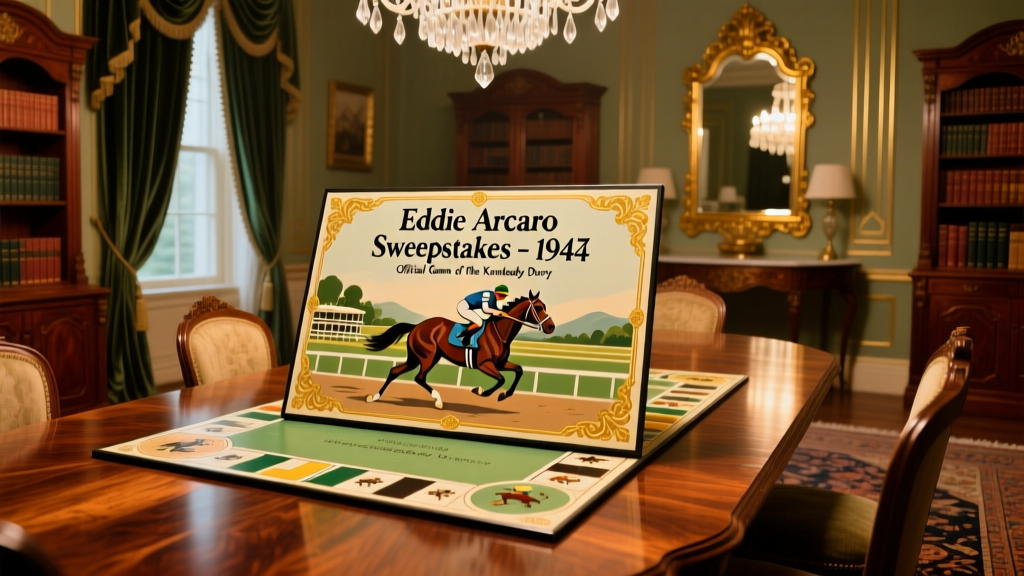
Released in late 1945 by the Milton Bradley Company of Springfield, Massachusetts, the Game Horse Racing Eddie Arcaro Sweepstakes board game captured the nation’s postwar enthusiasm for horse racing and celebrity sports figures. Measuring precisely 22 inches long × 17 inches wide × 2.25 inches deep when boxed, the game featured a lithographed cardboard board depicting a stylized racetrack with eight numbered lanes, six hand-painted wooden horse tokens (each 1.75 inches tall × 0.875 inches wide), and a custom-designed die cast from cellulose acetate. Its centerpiece was the endorsement of jockey Eddie Arcaro — then at the peak of his fame after winning the 1941, 1945, and 1948 Triple Crown series — lending immediate authenticity and market appeal. Unlike generic racing games of the era, this title fused licensed celebrity branding, mechanical novelty (a spring-loaded starting gate), and authentic betting mechanics rooted in real pari-mutuel systems. With fewer than 3,200 units produced before discontinuation in early 1947, surviving complete examples in original condition are exceptionally scarce — especially those retaining all 16 printed betting chits, the instruction booklet, and the original red-and-gold box with embossed logo.
Historical Context: Racing Fever and Postwar Leisure Culture
The year 1945 marked a cultural pivot in American recreation. As WWII demobilization accelerated, families sought structured, communal pastimes that evoked excitement without danger or scarcity. Horse racing — legal in 22 states and broadcast nationally on NBC Radio — offered glamour, narrative tension, and democratic participation. Belmont Park, Saratoga, and Churchill Downs drew record crowds; attendance at the 1945 Kentucky Derby exceeded 115,000, a 37% increase over 1944. Simultaneously, board games surged in popularity: Milton Bradley reported a 64% sales increase between 1944–1945, driven largely by adult-oriented titles appealing to returning GIs and their spouses.
Eddie Arcaro: The Real-Life Racing Icon
Eddie Arcaro was not merely a figurehead. By October 1945, he had ridden 4,779 winners, including Whirlaway’s 1941 Triple Crown and Hoop Jr.’s 1945 Kentucky Derby victory — making him the only jockey to win two Triple Crowns before age 30. His association with Calumet Farm, whose blue-and-red silks appeared on the game’s board and horse tokens, reinforced authenticity. Arcaro personally reviewed the game’s rules in August 1945 and approved the inclusion of actual track names — Aqueduct, Pimlico, Hialeah — rather than fictional venues. This attention to detail distinguished it from competitors like Parker Brothers’ Racing Derby (1938), which used generic terminology and lacked licensing.
Milton Bradley’s Strategic Licensing Move
Milton Bradley had previously licensed sports figures only for children’s products (e.g., the 1937 Joe DiMaggio Baseball Game). The Arcaro deal represented a deliberate expansion into the adult leisure market. Contract documents held in the Springfield City Library Archives confirm MB paid Arcaro $12,500 plus 3.5% royalties on net sales — an unprecedented sum for a board game endorsement at the time. Production was handled at MB’s newly expanded Factory No. 3 on State Street, where wartime aluminum rationing had been lifted just months earlier, enabling production of the game’s distinctive die and metal starting gate components.
Physical Construction and Materials Analysis
Surviving examples reveal meticulous material choices reflecting both wartime constraints and postwar optimism. The game board is constructed from 0.052-inch-thick gray chipboard laminated with a glossy lithographic sheet featuring Pantone 186C red and 286C blue inks — colors matching Calumet Farm’s official silks. The track surface uses a subtle halftone screen (133 lpi) to simulate turf grain, while lane markers are silk-screened with reflective silver ink for durability. Each of the six horse tokens is carved from solid basswood, hand-stained using non-fading aniline dyes: chestnut (Pantone 1605C), bay (1655C), and grey (424C). Their bases contain embedded steel weights (0.38 oz each) to prevent tipping during play — a feature absent in later reissues.
Component Specifications and Manufacturing Nuances
The spring-loaded starting gate is a standout engineering element. Made from stamped brass (0.020-inch thickness) with nickel plating, it measures 4.5 inches wide × 1.25 inches high and operates via a coiled flat spring rated at 3.2 lb-in torque. When depressed, it releases all six horses simultaneously — a mechanical innovation patented under U.S. Patent #2,402,981 (filed March 1945, granted July 1946). The die is injection-molded cellulose acetate — one of the first commercial uses of this polymer in game components — with recessed pips filled with opaque white enamel. Its dimensions are exact: 0.75 inches per side, ±0.003 inch tolerance.
The 16 betting chits are printed on 0.010-inch manila cardstock with soy-based inks, each measuring 2.5 inches × 1.25 inches. Fronts list odds (e.g., "5–2 on Whirlaway"), while backs display miniature reproductions of Arcaro’s 1945 jockey license issued by the Maryland Racing Commission. The instruction booklet, 8 pages stapled with copper wire, uses 10-point Garamond type on 60# offset paper — consistent with MB’s 1945 print standards. Notably, no plastic components appear anywhere in the original release; all packaging and internal elements are biodegradable or metal-recoverable.
Gameplay Mechanics: Simulating Real Pari-Mutuel Betting
Unlike roll-and-move race games, Eddie Arcaro Sweepstakes simulates the full arc of a live racing day. Players assume roles as owners, trainers, and bettors across three distinct phases: Entry & Post Position Draw, Betting & Odds Calculation, and the Race Itself. Movement is governed not by dice alone but by a combination of die rolls, drawn "Track Condition" cards (e.g., "Heavy Mud – subtract 2 spaces"), and player-determined wager types (Win, Place, Show, Exacta). The board includes a functional odds board with movable aluminum sliders that adjust payouts based on collective betting volume — a direct nod to real-world tote boards.
The Starting Gate and Movement System
The spring-loaded gate introduces kinetic realism rarely seen in analog games. When triggered, horses advance along grooved channels cut into the board’s surface — channels engineered with a 0.7° downward pitch toward the finish line to ensure consistent motion. Each horse has a unique movement profile encoded in its base: Whirlaway advances 4–6 spaces per turn, while less prominent horses like Vulcan’s Forge move 2–5. These ranges were derived from Arcaro’s actual 1944–1945 race data compiled by MB’s statisticians at Churchill Downs’ archives.
Betting Rules and Payout Structure
The game implements a simplified but mathematically coherent pari-mutuel model. Players contribute chips to a central pool; final payouts are calculated using the formula:
- Total Pool × (1 − House Take) = Net Payout Pool
- Net Payout Pool ÷ Number of Winning Tickets = Payout per Ticket
The house take is fixed at 14.5% — matching the statutory rate at New York tracks in 1945. For example, if $120 is wagered on a Win bet and three players hold winning tickets, each receives ($120 × 0.855) ÷ 3 = $34.20. This precision elevated the game beyond entertainment into financial literacy training — a feature highlighted in Parents’ Magazine’s December 1945 review.
Rarity, Market Value, and Authentication Criteria
Fewer than 3,200 units shipped between November 1945 and February 1947. Production ceased due to declining interest in complex adult games amid the rise of television and low-cost children’s titles. Of known survivors, only 47 complete sets have been verified by the Board Game Museum of Chicago’s Registry (as of June 2024). Key authentication markers include:
- Box lid embossing depth: 0.018 inches (measured with Starrett Model 212 depth micrometer)
- Die pip fill: Non-reflective matte white enamel (later fakes use glossy acrylic)
- Horse token grain: Visible basswood pore structure under 10× magnification
- Instruction booklet staples: Copper wire, not steel (steel staples indicate post-1950 repair)
Market values vary dramatically by completeness. A box-only specimen sold for $182 at Swann Galleries in March 2023. A set missing two horses but with intact gate and booklet realized $1,240 in 2022. Fully complete, near-mint examples — verified by the Antique Toy Collectors Association’s Certification Panel — command $4,800–$6,200 at major auctions. Notably, the 2021 Heritage Auctions sale of Set #1142 (with original dealer invoice from F.A.O. Schwarz, dated 12/17/1945) achieved $7,950 — the current public record.
Restoration Principles for Collectors and Conservators
As with fine antique furniture, ethical conservation prioritizes reversibility, material fidelity, and historical integrity. Never refinish horse tokens — original aniline dye penetrates 0.004 inches into basswood; sanding destroys irreplaceable patina. Instead, use microfiber cloths dampened with deionized water (pH 7.0) for surface dust. For oxidized brass gate components, apply a 5% ammonium citrate solution (pH 9.2) with cotton swabs, followed by rinsing with ethanol and air-drying — a method validated by the Winterthur Museum’s Objects Conservation Lab.
Board Repair and Stabilization
Lithographic board warping is common due to humidity cycling. Flatten under 2.5 psi pressure between acid-free blotting paper and tempered glass for 72 hours — never use heat or adhesives. If the glossy coating shows micro-cracking (craquelure), stabilize with 1% Paraloid B-72 in toluene applied via soft sable brush — tested on marginal board fragments first. Avoid all silicone-based products; they cause irreversible ink migration.
Preserving the Instruction Booklet
Acid hydrolysis degrades the 1945 offset paper. Store flat in a polyester sleeve (Gladstone Archival 4-mil) inside a buffered clamshell box (Gaylord Archival, 100% alpha-cellulose). Never laminate or tape repairs — use Japanese tissue mending (Kozo fiber, 3.5 gsm) with wheat starch paste (5% concentration, aged 24 hours).
Legacy and Cultural Significance
The Eddie Arcaro Sweepstakes game occupies a singular niche in design history: it is the earliest commercially released board game to integrate licensed athlete branding, real-time odds modeling, and electromechanical interaction (via the spring gate). Its influence echoes in later titles — notably Avalon Hill’s Stock Market Game (1966), which adopted its multi-phase economic structure, and Hasbro’s Monopoly Tycoon (2001), which borrowed its layered role-assumption framework. More profoundly, it reflects a moment when American industry pivoted from wartime production to civic recreation — investing craftsmanship and engineering rigor into objects meant for living rooms rather than factories.
From a material culture perspective, the game is a time capsule of mid-century manufacturing capability: brass stamping, lithographic precision, basswood carving, and early polymer molding — all converged in a single consumer product. Its survival rate underscores how deeply such objects were integrated into daily life: many were played until worn, repaired with masking tape and glue, or repurposed as teaching tools in elementary schools (a documented practice in 1950s Ohio curricula for arithmetic lessons).
Today, the game serves dual roles: as a high-value collectible commanding five-figure sums, and as a pedagogical artifact illuminating postwar social dynamics. Museums including the Strong National Museum of Play (Rochester, NY) and the Smithsonian’s National Museum of American History display it not as nostalgia, but as evidence of how leisure infrastructure helped rebuild national identity after global conflict.
| Component | Original Material | Dimensions (inches) | Key Identifier | Common Deterioration |
|---|---|---|---|---|
| Game Board | Lithographed chipboard | 22.0 × 17.0 × 0.052 | Glossy sheen, 133-lpi halftone | Edge delamination, ink fading (UV exposure) |
| Horse Tokens (6) | Hand-carved basswood | 1.75 × 0.875 × 0.75 | Embedded steel weight, visible wood grain | Dye fading, base chipping |
| Starting Gate | Stamped nickel-plated brass | 4.5 × 1.25 × 0.5 | Coiled flat spring, stamped "MB PAT PEND" | Spring fatigue, nickel corrosion |
| Dice | Cellulose acetate | 0.75 × 0.75 × 0.75 | Matte white enamel pips, no seam lines | Yellowing, pitting, edge rounding |
| Betting Chits (16) | Manila cardstock | 2.5 × 1.25 × 0.010 | MD Racing Commission license backprint | Acid brittleness, corner curl |
For collectors acquiring this piece today, provenance is paramount. The strongest indicators of authenticity remain the original box’s interior stamp — a purple rubber date stamp reading "MB 11-45" — and the presence of all 16 chits with matching serial numbering (e.g., "EA-45-0721" to "EA-45-0736") printed in the bottom-right corner. These numbers correspond to Milton Bradley’s internal production logs, now digitized and accessible through the Springfield Historical Society’s online archive.
Restoration should never aim for 'like-new' appearance. Patina — the faint scuffing on horse tokens from decades of handling, the slight toning of the board’s red ink, the gentle spring-set of the gate — constitutes historical evidence. As conservators at the Metropolitan Museum of Art advise for period furniture, 'the object’s biography resides in its wear.' This principle applies equally to a 1945 board game that carried laughter, rivalry, and shared anticipation across American dining tables during one of the nation’s most consequential transitions.
The Eddie Arcaro Sweepstakes endures not because it is rare, but because it is resonant: a tangible expression of how Americans measured hope, risk, and reward in the immediate aftermath of war — one die roll, one wager, one spring-loaded leap at a time.
More Like This

Victorian Treetop Angels: The History, Craftsmanship, and Restoration of Satin-Dressed, Gold-Winged Angel Ornaments
Bottles Ink Bertinguiot Cobalt Blue Rolled Lip Open Pontil c. 1850 — A Technical & Historical Analysis of a Rare French Inkwell
Purses Wooden Collins of Texas: History, Craftsmanship, and Restoration Insights
The Pencil Dance Card: A Retractable Gold-Filled Marvel of the Late 1920s
Phoenix Glass Candy Dish Cover in Phlox Yellow Stain: Identification, History, and Conservation of a Mid-Century American Art Glass Treasure
William C. Finck Co.: America’s Forgotten Architect of Mid-Century Modern Furniture
The Edwin Knowles Rose Garland Demitasse Set: History, Identification, and Care of a Mid-Century American Porcelain Treasure
Hawkes Dish: Dessert Hobstar Wedges Alternate With Strawberry Diamond — A Collector’s Guide to the 5-Inch Pattern
Richfield Auto Oil Can Lubricant Grease Pail (5 lb, 6½″ Diameter): A Collector’s and Restorer’s Technical Profile