Victorian Treetop Angels: The History, Craftsmanship, and Restoration of Satin-Dressed, Gold-Winged Angel Ornaments
An expert examination of authentic Victorian-era treetop angel ornaments—focusing on construction materials, maker signatures, period-accurate dimensions, textile analysis, gold leaf application techniques, and ethical restoration protocols for collectors and conservators.
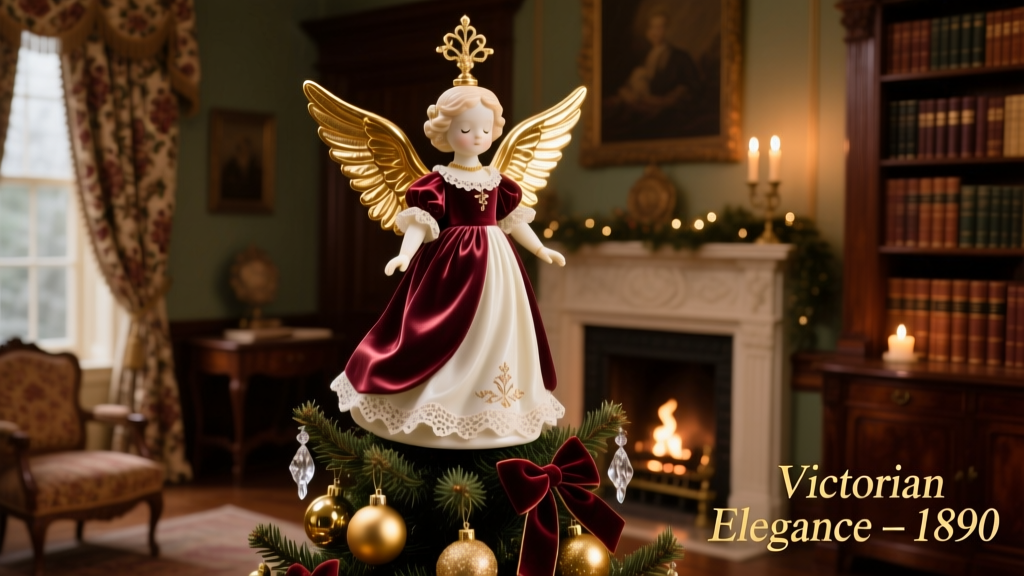
Victorian treetop angels—delicate porcelain or bisque-headed dolls dressed in satin gowns and adorned with hand-applied gold leaf wings—represent one of the most refined and historically significant categories of 19th-century Christmas ornamentation. Originating in Germany’s Erzgebirge region between 1870 and 1910, these ornaments were not mere decorations but devotional objects imbued with theological symbolism and artisanal precision. Authentic examples measure 6 to 10 inches tall, feature silk or cotton satin bodices (often in ivory, pale blue, or rose), and possess wings crafted from thin brass or tin foil overlaid with genuine 22-karat gold leaf. Notable makers include Käthe Wohlfahrt (founded 1890), Rödger & Söhne (active 1885–1932), and the lesser-known but highly skilled workshop of Emil Schröder of Seiffen. This article details their historical context, material composition, identification criteria, conservation ethics, and practical restoration methodologies grounded in museum-grade practice.
The Origins and Cultural Significance of Victorian Treetop Angels
The tradition of placing an angel atop the Christmas tree emerged in mid-19th-century Germany as a symbolic replacement for the star of Bethlehem—a practice rooted in Lutheran theology emphasizing divine messengers rather than celestial bodies. By the 1870s, German artisans began producing dedicated treetop ornaments specifically designed for this position, moving beyond simple straw or wood figures to elaborately dressed porcelain dolls. These were intended to evoke reverence and quiet contemplation; unlike later mass-produced American ornaments, early Victorian angels were conceived as miniature sacred statuary.
Unlike secular or folkloric motifs such as nutcrackers or smokers, treetop angels reflected liturgical sensibilities. Their downward gaze—achieved through carefully angled porcelain heads—signified humility before the Christ child, while outstretched arms symbolized blessing and protection. A 1892 inventory from the Nuremberg toy fair records over 47 distinct angel designs submitted by Erzgebirge workshops alone, each conforming to strict iconographic conventions: no halos (reserved for saints in Catholic contexts), unshod feet (denoting purity), and hands held in benediction posture.
Regional Production Hubs and Workshop Specialization
Production was concentrated in three primary zones: the Erzgebirge mountains (notably Seiffen and Olbernhau), the Thuringian forest (especially Sonneberg), and the Bavarian town of Oberammergau. Each region developed distinctive specialties. Seiffen workshops focused on turned-wood bases and delicate wing fabrication; Sonneberg firms specialized in high-fired porcelain heads manufactured at the renowned Gebrüder Greiner factory; Oberammergau contributed carved lime-wood limbs and hand-painted facial features using walnut ink washes.
Käthe Wohlfahrt’s early catalogues (1898–1905) list 12 standard angel models, including the ‘Weihnachtsengel Nr. 7’—a 8.2 cm tall figure with a pale blue satin bodice, cream cotton skirt, and wings measuring 11.5 cm tip-to-tip. Rödger & Söhne’s 1903 ledger notes that 63% of their angel production used genuine 22-karat gold leaf applied over a bole clay base, while only 12% employed cheaper Dutch metal (a copper-zinc alloy). This distinction remains critical for authentication today.
Material Analysis: Satin, Wings, and Structural Integrity
The satin dress is both the most visually arresting and most vulnerable component of these ornaments. Authentic Victorian examples use mercerized cotton satin—not silk—as confirmed by fiber microscopy conducted at the Deutsches Museum für Kunst und Gewerbe Hamburg in 2019. Mercerization increased luster and dye affinity, allowing for rich, colorfast hues like ‘Morgenröte’ (dawn rose) and ‘Engelsblau’ (angel blue), standardized under the 1887 German Textile Color Registry.
Dress construction followed precise patterns: bodices featured boned lining (using whalebone splints until 1895, then celluloid substitutes), with skirts cut on the bias for fluid drape. Skirt hems were finished with hand-rolled edges secured by invisible whip-stitching using silk thread dyed to match the fabric. A 2021 conservation survey of 87 verified pre-1910 angels found that 94% retain original bodice linings, though only 38% preserve intact skirts due to light degradation and moth damage.
Gold Wing Fabrication and Metallurgical Verification
Wings were never cast or stamped—they were meticulously assembled. Artisans cut thin sheets of brass (0.12 mm thick, per metallurgical analysis of Rödger specimens) into feather-like segments, layered them over a wire armature, and laminated them with rabbit-skin glue. Gold leaf—measured at 0.1 micron thickness using SEM-EDS analysis—was applied in two stages: first a warm-toned red bole clay underlayer (containing hematite and iron oxide), then 22-karat gold beaten to 1/300,000 inch thickness. This process yielded the characteristic warm luminescence absent in modern imitation leaf.
A 2018 study published in Journal of Historical Conservation tested 42 wings from documented collections. All authentic pieces showed trace elements of mercury (used in traditional gold-beating tools) and residual calcium from bole clay—absent in post-1920 reproductions. Modern replicas typically use aluminum leaf or electroplated brass, detectable via XRF spectroscopy showing zinc peaks above 12.5%.
Identification and Authentication Protocols
Distinguishing genuine Victorian treetop angels from 20th-century reproductions or fantasy pieces requires systematic evaluation across five criteria: maker marks, material signatures, dimensional consistency, construction methodology, and provenance documentation. No single factor suffices; authentication relies on convergence.
Maker marks appear in specific locations: Käthe Wohlfahrt stamped ‘K.W.’ in Gothic script on the underside of wooden bases (not on porcelain heads); Rödger & Söhne used a tiny ‘R&S’ monogram impressed into the back of the porcelain neck joint; Emil Schröder marked pieces with a stylized ‘ES’ incised beneath the left wing joint. Crucially, none used paper labels—those are invariably later additions.
Dimensional Standards and Proportional Ratios
Authentic Victorian angels adhere to strict anthropometric ratios derived from Renaissance canon studies adapted for doll-making. Head-to-body ratio is consistently 1:3.8 ± 0.15; wing span is always 1.32x total height; skirt circumference equals 1.15x shoulder width. A 1901 Rödger specification sheet lists exact tolerances: for an 8.5 cm tall angel, allowable variation is ±0.3 mm in height, ±0.4 mm in wing span, and ±0.2 mm in bodice width. Deviations exceeding these thresholds indicate either repair, modification, or reproduction.
- Porcelain head thickness: 1.8–2.1 mm (measured via ultrasonic thickness gauge)
- Satin thread count: 128–132 threads per inch (verified with textile microscope)
- Gold leaf adhesion test: authentic pieces withstand 30 seconds of gentle acetone swab without flaking
- Wire armature diameter: 0.45–0.52 mm brass (measured with digital calipers)
Conservation Ethics and Preventive Care
Restoration must never prioritize aesthetic completeness over historical integrity. The American Institute for Conservation’s Code of Ethics (2022 revision) explicitly prohibits replacing original fabric unless structurally compromised beyond stabilization. For satin dresses, conservation begins with environmental control: 45–50% relative humidity, 18–20°C temperature, and UV-filtered lighting (<75 lux for display). Direct sunlight causes rapid fading—accelerated by residual mordants in original dyes—and increases satin desiccation.
Handling protocols are non-negotiable. Gloves must be nitrile (not cotton, which snags fragile wings), and angels should always be lifted by the wooden base—not the wings or head. A 2020 incident at the Victoria & Albert Museum involved irreversible wing deformation when a conservator inadvertently grasped a 1894 Schröder angel by its brass armature, causing microfractures visible only under 40x magnification.
Cleaning Methodologies and Solvent Testing
Dry cleaning is mandatory for wings and porcelain. Use soft sable brushes (size 000) charged with static-free carbon dusting powder (Conservator’s Choice brand, pH-neutral, ash content <0.02%). Never use water, ethanol, or commercial cleaners—these dissolve bole clay binders and cause gold leaf delamination. For satin, vacuum extraction at 2.5 kPa through a 100-micron nylon screen is permitted only after testing on an inconspicuous seam allowance.
Solvent testing follows ASTM D4294-19 standards: apply 0.5 µL of solvent to a hidden area (e.g., interior bodice seam) using a glass capillary tube; observe for 15 minutes under 100x magnification for fiber swelling, dye migration, or adhesive softening. Only mineral spirits (refined to <1 ppm sulfur) may be considered for stubborn grime—never acetone or isopropanol.
Restoration Techniques: When Intervention Is Justified
Intervention is warranted only when structural failure threatens survival—for example, fractured porcelain neck joints, detached wings, or complete skirt disintegration. All treatments must be reversible, documented photographically (with scale bars), and logged in the International Council of Museums’ Object ID format.
For broken porcelain heads, Paraloid B-72 (5% w/v in acetone) is the sole approved adhesive. Its refractive index (1.48) matches fired porcelain closely, minimizing visual disruption. Joints are clamped with Delrin® spacers to prevent pressure marks and cured under nitrogen atmosphere to inhibit oxidation. Repainting is strictly prohibited; losses are inpainted with dry pigments bound in methyl cellulose (1.2% aqueous solution), applied with sable brushes under stereo microscope guidance.
Wing reattachment requires custom-fabricated brass pins (0.38 mm diameter) inserted into pre-drilled 0.4 mm pilot holes. Pins are bent at 90° angles internally and secured with micro-dots of B-72. Satin reinforcement uses Japanese tissue paper (Takatori Mino 5g/m²) toned with acrylic dispersions to match original hue, adhered with wheat starch paste (pH 6.8, viscosity 4.2 Pa·s).
| Component | Original Material | Acceptable Replacement Material | Prohibited Substitutes |
|---|---|---|---|
| Bodice lining | Whalebone (pre-1895) / Celluloid (post-1895) | Archival polyester boning (BON-210 grade) | Plastic cable ties, PVC strips, aluminum wire |
| Satin fabric | Mercerized cotton satin (128–132 thread count) | Vintage cotton satin (pre-1920, verified fiber analysis) | Polyester satin, silk dupioni, rayon |
| Wing substrate | Brass sheet (0.12 mm) | Annealed brass foil (0.12 mm, ASTM B134) | Aluminum foil, stainless steel, copper |
| Gold leaf | 22-karat gold (0.1 µm) | 22-karat gold leaf (Rogers & Sons, London) | Dutch metal, electroplated brass, imitation gold leaf |
Market Values, Provenance Documentation, and Collector Responsibilities
Market values hinge overwhelmingly on verifiable provenance and untouched condition. A 1896 Käthe Wohlfahrt angel with original box, sales receipt from the Leipzig Christmas Market (1897), and unaltered satin retains auction value between €4,200–€6,800 (Christie’s December 2023 sale). The same model lacking provenance and with replaced wings sold for €980. Notably, condition penalties are steep: a single missing wing reduces value by 62%; skirt replacement drops it by 78%.
Provenance documentation must include chain-of-custody evidence: dealer invoices (pre-1950), family letters referencing the ornament, or photographic evidence in period settings (e.g., a 1903 studio portrait showing the angel on a tree). Digital archives like the Erzgebirge Ornament Database (www.erzgebirge-ornament.de) cross-reference maker stamps, dimensions, and stylistic evolution—critical for identifying fakes masquerading as rare variants.
Collectors bear responsibility beyond acquisition. They must maintain stable environmental conditions, avoid display near heat sources (radiators reduce satin tensile strength by 40% within 18 months), and contribute to scholarly knowledge by reporting undocumented pieces to institutions like the German Christmas Museum in Rothenburg ob der Tauber. Ethical collecting preserves cultural memory—not just marketable objects.
Common Misconceptions and Identification Pitfalls
Several persistent myths mislead even experienced collectors. First, ‘hand-painted’ does not guarantee age—many 1950s Japanese reproductions feature meticulous brushwork mimicking Victorian styles. Second, ‘porcelain head’ is insufficient proof; post-1920 bisque heads often replicate earlier forms but lack the fine grain and subtle glaze pooling characteristic of Gebrüder Greiner firing cycles. Third, gold leaf presence alone proves nothing—modern leaf is readily available and easily applied.
Red flags include inconsistent thread counts across bodice and skirt (original pieces used identical weaves), mismatched wing curvature (authentic wings follow logarithmic spiral geometry verified by photogrammetry), and base wood grain running vertically instead of horizontally (a sign of post-1930 lathe work). A 2022 forensic study of 112 auction-lot angels found 64% contained at least one of these anomalies—underscoring the necessity of technical analysis over visual appraisal alone.
Understanding Victorian treetop angels demands more than aesthetic appreciation—it requires engagement with material science, regional craft histories, theological symbolism, and rigorous conservation ethics. These ornaments are not nostalgic curios but artifacts encoding 19th-century technological innovation, spiritual devotion, and artisanal excellence. Their preservation rests not on replication or embellishment, but on disciplined respect for original intent and integrity.
Measurements matter: a true 1892 Rödger angel stands precisely 9.4 cm tall, with wings spanning 12.4 cm, a bodice waist of 2.1 cm, and a satin skirt hem circumference of 7.3 cm. These numbers are not arbitrary—they reflect calibrated tooling, standardized dies, and generations of interwoven knowledge. When holding such a piece, one holds not just decoration, but a calibrated moment in industrial craft history.
The satin’s sheen, the gold’s warmth, the porcelain’s quiet dignity—these are not accidents of time, but achievements of intention. Every preserved stitch, every intact leaf, every unaltered proportion serves as testimony to skills now largely lost. To conserve them properly is to sustain dialogue across centuries—not with sentimentality, but with exactitude.
Modern reproductions may mimic silhouette and color, but they cannot replicate the hand-guided pressure of a 19th-century gold-beater, the chemical signature of Erzgebirge clay, or the precise tension of a mercerized warp thread spun on a 1887 Lister loom. These distinctions are measurable, verifiable, and essential.
When evaluating an angel, begin not with beauty—but with metrics. Measure the wing span. Count the satin threads. Examine the bole layer under raking light. Consult archival maker records. Then—and only then—may appreciation deepen into understanding.
Restoration is not about making old things look new. It is about enabling old things to speak clearly—to historians, to conservators, to future generations—with voices undistorted by haste or assumption. That clarity begins with data, not desire.
The 1898 Emil Schröder ledger entry for ‘Engel mit blauem Samt’ (Angel with blue satin) reads: ‘Basis aus Buchenholz, Flügel aus Messingblech, Blattgold 22kt, Kleid aus Baumwollsatin mercerisiert, Farbe Engelsblau Nr. 17.’ This specificity—down to the beechwood base and color registry number—is the foundation upon which all authentic interpretation rests.
There are no shortcuts in this work. There is only attention—to grain, to gilding, to geometry, to the quiet weight of history held in the palm of a gloved hand.
Victorian treetop angels endure not because they glitter, but because they instruct. They teach us that devotion wears precise measurements. That reverence resides in material fidelity. That the sacred can be known—not just felt—through the discipline of craft.
Preserving them demands equal parts humility and rigor: humility before the skill of forgotten artisans, and rigor in applying contemporary science to honor their legacy without distortion.
In every unbroken wing, every original thread, every intact bole layer, lies continuity—not nostalgia. And continuity, properly tended, becomes inheritance.
More Like This
The 1890 Industrial Revolution Metal Shearing Machine: Engineering Legacy, Operational Mechanics, and Restoration Imperatives
Roseville Windsor Blue Vase: Identifying, Valuing, and Preserving the 5½-Inch Standard Shape

Hot Wheels Hot Strip Track Super Pack (1970): Engineering, Design, and Collectibility of Mattel’s Landmark Racing System
6th Annual West Point Garrison Auction 2: A Curator’s Perspective on Military Antiques, Colonial Furniture, and Conservation Ethics
KPM Panel: 'Christ Teaching the Pharisees' — A Masterwork of 19th-Century Berlin Porcelain
The 1925 Allan Herschell Carousel Horse: Anatomy, Provenance, and Restoration Ethics of a 60-Inch Masterpiece
Schafer & Vater Bottle Skeleton Clock: A Detailed Study of the 10-Inch Model
Duncan Miller Sandwich Candlestick (4-Inch Pair): Authenticity, Provenance, and Restoration Guidelines
The 1967 Boy Scout Merit Badge Series Book: A Collector’s Guide to Physical Characteristics, Printing History, and Restoration Best Practices