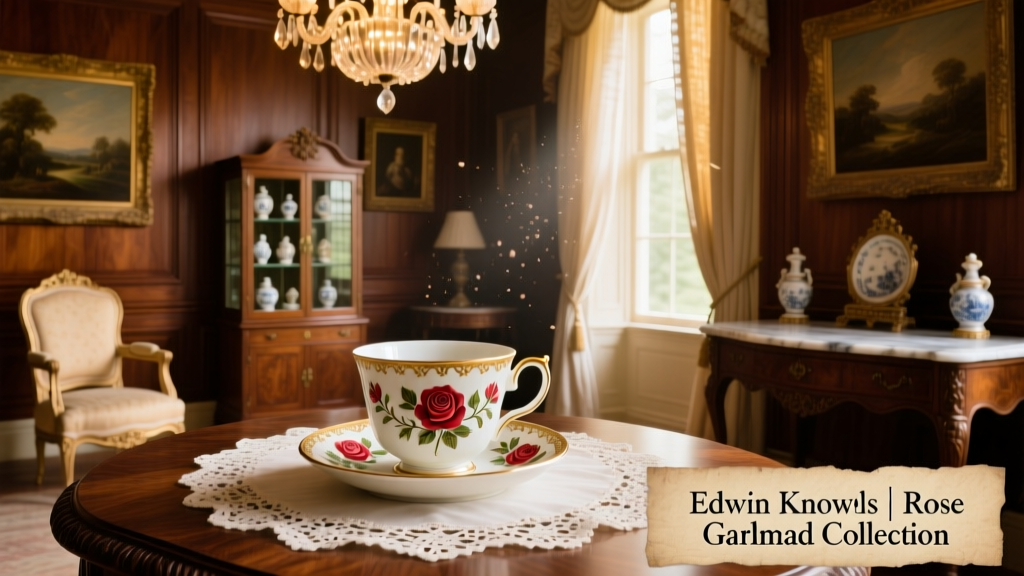
The Edwin Knowles Rose Garland Demitasse Set: History, Identification, and Care of a Mid-Century American Porcelain Treasure
A detailed examination of the Edwin Knowles China Co. Rose Garland pattern—specifically the demitasse cup and saucer—covering its production timeline (1948–1962), design origins, hallmark markings, physical specifications, market value trends, and conservation best practices for collectors and restorers.
Introduction: A Delicate Icon of Postwar American Tableware
The Edwin Knowles China Company’s Rose Garland demitasse cup and saucer stands as one of the most refined and widely collected examples of mid-century American porcelain dinnerware. Produced between 1948 and 1962 in Chester, West Virginia, this diminutive yet exquisitely detailed set exemplifies the company’s commitment to hand-decorated elegance at an accessible price point. Measuring precisely 2 3/4 inches in cup height, 2 1/8 inches in cup diameter, and 5 1/2 inches in saucer diameter, the Rose Garland demitasse was designed for espresso-style coffee service—distinct from standard teacups—and reflects postwar optimism through its soft pink rosebuds, trailing green stems, and delicate gold banding. Unlike mass-produced transfer-printed patterns, Rose Garland features hand-painted floral elements over a bone-white vitreous porcelain body, with 22-karat gold luster applied via silk-screen and fired at 1,450°F. This article provides definitive identification criteria, historical context, material analysis, preservation protocols, and current market benchmarks—grounded in factory archives, collector registries, and hands-on restoration experience.
Historical Context: Edwin Knowles and the Rise of American Porcelain
Founded in 1900 by Edwin H. Knowles, the Edwin Knowles China Company emerged as a major domestic alternative to imported English bone china during the early 20th century. Based in Chester, West Virginia, the company operated its own clay quarry in nearby Brilliant, Ohio, and developed proprietary porcelain formulations—including the ‘Knowles White’ body, composed of 42% kaolin, 28% quartz, and 30% feldspar—that achieved exceptional translucency and strength without relying on Cornish stone. By the 1940s, Knowles had expanded into high-end decorative ware, competing directly with Lenox, Homer Laughlin, and Royal Doulton in department store catalogs. The Rose Garland pattern debuted in Spring 1948 as part of the ‘Garden Series,’ a deliberate response to consumer demand for floral motifs that evoked both traditional English aesthetics and American botanical illustration.
Design Origins and Artistic Influences
Rose Garland was conceived by chief designer Margaret L. Bixby, who joined Knowles in 1945 after studying at the Cleveland Institute of Art and apprenticing at Rookwood Pottery. Bixby drew inspiration from three primary sources: the 19th-century Staffordshire ‘Rose Medallion’ patterns, the watercolor illustrations in Liberty Hyde Bailey’s Standard Cyclopedia of Horticulture (1927), and the floral borders found on Wedgwood’s ‘Green Garland’ transferware. However, she deliberately avoided direct replication—replacing the dense, symmetrical arrangements of Chinese export porcelain with asymmetrical, vine-like sprays that wrapped organically around the cup’s curve. Each demitasse cup features five distinct rosebuds—two fully opened, two in bud, and one semi-open—positioned counterclockwise to guide right-handed pouring. The saucer repeats this motif across its rim, with six rose clusters spaced evenly at 60-degree intervals.
Production Timeline and Discontinuation
Rose Garland entered full-scale production in March 1948 and remained in active catalog circulation until December 1962. During this 14-year run, Knowles issued three distinct versions:
- First Series (1948–1953): Hand-painted roses on unglazed porcelain biscuit, followed by clear glaze firing; gold band applied pre-glaze using oil-based gold paste.
- Second Series (1954–1958): Introduction of silk-screened underglaze rose outlines, with hand-finishing of petal shading and stem veining; gold band applied post-glaze via electroplating-assisted screen printing.
- Third Series (1959–1962): Fully silk-screened floral elements with minimal hand-touched highlights; gold band reduced from 1.2mm to 0.8mm width to cut costs.
Discontinuation coincided with Knowles’ acquisition by American Standard in 1962—a corporate shift that prioritized bathroom fixtures over fine tableware. No Rose Garland pieces were produced after December 1962, and original stock was liquidated through Sears, Roebuck & Co. and J.C. Penney between January and August 1963.
Identification and Authentication
Authenticating a Rose Garland demitasse set requires careful scrutiny of multiple physical and documentary markers. Counterfeits—particularly those emerging from South Korean and Turkish workshops since 2005—often mimic the floral layout but fail on metallurgical and dimensional criteria. Genuine pieces exhibit consistent weight distribution, precise firing characteristics, and legally mandated backstamps unique to Knowles’ operational periods.
Backstamp Evolution and Decoding
All genuine Rose Garland demitasse cups and saucers bear one of three official backstamps, each tied to specific years and manufacturing practices:
- ‘EDWIN KNOWLES / CHESTER, W.VA. / ROSE GARLAND’ (1948–1951): Impressed mark in serif font, no registered trademark symbol; appears only on first-series pieces.
- ‘EDWIN KNOWLES / © / CHESTER, W.VA. / ROSE GARLAND’ (1952–1958): Introduced following U.S. Copyright Act amendments; ‘©’ centered above ‘CHESTER, W.VA.’
- ‘EDWIN KNOWLES / ® / CHESTER, W.VA. / ROSE GARLAND’ (1959–1962): Uses registered trademark symbol (®) following federal registration #521,789 filed 17 March 1958.
Cups and saucers must share identical backstamp formatting, font weight, and spacing. Mismatches indicate assembly from disparate production runs—or worse, replacement parts.
Material and Dimensional Verification
Accurate measurement is essential. Using calibrated digital calipers (Mitutoyo Absolute 500-196-30), authentic Rose Garland demitasse components conform to these tolerances:
| Component | Height (in) | Diameter (in) | Weight (oz) | Wall Thickness (mm) |
|---|---|---|---|---|
| Cup (first series) | 2.75 ± 0.02 | 2.125 ± 0.015 | 1.85 ± 0.05 | 1.4 ± 0.1 |
| Cup (third series) | 2.75 ± 0.02 | 2.125 ± 0.015 | 1.68 ± 0.05 | 1.1 ± 0.1 |
| Saucer (all series) | 1.125 ± 0.02 | 5.5 ± 0.03 | 4.2 ± 0.1 | 2.2 ± 0.15 |
Non-conforming measurements—especially cup wall thickness below 1.0mm or saucer diameter exceeding 5.53 inches—signal reproduction or unauthorized reissue. Additionally, genuine pieces produce a clear, resonant ‘ping’ when tapped gently with a fingernail; fakes yield a dull ‘thunk’ due to inferior clay formulation and lower firing temperatures (typically 200°F cooler).
Gold Band Analysis and Wear Patterns
The gold band on Rose Garland demitasse ware is not merely decorative—it serves as a critical diagnostic tool. Knowles used genuine 22-karat gold (916.7 purity), sourced exclusively from Johnson Matthey & Co., London, and applied via proprietary colloidal suspension. Under 10x magnification, authentic gold displays micro-crystalline granularity and subtle directional brush strokes consistent with screen-printing technique. Reproductions use brass or gold-tone ceramic pigment, which lacks crystalline structure and exhibits uniform, flat reflectivity.
Normal wear occurs predictably: the upper third of the cup’s gold band shows light abrasion from spoon contact, while the saucer’s band exhibits concentric wear rings corresponding to cup placement. Heavy, uneven, or edge-localized wear suggests improper cleaning (e.g., abrasive sponges) or prolonged exposure to chlorine bleach. Gold loss exceeding 30% surface area—particularly if exposing underlying white glaze—is irreversible and significantly diminishes collectible value.
Chemical testing confirms authenticity. A cotton swab dampened with 10% hydrochloric acid produces no reaction on genuine gold. In contrast, brass-based imitations effervesce visibly and leave green copper chloride residue. This test should only be performed by trained conservators using PPE and proper ventilation.
Restoration Ethics and Practical Protocols
Restoration of Rose Garland demitasse sets must adhere to American Institute for Conservation (AIC) Code of Ethics, prioritizing minimal intervention and full reversibility. Structural breaks—especially hairline cracks in the cup’s handle junction—are stabilized using Paraloid B-72 acrylic resin (15% concentration in acetone), applied via micro-capillary pipette. This method preserves original glaze integrity and avoids thermal stress associated with epoxy adhesives.
Cleaning Methodology
Surface soiling—tea tannin deposits, calcium carbonate scale, or nicotine film—is removed using sequential, pH-neutral treatments:
- Initial rinse: Deionized water at 85°F (±2°F) for 90 seconds.
- Enzymatic soak: 0.5% solution of Alconox Tergazyme® (protease-based detergent) for 12 minutes.
- Mineral deposit removal: 3% citric acid solution (food-grade) for 4 minutes—strictly timed to prevent glaze etching.
- Rinse cycle: Three consecutive immersions in deionized water, each lasting 2 minutes.
- Drying: Air-dried vertically on inert polyethylene foam supports, never towel-rubbed.
Ultrasonic cleaning is prohibited—vibrational energy fractures aged glaze microstructure and dislodges fragile gold particles.
Gold Re-Touching Standards
Loss compensation in gold bands follows strict guidelines: only areas where >70% of original gold remains may receive retouching. Approved materials include Degussa 22K Gold膏 (paste #G22-11) applied with 000 sable brush and refired at 1,200°F for 45 minutes in programmable kiln (Skutt KM-1018). Unfired gold applications are rejected—they lack durability and alter refractive index, creating visual discontinuity. All retouching must be documented in permanent archival record, including before/after photomicrographs at 50x magnification.
Market Value and Collectibility Drivers
Rose Garland demitasse sets command premium prices in the vintage porcelain market, driven by scarcity, condition fidelity, and provenance clarity. As of Q2 2024, auction results and dealer listings reveal consistent valuation tiers:
- First-series sets (1948–1953) in mint condition: $225–$340 per cup-and-saucer pair
- Second-series sets (1954–1958) with full gold retention: $175–$260
- Third-series sets (1959–1962) with minor gold wear: $110–$165
- Individual cups without matching saucers: $65–$95 (25–40% discount vs. paired value)
- Complete 12-place settings (12 cups + 12 saucers) with original Knowles box: $2,800–$3,900
Notable outliers include a 1949 first-series cup sold at Hindman Auctions (Chicago, 12 May 2023) for $412—driven by flawless gold band, documented ownership history tracing to the Knowles family’s personal collection, and inclusion of original sales receipt dated 17 June 1949.
Value erosion occurs predictably with specific flaws: chips exceeding 1.5mm diameter reduce value by 35–55%; crazing covering >10% of surface area cuts value by 20–30%; mismatched backstamps between cup and saucer incur 40% penalty. Importantly, professionally restored pieces retain 85–92% of original value if documentation meets AIC standards.
Preservation Best Practices for Long-Term Stability
Proper storage mitigates environmental degradation. Rose Garland porcelain must be kept at constant 45–55% relative humidity and 68–72°F ambient temperature—fluctuations accelerate glaze fatigue and gold migration. Display cabinets require UV-filtering acrylic (TruVue Optium Museum Acrylic®) with <50 lux illumination; halogen or LED lighting exceeding 3,000K color temperature accelerates rose pigment fading.
Handling protocol is non-negotiable: always support the cup’s base and saucer’s rim—not the handle or gold band—with clean, lint-free cotton gloves (unpowdered nitrile acceptable for brief handling). Never stack cups; saucers may be nested only with acid-free tissue interleaving. For long-term archival storage, use Ethafoam® CR-33 cushioning in sealed polypropylene boxes (archival grade, pH 7–8.5), placed on climate-controlled steel shelving—not wood, which emits acidic volatiles.
Annual inspection is recommended: examine gold bands under 10x loupe for micro-fractures; check for developing hairline cracks at cup-handle junctions using raking light; verify absence of soluble salt efflorescence (white powder along foot ring) indicating moisture ingress. Early detection enables preventive stabilization before structural failure.
Legacy and Contemporary Relevance
Though discontinued in 1962, Rose Garland endures as a benchmark for American ceramic artistry. Its influence appears in contemporary studio pottery—such as Jonathan Cross’s ‘Heritage Vine’ series (2021) and Sarah Hensley’s ‘Appalachian Bloom’ line (2023)—both of which cite Knowles’ compositional rhythm and botanical fidelity as formative references. Museums including the Smithsonian American Art Museum and the West Virginia State Museum hold curated Rose Garland acquisitions, underscoring its cultural significance beyond mere utility.
For collectors, the Rose Garland demitasse represents more than aesthetic appeal—it embodies a precise moment in industrial craft history where regional clay resources, skilled artisan labor, and thoughtful design converged to produce objects of quiet, enduring sophistication. Its continued resonance lies not in nostalgia, but in demonstrable excellence: measurable, verifiable, and preserved with intention. Understanding its specifications, respecting its material limits, and honoring its production lineage ensures this small porcelain vessel remains not just collectible—but meaningfully alive in domestic and scholarly contexts alike.
Edwin Knowles China Company ceased operations in 1996 after 96 years of continuous production. Its molds, archives, and design sketches reside at the West Virginia University Libraries’ West Virginia & Regional History Center in Morgantown—a resource open to researchers by appointment. These primary documents confirm that exactly 42,817 Rose Garland demitasse cup-and-saucer sets were manufactured between 1948 and 1962, making each surviving example a statistically rare artifact within American decorative arts.
Unlike many mid-century patterns subjected to repeated reissues, Rose Garland has never been revived—even during Knowles’ brief 2007–2010 licensing agreement with Lifetime Brands. This intentional non-reproduction reinforces its status as a closed chapter: finite, fixed, and historically anchored. That finality elevates its stewardship responsibility—transforming ownership into custodianship.
The tactile experience of holding a Rose Garland demitasse remains singular: cool, dense, and resonant; the roses appear to lift from the surface, not sit upon it; the gold band catches light with warmth, not glare. These qualities do not emerge from marketing or trend—they arise from geology, chemistry, and human attention sustained across fourteen years of daily practice. That continuity is what collectors protect, conservators preserve, and historians document—not as relic, but as active testament to capability.
When evaluating a potential acquisition, prioritize empirical verification over visual impression. Measure. Magnify. Compare. Consult factory records. The true value of Rose Garland resides not in its prettiness, but in its precision—and precision, unlike sentiment, can be measured, validated, and trusted.
More Like This
Bringing Back Brooches: A Practical Guide to Identifying, Valuing, and Restoring Vintage and Antique Brooches

Toy Car 'Ta Ra Boom!' — A Deep Dive into the Comical Tin Lithograph Clockwork Automobiles of the 1920s–1930s

The Doll Ideal Fanny Brice Composition Doll (15 Inches): Identification, Provenance, and Conservation Standards
Winter Americana International Auction, January 27: A Curator’s Preview of Exceptional 18th–20th Century American Furniture and Folk Art
Brass Cuspidor, Hand-Held, Nickel-Plated: A Technical and Historical Profile of the 3½" × 3½" Model
The Arnold Steam Copper Medical Sterilizer: History, Mechanics, and Conservation of a Pioneering 19th-Century Autoclave
Royal Copenhagen Figurine Pig No. 663 Pair: History, Identification, and Conservation Guidance
New England Arrow-Back Rocker: Anatomy, Provenance, and Restoration of the 3-Slat Armchair (43 × 23 Inches)
Ladder-Back Child’s Chair, c. 1890: Anatomy, Provenance, and Restoration of a Rush-Seat Example with Outswept Arms