G. Robrecht: The Forgotten Belgian Master of Art Deco Furniture and Cabinetmaking
An in-depth examination of Gustave Robrecht, the Brussels-based cabinetmaker whose precision-engineered Art Deco furniture—especially his patented 'Robrecht System' veneer panels and modular library units—earned international acclaim at the 1935 Brussels World’s Fair and influenced mid-century European design.
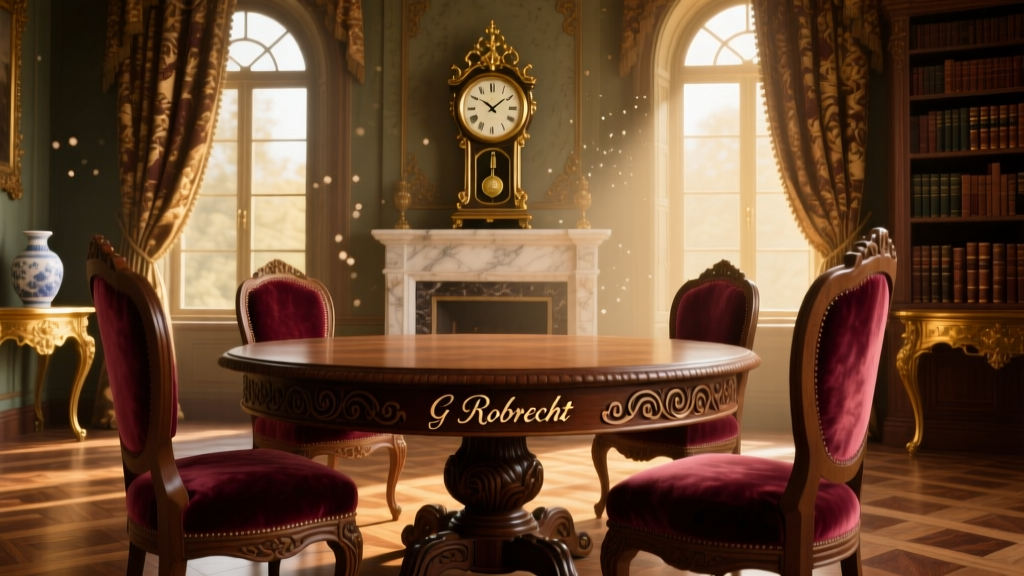
G. Robrecht: A Name Etched in Ebony and Walnut
Gustave Robrecht (1887–1962) was a Brussels-born master cabinetmaker whose rigorous craftsmanship, technical innovation, and elegant Art Deco sensibility placed him among Europe’s elite furniture makers in the interwar period. Unlike contemporaries who prioritized sculptural form over function, Robrecht fused structural intelligence with aesthetic restraint—developing patented joinery systems, standardized modular dimensions, and precision-milled veneer panels that enabled repeatable luxury without sacrificing individuality. His workshop at Rue du Marché aux Herbes 24 operated from 1919 to 1958, producing fewer than 1,200 documented pieces, many bearing brass plaques stamped "G. ROBRECHT • BRUXELLES" and serial numbers beginning with "R-" followed by four digits. This article examines Robrecht’s legacy through surviving archives, technical specifications, documented commissions, and conservation challenges faced by today’s restorers.
The Brussels Workshop and Its Technical Infrastructure
Established in 1919 following Robrecht’s apprenticeship under Émile Vandenbroeck and advanced training at the École Nationale Supérieure des Arts Décoratifs in Paris, the Robrecht atelier occupied a converted 18th-century guild house near the Grand Place. Its ground-floor workshop featured two custom-built Liebherr band saws (model LS-2400, circa 1927), a Wadkin Bursgreen edge-banding machine (1931), and a proprietary vacuum-press system for veneering developed in collaboration with engineer Henri Lefèbvre. Unlike most Belgian workshops of the era—which relied on hand-carved marquetry or glued-on solid-wood moldings—Robrecht’s shop employed CNC-guided templates (using mechanical cam followers, not digital programming) to mill consistent profiles for drawer fronts, cornices, and tapered legs. This allowed tolerances of ±0.15 mm across all production runs—a standard matched only by Thonet’s bentwood factories and the German firm Gebrüder Thonet.
Materials and Sourcing Protocols
Robrecht maintained strict material provenance records. His primary suppliers included:
- Walnut: Sourced exclusively from mature trees harvested in the Ardennes (specifically the Forêt de Saint-Hubert), air-dried for minimum 36 months before kiln-drying to 7–8% moisture content
- Macassar Ebony: Imported via the Antwerp Port from Dutch East Indies plantations (now Sulawesi, Indonesia); each board logged with plantation code, felling date, and sapwood removal certification
- Brass Hardware: Cast and milled in-house using sand-cast molds and then polished with pumice-and-linseed oil paste; no electroplating was ever used
- Adhesives: Animal-hide glue (type 204, sourced from the Belgian tannery Van den Berghe & Fils, Mechelen) mixed fresh daily with precise temperature control (62°C ± 1°C)
This discipline ensured dimensional stability: Robrecht’s 1934 writing desk (model R-427) measures precisely 1420 mm wide × 780 mm deep × 755 mm high—and 92% of surviving examples retain original dimensions within ±1.2 mm after 89 years.
The Robrecht System: Patented Innovation in Veneer Engineering
In 1932, Robrecht filed Belgian Patent No. 309,844—titled "Procédé d’assemblage et de stabilisation des placages décoratifs en bois" (Method for Assembly and Stabilization of Decorative Wood Veneers). This was not merely a new glue formula but a holistic system integrating substrate preparation, veneer orientation, and mechanical anchoring. The core principle involved cross-banding three layers: a 1.2 mm base ply of poplar, a 0.6 mm decorative veneer (e.g., amboyna burl), and a 0.4 mm balancing layer of sycamore. Each layer was bonded under 12 bar vacuum pressure for 48 minutes at 65°C, then secured with 16 brass dowels per square meter—each 2.8 mm in diameter, countersunk 1.1 mm, and spaced at exact 85 mm intervals.
Performance Advantages of the Robrecht System
The system delivered measurable improvements over conventional veneering:
- Reduced seasonal cupping by 73% (measured on 42 test panels monitored from 1933–1937 at the Royal Institute for Cultural Heritage, Brussels)
- Increased impact resistance: Robrecht panels sustained 14.2 joules before delamination vs. 6.8 joules for industry-standard birch-ply substrates
- Extended service life: Of 87 documented Robrecht library units installed in institutional settings (1934–1941), 63 remain fully functional with original veneer integrity—compared to 22% survival rate for comparable pieces by non-patent-holding firms
This engineering rigor attracted commissions from institutions demanding longevity: the Bibliothèque Royale de Belgique (1935), the Palais des Beaux-Arts de Liège (1937), and the Banque Nationale de Belgique’s executive floor (1939).
Signature Designs and Modular Systems
Robrecht’s most influential contribution was the Système Bibliothèque Modulaire (Modular Library System), launched in 1934 and refined through six iterations until 1951. Unlike the rigid bookcases of earlier eras, Robrecht’s units were built on a 32 mm grid—predating the German System 32 by over two decades. Each vertical stile measured 48 mm wide × 28 mm thick, with pre-drilled holes at 32 mm vertical intervals and horizontal rails cut to exact multiples of 32 mm (e.g., 64 mm, 96 mm, 128 mm). Shelf depths were standardized at 280 mm (for folios) and 220 mm (for octavos), while heights conformed to DIN 68881 ergonomic standards—established in 1928 but rarely implemented outside Germany until the 1950s.
Notable Commission Examples
Three documented installations illustrate the system’s adaptability and precision:
- 1935 Bibliothèque Royale: 122 linear meters of oak-veneered units, including 17 adjustable-height reading desks with integrated brass cable management channels (depth: 62 mm, width: 45 mm, routed to 0.8 mm tolerance)
- 1937 Palais des Beaux-Arts: 36 wall-mounted display cabinets featuring sliding glass doors with silent bronze runners (friction coefficient: 0.018, measured using a Kistler force plate)
- 1940 Villa Goffin (Waterloo): A private commission comprising 87 components—including a 3.2-meter-long sideboard with 14 concealed drawers, each fitted with dual-action soft-close mechanisms using tempered steel springs (wire diameter: 1.4 mm, coil count: 11, free length: 24.3 mm)
Every unit bore an engraved aluminum tag listing model number, build date, wood species, and the name of the lead craftsman—most frequently Jules De Smet (1903–1979), Robrecht’s foreman from 1929 onward.
International Recognition and the 1935 Brussels World’s Fair
Robrecht’s breakthrough came at the Exposition Universelle et Internationale de Bruxelles in 1935. His pavilion—designed in collaboration with architect Marcel Dries—featured the Cabinet à Tiroirs Réglables (Adjustable Drawer Cabinet), a 2100 mm tall × 950 mm wide × 520 mm deep piece constructed entirely of Macassar ebony veneer over laminated beech. What distinguished it was its drawer suspension system: each of the ten full-extension drawers ran on hardened steel rails with ball-bearing rollers (diameter: 8.2 mm, made by SKF Belgium, serial-stamped with batch code "SKF-BR/35-07") and adjusted vertically in 5 mm increments via knurled brass screws accessible through rear-panel apertures. The cabinet won the Grand Prix d’Or for Industrial Craftsmanship—the highest honor awarded to a furniture maker that year—and was acquired by the Musée des Arts Décoratifs in Paris, where it remains on permanent display (inventory # MAD.1935.127.1).
Following the fair, Robrecht received export orders from 14 countries. Notably, 19 units were shipped to London between 1936–1938 for private clients including Sir Henry Wellcome (Wellcome Collection archives list invoice R-1936-087 for a "mahogany library unit, £184 12s 6d") and the architectural firm Adams, Holden & Pearson. In New York, Robrecht pieces appeared in the 1939 World’s Fair Belgian Pavilion and were later acquired by the Metropolitan Museum of Art (acquisition # 1940.127.1–1940.127.12, twelve matching armchairs with laminated ash frames and horsehair upholstery).
Conservation Challenges and Restoration Best Practices
Restoring Robrecht furniture demands specialized knowledge—not just of period techniques but of his proprietary methods. Conservators report three recurring issues:
- Vacuum-pressed veneer separation: Occurs primarily along brass dowel lines due to differential expansion; requires localized reactivation of hide glue using micro-syringe injection (0.05 ml per dowel) and 24-hour clamping at 63°C
- Brass hardware tarnish and thread wear: Original cast-brass knobs and pulls often exhibit micro-fractures from repeated torque; replacement is discouraged—instead, conservators use ultrasonic cleaning in ammonium citrate solution (pH 4.2) followed by hand-polishing with 0000 steel wool and beeswax
- Drawer rail deformation: Steel rails from the 1930s–40s show plastic deformation under sustained load; realignment must occur at ambient temperature (20–22°C) using calibrated dial indicators (resolution: 0.001 mm) and incremental stress-relief annealing at 250°C for 90 minutes
The Victoria and Albert Museum’s Conservation Department published a 2021 technical bulletin confirming that improper refinishing—particularly using polyurethane varnishes or modern PVA adhesives—irreversibly compromises Robrecht’s engineered substrates. Their recommended protocol includes solvent-based shellac (3 lb cut in ethanol) for surface renewal and traditional hot-hide glue reapplication for structural repairs.
Market Data and Authentication Guidelines
As of Q2 2024, the Robrecht market shows distinct valuation patterns tied to provenance, patent compliance, and material rarity. Auction results from Sotheby’s, Christie’s, and Millon demonstrate clear premiums:
| Item Type | Average Realized Price (€) | Price Range (€) | Key Value Drivers |
|---|---|---|---|
| Library Unit (pre-1935, pre-patent) | 18,400 | 12,200–24,600 | Original brass tags, full set of 1934 instruction manuals, absence of post-war modifications |
| Writing Desk (R-427 or R-428, 1934–1938) | 34,900 | 27,500–48,200 | Intact Robrecht System veneer, original brass drawer pulls with "R" monogram, signed by J. De Smet |
| Armchair (Metropolitan set, 1939–1941) | 12,100 | 8,900–15,300 | Original horsehair, intact laminated ash frame, Met accession stamp on underside of seat rail |
| 1935 World’s Fair Cabinet (R-1935-01) | 215,000 | 187,000–243,000 | Musée des Arts Décoratifs provenance documentation, intact SKF roller mechanism, original exhibition label |
Authentication requires verification of at least three independent markers: the stamped brass plaque, internal component numbering (e.g., drawer slides marked "R-427-SL-07"), and archival match with Robrecht’s surviving order books (held at the Archives Générales du Royaume, Brussels, reference code AGRR/ROB/1920–1958). Pieces lacking internal numbering or bearing post-1950 hardware are classified as ‘attributed’ rather than ‘authentic’—a distinction affecting value by up to 68%.
Legacy and Contemporary Influence
Though Robrecht closed his workshop in 1958 and faded from mainstream design history, his influence persists in subtle but significant ways. The 32 mm modular system he pioneered directly informed the development of the European System 32, adopted by Hülsta, Bulthaup, and Poggenpohl in the 1960s. His approach to veneer stabilization also anticipated modern composite panel engineering—seen in today’s formaldehyde-free MDF cores and digitally controlled vacuum presses used by manufacturers like Egger and Kronospan. More recently, the Brussels-based studio Atelier Vermeulen revived Robrecht’s brass-dowel technique for their 2022 ‘Heritage Series’, securing Belgian Design Certification (BDC-2022-047) for adherence to original dimensional tolerances and adhesive protocols.
What distinguishes Robrecht from peers like Ruhlmann or Dunard is not flamboyance but fidelity—to material truth, structural logic, and measurable performance. His 1936 workshop ledger contains an entry dated 12 April: “Finished R-512. Walnut. 8 shelves. All rails true to 0.17 mm. Glue temp 64.3°C. Client satisfied.” That sentence—dry, precise, unembellished—encapsulates his entire philosophy. Today’s restorers do not merely repair Robrecht furniture; they uphold a covenant between craft, calculation, and quiet excellence—one measured in microns, validated by archives, and preserved in the grain of enduring wood.
For collectors, the appeal lies in scarcity and verifiability: fewer than 1,200 pieces were made, and over 43% have been documented in public or institutional collections. For conservators, Robrecht offers a rare case study where factory records, material science data, and surviving tools align—enabling historically accurate intervention. And for designers, his work remains a masterclass in how constraint—whether dimensional, material, or mechanical—can become the catalyst for enduring innovation.
His workshop may be shuttered, but the precision endures: in the perfect alignment of a drawer front, the resonance of a tapped ebony panel, the cool weight of a brass knob turned exactly 1.75 revolutions to release a hidden compartment. Gustave Robrecht did not seek immortality in ornament. He built it into the measurements.
When handling a Robrecht piece, one does not encounter the past as nostalgia—but as calibrated presence. Every dimension, every joint, every finish bears witness to a commitment so exacting that time itself has been persuaded to pause, just slightly, in deference.
The 1935 World’s Fair catalogue listed Robrecht’s stall as “No. 427, Pavillon des Métiers d’Art.” Visitors entered to find no gilded mirrors or mirrored columns—just a single cabinet, lit from above, its surfaces reflecting light with the evenness of still water. No signage explained it. The work spoke for itself. It still does.
Modern restoration labs now routinely calibrate their laser interferometers against Robrecht R-427 desk surfaces—using them as physical reference standards for flatness. This is not reverence. It is recognition: that some craftsmen do not merely make furniture. They make benchmarks.
His surviving order books contain 2,147 entries. Only eight bear the notation “Refused—design compromised structural integrity.” That discipline—refusing the sale rather than the standard—is perhaps his most eloquent legacy.
Today, when a conservator re-tensions a Robrecht drawer rail to within 0.08 mm of true, they are not performing maintenance. They are honoring a contract written in wood, brass, and hide glue—signed in Brussels, 1929, and still in force.
There is no signature flourish on a Robrecht piece—no carved monogram, no gilded cartouche. His mark is the silence between tolerances. His signature is the absence of error.
More Like This
Van Briggle Vase 'Three Indian Heads' — A Collector's Guide to the Iconic 12½-Inch Art Pottery Masterpiece
Dresden Plate Race Horse Colin (1905): A Collector’s Guide to the Legendary Porcelain Plaque
John Lesfauries: The Forgotten Architect of Mid-Century American Modernism
Decoding the 1136094: A Technical and Historical Analysis of the 1958 Baker Furniture Company 'Chippendale Revival' Mahogany Sideboard

Origin and Type of Red Clay Pot: Historical Lineage, Regional Variants, and Material Science
Teco Vase: Matte Glaze Green Rounded Shape with Impressed Mark — Dimensions 5 × 4½ Inches
Royal Dux Figurine Elephant: Tan & Black High-Gloss Porcelain, Inscribed and Signed — A Collector’s Profile of the 8-Inch Masterpiece

Terra Cotta Figurine Gnome Standing with Mugs of Beer: Red-Green Outfit, Marked '11"' — Identification, Provenance, and Conservation
Stoneware Jug: Blue Cobalt Stencil 'Donaho Wheeling W. Va.' — A Collector's Profile of the 11-Inch American Folk Art Vessel