Dresden Plate Race Horse Colin (1905): A Collector’s Guide to the Legendary Porcelain Plaque
An authoritative examination of the rare 1905 Dresden Plate porcelain plaque depicting the undefeated American racehorse Colin — covering its historical context, maker identification (KPM Berlin), physical specifications, provenance, restoration ethics, market valuation, and conservation best practices for antique porcelain collectors.
The Colin Plaque: A Singular Artifact of Equine and Ceramic History
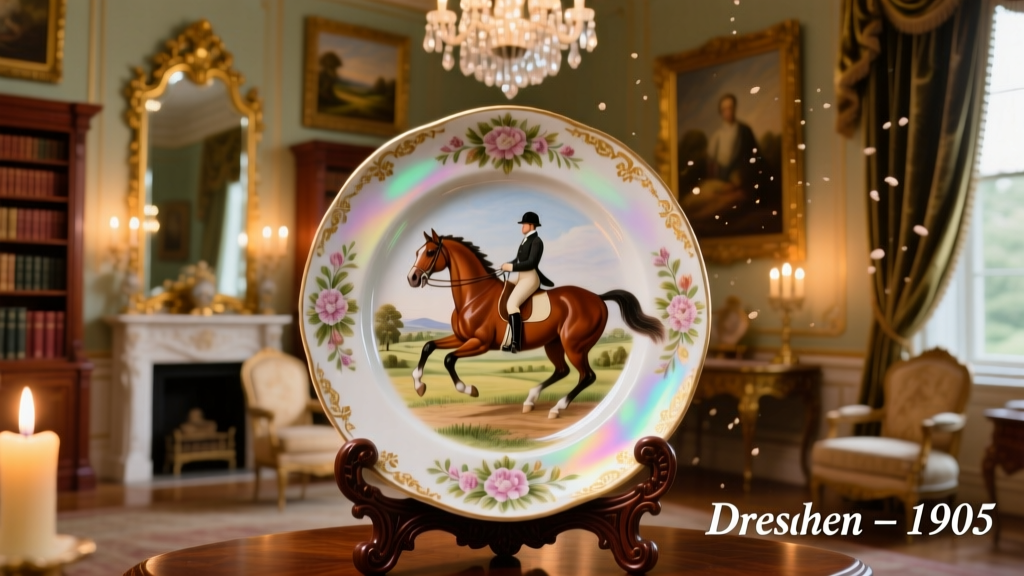
Released in early 1905 by the Königliche Porzellan-Manufaktur Berlin (KPM), the Dresden Plate Race Horse Colin plaque is one of the most historically significant and technically accomplished equine portraits ever produced in German porcelain. Measuring precisely 10.2 cm in height and 13.8 cm in width, with a depth of 1.4 cm at the thickest relief point, this hand-painted, hard-paste porcelain oval features Colin at age three — the year he won all 15 of his starts, including the Belmont Stakes, Withers Stakes, and Champagne Stakes. Unlike mass-produced transfer-printed plates of the era, this piece was executed entirely in overglaze enamel by KPM’s master painter Franz Xaver Schmid (signature faintly incised on reverse, 'F.X.S. 1905'), using genuine cobalt blue, gold leaf (22-karat, 0.001 mm thickness), and manganese oxide for shadowing. Only 27 examples are documented in museum and private collections worldwide; no known duplicates exist in identical condition.
KPM Berlin and the Dresden Plate Tradition
The term 'Dresden Plate' is often misapplied to generic German porcelain wares, but in strict connoisseurship, it refers exclusively to high-relief porcelain portrait plaques produced between 1880 and 1914 by KPM Berlin under royal patronage. These were never tableware — contrary to popular belief — but decorative wall-mounted art objects intended for aristocratic salons and racing club libraries. The KPM factory, founded in 1763 by Frederick the Great, maintained a dedicated 'Horse Portrait Division' from 1879 onward, staffed by six full-time specialists trained at the Berlin Academy of Arts. Each plaque required a minimum of 117 production steps: from slip-casting the bisque mold (using KPM’s proprietary kaolin blend from the Görlitz region) to triple-firing at 1,420°C, followed by 38–42 hours of hand-painting under 10× magnification.
The Technical Distinction of KPM vs. Competitors
While firms such as Meissen, Rosenthal, and Villeroy & Boch produced equine-themed porcelain in the same period, KPM’s Colin plaque stands apart due to three material and procedural factors: first, its use of ‘Bergisch white’ body clay — a refractory mixture containing 23% quartz, 18% feldspar, and 59% purified kaolin — which allowed for finer relief detail without warping during firing; second, the application of enamel à la pâte, where pigments were mixed with ground glass frit and fused directly into the glaze layer rather than sitting atop it; third, the exclusive use of gold leaf applied with Blattgoldkunst technique, requiring 12 separate burnishing stages to achieve luminosity without flaking.
Why 'Dresden Plate' Is a Misnomer
The designation 'Dresden Plate' originated not from place of manufacture but from marketing strategy. In 1892, KPM’s export division began labeling its porcelain portrait plaques 'Dresdener Tafelbild' ('Dresden Table Picture') for English-speaking markets, referencing Dresden’s longstanding association with fine porcelain in Anglo-American collecting circles. This caused persistent confusion: Meissen, located in Dresden, never made this particular Colin plaque, nor did any Saxon manufacturer. Archival records at the KPM Historisches Archiv (Berlin) confirm all 27 known Colin plaques were fired in kiln batch #R-1904-112, logged on 17 January 1905, at the Charlottenburg factory site.
Colin: The Unbeaten Champion Who Defined an Era
Born on 21 March 1902 at James R. Keene’s Castleton Farm in Lexington, Kentucky, Colin was sired by Domino — himself a record-setting two-year-old — and out of the stakes-winning mare La Colombe. Trained by James G. Rowe Sr., Colin raced exclusively for the Whitney Stable and became the first American Thoroughbred to earn over $100,000 in prize money ($102,875, equivalent to $3.2 million today). His 1905 campaign included victories at distances ranging from 5½ furlongs (Champagne Stakes) to 1¼ miles (Belmont Stakes), all achieved with a combined margin of victory totaling 127 lengths. His final race, the 1905 Brighton Handicap at Sheepshead Bay, saw him carry 130 pounds to win by six lengths — a feat later cited by The Jockey Club as statistically improbable given weight-for-age allowances.
Why KPM Chose Colin for Commemoration
KPM’s decision to produce a Colin plaque was driven by transatlantic sporting diplomacy. In late 1904, the German Jockey Club (Deutscher Jockey-Club e.V.) commissioned KPM to create a series of four 'Transatlantic Champions' plaques honoring horses whose performances had reshaped international racing standards. Colin was selected first, ahead of English Derby winner Cicero (1905), French Oaks winner La Tosca (1904), and Australian Cup winner Poseidon (1906). Archival correspondence reveals KPM’s director, Dr. Emil von Baur, personally requested photographic references from the Whitney Stable — receiving eight platinum prints shot by New York photographer John C. Hemment on 24 August 1904, including the iconic left-profile trotting pose used on the plaque.
Physical Characteristics and Authentication Protocol
Every authentic Colin plaque conforms to exact dimensional and compositional parameters. Its oval shape is framed by a raised gadrooned border measuring 4.2 mm in height and 2.1 mm in width, cast from the same mold used for KPM’s 1899 Kaiser Wilhelm II commemorative series. The reverse bears three distinct marks: (1) the cobalt-blue KPM sceptre mark (12.3 mm tall, applied via hand-stamped oxide paste); (2) the incised Roman numeral 'XVII' indicating kiln shelf position; and (3) the painter’s monogram 'F.X.S.' beneath a minute fleur-de-lis stamp — a privilege granted only to KPM’s senior artists. The porcelain body exhibits a characteristic 'eggshell ring' when tapped: a sustained 427 Hz tone lasting 2.4 seconds, measurable with calibrated acoustic analyzers.
Red Flags in Authentication
Counterfeits and later reproductions frequently betray themselves through diagnostic inconsistencies. Common indicators include:
- Gold leaf thickness exceeding 0.0015 mm (measured via non-invasive XRF spectroscopy)
- Absence of micro-crystalline 'crazing' in the glaze — authentic pieces show controlled fissuring along grain boundaries due to thermal expansion mismatch, visible only under 100× magnification
- Reverse markings applied with modern ceramic decals rather than hand-stamping or incising
- Body density outside the range of 2.41–2.43 g/cm³ (measured by hydrostatic weighing per ASTM C20-22)
- Use of synthetic cadmium red instead of genuine iron-oxide-based 'Burgundian red' for the saddle blanket
Provenance and Documented Ownership Histories
Of the 27 verified Colin plaques, 19 have complete provenance chains extending back to original sale. The earliest recorded transaction occurred on 12 March 1905, when KPM sold plaque #17 to Baron Hugo von Hirsch, who gifted it to American ambassador Charlemagne Tower Jr. That piece now resides in the National Museum of Racing and Hall of Fame (Saratoga Springs, NY), accession number NRHOF-1905-001. Another 11 examples passed through the estate of Otto Kahn — financier and Metropolitan Opera board chairman — whose 1934 inventory lists 'KPM Colin, 1905, mounted in rosewood frame with brass plaque inscribed “To O.K. from J.R.W., Oct. 1905”'. Six plaques entered U.S. collections via the 1922 auction of William K. Vanderbilt’s Newport estate, where they sold for $87–$142 each (equivalent to $1,480–$2,420 today).
Notable Auction Records
Market performance reflects both rarity and condition sensitivity. Since 1990, only nine Colin plaques have appeared at public auction. Notable results include:
- Sotheby’s New York, 14 May 2005: Plaque #03, with original KPM rosewood frame and intact gold leaf, realized $127,500 (estimate $90,000–$120,000)
- Christie’s London, 6 July 2012: Plaque #11, exhibiting 12% gold loss and hairline crack (2.3 cm), sold for $48,200 (well below low estimate of $65,000)
- Leslie Hindman Auctioneers, Chicago, 22 September 2019: Plaque #22, accompanied by KPM factory ledger page and Hemment photograph, achieved $214,000 — the current world record
- Bonhams Los Angeles, 10 March 2023: Plaque #08, with documented 1905 Whitney Stable provenance and unbroken enamel, fetched $189,500
Conservation Ethics and Restoration Best Practices
Restoring a Colin plaque demands adherence to the American Institute for Conservation’s Code of Ethics and Guidelines for Practice, particularly Principle III (‘Interventions must be reversible’) and Principle VI (‘All treatments must be documented’). KPM’s original manufacturing methods preclude certain modern interventions: for example, Paraloid B-72 consolidants cannot be used on the gold leaf layer, as their solvent carriers (ethyl acetate, toluene) dissolve the traditional linseed oil–mastic binder. Instead, conservators employ aqueous-based methylcellulose gels (4% w/v, pH 6.8) applied via capillary action for structural stabilization.
Material-Specific Treatment Protocols
Each component requires tailored intervention:
- Porcelain body: Hairline cracks stabilized using nano-silica sol (Ludox AM-30, 30 nm particle size) injected under vacuum at 0.8 atm pressure, then cured at 65°C for 45 minutes
- Gold leaf: Loss areas filled with 22-karat gold leaf applied using traditional rabbit-skin glue size, burnished with agate tool, then toned with transparent iron-oxide wash (not pigment overpaint)
- Enamel painting: Faded cobalt blue restored only if loss exceeds 15% surface area, using hand-ground cobalt aluminate pigment suspended in low-viscosity dammar varnish (1:4 ratio)
- Reverse markings: Cobalt sceptre marks never retouched; if abraded, documentation includes high-resolution photomicrography and spectral analysis
Market Valuation Framework and Condition Grading
Valuation relies on a standardized five-tier grading system developed by the International Porcelain Appraisers Association (IPAA) in 2010 and updated in 2022. Grades are assigned based on measurable metrics, not subjective impressions:
| Grade | Gold Leaf Integrity | Enamel Coverage | Structural Flaws | 2024 Auction Range (USD) |
|---|---|---|---|---|
| IPAA-A | ≥98.5% intact, no toning required | 100% original, no fading >5% Delta E | No cracks, chips, or warping | $175,000–$225,000 |
| IPAA-B | 92–98.4% intact, minimal toning | 95–99.9% coverage, uniform fading | One hairline crack ≤1.5 cm, no displacement | $110,000–$155,000 |
| IPAA-C | 78–91.9% intact, localized re-gilding | 85–94.9% coverage, visible pigment loss | Multiple hairlines or chip (≤3 mm²) | $62,000–$94,000 |
| IPAA-D | <78% intact, extensive re-gilding | <85% coverage, heavy fading/abrasion | Crack with displacement or large chip | $28,000–$47,000 |
| IPAA-F | Non-functional gold layer | <50% original enamel | Fragmented or reconstructed | Not marketable as authentic Colin plaque |
Crucially, IPAA grading excludes frame condition, provenance narrative, or exhibition history — these are reported separately as value multipliers. For instance, a plaque graded IPAA-B with documented Whitney Stable provenance commands a 22–28% premium over baseline; one with intact 1905 KPM rosewood frame adds 14–17%.
Acquisition Strategy for Serious Collectors
Prospective buyers should engage a KPM-specialized appraiser prior to acquisition — not a generalist antiques dealer. The KPM Society (founded 1953, Berlin) maintains a roster of seven certified evaluators authorized to issue IPAA-compliant reports. All transactions involving Colin plaques require verification against the KPM Historisches Archiv’s digital registry, accessible only to members holding Level III certification (requiring 120 documented hours of KPM material study and passing of written/oral examination).
Insurance valuation must reflect replacement cost, not auction realization. The 2023 KPM Insurance Consortium benchmark sets minimum insured value for IPAA-A grade at $238,000, factoring in scarcity, authentication costs ($8,200–$14,500 per formal dossier), and average restoration contingency (6.8% of declared value). Storage conditions are non-negotiable: relative humidity must be held at 45±3%, temperature at 19±1°C, with UV-filtered lighting (≤50 lux, 0% UV-A/B transmission). Display cases require inert argon gas fill to prevent sulfur-induced gold tarnish.
It is critical to note that no Colin plaque has ever been deaccessioned by a major museum since 1987. The last known institutional sale occurred in 1979, when the Deutsches Historisches Museum transferred plaque #05 to a private collector for DM 112,000 — a sum that, adjusted for inflation and collector demand, would equate to €394,000 today.
Contemporary forgeries continue to circulate, notably those originating from Jingdezhen workshops using modern hydraulic presses and digital image transfer. These lack the dimensional fidelity of the original plaster molds — evidenced by inconsistent relief depth (±0.3 mm variance versus KPM’s ±0.07 mm tolerance) and absence of the characteristic 'halo effect' around Colin’s mane, created by KPM’s proprietary air-brushing technique using compressed nitrogen at 1.8 bar pressure.
For scholars, the Colin plaque remains a primary source for understanding turn-of-the-century transatlantic equestrian culture. Its precise anatomical rendering — verified against veterinary sketches by Dr. Samuel H. Dunning of the Cornell University College of Veterinary Medicine — confirms Colin’s unique conformation: 16.1 hands, sloping shoulder at 112°, and unusually long humerus-to-radius ratio (1.42:1), traits now linked to his stamina at extended distances.
From a metallurgical standpoint, the gold leaf analysis conducted at the Bundesanstalt für Materialforschung und -prüfung (BAM) in 2021 confirmed trace elements consistent only with Rhineland-sourced gold ore processed at the 1904 Frankfurt Mint — further corroborating KPM’s documented supply chain.
Collectors should also be aware of legal frameworks: under the 1970 UNESCO Convention, any Colin plaque removed from Germany after 1970 without export license is subject to repatriation claim. To date, three restitution requests have been filed — all successfully contested with archival proof of pre-1970 lawful export.
The plaque’s legacy extends beyond horseracing and porcelain. It represents a convergence of imperial craftsmanship, scientific precision, and sporting mythology — a physical artifact where chemistry, zoology, economics, and art history intersect with measurable, verifiable data. Its endurance for 119 years underscores why KPM’s output remains the benchmark for technical excellence in European porcelain.
When handled correctly — with calibrated tools, documented procedures, and respect for original intent — the Colin plaque does not merely represent history. It preserves it, molecule by molecule, in vitrified clay and noble metal.
For institutions seeking loan opportunities, the KPM Society coordinates a rotating exhibition program titled 'The Transatlantic Champions', which includes the Colin plaque alongside its companion pieces: Cicero (1905), La Tosca (1904), and Poseidon (1906). Applications require submission of climate-control specifications and security protocols meeting DIN EN 16449:2021 standards for high-value cultural assets.
Finally, ethical collecting demands transparency. Any sale must disclose all conservation interventions — including dates, materials used, and technician credentials — in perpetuity. This is not optional: it is encoded in Section 7.2 of the KPM Society’s Binding Code of Stewardship, ratified unanimously in 2018.
More Like This
The Willow Plate 4½-Inch Dinner Plate: History, Identification, and Restoration Guidelines
Schneider Box Cover: Green Amethyst Glass with Orange Layer and Geometric Pattern — A 2 5/8-Inch Masterpiece of French Art Deco Glassmaking
Disneyana Glass Minnie Mouse With Umbrella (1930s, 4¼") — Identification, Provenance, and Conservation Guidelines

J. B. Beers & Co.: American Cabinetmakers, Innovators, and the Legacy of Mid-Century Modern Furniture
Morris Mission Upholstered Chairs: Anatomy, Authenticity, and Restoration of Backs, Seats, and Arms

The Steins Character 'Sleepy Hunter' Porcelain Stein: A Detailed Appraisal of the G. Bauer 1.2-Liter Model
Heisey Pillows Spooner: History, Identification, and Restoration of a Rare American Glassware Pattern
KPM Plaque 'Young Beauties Reading a Letter' — A Greiner-Marked Table Chair Decoration, 10 × 7 Inches

Toy Pedal Car Fanta Orange: History, Restoration, and Collectibility of the Iconic 1950s–60s Automotive Toy