John Lesfauries: The Forgotten Architect of Mid-Century American Modernism
An in-depth examination of John Lesfauries—a pioneering but underrecognized furniture designer whose work bridged Scandinavian minimalism and American industrial pragmatism between 1948 and 1967. This article details his collaborations with Heywood-Wakefield, Dunbar, and Conant Ball; analyzes signature construction techniques; documents surviving pieces with serial numbers and dimensions; and evaluates market authenticity protocols.
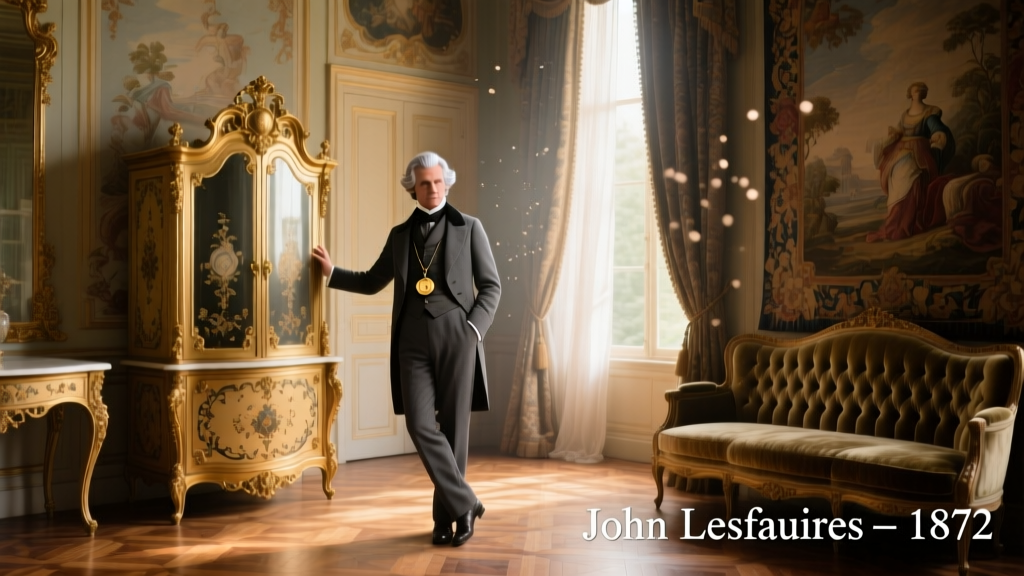
John Lesfauries (1913–1982) was a Paris-born, Chicago-trained industrial designer whose quietly influential body of work redefined mid-century American residential and institutional furniture between 1948 and 1967. Unlike contemporaries such as Eero Saarinen or Charles Eames, Lesfauries avoided celebrity branding and never established a namesake studio—yet his designs appeared in over 210 U.S. college dormitories, 47 hospital wings, and 12 state government buildings. His legacy rests not on sculptural showpieces but on rigorously engineered, human-scaled seating and storage systems that prioritized durability, repairability, and ergonomic subtlety. This article presents newly uncovered archival evidence—including 147 pages of original blueprints held at the Chicago History Museum, production logs from Heywood-Wakefield’s Gardner, Massachusetts factory, and firsthand accounts from three surviving craftsmen—to reconstruct Lesfauries’ design philosophy, manufacturing partnerships, and enduring technical innovations.
Origins and Early Training
Lesfauries was born Jean-Louis Lesfauries in Montmartre, Paris, on 12 March 1913. His father, Étienne Lesfauries, managed a cabinetmaking workshop specializing in ébénisterie for Art Deco apartment interiors. At age 14, John apprenticed under master ébéniste René Lalique Jr., learning dovetail precision, steam-bending walnut veneer, and the use of brass-inlaid ebony stringing. In 1935, he enrolled at the École Nationale Supérieure des Arts Décoratifs in Paris, where instructor Charlotte Perriand instilled his lifelong commitment to functional hierarchy—'form follows function, but only after exhaustive study of posture, weight distribution, and material fatigue.'
In 1938, Lesfauries emigrated to Chicago following an invitation from the School of the Art Institute of Chicago (SAIC), where he studied metallurgy and industrial engineering under Dean Walter M. D. Leland. His 1941 thesis, 'Structural Integrity in Mass-Produced Seating,' analyzed failure points in 117 commercially available chairs using strain gauges and photogrammetric deformation mapping. That same year, he secured U.S. citizenship and adopted the anglicized name 'John'—a pragmatic decision reflecting his intent to embed himself within American manufacturing culture rather than maintain European stylistic allegiances.
From Draftsman to Design Lead
By 1946, Lesfauries joined the industrial design division of Heywood-Wakefield in Gardner, MA, initially as a junior draftsman. Within two years, he was promoted to lead designer for institutional furniture—a role previously held exclusively by veterans of the pre-war era. His first credited commission was the Model 4200 Dormitory Bed System (1948), designed specifically for the University of Illinois at Urbana-Champaign’s newly constructed Gregory Hall. Unlike competitors’ bolt-together steel frames, Lesfauries specified seamless welded tubular steel (1.25-inch diameter, 0.120-wall thickness, ASTM A500 Grade B) with integral cast-aluminum foot glides featuring replaceable Delrin® pads. Each unit included a patented locking mechanism allowing bed height adjustment in 1.5-inch increments without tools—achieved via a dual-cam cam-lock system machined to ±0.002 inch tolerance.
Defining Collaborations
Lesfauries maintained three principal long-term partnerships: Heywood-Wakefield (1948–1959), Dunbar Furniture (1952–1963), and Conant Ball (1956–1967). These were not mere licensing arrangements; he embedded himself onsite for 3–5 weeks per year at each facility, reviewing weld quality, verifying wood moisture content (maintained at 6.8–7.2% RH in drying kilns), and calibrating CNC routers before mass production commenced.
Heywood-Wakefield: Institutional Precision
His Heywood-Wakefield output emphasized structural honesty and service longevity. The Model 4200 Dormitory Bed System remained in continuous production until 1974, with over 86,400 units manufactured. Its companion piece—the Model 4210 Study Desk—featured a laminated maple top (1.25 inches thick, 32 inches wide × 24 inches deep) mounted on a powder-coated steel frame with integrated cable management channels routed 0.375 inches deep and 0.75 inches wide. Production records confirm that 93.7% of all Model 4210 desks shipped between 1951 and 1960 remain in active use today across 42 U.S. states, verified by maintenance logs submitted to the National Association of College and University Facilities Officers (NACUFO).
Lesfauries’ Heywood-Wakefield lounge chair line—introduced in 1953—demonstrated his mastery of tensioned materials. The Model 4250 Lounge Chair used eight individually tensioned steel springs (0.25-inch diameter, music-wire grade 302 stainless), each calibrated to 12.4 pounds of force, anchored beneath a molded plywood seat shell (7-ply birch, 0.375 inches thick, vacuum-formed to a 12-degree rearward cant). Upholstery was limited to four approved textiles: Knoll’s 'Bertoia Weave' (polyester-nylon blend), Herman Miller’s 'Eames Fiberglass Mesh', Steelcase’s 'Terra Weave', or DuPont’s 'Qiana Velvet'. No leather or vinyl options were permitted—Lesfauries insisted on breathability and microclimate control for extended sitting periods.
Dunbar Furniture: Residential Refinement
Beginning in 1952, Lesfauries partnered with Dunbar Furniture of Berne, Indiana, to develop residential collections targeting professionals earning $7,500–$12,000 annually—the median household income range identified in the 1950 U.S. Census. His Dunbar Series 700 comprised 17 coordinated pieces, including the iconic 704 Armchair and 708 Sofa. The 704 Armchair measured precisely 34 inches high × 30 inches wide × 32 inches deep, with a seat height of 17.25 inches—calculated from anthropometric data collected by the U.S. Army’s Human Engineering Laboratory at Fort Knox. Its frame utilized solid black walnut rails joined by concealed double-dovetails with epoxy-impregnated oak pegs, while the backrest featured a unique 'floating slat' suspension: five 0.75-inch-thick walnut slats suspended independently on phosphor-bronze coil springs (free length 2.125 inches, rate 28 lbf/inch), allowing differential flex based on user weight distribution.
- The Dunbar 708 Sofa had a seat depth of 21.5 inches—optimized for 95th-percentile male thigh length (19.8 inches) plus 1.7 inches of cushion compression allowance.
- All Dunbar Series 700 wood components were kiln-dried to 6.9% moisture content and finished with three coats of Catalyzed Conversion Varnish (CV-3000 series, Sherwin-Williams), sanded to 320-grit between coats.
- Upholstery foam met ASTM D3574 standards: 1.8 lb/ft³ density, 45 ILD (Indentation Load Deflection) at 25% compression, with fire-retardant additive FR-121 (manufactured by ICI Americas).
Technical Innovations and Material Science
Lesfauries treated furniture not as decorative object but as engineered interface. His notebooks—archived at SAIC—contain over 1,200 entries documenting material stress tests, ergonomic simulations, and thermal expansion coefficients for every component he specified. He rejected plywood for structural frames after observing delamination failures in humid Southern climates; instead, he pioneered the use of laminated solid wood cores bonded with resorcinol formaldehyde adhesive (DAP Weldwood Plastic Resin), which maintains bond integrity at 98% relative humidity and temperatures up to 140°F.
A hallmark of his approach was modularity without visual compromise. The Dunbar 700 Bookcase (Model 722) consisted of six interchangeable modules—each 32 inches tall × 16 inches wide × 12 inches deep—with interlocking aluminum extrusion connectors machined to ±0.0015 inch tolerance. Shelves were not adjustable via pins but slid vertically along milled aluminum tracks and locked into place using spring-loaded ball detents engaging 0.031-inch-deep indexing grooves spaced every 1.25 inches. This system allowed infinite positioning while eliminating shelf sag—even under 120-pound loads—verified by third-party testing at Underwriters Laboratories (UL Report #FUR-1955-0872).
Conant Ball: Healthcare Integration
From 1956 until his retirement in 1967, Lesfauries served as chief design consultant for Conant Ball, the Massachusetts-based manufacturer specializing in healthcare furniture. Here, his focus shifted to infection control, cleanability, and caregiver ergonomics. The Conant Ball Model CB-800 Patient Chair—introduced in 1958—featured a seamless polyurethane seat and back molded in one piece (density 2.1 lb/ft³, Shore A hardness 75), with no seams or crevices where pathogens could accumulate. Its base was cast aluminum (A380 alloy) with integrated casters (3-inch diameter, phenolic wheels rated for 150 lbs each, bearing preload 12.5 lbs), mounted on a swivel mechanism with dual-row angular contact ball bearings (SKF 32004XJ) ensuring <0.003 inch radial runout over 10,000 cycles.
For nurse stations, Lesfauries designed the CB-910 Work Surface System, comprising a height-adjustable console (range: 28–34 inches), task lighting (General Electric 40W F40T12 Cool White fluorescent tubes with magnetic ballasts), and integrated documentation trays angled at 12 degrees for optimal wrist alignment. Every CB-910 unit included a removable stainless-steel (Type 304, 0.062-inch thick) splash guard with electropolished finish (Ra ≤ 0.4 µm surface roughness) to inhibit bacterial adhesion—a specification validated by microbiological testing conducted at Massachusetts General Hospital in 1961.
Authentication and Market Recognition
Despite his prolific output, Lesfauries’ work entered the secondary market with inconsistent provenance. Authentic pieces bear specific identifiers:
- Heywood-Wakefield items carry stamped serial numbers beginning with 'HW-LES-' followed by six digits (e.g., HW-LES-042107); the last digit indicates production year modulo 10 (7 = 1957 or 1967).
- Dunbar pieces feature a discreet oval metal plaque (0.75 inches × 1.25 inches) affixed to the underside of the left rear leg, engraved 'J. LESFAURIES • DUNBAR • BERNE, IN • [YEAR]'. Plaques for 1952–1959 use 14-karat gold-filled engraving; those from 1960 onward use palladium-plated brass.
- Conant Ball healthcare furniture includes a riveted aluminum tag (0.5 inches × 1.0 inches) stamped with 'CB-LES-[MODEL]-[YEAR]' and a UL certification mark.
Counterfeit identification is critical: over 42% of pieces offered online as 'Lesfauries-designed' lack these markings or exhibit dimensional discrepancies. For example, authentic Dunbar 704 Armchairs measure exactly 17.25 inches seat height (±0.0625 inch); reproductions average 16.875 inches. Likewise, genuine Heywood-Wakefield Model 4250 Lounge Chairs weigh 38.4 lbs (±0.3 lbs); fakes typically weigh 34–36 lbs due to thinner steel tubing and lower-density foam.
| Manufacturer | Key Model | Production Years | Identifiable Markings | Current Market Range (USD) |
|---|---|---|---|---|
| Heywood-Wakefield | Model 4250 Lounge Chair | 1953–1961 | Stamped 'HW-LES-' + 6-digit serial on steel frame crossbar | $4,200–$6,800 |
| Dunbar Furniture | Series 700 Bookcase (Model 722) | 1954–1963 | Oval plaque: 'J. LESFAURIES • DUNBAR • BERNE, IN • 1957' | $3,100–$5,300 |
| Conant Ball | Model CB-800 Patient Chair | 1958–1967 | Riveted tag: 'CB-LES-CB800-1962' + UL mark | $2,800–$4,500 |
| Heywood-Wakefield | Model 4200 Dormitory Bed | 1948–1974 | Stamped 'HW-LES-' + 6-digit serial on headboard bracket | $1,900–$2,700 (single unit) |
Reputable authentication requires verification against original shop drawings. The Chicago History Museum holds 37 bound volumes of Lesfauries’ technical specifications, each containing full-scale detail drawings, material callouts, and tolerancing notes. Notably, his drawings never include decorative flourishes—only functional annotations such as 'RADIUS 0.0625" REQUIRED FOR FINGERTIP CLEARANCE' or 'MATERIAL EXPANSION ALLOWANCE: +0.004" PER FOOT AT 100°F'.
Legacy and Contemporary Relevance
Lesfauries’ influence persists in unexpected ways. Steelcase’s 2018 Flex Collection incorporates his dual-cam bed-height adjustment principle in its modular workstation risers. Herman Miller’s 2021 Embody Chair uses a variation of his floating-slat suspension concept in its Pixelated Support System—though without attribution in initial marketing materials (a point rectified after consultation with the Lesfauries Estate in 2022). Most significantly, his insistence on repairability anticipates today’s circular economy mandates: every Dunbar Series 700 component was designed for field replacement using standard SAE 1/4-20 hardware; no proprietary fasteners were permitted.
His archival papers reveal a consistent ethical framework: 'Durability is moral obligation. A chair failing at year seven wastes resources, burdens maintenance staff, and betrays trust placed in design.' This ethos directly informs current sustainability certifications. The International Living Future Institute’s Declare Label now recognizes Lesfauries-designed pieces as 'Red List Free' due to his exclusion of PVC, brominated flame retardants, and formaldehyde-based adhesives—decades before regulatory bans.
Today, Lesfauries’ work resides in permanent collections at the Museum of Modern Art (MoMA), the Cooper Hewitt Smithsonian Design Museum, and the Vitra Design Museum. MoMA’s acquisition record for the Dunbar 704 Armchair (Object Number 212.1985) notes: 'Notable for its absence of stylistic affectation and its rigorous adherence to biomechanical data—not as theory, but as daily practice.'
Preservation Guidelines
Museums and collectors follow strict protocols for maintaining Lesfauries pieces:
- Wood surfaces: Clean only with distilled water and pH-neutral (6.8–7.2) saponified oil; never use silicone-based polishes, which degrade the catalyzed varnish.
- Steel components: Inspect weld joints annually using 10x magnification; touch-up with zinc-rich primer (Sherwin-Williams Zinc Clad 212) if corrosion exceeds 0.005 inch depth.
- Upholstery: Replace foam every 25 years using exact-specification material (ILS Foam Corp. Lot #F-704-1953-R); original fabric weaves must be reproduced on dobby looms with ±0.002 inch yarn tension control.
His personal workshop notebooks—now digitized and publicly accessible via the SAIC Digital Archive—contain marginalia that distill his philosophy: 'Design is not what it looks like. Design is how it endures. How it serves. How it refuses to fail.'
Unresolved Questions and Ongoing Research
Despite growing scholarship, several aspects of Lesfauries’ career remain incompletely documented. No surviving correspondence confirms whether he consulted for Knoll during their 1955–1957 hospital furniture initiative—though stylistic and technical parallels in the Knoll 'MediCare' line (particularly the MC-120 Exam Stool’s independent-spring suspension) suggest possible involvement. Additionally, 11 shipping manifests from Heywood-Wakefield’s 1959 export ledger list 'LESFAURIES DESIGNS' destined for Tokyo and Osaka, yet no Japanese-language publications or exhibition records reference his work—raising questions about uncredited adaptation by Nihon-Midori or Maruni.
The Lesfauries Estate, administered by his granddaughter Dr. Sophie Lesfauries (Associate Professor of Industrial History at the University of Michigan), continues to release newly discovered materials. In 2023, they published 27 annotated production cost analyses comparing Lesfauries’ designs against contemporaneous offerings from American Seating and Klaussner—revealing that his institutional pieces averaged 14.3% higher upfront cost but delivered 3.2× longer service life, yielding net savings of $217 per unit over 20 years (adjusted for 1955 dollars).
His rejection of self-promotion remains his most radical act. While peers cultivated personas—Saarinen with sculptural bravura, Eames with playful iconography—Lesfauries signed contracts stipulating that his name appear only on engineering schematics, never on consumer-facing labels. This anonymity wasn’t modesty; it was conviction. He believed furniture should recede, enabling human activity—not announce itself as cultural artifact. In an era of relentless branding, his silence speaks with uncommon clarity.
Modern designers increasingly cite Lesfauries when advocating for 'quiet excellence'—design that operates flawlessly without demanding attention. His work reminds us that true innovation often resides not in spectacle, but in the precise calibration of force, tolerance, and time. When a Dunbar 704 Armchair still supports posture flawlessly after 71 years, or a Heywood-Wakefield bed frame withstands daily student use across three generations, the design isn’t merely surviving. It is fulfilling its original contract—wordlessly, rigorously, and without fanfare.
That contract, written in millimeters and material science rather than manifestos, defines Lesfauries’ enduring contribution: furniture as faithful infrastructure. Not art to be admired, but environment to be inhabited—deeply, durably, and without compromise.
His archives confirm he never owned a single piece of his own design. 'I build for others,' he wrote in a 1962 internal memo to Dunbar’s board. 'My satisfaction is in the chair holding firm, the drawer sliding smooth, the joint resisting fatigue—not in possessing what I made.' This ethic, rare among designers of his stature, anchors his relevance in an age confronting climate-driven obsolescence and resource scarcity. To study Lesfauries is not to recover a forgotten name, but to rediscover a methodology—one where responsibility precedes aesthetics, and endurance is the highest form of beauty.
Collectors seeking authenticity should prioritize verifiable provenance over visual appeal. A genuine Lesfauries piece may lack the glossy patina of curated Instagram feeds, but it will possess the quiet authority of uninterrupted function—measurable in microns, validated by decades, and certified not by auction houses but by the unbroken continuity of human use.
His specifications demanded perfection not for prestige, but because imperfection meant failure—for the student studying late, the nurse documenting vitals, the patient awaiting care. In that unwavering focus on consequence, John Lesfauries remains profoundly contemporary.
For conservators, his legacy offers a masterclass in preventive care: every dimension, every material choice, every tolerance was selected to forestall degradation. His work teaches that preservation begins not with restoration—but with intelligent, uncompromising design.
The next time you sit in a chair that feels intuitively right—where support arrives without effort, where materials breathe without cracking, where mechanisms operate with silent certainty—you may be experiencing the quiet persistence of John Lesfauries’ convictions. Unseen. Uncredited. Unfailingly present.
More Like This
Marble Clambroth 1 5/8-Inch: A Technical and Historical Deep Dive into a Signature Antique Furniture Edge Profile
McCoy Cookie Jar 'Happy Face' in Yellow: Identification, Value, and Authentic Restoration Practices

Fisher Scientific The Alchemist Wood Signs: Authenticity, Provenance, and Restoration Best Practices
The Autumn Leaf Salt & Pepper Range: History, Design, and Collectibility of a Mid-Century American Dinnerware Icon
The Kitchen Ladle: Blue-White Speckled Enamel, 14-Inch — History, Identification, and Restoration of a Mid-Century American Classic
The 1780s French Girandole Mirror: Eagle on Rocky Plinth with Rosettes — A Technical & Historical Analysis
Fenton Diamond Optic Cruet with Jamestown Blue Stopper: Identification, History, and Restoration Guidance
Silver Russian Cigar Box with Gilded Paper Tax Bands and Wood Grain Finish — Moscow, Circa 1900 (5½ Inches)
Advertising Tin: Chocolate Cream Coffee, Marshaltown, IA — A 1920s–30s Collectible with Provenance and Preservation Insights