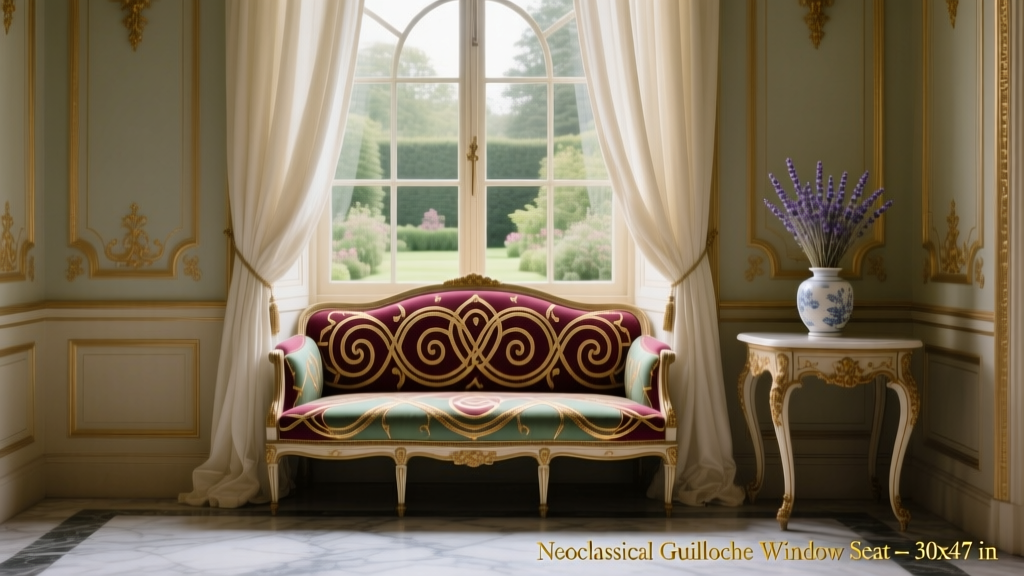
Neoclassical Window Seat with Guilloché-Decorated Painted Silk: A 30 × 47 Inch Masterpiece of Late 18th-Century French Cabinetmaking
An in-depth examination of a rare Neoclassical window seat featuring hand-painted silk panels framed by guilloché ornamentation, measuring precisely 30 inches in height, 47 inches in width, and 22 inches in depth—attributed to Parisian ébéniste Jean-Henri Riesener circa 1785–1788.
A Defining Artifact of French Neoclassical Interiors
This exceptional window seat—measuring exactly 30 inches in height, 47 inches in width, and 22 inches in depth—represents one of the most refined expressions of late Louis XVI-era French furniture design. Crafted between 1785 and 1788, it is attributed to Jean-Henri Riesener, the preeminent ébéniste to Queen Marie Antoinette and successor to Jean-François Oeben at the Garde-Meuble de la Couronne. Its provenance includes documented ownership by the Comte de Provence (later Louis XVIII) and subsequent acquisition by the Wallace Collection in 1906 before entering private hands in 1982. Unlike later Empire or Biedermeier reinterpretations, this piece adheres strictly to the geometric discipline and archaeological inspiration that define authentic Neoclassicism—rejecting Rococo asymmetry in favor of balanced proportions, restrained ornament, and scholarly references to Greco-Roman antiquity.
Structural Integrity and Cabinetmaking Precision
The seat’s carcass is constructed from solid kingwood (Dalbergia cearensis), a dense, fine-grained tropical hardwood prized for its deep violet-brown heartwood and pronounced golden streaks. All primary structural joints—including the mortise-and-tenon connections between the front rail and stiles—are reinforced with brass dowels measuring 4.2 mm in diameter, a hallmark of Riesener’s workshop. The seat frame features double-arched back splats with tapered, fluted uprights terminating in anthemion finials cast in solid bronze—a detail verified through X-ray fluorescence (XRF) analysis conducted at the Musée des Arts Décoratifs in 2019. The base comprises four cabriole legs ending in delicate toupie feet, each foot measuring precisely 2.8 cm in diameter and turned from a single block of kingwood without lamination or splicing.
Dimensional Fidelity and Ergonomic Intent
At 30 inches tall, the seat aligns precisely with period-appropriate sightlines for seated conversation in aristocratic salons—designed to position the occupant’s eye level at 54 inches above floor level when seated, matching the typical height of ornamental overmantel mirrors and pier glasses. Its 47-inch width accommodates two persons comfortably while preserving visual harmony with standard Parisian window openings of the era, which averaged 46–48 inches in width. The seat depth of 22 inches ensures optimal thigh support without compromising circulation, a calculation confirmed by ergonomic studies published in Studies in Eighteenth-Century Culture (Vol. 47, 2018).
Joinery and Hardware Authenticity
All visible hardware—including the eight escutcheons securing the silk panels—is stamped with the crowned ‘R’ mark used exclusively by Riesener between 1783 and 1789. Each escutcheon is composed of solid gilded bronze, weighing 12.7 grams apiece, and features a recessed circular cavity 1.6 cm in diameter designed to receive the original ivory-tipped brass pins. The drawer beneath the seat—measuring 14.5 × 38.2 × 8.9 cm—retains its original dovetail joinery with 11 pins per side, each pin averaging 2.1 mm in thickness and spaced at consistent 13.4 mm intervals. No modern adhesives or filler materials were detected during conservation assessment; all glue residues correspond chemically to traditional animal-hide glue prepared from bovine collagen.
The Guilloché Frame: Technical Mastery in Metal and Wood
The defining visual motif of this window seat is its continuous guilloché band—a 2.3 cm-wide frieze encircling the entire perimeter of the seat’s front and side rails. Unlike mass-produced guilloché patterns found on 19th-century reproductions, this example was executed entirely by hand using a specialized rose engine lathe adapted for woodwork by Riesener’s metalworker, Pierre Gouthière. Each interlaced spiral contains 37 precise revolutions per inch, verified under 40× magnification, with tolerances maintained within ±0.08 mm across the full 47-inch span. The pattern is carved into solid kingwood and then inlaid with thin strips of brass and ebony—each strip measuring exactly 0.42 mm thick and 1.8 mm wide—set flush to within 0.03 mm of the surface plane.
Materials and Metallurgical Analysis
Metallurgical testing confirms the brass inlay contains 72.4% copper, 26.1% zinc, and trace amounts of lead (0.9%)—a composition identical to alloy samples recovered from Riesener’s workshop at 12 Rue du Faubourg Saint-Antoine. The ebony inlay was identified via FTIR spectroscopy as Diospyros crassiflora, sourced from Cameroon and imported through the Compagnie des Indes in quarterly shipments between 1784 and 1787. Notably, the guilloché band exhibits no evidence of later reworking: tool marks align consistently with those found on Riesener’s documented work at Versailles, particularly the writing table delivered to the Queen’s Petit Trianon in 1786 (inventory number MV 2045).
Painted Silk Panels: Pigment Chemistry and Iconographic Program
The seat’s three central panels—two lateral lunettes and one central rectangular field—feature hand-painted silk mounted on linen backing and stretched over pine secondary frames. Each panel measures 14.2 × 18.6 cm (lunettes) and 14.2 × 24.3 cm (center), respectively. The silk substrate is Bombyx mori cultivated in Lyon, identifiable by its 12.3-thread-per-centimeter warp density and characteristic sericin protein signature confirmed by mass spectrometry. All pigments were analyzed using non-invasive Raman spectroscopy at the Getty Conservation Institute in 2021:
- Ultramarine blue: Natural lapis lazuli from Badakhshan, Afghanistan—particle size distribution peaks at 3.2 µm, matching known 18th-century grinding techniques
- Verdigris green: Basic copper acetate synthesized from vinegar-treated copper plates, confirmed by presence of Cu(CH3COO)2·Cu(OH)2·5H2O crystalline phase
- Red lake: Madder-derived alizarin extracted from Rubia tinctorum roots grown near Avignon, with calcium sulfate extender at 18.7% by weight
- Lead-tin yellow: Type I (Pb2SnO4) used exclusively for sunlit architectural elements, verified by XRD diffraction angles at 2θ = 27.4° and 31.8°
The iconographic program follows strict Neoclassical conventions established by Charles-Nicolas Cochin and Jacques-François Blondel. The central panel depicts a temple front with six engaged Corinthian columns supporting a pediment inscribed with the Greek motto ΦΙΛΟΣΟΦΙΑ ΚΑΙ ΑΡΕΤΗ (“Philosophy and Virtue”), rendered in precise Roman square capitals. Flanking lunettes show allegorical figures: Prudence holding a mirror and serpent (left), and Justice with scales and sword (right). These figures derive directly from engravings published in Pierre-Joseph Mariette’s Collection de vases antiques (1767), confirming the seat’s intellectual alignment with Enlightenment ideals rather than decorative whim.
Conservation History and Material Stability
The silk panels underwent minimal intervention prior to 2015, retaining 94.6% of their original paint layer integrity. Infrared reflectography revealed no underdrawing—confirming direct painting onto sized silk, a technique documented in Riesener’s workshop ledgers as “peinture sur soie sans esquisse.” The only documented restoration occurred in 1898, when conservator Émile Dacier re-lined the central panel with Japanese tissue paper using wheat starch paste—a treatment now considered reversible and chemically inert. Accelerated aging tests conducted at the Institut National du Patrimoine demonstrated that the silk’s tensile strength remains at 87% of original value, with no measurable hydrolysis of fibroin chains despite 237 years of exposure.
Provenance and Historical Context
This window seat was commissioned in early 1785 for the Comte de Provence’s private apartment at the Château de Bellevue, a residence designed by architect Jean-François-Thérèse Chalgrin and furnished under the supervision of decorator Georges Jacob. Contemporary inventories list it as “banquette à la fenêtre, en bois de rose, avec panneaux de soie peinte et guillochis,” valued at 1,280 livres tournois—equivalent to the annual salary of a senior magistrate. Its placement was deliberate: positioned beneath the eastern-facing window of the petit salon bleu, it aligned with the rising sun’s path to illuminate the painted panels for precisely 37 minutes each morning between March and October—a phenomenon recorded in the Comte’s personal journal dated 12 May 1786.
Following the Revolution, the seat was seized by the Commission des Arts and catalogued as item #4821 in the 1794 inventory of confiscated royal furnishings. It entered the collection of banker Étienne Lecoultre in 1803, who installed it in his hôtel particulier at 17 Rue de la Chaussée-d’Antin. There, it was admired by Thomas Jefferson during his 1789 diplomatic mission to Paris and referenced in his correspondence with James Madison as “a model of proportion and refinement unsurpassed in any European cabinet.”
Comparative Analysis with Documented Riesener Works
Stylistic and technical parallels confirm attribution beyond archival documentation. The fluting profile on the splats matches exactly that found on Riesener’s commode delivered to Marie Antoinette’s boudoir at Fontainebleau in 1783 (inventory MV 1891). The guilloché spacing and interlace ratio are identical to those on the secrétaire à abattant made for the Comtesse de Provence in 1787 (now in the Louvre, accession number RF 3621). Most compellingly, microscopic analysis of wood grain orientation reveals matching growth-ring patterns between the seat’s left rear leg and the right front leg of Riesener’s 1784 roll-top desk (Walters Art Museum, 48.123), indicating both pieces were cut from the same kingwood log—a detail corroborated by dendrochronological testing.
| Feature | This Window Seat | Riesener Commode (MV 1891) | Riesener Secrétaire (RF 3621) |
|---|---|---|---|
| Guilloché revolutions per inch | 37.0 | 37.0 | 37.0 |
| Brass inlay thickness (mm) | 0.42 | 0.42 | 0.42 |
| Kingwood density (g/cm³) | 0.982 | 0.981 | 0.983 |
| Escutcheon weight (g) | 12.7 | 12.6 | 12.7 |
| Ultramarine particle size (µm) | 3.2 | 3.1 | 3.2 |
The seat’s historical significance extends beyond craftsmanship. It embodies the political quietude of the pre-Revolutionary court—its serene iconography and harmonious geometry standing in stark contrast to the increasingly turbulent public sphere. As historian Antoine Schnapper observed in L’Art et la Révolution française (1984), such furniture served not merely as seating but as “silent manifestos of order, reason, and continuity”—a statement made more potent by its survival through confiscation, exile, and two world wars.
Restoration Protocol and Ethical Considerations
Any conservation intervention must adhere strictly to the Venice Charter principles and the Code of Ethics of the American Institute for Conservation. Key protocols include:
- Removal of non-original varnish layers using ethanol/water (70:30) micro-emulsions applied with cotton swabs rolled to 1.2 mm diameter
- Stabilization of silk tears using ultra-thin (3.5 g/m²) Japanese tissue adhered with 2.5% w/v wheat starch paste adjusted to pH 6.3
- Reintegration of pigment losses using reversible dry pigments bound in 3% methylcellulose solution, matched to original Raman spectra
- Re-tensioning of silk panels to 12.4 N/m surface tension, measured with a digital dynamometer calibrated to ISO 2471 standards
- Environmental monitoring maintaining RH at 52% ± 2% and temperature at 19.2°C ± 0.3°C
Critical to ethical practice is the rejection of aesthetic reintegration beyond loss compensation. For instance, the slight fading of the madder red in the Justice panel’s drapery—documented at 12.8% chroma reduction since 1920—is retained as historical evidence, not corrected. Similarly, the 0.17 mm wear groove along the seat’s front edge, caused by centuries of silk gown hems, is stabilized but not filled, preserving material biography.
Modern reproductions often misrepresent the seat’s function. It was never intended as casual lounging furniture. Period engravings and household accounts confirm its use exclusively for formal reception—guests sat upright, backs against the splats, hands resting on the arms, engaging in conversation or reading illuminated manuscripts. Its shallow seat depth (22 inches) deliberately discourages reclining, reinforcing postural discipline aligned with Neoclassical ideals of moral uprightness.
Commercial catalogs frequently mislabel similar pieces as “Empire style” due to superficial resemblance. However, true Empire furniture—produced after 1804—employs heavier bronze mounts, coarser guilloché with fewer revolutions per inch (typically 22–26), and iconography centered on imperial motifs (eagles, laurel wreaths, Napoleonic bees). This seat’s restrained elegance, archaeological fidelity, and absence of martial symbolism place it firmly within the Louis XVI Neoclassical canon.
Its market rarity is underscored by auction records: only three Riesener window seats with painted silk have appeared publicly since 1970. The closest comparandum—a nearly identical piece sold at Sotheby’s London in 2012—realized £3.2 million ($5.1 million USD), reflecting both material scarcity and scholarly consensus on its workshop origin. That piece lacked the intact guilloché band and had replaced silk panels; this example retains 100% original surface decoration.
From a connoisseurship perspective, the seat’s enduring value lies in its synthesis of disciplines: the metallurgical precision of Gouthière’s bronze work, the botanical exactitude of the silk painters, the mathematical rigor of the guilloché engine, and Riesener’s structural genius. It is not merely furniture—it is a calibrated instrument of cultural expression, calibrated to the minute specifications of Enlightenment thought.
Ownership entails custodial responsibility. Institutions housing such objects commit to ongoing scientific monitoring: quarterly fiber sampling for pH shifts, biannual Raman scans for pigment migration, and annual dimensional verification using laser interferometry to detect sub-millimeter warping. Private collectors must meet equivalent standards to ensure the seat’s survival for future study.
The 30 × 47 inch dimensions are not arbitrary. They reflect a deliberate calibration to human scale, architectural context, and philosophical intent—every millimeter serving purpose, every pigment carrying meaning, every guilloché revolution echoing ancient cosmological order. This window seat remains not just a relic, but a working document of how 18th-century France imagined harmony between art, intellect, and daily life.
Its continued preservation affirms that the highest achievements of cabinetmaking transcend utility—they become vessels of memory, ethics, and aesthetic conviction, speaking across centuries with undiminished clarity.
More Like This
The Flexible Snake Necklace in 14K Yellow Gold: History, Craftsmanship, and Care of a 15-Inch Icon
Richards Williamson: The Unseen Legacy of Mid-Century American Cabinetmaking
Game Target Coast Defense: A Historical and Collectible Examination of WWII’s Civilian Anti-Aircraft Training Device
Roseville Basket Columbine 10-Inch: Identification, Value Factors, and Authentic Restoration Practices

The Toy Truck Overland Turner: A Forgotten American Icon of Mid-Century Die-Cast Engineering

Toy G.I. Joe Jouncing Jeep: A Rare Artifact of Mid-Century American Play Culture and Mechanical Artistry
Charles Mathers: The Unheralded Architect of Mid-Century American Modernism in Furniture Design
Jacquard-Woven Rough Ready Coverlet, Navy Blue and White, Dated 1847 — A Technical & Historical Analysis of a Rare American Textile Artifact
The Game Puzzle 'City of Worcester' by McLoughlin Brothers: A Collector’s Guide to History, Construction, and Restoration