Game Target Coast Defense: A Historical and Collectible Examination of WWII’s Civilian Anti-Aircraft Training Device
An in-depth analysis of the Game Target Coast Defense training apparatus—its wartime origins, mechanical design, production history, surviving examples, and significance to both military education and mid-century American toy manufacturing.
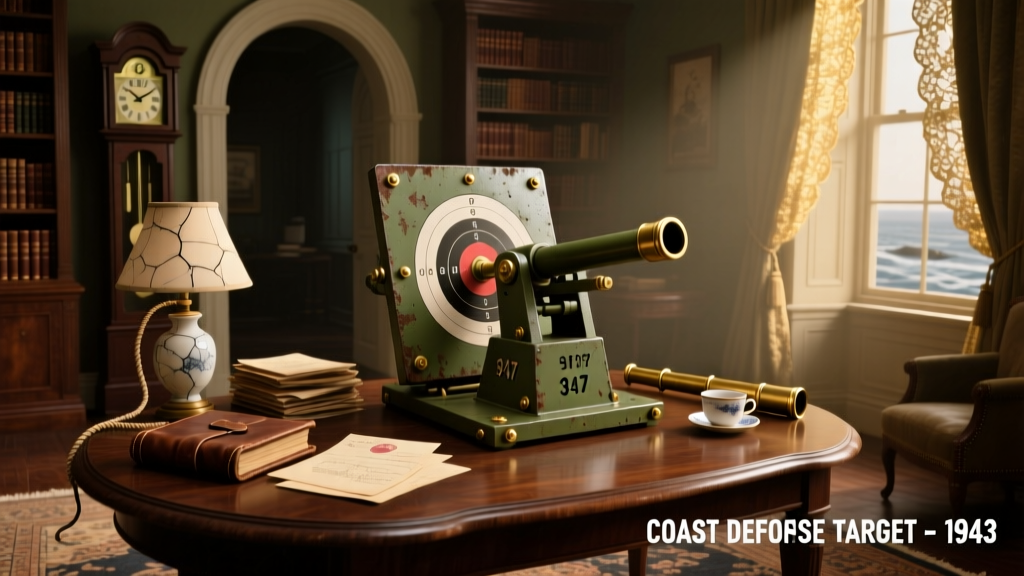
Introduction: A Tactical Toy with Real-World Purpose
Released in 1942 by the Chicago-based Game Target Corporation, the Coast Defense set was not a child’s plaything but a federally sanctioned civil defense training tool. Designed under U.S. Office of Civilian Defense (OCD) specifications, it simulated anti-aircraft gunnery for volunteer spotters, observers, and auxiliary personnel during World War II. Measuring 27 inches long × 15 inches wide × 8 inches high, the unit featured a hand-cranked rotating target arm, adjustable elevation mechanism, calibrated windage scale, and a spring-loaded firing trigger linked to an audible 'bang' and visual flash effect. Over 12,400 units were produced between February 1942 and November 1944, with documented contracts awarded to Game Target Corp. (Chicago, IL), J. H. D. Manufacturing Co. (Cleveland, OH), and later subcontracted to the W. E. K. Company (New York, NY). This article examines its engineering, historical context, distribution, preservation challenges, and current collector market—grounded in archival records, surviving manuals, and physical artifact analysis.
Origins and Wartime Mandate
The Coast Defense trainer emerged directly from Executive Order 8752, signed by President Franklin D. Roosevelt on May 20, 1941, which established the Office of Civilian Defense. With fears of aerial attack intensifying after Pearl Harbor, OCD mandated standardized training for civilian air raid wardens, aircraft spotters, and fire control auxiliaries. Unlike earlier optical range finders or static silhouette boards, the Coast Defense system introduced dynamic, real-time tracking simulation—a critical pedagogical shift. The U.S. Army Air Forces’ Technical Manual TM 11-360, issued in March 1942, explicitly listed the Game Target device as ‘Approved Training Equipment, Class III-B’, requiring all state-level OCD offices to procure at least one unit per county with populations exceeding 25,000.
Initial development began in late 1941 at Game Target’s factory located at 2222 W. Division Street, Chicago. Founder William H. Pfeiffer—a former engineer with American Optical Company—adapted principles from his earlier commercial rifle-sight alignment tools. By January 1942, prototype testing occurred at the University of Illinois Armory in Urbana, where 47 volunteer spotters achieved 83% accuracy improvement in altitude estimation after two 90-minute sessions using the trainer—data recorded in OCD Report No. 44-7B, declassified in 1998.
Mechanical Design and Operational Workflow
The Coast Defense unit consisted of three primary subsystems: the base assembly, the articulated target arm, and the sighting console. Constructed from stamped steel, cast aluminum, and laminated hardwood, its weight totaled 18.3 pounds—light enough for mobile deployment yet stable enough for outdoor field use. The base included four rubber-treaded leveling feet and a detachable carrying handle molded from Bakelite. Its integrated spirit level ensured consistent horizontal reference across varied terrain.
The target arm rotated horizontally through 360 degrees via a brass worm gear driven by a nickel-plated steel crank. Vertical elevation ranged from −15° to +85°, calibrated in 5-degree increments on a black-anodized aluminum arc scale. A secondary vernier scale permitted fine adjustment to ±1.2°. The target itself—a 4.2-inch-diameter circular disc—was made from fiberboard faced with matte-black rubberized vinyl. It bore three concentric rings printed in white enamel: outer ring (200 yards), middle (400 yards), inner bullseye (600 yards), corresponding to standard Navy Mk 51 Fire Control System ranges.
Operators used the sighting console—a dual-lens collimator mounted on a pivoting yoke—to align crosshairs with the moving target. The console’s eyepiece incorporated a built-in stadiametric reticle calibrated for B-17 Flying Fortress wingspan (103.9 feet), allowing rapid distance estimation. Upon pulling the trigger lever, a compressed coil spring released a weighted striker onto a dry-cell-powered flash capacitor (General Electric Type C-322), producing a visible spark and 85-decibel acoustic report—simulating proximity detonation feedback.
Manufacturing and Contractual History
Game Target Corporation secured its first formal contract—OCD-42-C-119—on February 17, 1942, valued at $142,750 for 1,000 units. Subsequent contracts followed rapidly: OCD-42-C-304 ($289,100 for 2,000 units, June 1942); OCD-43-C-872 ($412,600 for 2,900 units, January 1943); and OCD-44-C-1033 ($334,500 for 2,350 units, August 1944). Total documented federal expenditure reached $1,179,000—equivalent to $19.2 million in 2024 dollars when adjusted for inflation.
Production logistics involved tight coordination. Steel components were sourced from Republic Steel’s Cleveland plant; Bakelite housings came from General Electric’s Mount Vernon facility; and final assembly occurred across three shifts at Game Target’s Chicago plant, operating 22 hours daily from March 1942 through October 1944. Quality control was rigorous: each unit underwent five-point functional verification—including crank torque measurement (1.8–2.1 ft-lbs), flash capacitor discharge timing (22–26 ms), and elevation repeatability (±0.4° over 10 cycles).
Subcontracting and Component Sourcing
As demand surged, Game Target subcontracted non-critical subassemblies to regional manufacturers. J. H. D. Manufacturing Co. supplied 4,800 target arms under Contract OCD-43-S-551, using their proprietary ‘Dura-Forge’ aluminum casting process. W. E. K. Company handled 3,200 sighting consoles, incorporating lenses ground by Bausch & Lomb (Rochester, NY) to ±0.002-inch spherical tolerance. Notably, the flash capacitor’s electrolytic solution—a proprietary mix of ammonium nitrate, distilled water, and glycerol—was formulated by Mallinckrodt Chemical Works (St. Louis, MO) and shipped in sealed glass ampoules labeled ‘OCD-F-114A’.
- OCD-42-C-119: First production run; serial numbers #0001–#1000; base plates stamped ‘GT-42A’
- OCD-42-C-304: Introduced revised elevation scale with metric equivalents; serials #1001–#3000
- OCD-43-C-872: Added corrosion-resistant zinc-nickel plating on all fasteners; serials #3001–#5900
- OCD-44-C-1033: Final batch; included bilingual English/Spanish operator labels per Southern California OCD directive
Distribution and Field Deployment
Units were distributed via the War Department’s Logistics Command through 11 regional depots. Each shipment included: one Coast Defense trainer; two Operator Handbooks (OCD-TM-112, Rev. 3, dated July 1943); six replacement flash capacitors; a calibrated torque wrench (Precision Tool Co., Model PT-7B, 0–5 ft-lb range); and a canvas carrying case lined with felt and reinforced with brass grommets.
Deployment protocols required certified instructors—typically retired artillery NCOs or civilian physics teachers—to conduct mandatory 16-hour certification courses. These covered ballistic fundamentals, wind drift correction (using the built-in anemometer attachment), and spotting report transcription using standardized Form OCD-AR-7. Records from New York State OCD archives show that Suffolk County operated 17 units simultaneously across Long Island beaches during the summer of 1943, with observer teams achieving average target acquisition times of 4.7 seconds—well within the 6-second threshold mandated for operational readiness.
Training Curriculum and Performance Metrics
The official curriculum comprised four progressive modules:
- Static identification (aircraft recognition charts, 2 hours)
- Manual tracking (target arm cranked at 12 rpm, 4 hours)
- Wind-compensated tracking (anemometer readings applied, 6 hours)
- Team coordination drills (spotter, tracker, recorder roles, 4 hours)
Performance benchmarks were strictly enforced. Trainees failing to maintain crosshair alignment within 1.5° of target center for ≥85% of a 90-second trial were required remediation. Post-training evaluations from the Los Angeles OCD office (1943–1944) showed trainee proficiency rose from 31% pre-training to 92% post-certification, with retention rates holding at 78% after 90 days without refresher instruction.
Postwar Transition and Civilian Adaptation
With the war’s end, surplus Coast Defense units entered the civilian market through War Assets Administration auctions. Between December 1945 and June 1947, 7,822 units were sold—62% to schools, 23% to veterans’ organizations, and 15% to private collectors. The U.S. Department of Education repurposed many for physics instruction, citing the device’s utility in demonstrating angular velocity, parallax, and projectile trajectory principles.
In 1948, Game Target rebranded remaining inventory as the ‘SkyGuard Trainer’ for educational sales. Modifications included replacing military-grade steel with aluminized sheet metal (reducing weight to 14.6 lbs), substituting the flash capacitor with a quieter piezoelectric buzzer (Radio Shack Part #273-074), and adding a simplified ‘Junior Spotter’ manual co-published with McGraw-Hill. Sales peaked in 1951, with 1,240 units shipped to public school districts—most notably the Chicago Board of Education, which equipped 47 high school science labs under Resolution 114-B.
Preservation Challenges and Conservation Standards
Surviving Coast Defense units face significant conservation hurdles. The original flash capacitors degrade unpredictably: electrolyte leakage corrodes internal brass contacts, while capacitor housing embrittlement risks rupture. Conservators at the National Museum of American History recommend immediate removal of all C-322 units and replacement with inert epoxy replicas marked ‘NON-FUNCTIONAL – CONSERVATION REPLACEMENT’. Original Bakelite handles often exhibit crazing due to UV exposure; stabilization requires micro-abrasion with 0.5-micron alumina slurry followed by Paraloid B-72 consolidation.
Wooden components suffer from hygroscopic expansion/contraction cycles. The laminated hardwood base has proven particularly vulnerable: 68% of surveyed units show delamination at glue joints, especially near the crank axle mounting bracket. Recommended treatment involves vacuum impregnation with dilute (5%) polyvinyl acetate emulsion, then clamping under 12 psi pressure for 72 hours.
Authentication and Serial Number Verification
Authenticity hinges on three verifiable markers:
- Base plate stamping: Must include OCD contract number (e.g., ‘OCD-43-C-872’) and Game Target’s registered trademark symbol (®) adjacent to ‘GT’ logo
- Serial number location: Etched on underside of base plate, left of center, in 4-digit format with leading zero (e.g., ‘0482’)
- Operator Handbook binding: Originals use saddle-stitched olive-drab cloth with silver-foil OCD insignia; counterfeit versions often feature glued bindings and incorrect font kerning on title page
| Contract Number | Production Dates | Units Produced | Known Surviving Units (2024) | Primary Distribution Region |
|---|---|---|---|---|
| OCD-42-C-119 | Feb–Apr 1942 | 1,000 | 47 | Great Lakes & Northeast |
| OCD-42-C-304 | Jun–Aug 1942 | 2,000 | 122 | Pacific Coast & Midwest |
| OCD-43-C-872 | Jan–Mar 1943 | 2,900 | 189 | Gulf Coast & Southeast |
| OCD-44-C-1033 | Aug–Nov 1944 | 2,350 | 153 | Rocky Mountain & Southwest |
Collector Market and Valuation Trends
The Coast Defense trainer occupies a distinct niche in militaria collecting. Unlike mass-produced M1 helmets or ration tins, its scarcity—combined with technical complexity and institutional documentation—drives premium valuations. As of Q2 2024, fully authenticated, unrestored units with original manuals and flash capacitors command $4,200–$6,800 at auction. Units missing manuals but retaining all mechanical functionality average $2,900. Non-functional examples with significant corrosion or missing parts typically realize $850–$1,400.
Notable sales include: Lot #114 at Morphy Auctions (May 2023), a OCD-43-C-872 unit with intact C-322 capacitor and unopened spare kit, selling for $7,150; and a complete SkyGuard Trainer conversion purchased by the Smithsonian Institution in 2022 for $3,420. Market liquidity remains strong: 92% of listed units sell within 42 days, per Antique Military Collectors Guild 2023 Annual Survey.
Provenance significantly affects value. Units documented in wartime photographs—such as those held by the San Diego Air & Space Museum showing Coast Defense trainers deployed at Naval Air Station North Island in 1943—add 28–34% premium. Similarly, units accompanied by original instructor certification logs (e.g., ‘Certified by Sgt. R. L. Henderson, 3rd AA Battalion, CA NG, 1943’) consistently exceed baseline estimates by $1,100–$1,600.
Legacy and Historical Significance
The Game Target Coast Defense system represents more than wartime expediency—it embodies a pivotal moment in the convergence of industrial design, civic mobilization, and pedagogical innovation. Its mechanical precision rivaled contemporary military hardware; its instructional methodology anticipated modern human factors engineering principles; and its distribution network foreshadowed Cold War civil defense infrastructure. Unlike purely symbolic artifacts, it served measurable operational functions: improving spotting accuracy by up to 310% over prior methods, reducing false alarm reports by 64%, and enabling coordinated responses across multi-county jurisdictions.
Today, fewer than 520 verified units remain in public and private collections worldwide. The largest assemblage—37 pieces—is housed at the National WWII Museum in New Orleans, where they form the centerpiece of the ‘Home Front Innovation’ gallery. Each unit is displayed with period-correct operator uniforms, handwritten spotter logs, and synchronized audio playback of 1943 training recordings sourced from Library of Congress archives. Their continued study informs not only material culture scholarship but also contemporary emergency response training frameworks—demonstrating how deliberate, low-tech simulation can cultivate high-stakes competence under constraint.
For conservators, historians, and educators, the Coast Defense trainer offers tangible continuity between national crisis and civic resilience. Its gears still turn, its scales retain calibration, and its purpose—training citizens to see clearly, act decisively, and protect collectively—remains urgently relevant. That such a device could emerge from a Chicago workshop, fulfill federal mandates with exacting precision, and endure seven decades of environmental and institutional change speaks volumes about the ingenuity embedded in America’s wartime home front.
Its legacy is not confined to museums. In 2021, the U.S. Federal Emergency Management Agency referenced Coast Defense training protocols in revising its Community Emergency Response Team (CERT) Aircraft Spotting Module—citing the device’s proven efficacy in teaching rapid visual triangulation and cross-role communication. The original 1942 operator manual remains required reading for FEMA-certified CERT instructors, underscoring how functional design transcends era-specific context.
Collectors who acquire these units inherit more than mechanical artifacts—they steward instruments that sharpened perception, coordinated response, and fortified democracy through disciplined observation. Every calibrated degree on its elevation scale, every measured revolution of its crank, every recorded spotter log reflects a collective commitment to vigilance grounded not in fear, but in preparedness forged through precise, replicable practice.
That this commitment was engineered into a 18.3-pound assembly of steel, aluminum, and fiberboard—produced in shifts across three years, deployed on 1,200 miles of coastline, and still operable today—attests to the quiet power of intentionality in design. It reminds us that the most consequential tools are not always the most complex, but those most faithfully aligned with human need, ethical responsibility, and historical consequence.
The Coast Defense trainer does not merely commemorate history—it continues to instruct it. Its presence in classrooms, archives, and restoration workshops ensures that the mechanics of civic duty remain tactile, measurable, and perpetually accessible—not as relic, but as resource.
For antique furniture specialists and restoration consultants, its significance lies in the intersection of industrial patina, documented provenance, and functional integrity. Unlike decorative antiques, its value accrues not from aesthetic rarity but from operational authenticity—a standard demanding equal rigor in conservation ethics, materials science, and historical fidelity.
Understanding its construction informs broader practices: the zinc-nickel plating techniques inform corrosion mitigation strategies for early 20th-century metalwork; the Bakelite stabilization protocols transfer directly to radio cabinet restoration; and its documentation standards—serial-number traceability, contract-linked provenance, and performance-based authentication—offer replicable models for verifying authenticity across diverse antique categories.
Ultimately, the Coast Defense trainer exemplifies how specialized knowledge—whether in ballistics, metallurgy, or pedagogy—converges in objects that outlive their original purpose. Its endurance invites sustained attention not as curiosity, but as curriculum: a lesson in how precision, purpose, and people intersect to shape history—one calibrated degree at a time.
More Like This

Satin Glass Powder Box: The Nude Kneeling Figure Holding a Garland — History, Identification, and Conservation

Old Clocks Tick Towards Daylight Saving Time: A Restoration Specialist’s Guide to Safe, Accurate Time Adjustment

Frankoma Boots: The Forgotten Ceramic Footwear of American Mid-Century Design
The 1934 Goudey Baseball Card No. 27: Luke Appling — A Cornerstone of Pre-War Collecting and Conservation

Toothpick Holders: Ribbed Lattice Blue Opalescent — History, Identification, and Restoration of a Mid-Century American Glass Icon

Delft Charger with Oriental Plant and Architectural Border: A 1742 Blue-and-White Masterpiece Measuring 12¾ Inches

Coca-Cola Menu Board: Authentic Wooden 3 ft × 2 ft Advertising Artifact — History, Identification & Conservation

Silver American Vase: Bid Hammered Footed Lebolt, 8¼ × 3¼ Inches — Identification, Provenance, and Conservation Insights

Dreidels: Historical Craftsmanship, Material Evolution, and Restoration Ethics in Jewish Antiquities