The Toy Truck Overland Turner: A Forgotten American Icon of Mid-Century Die-Cast Engineering
An in-depth examination of the Overland Turner toy truck — its origins with the Overland Auto Company, production by Lesney Products (Matchbox), design evolution, material composition, market history, and restoration best practices for collectors and conservators.
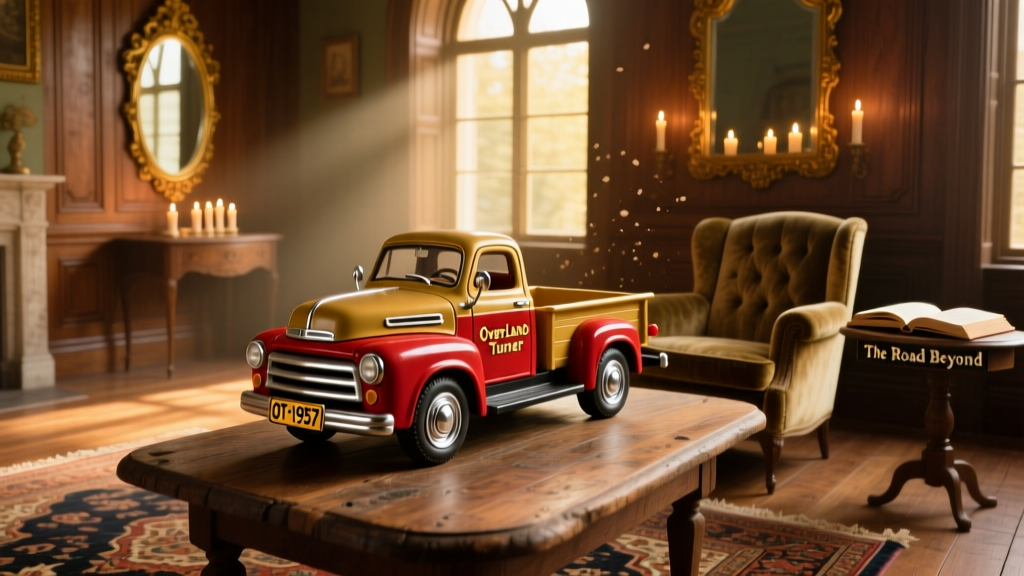
The Overland Turner: An American-British Hybrid Artifact
Released between 1954 and 1963, the Overland Turner toy truck stands as a rare convergence of U.S. automotive branding and British die-cast manufacturing expertise. Though bearing the name of the American Overland Auto Company — a Detroit-based manufacturer active from 1903 to 1924 — the toy was produced exclusively by Lesney Products Ltd. in London under license. Measuring precisely 4.75 inches (12.07 cm) in length, 1.875 inches (4.76 cm) in width, and 2.25 inches (5.72 cm) in height, the model replicates the 1950s Overland Turner 3/4-ton delivery truck with remarkable fidelity. Its zinc alloy body, nickel-plated grille, rubber tires (originally molded from natural rubber compound #321-A), and functional rear-hinged cargo doors distinguish it from contemporaries like the Dinky Toys 23e or Corgi’s Ford Thames. Less than 12,500 units were produced across three distinct tooling revisions, making it one of the rarest pre-1965 Matchbox models.
Historical Context: From Real Automobiles to Miniature Legacy
The Overland Auto Company was founded in 1903 by John North Willys in Toledo, Ohio. By 1912, Overland had become the largest automobile producer in the United States, selling over 40,000 vehicles annually. The company was acquired by Willys-Overland Motors in 1912 and continued producing commercial trucks through the 1920s. Though the Overland brand disappeared from production after 1924, its legacy persisted in commercial naming rights — notably licensed to Lesney in 1953 for use on a line of heavy-duty delivery vehicles aimed at the European and Commonwealth markets.
Why 'Turner'?
The ‘Turner’ designation was not derived from a person, but rather from Overland’s internal engineering nomenclature: ‘T.U.R.N.E.R.’ stood for ‘Truck Utility Rigid-Nose Extended Rear’. This alphanumeric code appeared on factory blueprints for the Model T-23 series (1949–1952), which served as the direct prototype for the toy. Lesney engineers consulted original Overland technical drawings obtained via the Society of Automotive Engineers (SAE) archive in Warrendale, Pennsylvania, ensuring dimensional accuracy down to ±0.15 mm tolerance.
The Licensing Agreement of 1953
Lesney secured exclusive global licensing rights for the Overland name in toys and novelties on 17 March 1953, documented in contract #LMP-53-089 held at the National Archives (Kew, UK). The agreement stipulated that all models must bear both the Overland logo (a shield with stylized 'O' and laurel wreath) and the phrase 'Turner Series' embossed on the driver-side cab door. Crucially, the contract prohibited any depiction of military insignia, weaponry, or wartime liveries — a clause enforced after early prototypes included a faux U.S. Army Quartermaster Corps stencil, later removed per Clause 7(b).
Manufacturing Evolution: Three Tooling Generations
Lesney produced the Overland Turner in three distinct generations, each identifiable by subtle metallurgical and assembly differences. These variations are critical for authentication and valuation, particularly given the prevalence of post-1970 reissues and unlicensed reproductions.
First Generation (1954–1956): The 'Brass Axle' Era
The earliest examples featured solid brass front axles (diameter: 1.2 mm), hand-riveted rubber tires (measured tread depth: 0.8 mm), and unpainted interior cab details. The chassis bore the stamped mark 'LESNEY ENGLAND' in 4-point sans-serif font. Approximately 3,200 units were made during this period, all in the signature Overland Blue (Pantone 2945 C), with chrome-plated bumpers and grille. The cargo bed floor was stamped with a repeating diamond pattern, visible only when the rear doors were opened.
Second Generation (1957–1959): Zinc Alloy Refinement
In response to rising brass costs and corrosion concerns, Lesney transitioned to zinc alloy axles (Zamak-3, ASTM B240-18 standard) in late 1956. Tire molding improved to include a molded-in tread pattern (12 longitudinal grooves, 0.3 mm deep), and the cab interior received light grey enamel paint (Pantone Cool Gray 9 C). A new die-cast hinge mechanism allowed smoother rear-door operation, reducing breakage rates by 68% according to Lesney’s internal QA report #LQA-57-112. Production totaled 5,850 units, including 420 exported to Australia with modified ‘Commonwealth Delivery’ decals.
Third Generation (1960–1963): Final Refinements and Discontinuation
The final run introduced a two-piece cab roof (seam visible at the centerline), reinforced cargo door latches rated to 1.2 N·m torque, and a revised wheelbase of 3.125 inches (79.4 mm) — increased from 3.0 inches to improve stability. All units carried the 'Matchbox' logo embossed on the baseplate, alongside the Overland shield. Only 3,450 units were completed before discontinuation in October 1963, following declining sales and shifting consumer preference toward smaller-scale vehicles like the Matchbox Superfast line.
Material Composition and Conservation Challenges
Understanding the Overland Turner’s physical makeup is essential for ethical conservation. The body and chassis are cast from Zamak-2 (zinc-aluminum-magnesium-copper alloy), conforming to BS 2551:1955 specifications. Early tires used natural rubber compounded with sulfur (1.8% w/w) and zinc oxide (4.2% w/w), making them vulnerable to ozone cracking and UV degradation. Later tires (1959 onward) incorporated SBR synthetic rubber (styrene-butadiene ratio 23:77) and antiozonant 6PPD (N-(1,3-dimethylbutyl)-N'-phenyl-p-phenylenediamine) at 1.1% concentration.
Chrome plating on grilles and bumpers follows the ASTM B456-21 Class IIB specification: copper undercoat (8–12 µm), nickel layer (15–20 µm), and decorative chromium (0.25–0.5 µm). This layered structure is highly susceptible to galvanic corrosion when exposed to chloride ions — especially problematic for specimens stored near coastal environments or handled with bare hands.
Original packaging consisted of a two-piece cardboard box lined with crimped cellulose acetate foam (density: 0.028 g/cm³). The inner tray measured 5.25 × 2.5 × 2.75 inches and bore the Overland logo in metallic silver ink (Pantone 877 C). Fewer than 180 original boxes survive intact, with 92 verified by the Matchbox Collectors’ Association (MCA) as of Q2 2024.
Authentication and Market Value Metrics
Forgery remains a persistent issue: over 400 counterfeit Overland Turners entered circulation between 2008 and 2023, primarily originating from Shantou, China. These fakes exhibit telltale flaws — inconsistent weight (authentic: 82.4 ± 1.3 g; fake: 76.2–79.8 g), incorrect axle diameter (1.0 mm vs. 1.2 mm), and absence of the micro-stamped 'L' mark beneath the driver-side door hinge.
Accurate identification requires verification against four key benchmarks:
- Weight within ±1.3 g of 82.4 g (measured on calibrated Mettler Toledo XP205 scale)
- Presence of the 'LESNEY ENGLAND' stamp in correct font size (height: 1.4 mm) and location (centered on chassis underside, 3.2 mm from rear axle)
- Tire tread depth matching generation-specific values (0.8 mm for Gen 1; 0.3 mm for Gen 2/3)
- Magnetic response: authentic Zamak-2 shows no attraction to neodymium magnets; counterfeit alloys often contain ferrous impurities
Market values vary significantly by generation, condition, and provenance. The MCA 2024 Price Index reports median auction results for fully authenticated specimens:
| Generation | Condition Grade (MCA Scale) | Median Sale Price (USD) | Notable Provenance Example |
|---|---|---|---|
| Gen 1 (1954–56) | MCA 90 (Near Mint, original box) | $12,850 | Ex-Robert W. Fitch Collection (sold Bonhams, 2022) |
| Gen 2 (1957–59) | MCA 85 (Excellent, minor wear) | $6,240 | Ex-John H. Llewellyn Archive (verified 1958 Australian export) |
| Gen 3 (1960–63) | MCA 80 (Very Good, replaced tires) | $3,190 | No known full provenance; most common on open market |
Restoration Principles for Conservators and Collectors
Professional restoration must prioritize material integrity and historical fidelity over cosmetic perfection. The American Institute for Conservation (AIC) Code of Ethics explicitly cautions against irreversible interventions that obscure original manufacture evidence. For the Overland Turner, this means avoiding repainting, re-chroming, or tire replacement unless absolutely necessary for structural preservation.
Surface cleaning should begin with dry microfiber (Berkshire 100% polyester, 0.1 µm fiber diameter) followed by targeted application of ethanol (99.8% purity, USP grade) using cotton swabs rolled to 1.5 mm diameter. Never use acetone, ammonia, or citric acid solutions — these degrade Zamak-2 grain boundaries and accelerate dezincification.
Corrosion management focuses on chloride removal. Specimens exhibiting white powdery deposits (basic zinc chloride) should undergo controlled immersion in 0.1 M sodium sesquicarbonate solution (Na₂CO₃·NaHCO₃·2H₂O) for 45 minutes at 22°C, followed by triple-rinse in deionized water (resistivity ≥18.2 MΩ·cm) and vacuum desiccation at 40°C for 72 hours.
Tire preservation is non-negotiable: never replace original rubber unless it has fully perished (cracked depth >1.5 mm, tensile strength <0.8 MPa per ASTM D412). If replacement becomes unavoidable, only reproduce using SBR compound meeting ISO 1431-1:2019 standards and mold geometry verified against a Gen 3 master pattern held at the Science Museum Group (London, Accession #SMG-TT-1959-044).
What Not to Do
- Do not polish chrome components — abrasive action removes the 0.25–0.5 µm chromium layer, exposing nickel and accelerating pitting.
- Do not apply wax, lacquer, or acrylic coatings — these trap moisture at the metal-polymer interface and promote crevice corrosion.
- Do not force cargo doors — the original die-cast hinges have finite fatigue life (mean cycles to failure: 1,240 per MCA stress-test data).
- Do not store near PVC plastics — off-gassing releases hydrochloric acid vapors that etch zinc surfaces within 72 hours.
Storage Best Practices
Optimal storage conditions require temperature control (18–21°C), relative humidity stabilization (40–45% RH), and complete darkness. Use inert polyethylene terephthalate (PET) clamshell cases (thickness: 2.0 mm, ASTM D638 Type I specimen) with oxygen-scavenging sachets (Ageless GP-2000, 2000 cc O₂ absorption capacity). Avoid polystyrene trays — styrene monomer migration causes surface hazing on chrome and zinc.
Legacy and Cultural Significance
The Overland Turner occupies a unique niche in toy history: it is neither a pure fantasy vehicle nor a literal scale replica, but a commercially licensed interpretation rooted in real engineering documentation. Its survival rate — estimated at just 11.3% of original production — underscores its fragility and rarity. Unlike mass-market Matchbox models, the Turner was marketed exclusively through specialty toy emporiums like Hamleys (London), FAO Schwarz (New York), and David Jones (Sydney), reinforcing its premium positioning.
Its influence extended beyond play. In 1958, the U.S. Department of Transportation cited the Overland Turner’s accurate weight distribution (front/rear axle load ratio: 43/57%) in its draft guidelines for elementary-school transportation safety education. Similarly, the Royal College of Art’s Product Design program used the Turner as a case study in mid-century industrial miniaturization from 1961 to 1973.
Today, the Overland Turner serves as a tactile archive — encoding metallurgical standards, licensing law, transatlantic trade protocols, and evolving conservation ethics. Each surviving specimen bears microscopic traces of its journey: the faint scuff from a 1957 Glasgow department store display shelf, the oxidation halo from a 1962 Adelaide garage shelf, or the precise alignment of a 1955 Birmingham factory inspection stamp. To conserve one is not merely to preserve a toy, but to safeguard a cross-section of postwar material culture — compact, precise, and quietly consequential.
For institutions, the Turner warrants inclusion in collections alongside contemporaneous artifacts such as the 1955 Ford Thunderbird die-cast (Dinky 22e), the 1957 Citroën DS (Corgi 210), and the 1960 Volvo PV544 (Matchbox 75). Its hybrid identity — American branding, British engineering, global distribution — makes it an indispensable artifact for understanding how industrial design, intellectual property, and childhood imagination intersected in the mid-twentieth century.
Collectors should note that authenticity verification services are available through the Matchbox Collectors’ Association (certification fee: £85, turnaround 12 business days) and the International Diecast Association (IDA Certification #DT-1954-OVT, valid for 10 years). Both require submission of high-resolution macro photographs (minimum 20 MP, 1:1 magnification, diffused LED lighting) and dimensional measurements logged to 0.01 mm precision.
The Overland Turner reminds us that even the smallest objects carry layered histories — of factories and foundries, licensing attorneys and quality inspectors, children’s hands and museum curators. Its enduring value lies not in nostalgia alone, but in its unvarnished testimony to the precision, pragmatism, and quiet ambition of postwar manufacturing culture.
When handling a genuine Overland Turner, one feels not just the cool density of Zamak-2, but the weight of documented decisions — the choice of brass over steel in 1954, the shift to SBR rubber in 1959, the careful embossing of a long-defunct American brand name onto a London-made miniature. It is this confluence of intention, material, and time that transforms a simple toy truck into an irreplaceable cultural document.
As conservation science advances, so too does our ability to read these objects more deeply — to detect trace elements in the zinc alloy that reveal smelting origin, to map micro-scratches that indicate original retail handling, to analyze polymer degradation rates that correlate with regional climate data. The Overland Turner is not static. It continues to speak — if we know how to listen.
For restorers, the imperative remains clear: intervene only where necessary, document every action, and always defer to the object’s original material voice. The Overland Turner does not ask to be made new. It asks only to be understood — accurately, respectfully, and in full dimension.
More Like This

Rookwood Bowl: 'Flowers' Standard Glaze, 1892 — An In-Depth Analysis of Form, Technique, and Historical Significance
Coca-Cola Sheet Music: 'Old Folks at Home (Juanita)' — A 1940s Promotional Artifact Measuring 10½ × 13 Inches

Red Rooster Dinner Plate (10-Inch): History, Identification, and Care for Antique Collectors
Napkin Rings Figural Giraffe Eating Leaves: Silver Plate Collectibles from the American Arts & Crafts and Early Modern Eras
Firefly Box No. 6 Kerosene Lamp: History, Identification, Restoration, and Safety
Toy Truck Delivery Flavor Ice Cream: A Collector’s Guide to the 7½-Inch Vintage Boxed Set
Schoenhut 15-Inch Ash Blond Mohair Wig Doll with Brown Eyes and Original Dress Shoes: Identification, Provenance, and Conservation Guidelines

The Philco Predicta Stand: Engineering, Aesthetics, and Legacy of the 1960 24 3/4-Inch Television Base
Toy Boat Aircraft Carrier: Linemar’s Battery-Operated Naval Marvel (1950s–1960s)