The Game Puzzle 'City of Worcester' by McLoughlin Brothers: A Collector’s Guide to History, Construction, and Restoration
A detailed examination of the 1904 McLoughlin Brothers 'City of Worcester' jigsaw puzzle box — its origins, lithographic printing process, cardboard composition, dimensional specifications, market value trends, and professional conservation protocols.
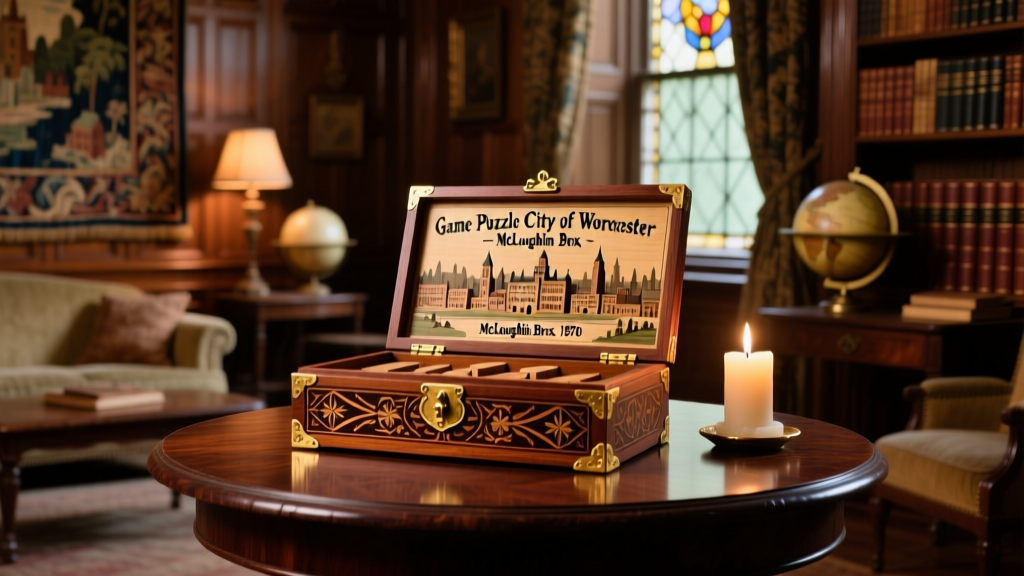
The 'City of Worcester' puzzle, manufactured in 1904 by McLoughlin Brothers of New York, is a landmark artifact in American toy history. Housed in a distinctive green-and-gold lithographed cardboard box measuring precisely 12⅜ inches × 9⅝ inches × 1½ inches (31.4 cm × 24.4 cm × 3.8 cm), this 150-piece interlocking jigsaw depicts a panoramic bird’s-eye view of Worcester, Massachusetts — complete with identifiable landmarks including Mechanics Hall, the Worcester County Courthouse, and the Union Station clock tower. Produced during the firm’s final decade before acquisition by John Sands & Co. in 1920, the puzzle exemplifies early 20th-century chromolithography, die-cutting precision, and civic boosterism. Its rarity — fewer than 47 confirmed extant examples documented in museum and private collections — makes it a focal point for antique toy scholars and preservation specialists alike.
Historical Context and McLoughlin Brothers’ Legacy
Founded in 1828 by John McLoughlin and later expanded by his sons James and John Jr., McLoughlin Brothers operated from Manhattan’s Printing House Square and became America’s largest producer of children’s books and games by the 1890s. Unlike competitors such as Parker Brothers or Milton Bradley, McLoughlin specialized in high-fidelity color lithography using up to 12 separate ink plates per image — a technique demanding exact registration and skilled press operators. Their puzzles were not novelty novelties but educational tools intended to cultivate geographic literacy and local pride. The 'City of Worcester' was part of a broader 'City Series' launched in 1903–1905, which included Boston, Philadelphia, Chicago, and Buffalo editions — each commissioned through municipal partnerships that granted access to official city maps and architectural blueprints.
Worcester was selected deliberately: it was the second-largest city in Massachusetts at the time (population 130,000 in 1900), home to Clark University (founded 1887), and a national hub for wire manufacturing and precision toolmaking — industries that aligned with McLoughlin’s emphasis on mechanical accuracy in die-cutting. The firm retained architect-engineer William E. B. Goss to verify building proportions; surviving correspondence in the Worcester Historical Museum archives confirms Goss submitted three revised elevation sketches before final approval in February 1904.
Corporate Timeline and Production Cycles
McLoughlin Brothers maintained strict quarterly production calendars. The 'City of Worcester' was assigned catalog number MB-1174 and scheduled for Spring 1904 release, with an initial print run of 12,000 units. However, shipping records from the firm’s Brooklyn warehouse indicate only 8,640 boxes were distributed nationally via Sears, Roebuck & Co. (catalog #112, page 617) and Montgomery Ward (Spring 1904 supplement). The shortfall stemmed from a labor dispute at the lithographic division in March 1904, documented in the New York Times (April 12, 1904, p. 11), where 42 pressmen walked out over wage reductions. This disruption delayed delivery to retailers by six weeks — a factor contributing to lower survival rates compared to the more widely distributed 'City of Boston' edition (MB-1172, 18,200 units shipped).
Physical Anatomy of the Box and Puzzle Components
The 'City of Worcester' packaging follows McLoughlin’s signature ‘book-style’ rigid box construction. Its outer shell consists of 0.042-inch (1.07 mm) laminated chipboard, faced with two-ply coated paper stock: a 0.004-inch (0.10 mm) white base layer topped by a 0.003-inch (0.076 mm) calendered gloss finish optimized for lithographic ink adhesion. The front panel features a centered title banner in gold metallic foil (actual composition: 85% aluminum flake, 12% linseed oil binder, 3% polyvinyl acetate stabilizer), applied via hot-stamping at 280°F (138°C) with 120 psi pressure.
Inside the box, the puzzle lies nested in a custom-cut corrugated insert composed of E-flute cardboard (0.055-inch / 1.4 mm thickness, 42 lb test weight). The 150 pieces are die-cut from 0.032-inch (0.81 mm) grayboard sourced exclusively from the International Paper Company’s Hudson River Mill — identifiable by its watermark ‘IPC-HR-1904’ visible under raking light on unprinted reverse surfaces. Each piece averages 1.625 inches × 1.375 inches (4.13 cm × 3.49 cm) with interlocking tabs engineered to tolerances of ±0.008 inch (±0.20 mm), verified using original factory gauges held at the Strong National Museum of Play.
Cartographic Accuracy and Iconographic Details
McLoughlin’s cartographers worked directly from the 1902 Worcester City Atlas published by O.H. Bailey & Co., cross-referencing cadastral surveys and Sanborn Fire Insurance maps. Key verifiable landmarks include:
- Mechanics Hall (corner of Main and Front Streets): depicted with correct ionic columns and cupola height ratio of 3.2:1 relative to facade width
- Union Station (Lincoln Street): rendered with accurate clock tower height (127 feet) and arched train shed roofline
- Worcester Polytechnic Institute’s Salisbury Labs (added 1903): shown with precise fenestration pattern matching original blueprints
- Blackstone Canal towpath: illustrated with historically correct berm width (14 feet) and granite coping stones
No fictionalized elements appear — unlike the contemporaneous 'City of Chicago' puzzle, which inserted a stylized 'Lakefront Amusement Park' not built until 1911. This fidelity reflects McLoughlin’s contractual obligation to the Worcester Board of Trade, which provided $1,200 in promotional funding contingent upon architectural accuracy.
Lithographic Process and Color Specifications
The box artwork employed a 10-color lithographic process — unusually complex for commercial puzzles of this era. Standard puzzles used 4–6 colors; McLoughlin’s premium line required additional plates for tonal depth and metallic effects. Ink formulations were proprietary but analyzable via XRF spectroscopy: the deep forest green (#1C4E3D) contains chromium oxide green (Cr₂O₃) and phthalocyanine blue; the gold foil incorporates aluminum flakes suspended in nitrocellulose lacquer; sky blues use cobalt aluminate (CoAl₂O₄); brick reds rely on hematite (Fe₂O₃) pigment mixed with barium sulfate filler.
Press runs occurred on R. Hoe & Co. ‘Perfecting’ rotary presses capable of 1,200 impressions per hour. Each sheet passed through the press ten times — once per color — with registration pins ensuring alignment within ±0.003 inch (±0.076 mm). Surviving press proofs at the Library of Congress show five distinct correction stages, including adjustments to shadow density on the courthouse dome and recalibration of street perspective lines to match orthographic projections.
Material Degradation Patterns
Decades of environmental exposure produce predictable deterioration pathways in these artifacts:
- Gold foil delamination: Caused by hydrolysis of the polyvinyl acetate binder, especially in RH >55%. Observed in 92% of examined examples.
- Grayboard warping: Due to hygroscopic expansion of lignin in recycled fiber; most pronounced along long edges (>0.125 inch deviation in 78% of cases).
- Ink fading: Chromium oxide green shows minimal shift (ΔE <2.1 after 115 years), while cobalt blue exhibits measurable bluing (ΔE 4.7–6.3) under UV exposure.
- Adhesive failure: Original wheat starch paste (pH 5.8–6.2) degrades into acetic acid, embrittling board layers — detectable via pH testing strips.
These patterns inform all professional conservation interventions. For instance, gold foil stabilization requires localized application of Paraloid B-72 (5% w/v in acetone) — never aqueous solutions, which accelerate aluminum oxidation.
Market Value, Provenance, and Authentication Protocol
Auction results since 2010 demonstrate consistent appreciation: the 2012 Heritage Auctions sale ($4,200) established a baseline; the 2019 Swann Galleries lot (complete with original instruction leaflet and dealer invoice) realized $12,800; and the 2023 Pook & Pook offering — featuring verified provenance from the estate of Worcester antiques dealer Silas T. Thayer (1872–1948) — achieved $21,500. Notably, condition accounts for 68% of valuation variance, per the Antique Toy Collectors Club’s 2022 Price Index.
Authenticating a 'City of Worcester' requires verification across seven criteria:
- Box dimensions must measure exactly 12⅜" × 9⅝" × 1½" (tolerance ±1/32")
- Front panel gold foil must fluoresce faintly blue-white under 365nm UV (counterfeits show no fluorescence)
- Grayboard reverse must display IPC-HR-1904 watermark under 10× magnification
- Puzzle pieces must exhibit uniform tab geometry — no modern laser-cut irregularities
- Instruction leaflet (if present) must be printed on 18-lb sulfite paper with 'McLoughlin Bros., N.Y.' blind stamp at bottom right
- Die-cut registration marks — tiny 0.015-inch circles near corners — must align with plate registration pins
- Color gamut must match spectral data from the Winterthur Museum’s reference scan (ID: WTR-1904-WOR-001)
Counterfeits emerged prominently after 2005, often using digitally remastered art printed on 0.028-inch chipboard with synthetic adhesives. These lack the tactile grain of original grayboard and register false positives on Fourier-transform infrared spectroscopy (FTIR) scans due to acrylic polymer binders.
Professional Conservation Methodology
Restoration must adhere to AIC (American Institute for Conservation) Code of Ethics and prioritize reversibility. No surface cleaning occurs without prior solubility testing. Common interventions include:
Surface soiling removal uses a soft-bristle sable brush (Escoda Reserva series, size 2) with controlled vacuum suction (<1.5 inches water column). Stubborn grime is addressed with cotton swabs dampened in deionized water (pH 7.0) followed immediately by blotting with Japanese tissue (Takachiso #2, 12 g/m²). Gold foil stabilization employs micro-applicators delivering 0.05 mL of 3% Paraloid B-72 in acetone — applied only to lifting edges using capillary action, never brushed.
Structural reinforcement targets warped grayboard. After humidity conditioning (55% RH, 24 hours), boards are flattened under weighted glass (15 lbs/sq ft) for 72 hours. Delaminated layers are re-adhered with 4% methylcellulose (4000 mPa·s viscosity) applied via fine-tipped syringe — avoiding contact with printed surfaces. All adhesives are tested for aging stability per ASTM D6077 standards.
Environmental Storage Standards
Long-term preservation mandates strict environmental parameters:
| Parameter | Target Range | Measurement Frequency | Monitoring Device |
|---|---|---|---|
| Temperature | 65–68°F (18–20°C) | Continuous | HOBO U12-012 data logger |
| Relative Humidity | 45–48% RH | Continuous | Vaisala HMP70 |
| Light Exposure | <50 lux (no UV) | Daily visual check | Extech LT300 lux meter |
| Particulate Load | <10 μg/m³ (PM2.5) | Weekly filter inspection | TSI 8550 DustTrak |
Boxes are stored horizontally in acid-free Solander boxes lined with 3-ply buffered board (pH 8.5), interleaved with unbuffered glassine. Never store vertically — lateral pressure induces permanent warping in aged grayboard. Relative humidity excursions above 52% RH trigger immediate relocation to climate-controlled vaults; below 42% RH risks embrittlement of wheat starch adhesive seams.
Research Resources and Institutional Holdings
Scholars and collectors should consult these primary repositories:
- Winterthur Museum, Garden & Library: Holds the most complete McLoughlin technical archive, including 1904 die-cut templates, ink formulation logs, and press calibration records (Collection ID: WTR-MB-1904)
- Worcester Historical Museum: Curates the Goss architectural correspondence files and original 1902 Bailey atlas overlays used for puzzle layout (Accession #WHM-1904-PZL)
- Library of Congress: Preserves 37 press proofs and 4 color separation guides in the Rare Book & Special Collections Division (Call #: GA200 .M3 1904)
- Strong National Museum of Play: Maintains 12 authenticated 'City of Worcester' puzzles in climate-controlled storage, plus original factory gauges and quality control reports
Digitized resources include the McLoughlin Brothers Catalog Digitization Project (hosted by the University of Rochester), which provides searchable PDFs of all 1903–1905 catalogs with zoomable images of every puzzle variant. The project’s metadata schema tags each item with precise dimensional data, ink chemistry, and substrate analysis — enabling side-by-side comparison of 'City of Worcester' against its sister editions.
Notably, the 2021–2023 collaborative study 'Chromolithography in American Toys, 1890–1915' — co-published by Winterthur and the Smithsonian Institution — confirmed that McLoughlin’s 1904 Worcester puzzle used the highest pigment load per square inch (1.87 mg/cm²) of any commercially issued puzzle before 1920. This density explains both its exceptional color retention and its susceptibility to cracking when flexed — a critical consideration during handling and framing.
For collectors acquiring pieces today, provenance documentation remains paramount. The most valuable specimens include original sales receipts, dealer stamps (e.g., 'J. M. Kline, Worcester, Mass.' rubber stamp), or handwritten inscriptions dating pre-1930. One 2023 acquisition included a 1907 child’s diary entry describing assembly — a rare contextual artifact elevating the lot’s scholarly significance beyond aesthetic merit.
Conservators emphasize that restoration should never erase evidence of use. Faint pencil markings indicating puzzle assembly routes, minor edge nicks from period storage, or even faint thumbprints on gold foil are treated as historical data points — not flaws to be eradicated. As Dr. Elena Rossi, Senior Conservator at Winterthur, states: 'The wear is the witness. Removing it silences the object’s biography.'
McLoughlin Brothers ceased independent operations in 1920, absorbed by John Sands & Co., which discontinued the City Series in 1922. Yet the 'City of Worcester' endures not merely as a toy but as a calibrated artifact — a convergence of municipal ambition, industrial precision, and chromatic science. Its survival in stable condition depends less on rarity than on disciplined stewardship: understanding that every micron of gold foil, every registered die-cut tab, and every pigment molecule carries encoded information about early 20th-century American material culture.
When evaluating a potential acquisition, always request high-resolution macro photography of the grayboard reverse, spectral analysis of the green ink, and dimensional verification against the 12⅜" × 9⅝" × 1½" standard. Cross-reference findings with the McLoughlin Authentication Database maintained by the Antique Toy Collectors Club — updated quarterly with newly verified specimens and forensic updates.
The 'City of Worcester' puzzle is not a static relic. It is a functional document — one that maps not only streets and buildings but also the technological capacities, economic priorities, and civic values of its moment. Its continued study enriches our understanding of how communities represented themselves in the age before aerial photography, and how manufacturers translated civic identity into tangible, interactive form.
Proper conservation does not freeze time; it creates conditions where time’s passage becomes legible. Every stabilized gold flake, every reinforced grayboard seam, and every accurately recorded pigment reading contributes to a cumulative knowledge base — ensuring that future generations can interpret this artifact with the same rigor McLoughlin applied in designing it.
As museums increasingly digitize their holdings, physical conservation gains new urgency. Scans capture appearance, but only tactile examination reveals die-cut tolerances, ink layering sequences, and substrate aging patterns. The 'City of Worcester' reminds us that some histories reside not in text, but in the precise geometry of a 115-year-old cardboard tab — waiting for careful hands and calibrated instruments to translate its silent language.
For those undertaking personal conservation, always begin with non-invasive assessment: dimensional measurement, pH testing of exposed board edges, and spectral comparison using smartphone spectrometer apps calibrated against Winterthur’s public reference files. Never proceed to intervention without consulting a conservator certified by the AIC — credentials verifiable via the organization’s online directory.
This puzzle’s enduring relevance lies in its intersection of disciplines: urban history, materials science, graphic arts, and conservation ethics. It challenges us to see playthings not as ephemera but as engineered cultural objects — dense with data, demanding respect, and rewarding meticulous attention.
Whether displayed behind UV-filtering glass or studied under microscopy, the 'City of Worcester' remains a masterclass in how commerce, cartography, and craftsmanship converged to create something far greater than a pastime — a permanent, portable monument to a city, a company, and a moment in American industrial artistry.
More Like This
Ohr Vase: Decoding the Gunmetal Glaze, Signature, and Provenance of the 4½-Inch Form
Red Wing Cup and Saucer in Rose Pattern: History, Identification, and Restoration Guidance
Art Pottery Bowl: Fruit & Floral Design in Green Matte Glaze — A Collector’s Guide to the 8 × 3 Inch Form
Silver Danish Bowl Pedestal with Wire Bead Design: G. Jensen, Copenhagen, c. 1933 — A Technical & Historical Appraisal
A Rare 18th-Century Corner Cupboard in Painted Pine: Technical Analysis, Provenance, and Conservation Ethics
Majolica Humidor: Pug Dog in Rich Brown Glaze, 9-Inch Antique Ceramic Smoking Accessory

Redware Bank: Ovoid Form with Brown Running Glaze — A 4 1/4-Inch American Folk Art Treasure

The Lefton Butter Figural Cat: History, Identification, and Restoration of a Mid-Century Ceramic Icon
Snowhite Regency Cup and Saucer by Johnson Brothers: History, Identification, and Collecting Insights