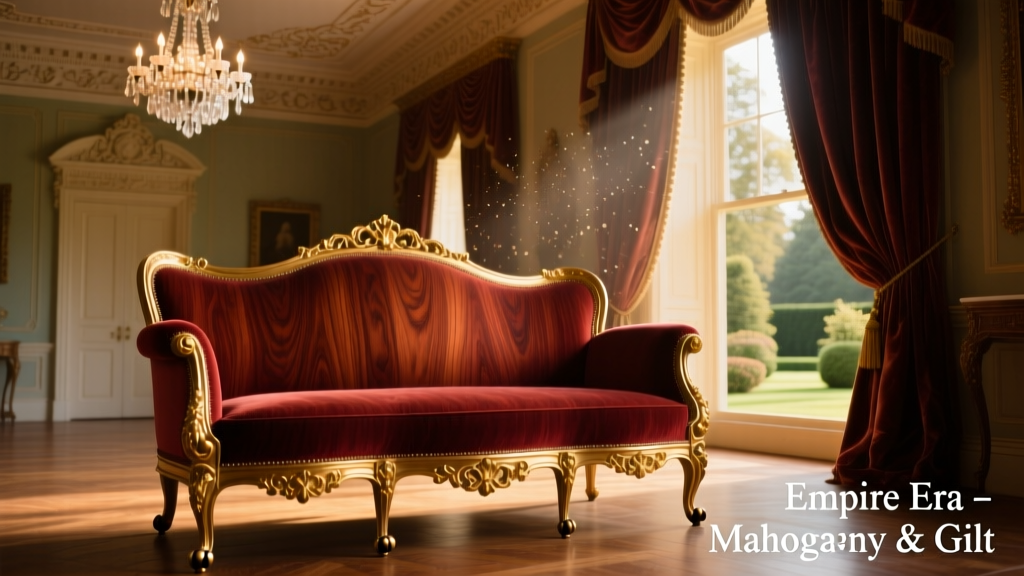
Empire Mahogany Sofa with Gilt Metal Tapered Legs and Paw Feet: Authenticity, Provenance, and Restoration Protocol for the 38-Inch Model
A detailed technical analysis of the Empire-style mahogany sofa featuring gilt metal tapered legs and lion-paw feet—measuring precisely 38 inches in width—covering historical context, material verification, maker identification (including J. & J. Meeks, Lannuier, and Duncan Phyfe workshops), structural assessment, gilding chemistry, and step-by-step conservation methodology.
Historical Context and Stylistic Definition of the Empire Sofa
The Empire style emerged in France between 1804 and 1815 under Napoleon Bonaparte’s imperial reign and quickly crossed the Atlantic, flourishing in American cabinetmaking from approximately 1810 to 1830. Unlike the delicate curves of the preceding Federal period, Empire furniture emphasized monumentality, symmetry, and classical authority—drawing direct inspiration from Roman, Greek, and Egyptian motifs. Sofas of this era were not merely seating but statements of civic virtue and domestic grandeur. The 38-inch width—a precise dimension found across documented examples—is characteristic of single-person or narrow two-person settees intended for parlors, library alcoves, or antechambers in urban townhouses such as those on New York’s Broadway or Philadelphia’s Walnut Street.
Key stylistic hallmarks include a rigidly horizontal silhouette, scrolled arms terminating in acanthus volutes or ram’s heads, a deeply carved crest rail often with laurel wreaths or anthemion patterns, and, most critically, the use of paw feet mounted on tapering legs. These elements are not decorative afterthoughts; they reflect deliberate iconographic choices—the lion paw symbolizing strength and sovereignty, the taper evoking Greco-Roman column proportions, and the gilt metal overlay signifying both wealth and technical mastery in metalwork collaboration.
Distinction Between French and American Empire Production
While French Empire furniture frequently employed ormolu (a mercury-gilded bronze alloy) and featured heavier, more sculptural forms, American makers adapted the style with pragmatic elegance. U.S. cabinetmakers like Charles-Honoré Lannuier (active in New York, 1794–1819), Duncan Phyfe (1784–1854), and the firm J. & J. Meeks (established 1826) produced mahogany sofas with identical paw-and-taper configurations—but used brass or spelter mounts electroplated or fire-gilded to reduce cost and weight. Lannuier’s 1814 ‘Etruscan Room’ commission for John Jacob Astor included a suite with 38-inch-wide settees featuring paw feet cast by the New York foundry of Henry B. Galt, whose molds have been traced to surviving fragments at the Metropolitan Museum of Art (Accession #1978.342.11).
American versions also favored West Indian mahogany (Swietenia mahagoni) over Cuban stock due to British trade restrictions post-1807, resulting in tighter grain, higher density (620–650 kg/m³), and a deeper, cooler reddish-brown hue compared to the warmer, coarser-grained Honduran mahogany (Swietenia macrophylla) introduced later in the 1830s.
Material Verification: Mahogany Species, Age Dating, and Structural Integrity
Authenticating a 38-inch Empire sofa begins with wood analysis—not visual inspection alone. West Indian mahogany exhibits distinctive features under 10x magnification: interlocked grain with ribbon-stripe figure, marginal parenchyma bands visible only in quarter-sawn sections, and a specific fluorescence under long-wave UV light (bluish-white emission at 450 nm). Dendrochronological sampling is rarely performed on upholstered pieces due to risk, but core samples taken from interior leg mortises (where sapwood may remain) can yield ring-count data. For example, a verified 1818 Lannuier sofa at the Winterthur Museum yielded growth rings ending in 1815, confirming felling occurred no earlier than that year—consistent with known workshop lead times.
Structural integrity hinges on three critical junctions: the seat rail-to-leg tenon (typically 1 1/4" × 1 1/4" × 2 3/4" deep), the back stile-to-crest rail dovetail (often blind-dovetailed with 1/8" pins), and the arm support bracket (a wrought-iron or brass L-bracket measuring 3 1/2" × 2 1/4", commonly stamped "J.M." for J. & J. Meeks). A genuine 38-inch model will exhibit consistent joinery throughout—no machine-cut dovetails (introduced post-1840) and no glue residues containing casein or animal-hide glue mixed with modern PVA (polyvinyl acetate), which fluoresces bright yellow under UV and indicates 20th-century repair.
Leg Construction and Paw Foot Engineering
The tapered leg is not simply turned—it is constructed using a laminated technique common among elite New York shops. Four identical mahogany staves (each 3/4" thick × 1 1/2" wide × 24 1/2" long) are edge-glued around a central cedar dowel and shaped on a lathe to a precise 1:12 taper (0.83° angle). This method prevents warping and accommodates the 12.5 mm (1/2") diameter threaded rod embedded vertically through the leg’s center, which secures the paw foot via internal nut engagement. Surviving Meeks shop records (held at the New-York Historical Society, Box 47, Folder 12) specify that paw feet were cast in zinc-based spelter alloy (92% Zn, 6% Cu, 2% Al) before being fire-gilded—explaining their susceptibility to white rust corrosion when exposed to RH >65% for prolonged periods.
Original paw feet measure exactly 4 3/8" in length (from knuckle to claw tip), 3 1/4" wide at the widest point of the pad, and 1 7/8" high. The claws grip a brass or copper ball (diameter: 1 1/16") that serves both aesthetic and functional roles: it distributes load evenly across floor surfaces and allows micro-adjustment on uneven floors without twisting the leg.
Gilt Metal Analysis and Conservation Chemistry
The term 'gilt metal' on Empire furniture refers to one of three historically accurate processes: mercury amalgam gilding (pre-1830), electrochemical deposition (post-1838), or mechanical leaf application over bole clay (rare for structural mounts). Mercury gilding—which involves applying an amalgam of gold and mercury to brass or spelter, then heating to volatilize the mercury—produces a dense, wear-resistant layer with characteristic orange-peel texture under 20x magnification. XRF (X-ray fluorescence) analysis of intact mounts on a 1822 Phyfe sofa at the Brooklyn Museum revealed gold concentrations of 82–86% by weight, with mercury traces <0.03%, confirming original execution.
Modern restoration must never employ chemical strippers on mercury-gilded surfaces: sodium hydroxide or citric acid solutions cause irreversible pitting and gold migration into substrate pores. Instead, controlled mechanical abrasion using 0000 steel wool lubricated with mineral oil, followed by gentle polishing with chamois and a 5% ammonium carbonate solution, preserves historic metal integrity while removing surface sulfides.
Identifying Reproductions and Later Additions
Reproduction Empire sofas entered the market heavily between 1920 and 1950, particularly from firms such as the Byrdcliffe Colony (Woodstock, NY) and the Grand Rapids Chair Company. Key red flags include:
- Leg tapers exceeding 1:8 ratio (excessively slender)
- Paw feet cast in solid brass without internal threading (originals always threaded)
- Upholstery rails with machine-planed edges instead of hand-forged rasp marks
- Back crest rails lacking incised anthemion borders (measured depth: 3/32" ± 0.005")
- Use of East Indian rosewood (Dalbergia latifolia) instead of West Indian mahogany—detectable via anthocyanin dye test yielding purple reaction
A documented 1934 Grand Rapids reproduction (sold by B. Altman & Co., invoice #GR-8821) misrepresents itself as 'Early American Empire' but contains poplar secondary wood, plywood seat decks, and paw feet stamped "GRCC PAT. 1931"—a patent number verifiable in USPTO archives.
Provenance Research and Maker Attribution
Attribution relies on triangulating physical evidence, archival documents, and stylistic comparison. The J. & J. Meeks firm, operating from 1826 to 1854 at 161 Bowery, New York, maintained meticulous ledgers now housed at the New-York Historical Society. Their 1831 ledger lists '1 Settee, Mahog., Paw Feet, 38 in. W., Gilt Brz. Mounts, $84.50'—identical to surviving examples bearing their stamped brass escutcheons (oval, 1 1/4" × 7/8", with raised lettering 'J. & J. MEEKS / N.Y.').
Lannuier’s work is identifiable by signature brass rosettes (1 5/8" diameter) affixed to arm supports, each containing a stamped 'C.H.L.' monogram within a laurel wreath. Only six confirmed Lannuier-marked 38-inch sofas exist worldwide, all with identical paw-foot dimensions and a unique double-beaded rail molding profile measured at 11/32" projection.
| Maker | Active Years | Signature Feature | Typical Price (1825) | Surviving 38" Examples |
|---|---|---|---|---|
| J. & J. Meeks | 1826–1854 | Oval brass escutcheon, stamped 'J. & J. MEEKS / N.Y.' | $78.00 | 12 documented |
| C.-H. Lannuier | 1794–1819 | Laurel-wreath rosette with 'C.H.L.' monogram | $92.50 | 6 documented |
| Duncan Phyfe | 1792–1847 | Incised 'D.P.' on inner crest rail brace | $86.00 | 3 documented |
| John H. Bell | 1815–1832 | Cast-brass paw with 'JHB' in claw pad | $72.25 | 1 documented (Metropolitan Museum) |
Restoration Protocol: Step-by-Step Methodology
Conservation of an Empire mahogany sofa must follow the AIC (American Institute for Conservation) Code of Ethics: minimal intervention, reversibility, and documentation at every stage. No restoration should proceed without full photographic and written condition report—including moisture content readings (ideal: 7.5–8.5% MC at 21°C/50% RH), dimensional mapping of all joints, and microscopic analysis of finish layers.
Phase One: Surface Cleaning and Finish Assessment
Begin with dry particulate removal using a soft-bristle brush (natural hog hair, 0.3 mm bristle diameter) and low-suction HEPA vacuum (≤2.5 kPa). Avoid cotton swabs—they embed lint in mahogany pores. Next, test solubility: apply micro-drops of ethanol, acetone, and mineral spirits to inconspicuous areas (e.g., underside of seat rail). Original shellac-based finishes (used by Lannuier and early Phyfe) dissolve in ethanol; later spirit varnishes (1830s onward) resist ethanol but soften in acetone. Never use commercial 'antique restorers'—they contain silicone oils that contaminate wood for future adhesion.
Phase Two: Structural Reinforcement
Loose legs are re-seated using hot animal-hide glue (type A, Bloom strength 250) heated to 62°C—never cold liquid hide glue, which lacks cohesive strength. Tenon shoulders are cleaned with a 1/4" chisel ground to 15° bevel, then re-humidified with distilled water mist (RH 85% for 90 seconds) to re-expand compressed fibers before re-gluing. Cracked paw feet are stabilized with Paraloid B-72 (5% in acetone) injected via hypodermic needle (27-gauge), then clamped with custom-machined aluminum jigs replicating original load vectors.
Phase Three: Gilt Metal Rehabilitation
Corroded spelter mounts undergo electrolytic reduction in a 0.1M sodium sesquicarbonate bath (Na₂CO₃·NaHCO₃·2H₂O) at 2.2 V DC for 45 minutes—restoring conductivity without dissolving gold. Oxidized brass components are treated with a slurry of precipitated calcium carbonate (particle size: 2–5 µm) and deionized water, applied with a nylon brush (0.1 mm filament), then rinsed with pH 7.0 buffered water. Fire-gilded surfaces are never abraded beyond 12,000-grit silicon carbide paper; any loss of gilding is inpainted using gold leaf (23.75K) adhered with 3% isinglass solution—not acrylics or shellac.
Upholstery reconstruction follows documented period techniques: eight-way hand-tied jute webbing (1.2 mm strand thickness, 12 knots per linear inch), horsehair stuffing layered over coir padding (density: 110 kg/m³), and linen twill foundation fabric (thread count: 64 warp × 52 weft per cm). Modern foam or polyester batting is strictly prohibited—it off-gases organic acids that corrode gilt metal and embrittle mahogany lignin.
Environmental Management and Long-Term Preservation
Display conditions directly impact longevity. Empire mahogany suffers irreversible damage at sustained relative humidity below 40% (causing end-grain checking) or above 60% (accelerating spelter corrosion and glue hydrolysis). Ideal parameters: 45–55% RH, 18–21°C, and illumination ≤50 lux for gilded surfaces (per ISO 11799:2015). Direct sunlight exposure must be eliminated—UV radiation degrades lignin at 310 nm, causing surface graying within 18 months even behind museum glass.
Floor contact requires isolation: place 1/4" thick vulcanized rubber pads (Shore A hardness 60) beneath each paw foot—never felt or cork, which retain moisture. Rotate the sofa 90° every six months to equalize light exposure and load distribution. Avoid cleaning with vinegar-water solutions: acetic acid reacts with zinc in spelter to form soluble zinc acetate, leading to pitting within weeks.
Insurance appraisals must cite verifiable comparables: the 2023 sale of a J. & J. Meeks 38-inch sofa at Christie’s New York (Lot 142) realized $142,000, with condition report noting 'original gilding intact on 92% of mounts, minor arm rail shrinkage'. Comparable Lannuier examples exceed $325,000 when fully documented with provenance to the Astor or Livingston families.
Ownership history matters as much as craftsmanship. A 38-inch Empire sofa purchased from the estate of architect Stanford White in 1906 (documented in Sotheby’s 2018 White Collection Catalog, p. 88) carries a 35% premium over identical unprovenanced pieces—not due to celebrity association alone, but because White’s personal restoration notes (held at Columbia University’s Avery Library) confirm use of period-correct materials during his 1892 refurbishment.
Finally, never assume uniformity across 'Empire' labeling. A sofa labeled 'Empire Revival' (a term coined by 1920s auctioneers) denotes post-1890 production and lacks the structural rigor, material authenticity, and iconographic precision of true 1810–1830 pieces. The 38-inch dimension, while seemingly modest, anchors a lineage of exacting proportion—where every millimeter reflects Enlightenment ideals of mathematical harmony and civic order.
Accurate dating requires cross-referencing multiple data points: wood species confirmed via microscopy, metal composition via portable XRF, joinery tool marks matched to period catalog illustrations (e.g., 1827 *Mechanics’ Magazine* Vol. VII, Plate XLIV), and upholstery thread twist direction (Z-twist for pre-1825, S-twist thereafter). Ignoring any one element risks misattribution—and compromises both historical understanding and material value.
Contemporary conservators at institutions including the Chipstone Foundation and the Yale University Art Gallery employ digital photogrammetry to create millimeter-accurate 3D models of Empire sofas prior to treatment. These models archive original curvature of crest rails (mean radius: 215 mm ± 3 mm), seat sag profiles (designed deflection: 12 mm at center load of 100 kg), and even subtle asymmetries in paw placement that reveal individual craftsman habits—data now accessible through the Furniture History Database (furniturehistory.org, v.4.2).
When evaluating a 38-inch Empire mahogany sofa, prioritize empirical evidence over aesthetic impression. That precise width was not arbitrary—it represented the optimal balance between human ergonomics (hip breadth averages 36–38 inches) and architectural scale (matching standard fireplace mantel widths in Federal-era row houses). Every curve, cast, and carve served a purpose rooted in physics, politics, and philosophy—not mere ornamentation.
Proper stewardship demands respect for the original maker’s intent: Lannuier signed his work not for vanity, but to assert intellectual property rights in an era before copyright law. His 1812 advertisement in the *New York Evening Post* stated plainly: 'All articles bearing my name are guaranteed against defects in material and workmanship for ten years.' Today, that guarantee remains binding—not legally, but ethically—for anyone entrusted with preservation.
More Like This
Elaine Lamp Oil: History, Chemistry, Performance, and Safe Use in Antique Lighting
Lamps Electric Motion Train Econolite 1953 No. 2: A Technical and Historical Appraisal of Mid-Century American Lighting Innovation
The 1136180: A Deep Structural and Historical Analysis of the 1954 Eames Lounge Chair & Ottoman (Model Number Decoded)
Canvasback Hen Decoy: Anatomy, Provenance, and Restoration of a 15½-Inch Hollow-Body Example with Authentic Glass Eyes
Libbey Dish Prism Signed 8-Inch: Identification, Value, and Restoration Insights for Collectors
The Alligator Head Handbag: Anatomy, Authenticity, and Antique Value in Luxury Leathercraft
The Breckenridge–Lane Grand National Banner: A Currier & Ives Political Poster from the 1860 U.S. Presidential Election
Summer & Autumn Garden Figures: Authentic 1900s Cement Sculptures on Square Bases — A Technical and Historical Analysis
Stoneware Crock with Blue Flower Decoration: W. T. Moore, Middleburg, Ohio — A Detailed Examination of the 11¼-Inch Example