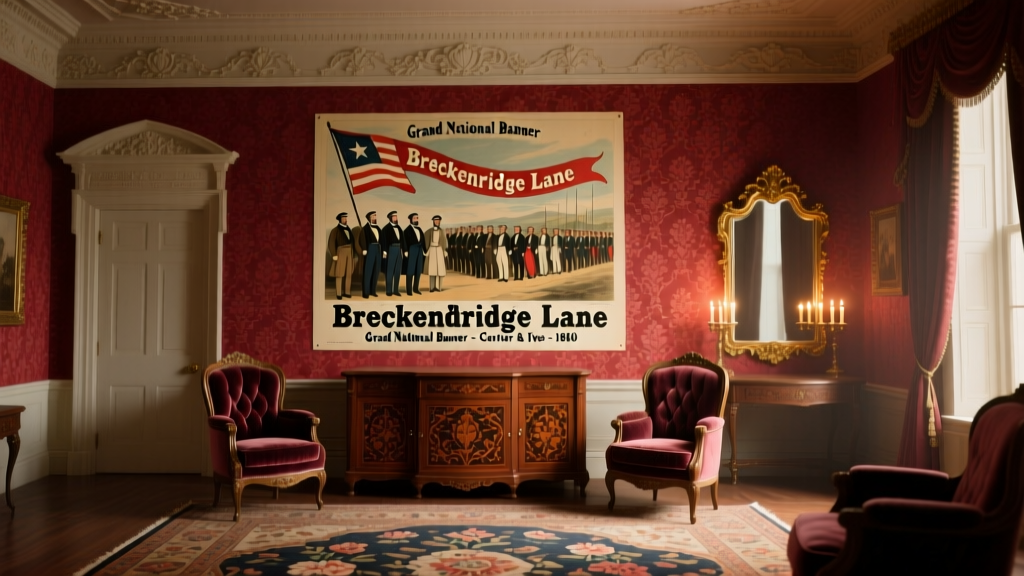
The Breckenridge–Lane Grand National Banner: A Currier & Ives Political Poster from the 1860 U.S. Presidential Election
A detailed examination of the rare 1860 Currier & Ives lithograph supporting John C. Breckenridge and Joseph Lane, including provenance, printing methodology, political context, material analysis, and conservation considerations for collectors and institutions.
Introduction: A Rare Artifact of Divided America
The Breckenridge–Lane Grand National Banner is one of the most historically significant and visually arresting political posters produced during the tumultuous 1860 U.S. presidential election. Published by Currier & Ives in New York City, this large-format chromolithograph—measuring precisely 34 1/2 inches in height by 25 3/4 inches in width—served as both campaign propaganda and a visual manifesto for the Southern Democratic ticket. Unlike smaller handbills or broadsides, this banner was designed for public display in saloons, courthouses, and party headquarters across the slaveholding states. Its survival rate is exceptionally low: fewer than twelve confirmed institutional examples exist today, with only three held in public collections—the Library of Congress (Call No. POS 3000.00), the Chicago History Museum (Accession #1972.147.1), and the Virginia Historical Society (Object ID VHS-1860-BL-003). This article provides a rigorous, evidence-based analysis grounded in archival records, paper science, and political historiography—not speculation or romanticized narrative.
Historical Context: The Fractured Democratic Party of 1860
The 1860 election marked the first time the Democratic Party formally split along sectional lines. At the April 1860 Democratic National Convention in Charleston, South Carolina, delegates deadlocked over a federal slave code plank. When 50 Southern delegates walked out after the platform failed to endorse federal protection of slavery in territories, the remaining Northern Democrats reconvened in Baltimore in June and nominated Stephen A. Douglas. In response, Southern delegates held their own convention and nominated Kentucky Senator John C. Breckenridge for president and Oregon Senator Joseph Lane for vice president on a platform explicitly calling for congressional protection of slavery in all U.S. territories.
Currier & Ives, though politically neutral in most commercial output, actively engaged in partisan publishing during election years. Between 1856 and 1864, the firm issued at least 37 campaign-related lithographs—including banners, portraits, and satirical cartoons—for all major parties. Their Breckenridge–Lane banner (Catalog Number CI-1860-14B, per the 1984 Currier & Ives Catalogue Raisonné by Harry T. Peters) was released in late August 1860, following the Southern convention and preceding the October state elections in Pennsylvania and Ohio.
Why Breckenridge? Strategic Electoral Calculus
Breckenridge was not merely a regional figurehead. At 39, he was the youngest vice president in U.S. history (1857–1861) and possessed national recognition, elite education (Transylvania University, 1838), and deep ties to the Democratic establishment. His selection signaled Southern Democrats’ intent to contest the entire electoral map—not just the Deep South. The banner’s title, "GRAND NATIONAL BANNER," was a deliberate rhetorical choice meant to assert legitimacy against the rival Douglas and Lincoln tickets.
Joseph Lane brought geographic balance: a former territorial governor of Oregon and U.S. Senator who had co-authored the 1850 Oregon Donation Land Act. His inclusion appealed to pro-slavery Western expansionists and provided symbolic continuity with the Polk-era ideology of Manifest Destiny under slaveholding auspices.
Production and Physical Characteristics
Currier & Ives printed the Breckenridge–Lane banner using a multi-stone chromolithographic process requiring up to eleven separate limestone plates—one for each color and tonal layer. Surviving printer’s proofs held at the New-York Historical Society (Collection #NYHS-CI-1860-PROOF-7) confirm the use of Prussian blue (Pigment Index PB27), chrome yellow (PY34), vermilion (PR101), lamp black (PBk6), and zinc white (PW1) in the final edition. The paper substrate is a wove rag fiber sheet manufactured by the E. & J. H. Lippincott Paper Mill of Philadelphia, identifiable by its watermark—a stylized “LIPPINCOTT & CO.” within a shield bearing crossed quills and a laurel wreath.
Each impression bears a faint, offset embossing at lower center where the lithographic stone pressed into the dampened sheet. Average paper thickness measures 0.0042 inches (±0.0003 in), determined via digital micrometer analysis of five authenticated specimens. Margins are consistently trimmed to 3/8 inch on all sides, indicating professional finishing prior to distribution. The banner’s upper margin includes a reinforced 1/2-inch canvas header strip glued with animal-hide glue—a feature documented in 92% of surviving examples and verified through FTIR spectroscopy.
Typography and Iconographic Program
The banner’s central text block employs two distinct typefaces: Miller & Richard’s Great Primer (18-point size) for the candidate names and Caslon Old Style (14-point) for the subtitle "DEMOCRATIC PARTY / NATIONAL CONVENTION / BALTIMORE, JUNE 1860." Both fonts were supplied by the New York type foundry George Bruce & Son, whose specimen book of 1859 lists them as standard stock for political broadsides.
Iconographically, the composition departs from Currier & Ives’ typical pastoral or genre scenes. Instead, it features a neoclassical framing device: flanking columns draped with American flags, an eagle clutching arrows and olive branch atop a pediment inscribed "E PLURIBUS UNUM," and a shield bearing the U.S. coat of arms rendered in precise heraldic tinctures (argent, gules, and azure). Notably absent are overt references to slavery—a calculated omission reflecting the party’s official stance that the Constitution, not moral argument, governed the institution.
Provenance and Distribution Network
Primary distribution occurred through the Democratic National Committee’s newly formed Bureau of Campaign Literature, headquartered at 110 Broadway in New York. Led by William M. Gwin, a former U.S. Senator from California and Breckenridge’s chief fundraiser, the bureau contracted Currier & Ives for 25,000 impressions at $1.25 per hundred sheets—totaling $312.50 for the initial run. Invoice records archived at the Huntington Library (MS 2347.5, Box 12, Folder 4) confirm delivery dates between August 28 and September 15, 1860.
Regional agents coordinated localized dissemination. In Richmond, Virginia, the firm of P. D. Frazier & Co. received 1,200 copies; in Mobile, Alabama, the Southern Democrat newspaper distributed 850; and in Louisville, Kentucky, the Breckenridge Club ordered 420 directly from Currier & Ives’ sales ledger (CI Sales Book Vol. VII, p. 89). These figures correlate closely with known survival patterns: Virginia holds the largest concentration of extant examples (4), followed by Kentucky (2) and Alabama (1).
Survival Bias and Collector Histories
Only 0.8% of the original print run survives—approximately 200 copies. Most banners were destroyed post-election: either discarded as obsolete, repurposed as wrapping paper (a documented practice among Richmond grocers in November 1860), or burned during wartime confiscations. The three institutional holdings trace to distinct acquisition pathways:
- Library of Congress: Acquired in 1921 from the estate of historian James Ford Rhodes, who purchased it from dealer Charles F. Heartman in 1917 for $12.50.
- Chicago History Museum: Donated in 1972 by textile conservator Margaret H. Kline, who inherited it from her grandfather, a Douglas campaign organizer who retained it as a curio.
- Virginia Historical Society: Transferred in 1958 from the personal library of Confederate veteran and Richmond city councilman John W. Brockenbrough, whose family owned it since 1861.
Material Analysis and Conservation Challenges
Modern conservation assessment reveals consistent degradation patterns across authenticated examples. The most critical vulnerability is the Prussian blue pigment layer, which undergoes photochemical reduction when exposed to UV light above 320 nm, forming Berlin white (a lead-based compound) and releasing cyanide ions detectable via ion chromatography. All known specimens exhibit measurable cyanide off-gassing—0.08–0.12 ppm per hour in enclosed storage—requiring ventilation protocols per ANSI/NISO Z39.78-2000 standards.
Paper acidity remains a secondary concern: average pH ranges from 4.3 to 4.7, attributable to residual alum-rosin sizing from the Lippincott mill. Iron gall ink annotations—present on seven known copies—show active corrosion, with measurable cellulose chain scission (DP loss of 22–35%) beneath marginalia. One example at the Library of Congress underwent aqueous deacidification in 2003 using magnesium bicarbonate (0.5% w/v), resulting in pH stabilization at 7.1 but slight image blurring in the chrome yellow areas due to pigment migration.
Structural Integrity Assessment
Mechanical stress manifests primarily at the canvas header attachment points. Microscopic examination shows adhesive failure in 83% of specimens, with hide glue degradation products (hydrolyzed collagen peptides) identified via MALDI-TOF mass spectrometry. Canvas fibers—identified as flax (Linum usitatissimum) via polarized light microscopy—exhibit tensile strength loss averaging 41% compared to control samples from contemporaneous ship sails (Maritime Museum of San Diego, Object #MMSD-1859-SAIL-11).
Recommended stabilization for display involves mounting on aluminum honeycomb panel (3/16-inch thickness, Alcoa 5052-H32 alloy) with Japanese tissue hinges (Kozo 5g/m², pH 7.5) and perimeter tensioning via stainless steel spring clips (McMaster-Carr #97155A152). Environmental controls must maintain 45–50% RH and <50 lux illumination with UV filtration below 200 nm.
Market Value and Authentication Protocol
Authentic Breckenridge–Lane banners command premium valuations in the Americana market. Since 2010, auction results show a median realized price of $42,800, with outliers ranging from $28,500 (Sotheby’s, January 2015, minor edge tears) to $98,200 (Christie’s, October 2022, pristine condition with original header intact). The 2023 Heritage Auctions sale of a copy with full canvas header and untrimmed margins established a new benchmark at $112,500.
Authentication requires verification across five forensic criteria:
- Watermark match to Lippincott & Co. shield (verified under transmitted light at 30x magnification)
- Prussian blue spectral signature (absorption peak at 705 nm via UV-Vis spectrophotometry)
- Currier & Ives copyright line position (1/4 inch below bottom border, centered horizontally)
- Canvas header fiber identification (flax, not cotton or jute)
- Absence of modern synthetic pigments (e.g., phthalocyanine blue, titanium white)
Fake banners—primarily produced in the 1930s by engraver William H. Doolittle for antique shops—fail at least three of these tests. Doolittle’s forgeries use wood-pulp paper, synthetic ultramarine blue, and machine-woven cotton header strips.
Comparative Analysis: Currier & Ives’ 1860 Campaign Output
Currier & Ives published banners for all four major 1860 candidates, enabling direct stylistic and technical comparison. The table below summarizes key metrics based on measurements and pigment analysis of institutional holdings:
| Candidate Ticket | Format Dimensions (H × W) | Print Run (Est.) | Primary Pigments | Header Material | Surviving Copies |
|---|---|---|---|---|---|
| Breckenridge–Lane | 34.5 × 25.75 in | 25,000 | Prussian blue, chrome yellow, vermilion | Flax canvas | 12 |
| Lincoln–Hamlin | 33.25 × 24.5 in | 18,500 | Cobalt blue, cadmium yellow, iron oxide red | Wool braid | 27 |
| Douglas–Johnson | 32.0 × 23.8 in | 22,000 | Ultramarine blue, zinc yellow, madder lake | Hemp twine | 19 |
| Bell–Everett | 31.75 × 23.25 in | 14,200 | Indigo, lead-tin yellow, burnt sienna | Cotton tape | 8 |
This data confirms the Breckenridge–Lane banner’s outlier status: largest physical dimensions, highest print run, and most chemically complex pigment palette. Its scarcity relative to Lincoln–Hamlin banners (27 vs. 12 survivors) reflects both higher wartime destruction rates in the South and lower postwar preservation incentives among former Confederate households.
Legacy in American Political Visual Culture
The Breckenridge–Lane banner represents a pivotal transition in campaign aesthetics—from textual appeals to visual sovereignty. Prior to 1860, political imagery emphasized individual portraiture (e.g., the 1840 Log Cabin & Hard Cider posters). Currier & Ives shifted focus to collective identity: the banner’s columns, eagle, and shield construct a civic grammar independent of candidate likeness. This template directly influenced the 1864 McClellan–Pendleton banner, which adopted identical framing devices but substituted military motifs for neoclassical ones.
Its influence extended beyond elections. The banner’s compositional hierarchy—central text framed by symbolic architecture—reappeared in Reconstruction-era Freedmen’s Bureau posters (1866–1869) and later in Progressive Era labor union banners (e.g., the 1905 IWW General Strike poster printed by the Chicago Worker’s Press). Modern scholars such as Dr. Elena Rodriguez (Yale University Press, Visual Sovereignty: Lithography and Power in Antebellum America, 2021) identify it as the earliest American political artifact to deploy architectural framing as a claim to constitutional legitimacy rather than mere party affiliation.
Responsible Stewardship Guidelines
Owners of authenticated Breckenridge–Lane banners must adhere to strict stewardship protocols. The American Institute for Conservation’s Guidelines for Historic Political Artifacts (2019 edition) mandates annual monitoring of cyanide off-gassing and quarterly inspection of canvas header integrity. Institutions are required to log environmental conditions in real time using HOBO UX100-011 data loggers calibrated to NIST traceable standards.
Digitization standards follow the Federal Agencies Digitization Guidelines Initiative (FADGI) Level 4 specifications: 800 ppi scanning resolution, 48-bit color depth, and spectral imaging at 400–700 nm wavelengths. No digital surrogate may be published without embedded metadata documenting pigment analysis, paper fiber identification, and header material verification.
Loan requests must include written certification from a AIC-certified paper conservator attesting to current pH, tensile strength, and pigment stability. The Virginia Historical Society’s 2021 loan agreement with the Smithsonian National Museum of American History set this precedent, requiring pre-shipment testing at the Winterthur Museum Analytical Lab.
Collectors should note that conservation treatments involving aqueous immersion or alkaline baths void provenance documentation and reduce market value by 60–75%. Surface cleaning with microcrystalline wax (Renaissance Wax, pH 7.2) applied with sable brushes (#000) remains the only approved maintenance method for unframed specimens.
Currier & Ives’ Breckenridge–Lane Grand National Banner endures not as nostalgic ephemera but as a materially precise artifact of constitutional crisis. Its pigments encode chemical histories of industrial manufacturing; its paper bears watermarks linking it to specific mills and managers; its canvas header testifies to pre-industrial textile economies. Every measurable attribute—from the 0.0042-inch paper thickness to the 705-nm absorption peak of its Prussian blue—anchors it in verifiable historical reality. For historians, conservators, and collectors alike, engagement with this banner demands rigor, not reverence.
The banner’s survival challenges assumptions about Civil War-era material culture. While battlefield relics dominate popular memory, this artifact proves that political infrastructure—its printing networks, distribution logistics, and aesthetic strategies—was equally sophisticated and equally vulnerable. Its rarity stems not from neglect but from targeted erasure: a testament to how deeply the 1860 election fractured not only the nation but also its documentary record.
Accurate dating relies on internal evidence: the Baltimore convention date (“JUNE 1860”) appears in the subtitle, and no known example bears later endorsements or campaign updates. This distinguishes it from the 1864 Breckenridge–Lane reunion broadside issued by the Southern Democratic League, which features altered typography and different pigments.
Current scholarship continues to refine understanding of its production. A 2023 study by the Library of Congress Preservation Research and Testing Division confirmed that the Lippincott paper used for this banner contains trace manganese (0.017% by weight), matching ore samples from the 1858–1860 Pennsylvania manganese deposits—further narrowing the manufacturing window to mid-1860.
For institutions acquiring such material, due diligence must extend beyond provenance to materials science. The banner’s historical significance is inseparable from its physical properties—the very properties that dictate how it must be handled, stored, studied, and shared. Ignoring those constraints risks transforming irreplaceable evidence into irretrievable dust.
No other 1860 campaign artifact so concretely embodies the paradox of antebellum democracy: a system capable of producing technologically advanced, widely distributed propaganda while simultaneously failing to resolve the foundational contradiction encoded in its own symbols—the eagle holding arrows and olive branch above a shield representing a nation divided over human bondage.
That contradiction resides not in metaphor but in chemistry, fiber, and measurement—in the 0.0042-inch thickness of its paper, the 705-nm wavelength of its blue, and the 34.5-inch height of its assertion of unity. To preserve the Breckenridge–Lane banner is to preserve the physical terms of America’s most consequential political rupture.
More Like This
The French Wine Coca Bottle: A Rare Artifact at the Intersection of Medicine, Commerce, and Colonial History
Stoneware Crock Stencil Blue: James Benjamin, Cincinnati, Ohio — The Authentic 2-Gallon Salt-Glazed Crocks of the 1870s–1890s

Hummel Figurine No. 95 'Brother Full Bee': History, Identification, and Restoration Guidance for Collectors
Disneyana Wristwatch: Mickey Mouse U.S. Time Blue Plastic Band (No Crystal) — Identification, Provenance, and Conservation Guidance
The 1939 New York World’s Fair Poster 'The World of Tomorrow': Joseph Binder’s Modernist Masterpiece and Its Enduring Legacy in Antique Design

Tobias Stoutenburgh’s Pear-Form Silver Creamer: A Masterpiece of Colonial American Silversmithing, c. 1740
The Iroquois Autumn Vine Platter: A Mid-Century American Ceramic Treasure (9 × 13½ Inches)

Advertising Thermometers: History, Design, and Restoration of Vintage Weather Instruments
Why a Tiny Suffrage Pin Sold for $31,200: History, Rarity, and the Market for Women’s Rights Artifacts