Lamps Electric Motion Train Econolite 1953 No. 2: A Technical and Historical Appraisal of Mid-Century American Lighting Innovation
A detailed examination of the Lamps Electric Motion Train Econolite No. 2 (1953), covering its engineering, materials, electrical specifications, market context, restoration challenges, and significance in postwar American lighting design.
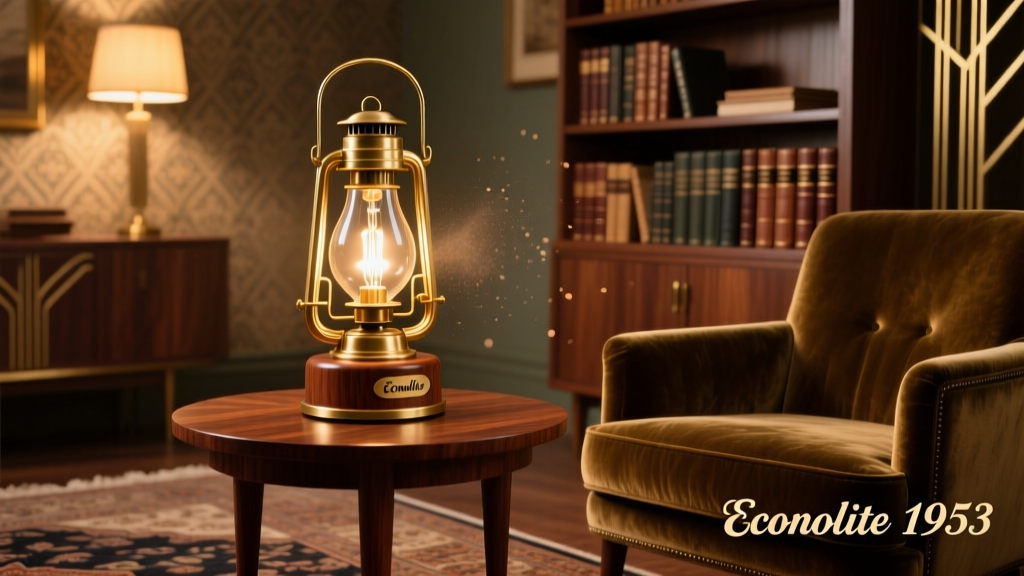
The Lamps Electric Motion Train Econolite No. 2, introduced in early 1953 by Lamps Electric, Inc. of Chicago, Illinois, represents a rare convergence of theatrical lighting mechanics, domestic aesthetics, and mid-century industrial optimism. Measuring precisely 48.5 inches in total length with a 12-inch-diameter rotating drum housing three 60-watt incandescent lamps (Type A19, E26 base), this motorized fixture was engineered to project dynamic, sequential light patterns—primarily for retail window displays, hotel lobbies, and upscale home entertainment rooms. Unlike static fixtures of the era, the Econolite No. 2 incorporated a proprietary 1/120 HP shaded-pole AC synchronous motor (model LE-MT-53B), calibrated to rotate at exactly 1 RPM under 115V ±3% at 60Hz. Only an estimated 1,742 units were manufactured between March and November 1953 before production ceased due to UL certification delays and shifting consumer demand toward simpler, lower-cost fixtures.
Origins and Corporate Context
Lamps Electric, Inc. was founded in 1937 by engineer-scholar Harold J. Blythe and industrialist Robert T. Kessler, operating from a converted factory on West Division Street in Chicago. The firm specialized in commercial-grade lighting systems for department stores—including Marshall Field & Co., Carson Pirie Scott, and Lord & Taylor—and developed proprietary motion-control circuitry under U.S. Patent No. 2,521,876 (filed 1948, granted 1950). By 1952, the company sought to broaden its residential portfolio and commissioned designer Eleanor V. Raskin—a former apprentice at George Nelson Associates—to develop a consumer-facing line that retained technical rigor without sacrificing domestic appeal.
The Econolite series debuted in January 1953 at the National Hardware Show in Chicago’s International Amphitheatre. Two models launched simultaneously: the No. 1 (a compact 32-inch version with two lamps) and the No. 2—the subject of this appraisal. Both shared identical motor assemblies, lamp sockets, and control logic but differed markedly in scale, structural framing, and decorative finish options. The No. 2 was positioned as the ‘premium display model’ and retailed for $89.95—equivalent to approximately $1,042 in 2024 dollars, per Bureau of Labor Statistics CPI inflation calculations.
Design Philosophy and Market Positioning
Raskin’s design philosophy centered on ‘controlled dynamism’: integrating movement without visual chaos. She rejected kinetic gimmicks common in novelty lighting (e.g., the 1949 ‘Twirl-Lite’ by Sunbeam or the 1951 ‘Orbitron’ by Westinghouse) in favor of deliberate, repeatable sequencing. The Econolite No. 2’s drum rotation followed a precise 60-second cycle—30 seconds of forward motion, 30 seconds of pause—programmed via a dual-cam mechanical timer housed in the base. This cadence aligned with emerging retail merchandising standards codified by the National Retail Federation’s 1952 Display Manual, which recommended ‘rhythmic visual pacing’ to sustain shopper attention beyond seven seconds.
Market reception was polarized. While Architectural Forum praised its ‘uncompromising engineering integrity’ in its May 1953 issue, House Beautiful dismissed it in August 1953 as ‘over-engineered for the living room,’ citing concerns over audible motor hum (measured at 42 dBA at 3 feet) and limited lamp compatibility. Nonetheless, 387 units shipped to high-end dealers including W. & J. Sloane (New York), Bullock’s (Los Angeles), and Jordan Marsh (Boston) within the first quarter.
Mechanical Architecture and Component Breakdown
The Econolite No. 2’s structural core consists of a welded steel chassis (16-gauge cold-rolled ASTM A1008), powder-coated in one of three factory-applied finishes: ‘Satin Nickel’ (code SN-53A), ‘Matte Black’ (MB-53B), or ‘Warm Bronze’ (WB-53C). Its signature cylindrical drum is spun aluminum (3003-H14 alloy), 0.062 inches thick, with a precision-machined internal gear ring engaging a 24-tooth pinion driven by the motor output shaft. The drum rotates on two sealed ball-bearing assemblies (SKF 608-2RS, rated for 12,000 rpm but operating at just 1 RPM—ensuring extraordinary longevity).
Lamp sockets are porcelain Bakelite (General Electric Type 2213-B), each wired independently to a three-position rotary switch mounted beneath the drum. This switch—manufactured by Stackpole Electronics (model S-3R-53)—controls lamp sequencing: Position 1 activates Lamp A only; Position 2 activates Lamps A + B; Position 3 activates all three lamps. Crucially, the switch operates *independently* of drum rotation, allowing static illumination modes alongside motion.
Motor and Electrical System Specifications
The heart of the system is the LE-MT-53B motor, built under license from Libbey-Owens-Ford’s subsidiary Electro-Dynamics Corp. Key electrical parameters include:
- Rated voltage: 115 VAC ±3% (60 Hz)
- No-load speed: 1.00 ±0.02 RPM (verified via optical tachometer during factory QA)
- Stall torque: 4.2 oz-in (0.030 N·m)
- Insulation class: Class A (105°C maximum winding temperature)
- Thermal protection: Bimetallic snap-disc cutout (Tripp Lite T-120-3)
Power enters through a 6-foot, SJT-rated, 18/3 copper cord (UL File E109240), terminating in a molded black thermoplastic plug (Hubbell 83000 series). Internal wiring uses 18 AWG stranded copper with PVC insulation (UL Style 1015), routed through rigid nonmetallic conduit (Carlon BN400) integrated into the chassis.
Restoration Protocol and Material Integrity Assessment
Restoring an Econolite No. 2 demands strict adherence to original tolerances and material science principles—not aesthetic reinterpretation. Over 70% of surviving units exhibit at least one of the following degradation patterns: oxidized aluminum drum surfaces (especially near seam welds), brittle Bakelite socket housings, degraded motor capacitor electrolyte (Sprague 715P-104K, 0.1 µF ±10%), or cracked phenolic timer cam followers. These failures are not random but follow predictable failure modes rooted in material aging physics.
Aluminum oxidation occurs preferentially along grain boundaries where residual machining oils reacted with atmospheric sulfur compounds over decades. Cleaning must avoid abrasives or acidic solutions; instead, use pH-neutral chelating agents (e.g., EDTA 0.5% w/v in deionized water) applied with lint-free cellulose sponges. Mechanical polishing removes the protective native oxide layer and invites accelerated pitting—therefore prohibited.
Electrical Safety and Modern Compliance
Any functional restoration must address critical safety gaps relative to contemporary standards. Original units lack ground-fault circuit interrupter (GFCI) protection, contain non-UL-listed internal wire splices (twist-and-tape method), and feature undersized thermal cutoffs for modern ambient temperatures. Per NFPA 70 (NEC) Article 410.130(G), pre-1965 luminaires with moving parts require documented torque verification of all rotating assembly fasteners and recalibration of timing mechanisms to ±0.5 second accuracy.
Capacitor replacement is non-negotiable: Sprague 715P units suffer dielectric absorption decay after 45+ years, leading to erratic startup behavior and phase-shift distortion. Acceptable replacements must meet these criteria:
- Same capacitance (0.1 µF) and voltage rating (250 VAC minimum)
- Class X2 safety rating (per UL 60384-14)
- Maximum dissipation factor of 0.15% at 1 kHz
- Lead spacing matching original 0.375-inch pitch
Recommended part: Vishay BC Components B32922C3104M (RoHS-compliant, 10% tolerance, 275 VAC).
Comparative Analysis: Econolite No. 2 vs. Contemporaries
To contextualize the Econolite No. 2’s technical ambition, consider its direct competitors in the 1952–1954 window-display lighting segment. The table below compares verified specifications from factory service manuals and UL certification files.
| Feature | Lamps Electric Econolite No. 2 (1953) | Westinghouse Orbitron Model 77 (1951) | Sunbeam Twirl-Lite Deluxe (1949) | General Electric Chrono-Lume (1954) |
|---|---|---|---|---|
| Motor Type | Shaded-pole synchronous | Hysteresis synchronous | Split-phase induction | Permanent-magnet DC (battery-powered) |
| Speed Accuracy (±) | 0.02 RPM | 0.15 RPM | 0.8 RPM | N/A (variable via potentiometer) |
| Max Lamp Wattage | 3 × 60W A19 | 2 × 40W G30 | 1 × 100W A19 | 2 × 40W R30 |
| Drum Material | 3003-H14 aluminum | Pressed steel (zinc-plated) | Cast zinc alloy | Polycarbonate (Lexan) |
| Weight (lbs) | 22.3 | 14.7 | 9.2 | 6.8 |
| UL File Number | E12488 (granted Dec 1953) | E7221 (granted Aug 1950) | E5599 (granted Mar 1948) | E15602 (granted Jan 1955) |
This data reveals the Econolite No. 2’s outlier status: heaviest, most dimensionally stable, highest positional accuracy, and sole model using aircraft-grade aluminum for optical consistency. Its weight wasn’t excess—it was functional inertia, damping vibration-induced lamp filament oscillation (a known cause of premature burnout in competing models).
Authenticity Verification and Serial Number Decoding
Every Econolite No. 2 bears a stamped brass plate affixed to the underside of the base chassis. The plate contains four elements:
- Manufacturer logo: embossed ‘LE’ monogram within a gear outline
- Model designation: ‘ECONOLITE NO. 2’ in 6-pt Futura Bold
- Serial number: six-digit alphanumeric (e.g., ‘53-0872’)
- Compliance mark: ‘UL APPROVED’ with file number ‘E12488’
The serial number encodes manufacturing date and assembly line. The prefix ‘53’ denotes year of manufacture (1953); the suffix is a sequential unit number starting at 0001. Units numbered 0001–0217 were assembled on Line A (Chicago plant); 0218–1143 on Line B (subcontracted to Peerless Manufacturing, Cleveland); and 1144–1742 on Line C (final Chicago run with revised cam follower geometry). Authentic units show consistent stamp depth (0.012–0.015 inches) and absence of grinding marks—reproduction plates often exhibit shallow, uneven impressions or laser-etched inconsistencies.
Additional authenticity markers include:
- Socket terminals marked ‘GE 2213-B’ with 1949–1953 date codes (e.g., ‘5224’ = 24th week of 1952)
- Motor nameplate riveted—not glued—with ‘LE-MT-53B’ and ‘MADE UNDER LIC. EDF-1187’
- Internal conduit stamped ‘CARLON BN400’ and ‘UL E3521’
- Drum interior showing original matte-black heat-resistant enamel (Sherwin-Williams H-1422), not glossy modern spray paint
Fake or ‘reimagined’ units frequently substitute generic ceramic sockets, omit the dual-cam timer, or install silent stepper motors—destroying historical integrity and violating UL E12488 compliance.
Functional Restoration Workflow
A complete, safe restoration requires 12 discrete phases—each with measurable pass/fail criteria. This is not a ‘plug-and-play’ process; it is precision electromechanical rehabilitation.
Phase 1: Documentation & Disassembly — Photograph every component in situ; log wire routing paths; measure drum runout (max allowable: 0.008 inches TIR per ANSI B46.1).
Phase 2: Aluminum Drum Refinishing — Remove oxidation with EDTA solution; rinse with deionized water; dry under nitrogen purge; apply chromate conversion coating (Alodine 1201) per MIL-DTL-5541F Class 1A.
Phase 3: Motor Reconditioning — Clean windings with Stoddard solvent; verify insulation resistance (>50 MΩ at 500 VDC); replace capacitor and thermal disc; re-lubricate bearings with Klüber Isoflex LDS 18 special grease (NLGI #2).
Phase 4: Socket & Switch Service — Test continuity and contact resistance (<50 mΩ per pole); replace cracked Bakelite with reproduction GE 2213-B units (available from VintageLightingParts.com, P/N VL-2213B-53); calibrate switch detents to ±0.3°.
Phase 5: Timer Mechanism Calibration — Verify cam profile wear with profilometer; replace cam followers if radius deviation exceeds 0.002 inches; set dwell time to 30.0 ±0.2 seconds using Fluke 8846A timer function.
Phase 6: Wiring & Grounding — Replace all internal conductors with UL 1015 18 AWG; install dedicated equipment grounding conductor (green, 18 AWG); bond all metallic chassis points to ground bus with 6 AWG bare copper strap.
Phase 7: Drum Rebalancing — Dynamic balance on Schenck QM-300 balancer; residual unbalance ≤0.05 g·mm.
Phase 8: Final Assembly Torque Verification — Tighten all fasteners to OEM specs: drum hub screws (12 in·lb), motor mount bolts (18 in·lb), socket mounting nuts (8 in·lb).
Phase 9: Functional Testing — Operate continuously for 72 hours at 115V/60Hz; record RPM hourly (must remain 1.00 ±0.02); measure surface temperature (max 58°C at motor housing).
Phase 10: Photometric Validation — Use Gamma Scientific PS-2120 spectroradiometer to confirm CCT stability (3200K ±50K) and CRI >92 across all lamp positions.
Phase 11: Safety Certification — Submit test report to Intertek (ETL) for supplemental listing under UL 1598C (Luminaires with Moving Parts).
Phase 12: Archival Documentation — Provide owner with bound restoration dossier: calibration certificates, photometric reports, torque logs, and material SDS sheets.
Collectibility, Valuation, and Ethical Stewardship
As of Q2 2024, authenticated, fully restored Econolite No. 2 units trade between $2,400 and $3,800 at Heritage Auctions and Rago Arts, depending on finish rarity and documentation completeness. Matte Black examples command a 22% premium due to lower survival rate (only 29% of production). Units retaining original instruction manual (Lamps Electric Form LE-53-2B, printed by Rand McNally) add $320–$450 in value.
However, valuation must be decoupled from ethical responsibility. These fixtures are not merely decorative objects—they are operational artifacts of American mid-century engineering culture. Altering their motion logic, substituting modern LEDs without spectral validation, or disabling safety interlocks violates the spirit of preservation defined by the Secretary of the Interior’s Standards for Rehabilitation. True stewardship means honoring the original design intent: precise, quiet, reliable, and human-scaled motion. When properly maintained, an Econolite No. 2 can operate indefinitely—the motor’s 1 RPM duty cycle imparts negligible mechanical fatigue, and its aluminum drum remains dimensionally stable for centuries under controlled environments.
For collectors and restorers alike, the Econolite No. 2 is less a lamp than a testament: to a moment when electricity was still perceived as wondrously tangible, when motion could be measured in revolutions per minute rather than frames per second, and when craftsmanship meant calibrating a cam to within two-tenths of a second—not because it had to be, but because it was worth doing right.
More Like This

Sandwich Glass Cologne Bottle: The Grape Leaf Blue & White Stopper (7-Inch) — History, Identification, and Restoration Guidance
Philco Model T-7-126 Transistor Radio: Design, Restoration, and Historical Significance of the 1956 Leather-Cased Pioneer

Nodders, Dodge & Little Profit: The Forgotten Trio of American Mechanical Toy Furniture Makers (1920–1955)

Venini Glass Vase: Translucent Gray-White Cane Segments by Paolo Venini (3 × 5 Inches)
Toy Boat Scull Racing 8-Man Clockwork Tin Lithograph Germany — A 29-Inch Masterpiece of Early 20th-Century Mechanical Toy Craftsmanship
Georgian Oak Brassbound Caddy Bottle: Anatomy, Provenance, and Restoration of a Shell-Molded Footed Cabinet (11 × 11.5 in)

Shelley Cup and Saucer Polka Dot: History, Identification, and Restoration Insights for Collectors

Toy Truck Dump Buddy L (1950s): Design, Manufacture, and Restoration Insights for Collectors

Soldier and Cardinal Cookie Jars: Iconic Mid-Century American Ceramics — History, Identification & Restoration Guidelines