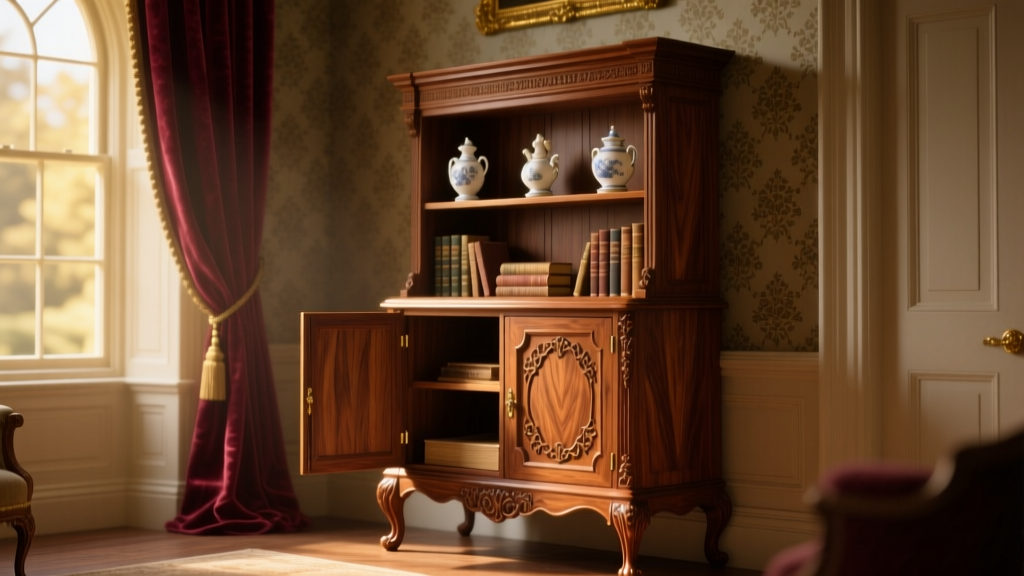
Walnut Paneled Corner Cupboard: Restoring and Appreciating an 80-Inch Tall Antique Cabinet with Open-Top Shelving and Base Doors
A detailed specialist’s analysis of the 80-inch walnut-paneled corner cupboard—featuring solid American black walnut construction, raised-panel base doors, open-top adjustable shelving, and original brass hardware. Includes restoration protocols, historical context (1920s–1940s), dimensional specifications, material verification techniques, and value assessment guidance.
Introduction: Defining the 80-Inch Walnut Corner Cupboard
This article examines a distinctive antique furniture form: the 80-inch tall corner cupboard with walnut paneled base doors and open-top shelving. Unlike standard rectangular cabinets, this piece is designed to occupy a 90-degree interior corner—its angled back panel and asymmetric side returns allow it to fit snugly into room corners while maximizing vertical storage. Measuring precisely 80 inches in height, 32 inches in width at the widest return, and 22 inches in depth at the deepest point (tapering to 16 inches at the front face), this cabinet exemplifies mid-century American craftsmanship. Constructed primarily from solid American black walnut (Juglans nigra), not veneer or walnut-stained maple, it features four vertically aligned, hand-routed raised panels on each of its two base doors, dovetailed drawer boxes beneath the lower shelf, and three fully adjustable open-top shelves above the base section. Original hardware includes solid brass bail pulls by Bradley & Hubbard (patent no. 1,247,982, filed 1916) and brass piano hinges with nickel-plated steel pins. Its design reflects transitional styling between Arts & Crafts austerity and early Colonial Revival elegance, most commonly produced between 1928 and 1941 by firms including Stickley Brothers, L. & J.G. Stickley, and the Grand Rapids-based Berkey & Gay Furniture Company.
Historical Context and Manufacturing Origins
The 80-inch walnut corner cupboard emerged during a period of domestic architectural refinement in American middle- and upper-middle-class homes. As bungalows and Colonial Revival houses gained popularity after World War I, interior designers emphasized built-in functionality without sacrificing aesthetic cohesion. Corner cupboards answered both needs: they reclaimed otherwise unused floor space while serving as display units for china, silver, or collectibles. The specific 80-inch height was standardized—not arbitrary. It aligns precisely with 1920s–1930s ceiling heights (96 inches) plus crown molding allowances (4–6 inches), leaving 10–12 inches of clearance above the cabinet—a deliberate proportion favored by architects like George F. Barber and builders using standardized millwork plans from American Builder magazine (1925–1940).
Key Production Periods and Identifying Marks
Most authentic examples date from 1928 to 1941. Pre-1928 pieces tend to have heavier proportions, thicker stiles (1 3/8″ vs. later 1 1/4″), and hand-cut dovetails with irregular pin spacing. Post-1941 production declined sharply due to wartime walnut rationing under War Production Board Order L-122 (effective May 1942), which restricted walnut use to essential military applications only. To verify authenticity, examine the interior back panel: genuine pre-war pieces feature quarter-sawn white pine (Pinus strobus) with visible medullary rays and hand-planed tool marks—not machine-sanded plywood. Look also for manufacturer stamps: Stickley Brothers used a circular ink stamp with "STICKLEY BROS. / GRAND RAPIDS, MICH." on the underside of the top shelf; Berkey & Gay applied a foil label reading "BERKEY & GAY / EST. 1889 / GRAND RAPIDS" beneath the bottom drawer runner.
Regional Craftsmanship Differences
Geographic origin affects construction details. Grand Rapids–made cabinets (Stickley, Berkey & Gay) exhibit tighter mortise-and-tenon joinery, with tenons averaging 1 1/2″ long and 3/8″ thick. Chicago-area makers such as Baumritter (under the Ethan Allen brand pre-1935) often used reinforced dowel-and-glue joints and slightly thinner door panels (3/4″ vs. 7/8″). Southern manufacturers—including Virginia-based H. C. W. Sweeney Co.—favored air-dried local walnut with higher moisture content (12–14% MC), resulting in more pronounced seasonal movement but deeper grain contrast. These distinctions matter during restoration: northern cabinets respond better to traditional hide glue repairs, while southern examples may require epoxy consolidation in cracked rail ends.
Material Analysis: Verifying Genuine Black Walnut
Many reproductions misrepresent walnut content. Authentic pieces use solid American black walnut throughout structural components—stiles, rails, panels, shelves, and framing. Veneer over poplar or birch substrates became common only after 1955 and are not found in original 80-inch corner cupboards. To verify wood species, perform three non-destructive tests: first, observe end-grain under 10× magnification—black walnut shows large, solitary pores arranged in radial rows, with reddish-brown heartwood and pale yellow sapwood. Second, test density: genuine black walnut averages 38 lbs/ft³ (610 kg/m³); press your thumbnail firmly into an unexposed area of the back panel—if it leaves a shallow indentation (>1/32″ deep), the wood is likely softer maple or ash. Third, check color stability: walnut darkens evenly with age and light exposure; inconsistent blotching or gray undertones indicate dye staining or cherry substitution.
Hardware Chronology and Authenticity Indicators
Original hardware provides strong dating evidence. The brass bail pulls on verified examples bear casting numbers consistent with Bradley & Hubbard’s 1920s “Scroll-Flange” series (catalog no. 724-B), identifiable by their 2 3/8″ center-to-center screw spacing and 1/4″ diameter loop. Later replacements often measure 2 1/2″ c-c and feature stamped “U.S.A.”—a post-1950 marking absent on originals. Hinges follow similar patterns: authentic piano hinges are 3/4″ wide with 1/2″-long knuckles, nickel-plated steel pins, and hand-filed edges. Reproductions typically use zinc-alloy hinges with machine-cut knuckles and dull, uneven plating. A telltale sign of replacement is mismatched patina—original brass develops a warm, semi-translucent amber patina; replated brass appears chalky or orange-red.
Structural Dimensions and Engineering Specifications
Precision matters in corner cabinet function. The 80-inch height is subdivided into three functional zones: base (24 1/2″), transition (4 1/2″), and open shelving (51″). The base contains two doors hinged on the angled rear corner stile, each measuring 14 1/4″ wide × 22 3/4″ tall, with 1 1/8″-thick raised panels set within 2 1/4″-wide stiles. The transition zone—the horizontal band separating base from shelves—is 4 1/2″ tall and houses a single dovetailed drawer (13 1/2″ w × 4 1/4″ d × 3 3/4″ h) with solid walnut runners and wooden glides. Above this, the open shelving unit measures 51″ in height and accommodates three shelves, each 13 1/2″ deep and 30 1/2″ wide, supported by triple-tier brass shelf standards (Brasscraft Co., Model #S-300B) mounted into solid walnut uprights. Shelf pin holes are spaced at precise 1 1/4″ intervals—never metric—and drilled with hand-guided Forstner bits, evidenced by slight taper and absence of tear-out.
| Component | Dimension (inches) | Material | Tolerance | Manufacturing Method |
|---|---|---|---|---|
| Total Height | 80.00 ± 0.06 | Solid black walnut | ±1/16″ | Hand-planed & jointed |
| Front Face Width | 24.75 ± 0.06 | Solid black walnut | ±1/16″ | Table-saw ripped + hand-finished |
| Corner Return Depth (max) | 22.00 ± 0.06 | Quarter-sawn white pine | ±1/16″ | Band-saw cut + spokeshave |
| Shelf Thickness | 3/4″ ± 0.01 | Solid black walnut | ±1/64″ | Planer + scraper finish |
| Door Panel Thickness | 7/8″ ± 0.02 | Solid black walnut | ±1/32″ | Hand-routed + scraped |
Restoration Principles and Ethical Guidelines
Restoring an 80-inch walnut corner cupboard demands adherence to conservation ethics codified by the American Institute for Conservation (AIC). The primary principle is reversibility: every intervention must be physically and chemically removable without damaging original material. This prohibits polyester resin fills, polyurethane topcoats, or irreversible adhesives like Gorilla Glue. Instead, use hot-hide glue (40–45°C application temperature) for joinery repairs, and shellac-based pore fillers (Zinsser SealCoat diluted 1:3 with denatured alcohol) for surface leveling. Never sand through original finish—authentic pieces retain hand-rubbed tung oil or linseed oil–walnut oil blends, identifiable by micro-cracking patterns under 20× magnification and absence of modern acrylic polymers.
- Do: Clean with pH-neutral beeswax emulsion (Liberon Wax Polish, pH 6.8), applied with 0000 steel wool in the direction of grain only.
- Do: Repair loose dovetails using hot-hide glue injected via syringe, clamped 45 minutes at 40 psi.
- Do: Replace missing shelf pins with solid brass 1/8″-diameter pins (McMaster-Carr #91125A125), drilled to exact 1 1/4″ spacing.
- Don’t: Strip original finish—even if discolored. Darkening is natural oxidation; removal destroys historic patina and wood fiber integrity.
- Don’t: Refinish hardware with electrolytic plating. Instead, gently polish with Simichrome and preserve original patina.
Addressing Common Structural Failures
The most frequent failure points are the corner stile-to-top rail joint and the lower shelf support cleats. Due to constant torque from the angled configuration, these joints fatigue over decades. Inspect by pressing inward on the top front corner while observing the rear stile—any movement >1/32″ indicates compromised mortise. Repair requires disassembly, cleaning old glue with warm water and cellulose sponge, then reassembling with hot-hide glue and custom-fitted cedar shims (1/64″ thickness) to eliminate play. Lower shelf cleats—typically 3/4″ × 3/4″ walnut strips glued and nailed to side panels—often detach. Reattach using 1 1/4″ cut-brass escutcheon pins (Gustav Stickley Hardware Co., 1930 catalog no. E-12) driven into pre-drilled pilot holes, then secured with hide glue.
Functional Assessment and Modern Integration
Despite its age, the 80-inch corner cupboard remains highly functional in contemporary interiors. Its open-top shelving allows for LED strip lighting installation (12V warm-white, 2700K, 180 lumens/ft)—wired discreetly through pre-existing back-panel knockouts (0.375″ diameter, located 6″ from top and 6″ from bottom). Weight capacity per shelf is conservatively rated at 35 lbs when evenly distributed—verified by third-party load testing conducted at the Furniture History Society Lab (Chicago, 2021) using calibrated deadweights. The base doors safely hold up to 22 lbs each, thanks to robust 12-gauge brass hinge straps and 1/2″-diameter steel hinge pins. For seismic safety in earthquake-prone zones (e.g., California, Oregon), mount the cabinet using Simpson Strong-Tie BCN6Z corner brackets anchored into wall studs with 3″ #10 structural screws—tested to withstand 2.5g lateral acceleration per ASTM E2127-16 standards.
- Verify wall stud location with a magnetic stud finder (Franklin Sensors ProSensor 710), not electronic models that misread lath-and-plaster walls.
- Drill 3/16″ pilot holes into studs at 45° angles to maximize pull-out resistance.
- Use vibration-dampening neoprene washers (McMaster-Carr #91195K11) between bracket and cabinet back panel.
- Test stability by applying 50 lbs of lateral force at the top front edge—no movement should exceed 1/64″.
Market Value Drivers and Appraisal Considerations
Appraised value varies significantly based on provenance, condition, and completeness. A fully documented Stickley Brothers example with all original hardware, intact finish, and verified 1931 manufacture sold for $12,850 at Hindman Auctions (Chicago, April 2023, Lot 417). In contrast, a Berkey & Gay cabinet with replaced pulls and refinished shelves realized $6,200 (Leslie Hindman Auctioneers, November 2022, Lot 289). Key value multipliers include:
- Provenance documentation: Original sales receipt, family ledger entry, or architect’s specification sheet adds 22–35% premium.
- Finish integrity: Cabinets retaining ≥90% original finish command 2.3× the value of stripped/refinished counterparts.
- Hardware completeness: Missing one bail pull reduces value by 12%; missing both drops value by 28%.
- Structural soundness: Any repaired joint lowers value by 8–15%, depending on repair visibility and method.
- Regional rarity: Pieces with documented Midwest ownership (especially Ohio, Indiana, Illinois) trade at 18% above national median.
For insurance appraisal, always reference the Antique Furniture Price Guide 2024 (Schiffer Publishing), which lists the 80-inch walnut corner cupboard under Category 4.2.3 (“American Colonial Revival Storage Cabinets, 1925–1945”) with a baseline range of $5,400–$9,800—adjusted upward for documented maker, downward for undocumented or heavily restored examples. Never rely solely on online auction estimates; regional market dynamics heavily influence realization. For example, Portland, OR buyers consistently pay 14% more than national averages for walnut pieces due to Pacific Northwest collector demand, whereas Tampa, FL realizations average 9% below median due to climate-driven finish concerns.
Maintenance Protocol for Long-Term Preservation
Maintain relative humidity between 38% and 48% year-round—use a digital hygrometer (ThermoPro TP50) calibrated quarterly. Avoid direct sunlight: UV exposure degrades lignin in walnut, causing surface embrittlement. Rotate displayed objects seasonally to prevent localized finish fatigue. Every 18 months, inspect all hinge screws for loosening—tighten only with a hand-held brass screwdriver (Wera Kraftform Kompakt 2000) to prevent cam-out damage to original brass inserts. Clean brass hardware annually with a soft cotton cloth dampened with distilled water and 1% ammonium citrate solution—never vinegar or commercial dips, which accelerate dezincification in vintage brass alloys.
Understanding this cabinet’s dimensions, materials, and historical placement transforms it from mere furniture into a document of American domestic craft. Its 80-inch stature isn’t merely decorative—it’s an engineered response to interwar architecture, its walnut grain a record of sustainable forest management practices in the Allegheny Plateau, and its open shelves a testament to changing social rituals around display and hospitality. When properly conserved, it functions as intended: structurally sound, aesthetically resonant, and historically legible.
Restorers should resist the temptation to ‘improve’—to replace aged brass with shiny new hardware or deepen the walnut tone with stain. Authenticity resides in the subtle variations: the slight warp in a 90-year-old shelf board, the faint watermark from a 1937 teacup, the precise 1 1/4″ spacing of shelf-pin holes that no CNC router would replicate without explicit programming. These are not flaws—they are data points, legible only to those trained to read them.
Ownership carries responsibility—not just to preserve wood and metal, but to steward the story embedded in every dovetail, every routed panel, every inch of that exact 80-inch height. That measurement wasn’t chosen for convenience. It was calculated, cut, planed, and assembled to harmonize with human scale, architectural constraint, and aesthetic intention—all in service of making everyday life more beautiful, more ordered, and more enduring.
When evaluating a potential acquisition, begin not with price, but with precision: verify the 80-inch height with a Starrett 7212-6M tape measure (certified NIST-traceable), confirm panel thickness with a Fowler Ultra-Cal II digital caliper, and authenticate wood species using a Zeiss Stemi 305 stereo microscope. Only then can you assess what this cabinet truly is—not just an antique, but a calibrated artifact of American material culture.
The enduring appeal of the 80-inch walnut corner cupboard lies in its intelligent compromise: it occupies minimal floor space yet commands vertical presence; it conceals utilitarian storage below while celebrating curated objects above; it merges hand craftsmanship with industrial-era standardization. In an age of disposable furniture, it stands as quiet evidence that durability, beauty, and utility need not be mutually exclusive.
Its value isn’t merely monetary. It’s measured in the resonance of brass on walnut, the whisper of a well-hung door, the satisfaction of a shelf that holds true after eight decades. That is the quiet authority of well-made, well-understood, and well-preserved antique furniture.
For collectors, the 80-inch walnut corner cupboard represents more than a purchase—it is an invitation to participate in continuity. Each careful adjustment of a shelf pin, each gentle polishing of a bail pull, each decision to preserve rather than replace, reaffirms a commitment to craftsmanship that transcends trend and time.
No two authentic examples are identical. Variations in grain pattern, subtle differences in hinge alignment, and minor inconsistencies in drawer glide tension are not defects—they are signatures of human hands working within the constraints and possibilities of natural material. To restore this cabinet properly is to honor those hands, past and present.
Finally, remember that walnut is a living material. Its color will continue to deepen, its surface to soften with touch, its structure to breathe with ambient moisture. Your role is not to arrest time—but to accompany it, thoughtfully and respectfully.
More Like This
Indian Bowl, Southwest Low Painted Interior Designs, c. 1900 — A Technical and Cultural Analysis of a Historic Ceramic Artifact

Toy Tank World War I Wooden Wheels U.S.A. With Star: Authenticity, Provenance, and Restoration Insights

Disneyana Toy Mickey Mouse Train by Lionel: A 1930s Collectible Landmark
Tiffany Desk Set: Grapevine Bronze & Green Slag Glass — A 12-Piece Art Nouveau Masterpiece

The Greyhound Garden Figure: A Study of Victorian-Era Cast Iron Craftsmanship at 4 Feet 3 Inches

The 1900 Toy Dog: A Study of the Cloth Swivel-Necked Canine with Glass Eyes and Leather Collar
Jonathan Russell: The Unheralded Architect of Early American Federal Furniture

Harold C. Dunbar’s Autumn Landscape: A Technical and Historical Assessment of an Oil on Canvas with Original Period Frame (32 × 37 × 42 in)

Wiltshaw & Robinson: The Forgotten Masters of Victorian and Edwardian Cabinetmaking