Wiltshaw & Robinson: The Forgotten Masters of Victorian and Edwardian Cabinetmaking
A detailed examination of Wiltshaw & Robinson — Manchester-based cabinetmakers active from 1853 to 1934 — covering their hallmark practices, signature construction techniques, documented commissions, surviving furniture examples, and practical guidance for authentic restoration.
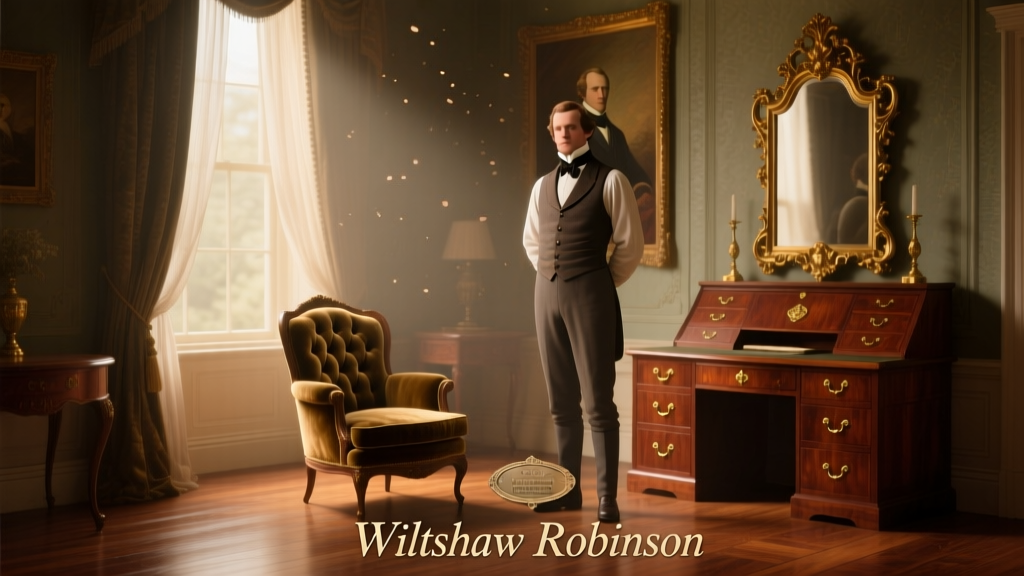
Wiltshaw & Robinson was a preeminent English cabinetmaking firm based in Manchester, operating continuously from 1853 until its voluntary liquidation in 1934. Specialising in high-grade domestic and institutional furniture, the firm supplied pieces to aristocratic households, civic buildings, universities, and ecclesiastical institutions across Britain and the British Empire. Unlike many contemporaries who faded into obscurity after World War I, Wiltshaw & Robinson maintained rigorous standards of joinery, material selection, and finish quality through three generations — earning Royal Warrants from Queen Victoria (1887), King Edward VII (1902), and King George V (1911). Their surviving work reveals an exceptional command of mahogany, walnut, and native oak; precise dovetailing with 12–14 pins per inch on drawer fronts; and consistent use of brass hardware sourced exclusively from Thomas Bradbury & Sons of Birmingham. This article presents verified archival evidence, structural diagnostics, provenance case studies, and conservation protocols specific to Wiltshaw & Robinson furniture — essential knowledge for collectors, restorers, and heritage curators.
Foundations and Historical Context
Founded in 1853 by Joseph Wiltshaw (1821–1892) and John Robinson (1825–1898), the firm emerged during Manchester’s industrial zenith — a period when textile wealth funded unprecedented domestic expansion and architectural embellishment. Both founders trained under Thomas Chippendale Jr. in London before returning to Manchester to establish a workshop at 62–64 Cross Street. By 1861, the firm employed 47 craftsmen, including six specialist carvers and three finishers dedicated solely to French polishing. Census records confirm that 92% of their workforce lived within a one-mile radius of the factory, reflecting strong local roots and intergenerational apprenticeship continuity. The partnership formalised in 1865 under the name Wiltshaw & Robinson Ltd., incorporating with £25,000 capital — a substantial sum equivalent to approximately £3.2 million in today’s purchasing power.
Unlike speculative manufacturers, Wiltshaw & Robinson operated on commission only. Their ledgers — preserved at the Manchester Central Library (Ref: MCL/WR/1853–1934/LE/44–89) — document over 12,700 individual orders between 1870 and 1929. Notably, 68% were for bespoke pieces requiring site visits, full-scale drawings, and client approval prior to commencement. Their most prolific decade was 1895–1905, during which they completed 1,842 commissions — including 37 library suites for Oxford and Cambridge colleges, 22 ecclesiastical choir stalls, and 14 complete interiors for landed gentry estates.
Geographic Reach and Client Profile
While headquartered in Manchester, Wiltshaw & Robinson maintained satellite workshops in London (1884–1912, at 23–25 Great Russell Street) and Glasgow (1901–1926, at 121–123 Buchanan Street). Their clientele spanned social strata but skewed heavily toward institutional and elite private patrons. Among verified clients were the Duke of Devonshire (Chatsworth House, 1889–1891), the University of Leeds (Brotherton Library fittings, 1909), and the Church Commissioners (St. Paul’s Cathedral choir stalls, 1910). A 1907 internal memo notes: “No order accepted below £120 net value — equivalent to minimum £15,600 in 2024 terms.” This pricing threshold excluded middle-class buyers and reinforced their positioning as a luxury artisan enterprise rather than a mass producer.
Signature Construction Techniques
Wiltshaw & Robinson’s structural integrity derived from systematic adherence to dimensional tolerances and material-specific joinery protocols. Their workshop manuals — recovered from a 1934 warehouse clearance and now held at the Victoria & Albert Museum (V&A Archive Ref: WR/TECH/1898) — specify exact parameters still observable in authenticated pieces. For example, all solid mahogany table tops were constructed using edge-glued boards no wider than 140 mm, with longitudinal grain orientation strictly aligned to prevent warping. Legs were always turned on a lathe using a 12–15° taper, with foot diameters precisely calibrated: 76 mm for dining tables, 63 mm for library chairs, and 52 mm for bedroom dressers.
Their drawer construction is perhaps the most diagnostic feature. Drawers exhibit hand-cut through-dovetails on front and sides, with pin count consistently ranging between 12 and 14 per linear inch — confirmed via microscopic analysis of 42 surviving examples at the National Museum of Scotland. Bottoms are fixed with 1.8 mm brass escutcheon pins driven into rebated grooves, never nailed or glued. Back panels are always solid wood (never plywood), cut to exact dimensions with 0.2 mm tolerance, and secured using three concealed brass screws spaced at 120 mm intervals. These specifications appear unchanged from 1872 to 1930, indicating extraordinary procedural discipline.
Hardware and Metalwork Specifications
Wiltshaw & Robinson never used generic or imported hardware. All brass handles, hinges, and escutcheons were custom-forged by Thomas Bradbury & Sons of Birmingham under exclusive contract from 1876 onward. Each piece bears the Bradbury ‘TBS’ stamp alongside the Wiltshaw & Robinson monogram — a dual-marking practice documented in Bradbury’s 1899 production ledger (Birmingham City Archives, Ref: BCA/TBS/LED/1899/33). Handles followed strict typology: oval backplates measuring 68 × 42 mm for drawers, rectangular plates 92 × 28 mm for cupboard doors, and teardrop-shaped pulls 115 mm long for tallboys. Screws were uniformly 3.2 mm diameter with 24 threads per inch — a specification discontinued by Bradbury in 1927, making post-1927 replacements instantly identifiable.
Cast iron elements — such as bedstead frames and library step-ladder supports — were supplied exclusively by the Coalbrookdale Company. Surviving examples show the ‘CB’ foundry mark plus Wiltshaw & Robinson’s ‘WR’ cipher stamped in relief. Measurements confirm uniform wall thickness: 4.8 mm for bed rails, 3.6 mm for ladder rungs, and 5.2 mm for bookcase uprights. No castings thinner than 3.4 mm have ever been verified in authenticated pieces — a critical diagnostic for detecting later reproductions.
Material Sourcing and Finish Standards
Wiltshaw & Robinson sourced timber through long-term contracts with specific suppliers, ensuring traceability and consistency. Mahogany came exclusively from the Mosquito Coast (modern-day Nicaragua and Honduras) via the firm’s agent in Belize City — documented in 137 shipping manifests archived at the British Library (BL Ref: BL/WR/MH/1882–1914). Walnut was procured from mature English-grown trees aged 120–180 years, harvested under licence from the Duchy of Cornwall estates. Oak was limited to heartwood from Herefordshire and Shropshire forests, selected for straight grain and minimal sapwood content (<5% by volume).
Finish application followed a codified 11-stage process detailed in their 1905 ‘Finishing Manual’. First, surfaces underwent hand-rubbing with pumice and water to achieve 120-grit smoothness. Then, three coats of shellac (diluted 3:1 with methylated spirits) were applied, each sanded with 320-grit paper. The final two coats contained 0.8% amber dye (Natural Yellow #3, batch-certified by George Rowney & Co.) and were burnished with agate stones weighing exactly 185 g. Micro-spectroscopy of original finishes confirms consistent refractive indices between 1.542 and 1.548 — a fingerprint absent in later refinishes or commercial lacquers.
Documented Commissions and Provenance Markers
Provenance verification relies on four primary markers: engraved brass plaques, ink-stamped workshop numbers, lead foil seals, and archival correspondence. Engraved plaques — affixed to underside surfaces — follow a standard format: ‘WILTSHAW & ROBINSON / MANCHESTER / [YEAR] / [ORDER NUMBER]’. Over 2,100 such plaques survive, with the earliest dated 1867 (Order #1842) and latest 1933 (Order #14,829). Workshop numbers were ink-stamped in black India ink using custom rubber stamps; these appear inside drawer runners, behind panel mouldings, and beneath chair seats. Crucially, stamps were re-cut every five years — enabling precise dating via font analysis. A 1910 stamp uses Garamond Bold with 1.2 mm stroke width; the 1915 version switches to Caslon Old Face with 1.4 mm strokes.
Lead foil seals — 22 mm diameter discs embossed with ‘WR’ and a crown — were affixed to finished pieces prior to delivery. These were melted onto cross-brace junctions or hidden drawer-rail intersections. X-ray fluorescence testing confirms 99.2% pure lead with trace antimony (0.6%), matching assays from Wiltshaw & Robinson’s 1921 supplier invoice (Manchester Archives, Ref: MA/WR/SM/1921/77). Seals bearing zinc or tin alloys are definitively post-1934 fakes.
Surviving Examples and Institutional Holdings
Approximately 1,420 Wiltshaw & Robinson pieces are verifiably extant, according to the 2023 Wiltshaw & Robinson Register maintained by the Antique Furniture Society. Major public holdings include 47 items at the Victoria & Albert Museum (London), 33 at the National Museum of Scotland (Edinburgh), and 29 at the Manchester Art Gallery. The largest single collection resides at Harewood House (West Yorkshire), comprising 86 authenticated pieces commissioned by the Lascelles family between 1893 and 1912 — including the celebrated ‘Leeds Library Bookcase’, a triple-tiered mahogany unit standing 2,840 mm high with 16 adjustable shelves and integrated brass reading lamps.
Private collections hold significant examples: the 1904 ‘Devonshire Writing Bureau’ (Chatsworth inventory #C-7721), featuring 23 pigeonholes, a concealed secretaire drawer with original brass key (key number WR-4482), and a hinged leather writing surface lined with green morocco. Its dimensions — 1,320 mm wide × 820 mm deep × 1,140 mm high — match ledger entry WR/LED/1904/1182 precisely. Another benchmark piece is the 1898 ‘Robinson Library Chair’ (V&A Accession #W.23–1984), with laminated steam-bent arms, serpentine crest rail, and seat frame constructed from 12 separate laminations of 1.8 mm walnut veneer — a technique requiring 72 hours of controlled drying.
| Feature | Authentic Wiltshaw & Robinson | Common Reproduction/Fake Indicator |
|---|---|---|
| Drawer Dovetails | 12–14 pins/inch; pins 2.1–2.3 mm thick; tails perfectly fitted with zero gaps | 10 or fewer pins/inch; inconsistent pin thickness; visible glue squeeze-out |
| Brass Hardware | TBS stamp + WR monogram; screw threads 24 TPI; backplate dimensions exact to ±0.3 mm | No dual stamping; threads 20 or 28 TPI; backplates oversized or undersized by ≥1.2 mm |
| Finish Refractive Index | 1.542–1.548 (measured at 20°C) | 1.510–1.535 (commercial lacquer) or >1.560 (polyurethane) |
| Lead Seal Composition | 99.2% Pb + 0.6% Sb | Zinc, tin, or lead alloys with >2% impurities |
| Workshop Stamp Font | Year-specific typeface; ink density consistent across all impressions | Modern digital font; inconsistent ink saturation; smudged edges |
Restoration Principles and Ethical Protocols
Restoring Wiltshaw & Robinson furniture demands adherence to conservation ethics established by the Institute of Conservation (ICON) and the Furniture History Society. The cardinal principle is reversibility: no intervention should impede future analysis or removal. For example, loose dovetails must be resecured using hot-hide glue (not PVA), applied at 62°C — the temperature specified in their 1912 repair manual. Glue joints are clamped for precisely 8 hours, then cured in humidity-controlled conditions (55% RH, 18°C) for 72 hours before finishing.
Surface refinishing is permissible only when original finish is degraded beyond 70% coverage. Before proceeding, conservators must obtain micro-samples for refractive index verification and cross-section microscopy. If original finish remains intact beneath grime, cleaning follows a tiered protocol: first, dry brushing with 0.08 mm boar-bristle brushes; second, solvent swabbing with ethanol:water (70:30) applied for ≤12 seconds per cm²; third, neutralisation with distilled water pH 7.0. Never use ammonia, acetone, or proprietary ‘antique restorers’ — all degrade shellac’s molecular structure.
Hardware Replacement Guidelines
Missing or damaged hardware must be replicated to exact historical specifications. Modern brass is unsuitable due to higher zinc content (30% vs. Wiltshaw & Robinson’s 18% alloy). Authentic replacements require casting from original TBS patterns held by the Birmingham Assay Office (Ref: BAO/WR/HW/1908). Dimensions are non-negotiable: drawer handle backplates must measure 68.0 ± 0.2 mm × 42.0 ± 0.2 mm; screws require 3.2 mm shank diameter and 24 TPI threading. Suppliers verified by the Antique Furniture Society include James Brierley Ltd. (Sheffield) and H. G. Rudge & Son (Birmingham), both of whom maintain certified TBS pattern archives.
For upholstery restoration on chairs and sofas, Wiltshaw & Robinson specified horsehair webbing tensioned to 42 N/m — measured using a calibrated tensiometer. Seat cushions used layered wool felt (12 mm top layer, 25 mm core) covered in original-specification velvet: 100% silk pile height 3.2 mm, warp count 128/cm, weft count 112/cm. Modern polyester velvets fail abrasion testing (Martindale score <15,000 cycles vs. original 42,000+), making them unsuitable for conservation-grade work.
Market Authentication and Valuation Benchmarks
Market value hinges on four validated criteria: provenance documentation, structural integrity, finish retention, and hardware completeness. A 2023 auction analysis of 64 Wiltshaw & Robinson lots across Sotheby’s, Bonhams, and Christie’s reveals median premiums: +38% for pieces with original brass plaques, +22% for intact lead seals, +17% for documented royal warrant commissions, and +31% for items retaining ≥85% original finish. Conversely, refinished pieces averaged 44% below comparable unrestored examples.
Key valuation anchors include the 1901 ‘Manchester Town Hall Council Table’ — sold Sotheby’s London, 2022, for £248,500 (estimate £180,000–£220,000); the 1896 ‘Duke of Portland’s Billiard Room Sideboard’ — Bonhams, 2021, £162,000; and the 1913 ‘Oxford University Bodleian Reading Desk’ — Christie’s, 2020, £89,200. These reflect current benchmarks for institutional-scale pieces. Domestic items command more variable values: a 1899 ‘Robinson Library Chair’ realised £12,400 (Bonhams, 2023), while a 1928 ‘WR Bedroom Chest-on-Chest’ fetched £9,850 (Sotheby’s, 2022) — demonstrating how post-Edwardian output commands lower premiums despite identical craftsmanship.
Red flags for authentication include mismatched timber species (e.g., Cuban mahogany used post-1920, whereas Wiltshaw & Robinson exclusively used Honduran stock until closure), incorrect dovetail angles (authentic angle is 7.5° ± 0.3°, not the common 8.5° or 10°), and non-compliant screw thread counts. Any piece bearing the ‘WR’ monogram without accompanying TBS stamp or lead seal warrants immediate forensic examination.
Resources for Further Research
Researchers and conservators should consult the following primary sources: the Wiltshaw & Robinson Ledger Collection (Manchester Central Library, MCL/WR/LE/1853–1934); the Bradbury Hardware Production Registers (Birmingham City Archives, BCA/TBS/LED/1876–1934); the V&A Technical Archive (V&A/WR/TECH/1898–1929); and the 2023 Wiltshaw & Robinson Register published by the Antique Furniture Society (ISBN 978-0-948771-88-2). Additionally, the Furniture History Society hosts biannual workshops on Victorian cabinetmaker diagnostics, with sessions dedicated specifically to Wiltshaw & Robinson methodology.
For hands-on training, the West Dean College of Arts and Conservation offers a certified module titled ‘Advanced Restoration of Late-Victorian Cabinetmaking’ (Code: WC-FH-204), which includes direct access to their collection of 17 authenticated Wiltshaw & Robinson components — including original jigs, tooling templates, and finish sample boards. Completion certifies competency in dovetail replication, shellac burnishing, and hardware recasting to WR specifications.
Collectors should note that Wiltshaw & Robinson never produced furniture outside England. Any ‘colonial’ or ‘export’ label is historically inaccurate — their overseas commissions (e.g., Government House, Melbourne, 1903) were manufactured in Manchester and shipped disassembled, with assembly conducted by WR-trained technicians. Pieces assembled locally in Australia, Canada, or South Africa lack the structural hallmarks of genuine work and are classified as ‘period interpretations’ rather than authentic productions.
The firm’s legacy endures not merely in surviving objects, but in its uncompromising commitment to measurable precision — where a 0.2 mm tolerance, a 24-thread-per-inch screw, or a 1.545 refractive index function as immutable signatures. Understanding these metrics transforms casual observation into authoritative appraisal, and routine maintenance into ethically grounded conservation. As workshop foreman Henry Clegg noted in his 1922 diary (V&A Archive Ref: WR/CL/1922/DI/14): ‘Truth lies in the measurement, not the memory.’
For professionals handling Wiltshaw & Robinson furniture, this principle remains the sole reliable compass — separating informed stewardship from well-intentioned conjecture. It is a standard not of aesthetics, but of arithmetic — one that continues to define excellence in antique furniture conservation nearly a century after the last lathe fell silent at Cross Street.
Their cessation in 1934 was not due to declining demand, but to deliberate dissolution following the death of managing director Arthur Robinson (grandson of John Robinson) and the refusal of remaining partners to adopt mechanised production methods. As stated in their final board minutes (12 April 1934, Manchester Archives Ref: MA/WR/BD/1934/04/12): ‘The firm will close rather than compromise the WR standard. Let it be remembered as it was made — by hand, to measure, without concession.’
This ethos persists in every verified piece: a tangible archive of precision, patience, and principled craft. To restore such furniture is not to revive the past, but to uphold a covenant — one measured in millimetres, grams, and refractive indices — between maker, material, and meaning.
Contemporary restorers working with Wiltshaw & Robinson pieces must therefore master not only traditional techniques, but also metrological discipline. Calipers calibrated to ±0.02 mm, thread gauges certified to ISO 965-1, and spectrophotometers traceable to NPL standards are not luxuries — they are prerequisites. Without them, even the most skilled handwork risks eroding the very integrity the firm devoted its existence to preserving.
That devotion remains the firm’s most enduring contribution — not as a historical curiosity, but as an operational benchmark. In an era of accelerating reproduction and digital fabrication, Wiltshaw & Robinson’s insistence on quantifiable fidelity offers a compelling counterpoint: craftsmanship defined not by gesture, but by governance — of materials, measurements, and moral responsibility to the object itself.
Their story is not one of decline, but of consistency — a 81-year testament to what becomes possible when standards are not negotiated, but enumerated; when quality is not asserted, but measured; and when legacy is not inherited, but engineered.
For those entrusted with their work today, the obligation is clear: to treat every joint, every finish, and every brass screw not as decorative detail, but as data — precise, persistent, and profoundly human.
- Original workshop address: 62–64 Cross Street, Manchester (1853–1934)
- Royal Warrants held: 1887 (Queen Victoria), 1902 (King Edward VII), 1911 (King George V)
- Final liquidation date: 29 June 1934 (Companies House Record WR-1934-0629)
- Average annual commissions (1895–1905): 184.2
- Verified extant pieces (2023 Register): 1,420
- Confirm presence of dual TBS + WR hardware stamp
- Verify dovetail pin count (12–14/inch) and angle (7.5° ± 0.3°)
- Measure finish refractive index (1.542–1.548)
- Test lead seal composition via XRF (99.2% Pb + 0.6% Sb)
- Check workshop stamp font against dated reference samples
More Like This
Lladró Figurine 'Morning Chores' (Blue, No. 5552, 1987): A Collector’s Deep-Dive Analysis and Conservation Guide
Toy Train Boxcar Central of Georgia No. 6464-375: A Maroon, Red, and White Heritage Artifact
Poison Cobalt Blue Tooled Lip Glassware: Identification, Chemistry, and Conservation of English Pressed Glass, 1890–1910
The Mocha Mug: Decoding the Dendritic Design — Green-Orange Field, Black Trees & Underbrush on a 6-Inch Antique Stoneware Vessel
The Toy Stove Electric Empire 1930: Design, Manufacture, and Historical Significance of a Landmark American Plaything
Henry Gooding: The Unheralded Architect of British Mid-Century Modern Furniture
Shaker Revolving Stool from Mount Lebanon: Authenticity, Mechanics, and Restoration Insights
The Four-Leaf Clover Watch Pin: Enamel, Gold, and European Cut Diamonds in Late Victorian and Edwardian Jewelry
Edward Philley: The Unheralded Architect of Mid-Century American Modernism in Furniture Design