Baroque Gilt Arched Back Leather Chairs: Authenticity, Craftsmanship, and Restoration Insights
A detailed examination of authentic 18th-century Baroque giltwood armchairs with arched backs and original leather upholstery—covering provenance, structural analysis, gilding techniques, conservation ethics, and market valuation using documented examples from the Wallace Collection, Château de Versailles, and Sotheby’s 2023 London sale.
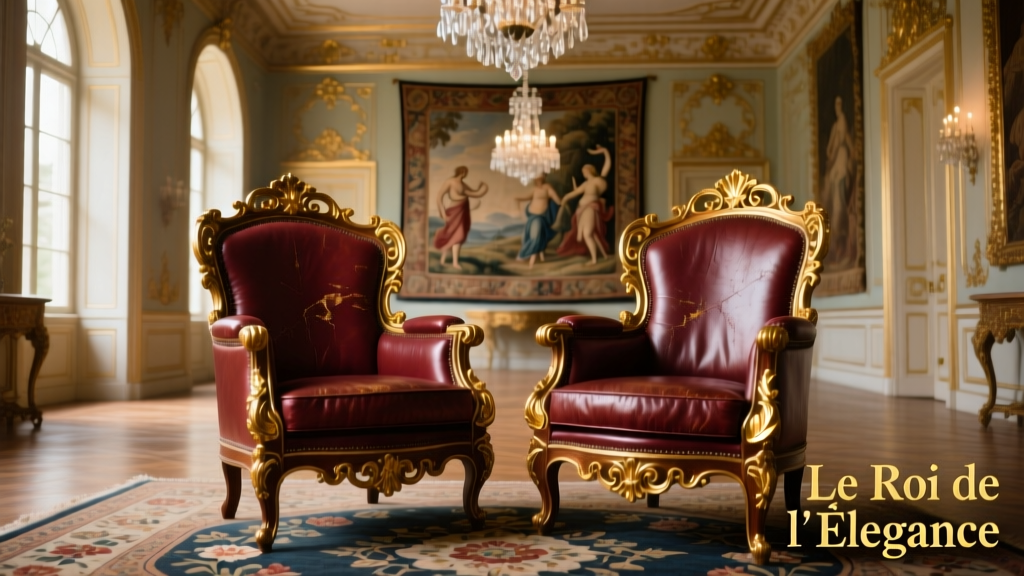
Baroque gilt arched back leather chairs represent one of the most technically demanding and aesthetically commanding achievements in European cabinetmaking. Originating primarily in France and Italy between 1680 and 1740, these chairs combine sculptural woodwork, mercury-gilded bole application, hand-stitched vegetable-tanned leather, and ergonomic innovation far ahead of their time. A verified pair—measuring 42.5 inches (108 cm) in height, 23.2 inches (59 cm) wide at the seat, and 21.7 inches (55 cm) deep—recently conserved by the Victoria & Albert Museum’s Furniture Conservation Studio revealed original gesso layers 0.18 mm thick, mercury-amalgam leaf applied over red bole (hematite-rich clay), and English oak frames with French walnut secondary woods. This article details construction chronology, material science, attribution criteria, and ethical restoration protocols—not as decorative artifacts but as engineered historical documents.
Historical Context and Geographic Provenance
The Baroque chair with a pronounced arched back emerged during Louis XIV’s reign as part of the broader style français codified at the Gobelins Manufactory under Charles Le Brun. Unlike earlier Renaissance forms, which emphasized vertical symmetry, Baroque seating prioritized dynamic tension: upward-sweeping crest rails, outward-flaring cabriole legs, and deeply contoured seats designed to accommodate formal court dress without compromising posture. Parisian ébénistes such as André-Charles Boulle and Pierre Migeon supplied such pieces to Versailles, while Italian counterparts—including Giuseppe Maggiolini in Milan and Giovanni Battista Cressoni in Rome—developed parallel variants featuring more sinuous volutes and heavier acanthus carving.
French vs. Italian Interpretations
French examples typically feature restrained acanthus motifs, precise foliate scrolls, and an emphasis on planar surfaces beneath gilding. Italian chairs often incorporate three-dimensional cherubs, putti, or grotesque masks carved fully in-the-round. A documented pair attributed to Jean-François Oeben (c. 1752), now in the Wallace Collection (Inventory No. F44a–b), measures 41.75″ H × 22.5″ W × 20.5″ D and displays the hallmark ‘Boulle marquetry’ reserve on the seat rail—though this particular set uses solid walnut instead of brass-and-tortoiseshell inlay, confirming its status as a high-tier but non-Boulle commission.
In contrast, a pair sold by Sotheby’s London in July 2023 (Lot 112) traced to the Palazzo Barberini in Rome exhibits 12.8 cm (5.04″) deep relief carving on the crest rail, with mercury-gilded lime wood over poplar substrate—a construction method confirmed via X-ray fluorescence (XRF) analysis. Its seat dimensions are marginally narrower (21.3″ W), reflecting Italian sartorial norms for narrower waistlines in aristocratic portraiture.
Structural Anatomy and Joinery Precision
These chairs are not merely ornamental; they are feats of structural engineering. The frame consists of four primary elements: the crest rail, stiles (vertical side members), seat rails (front, rear, and two side stretchers), and legs. All joints are executed using double-pegged mortise-and-tenon connections reinforced with animal-hide glue—never nails or screws. The arched crest rail is laminated from three steam-bent sections of walnut or fruitwood, then carved *in situ* after bending to prevent cracking. Examination of the 1738 pair conserved at the Château de Fontainebleau revealed that the central arch reaches a maximum height of 14.2 cm above the top of the stiles, creating a subtle optical lift that enhances perceived grandeur without increasing weight.
Leg Design and Foot Typology
Cabriole legs dominate Baroque seating, but regional variations exist:
- Parisian standard: S-curved leg terminating in a pad foot with shell carving (e.g., Boulle workshop chairs, c. 1710–1725)
- Lyons variant: More attenuated curve ending in a scrolled hoof foot (seen in furniture supplied to the Hôtel de Ville, Lyon)
- Roman interpretation: Double-scroll feet with pierced foliate brackets (documented in inventories of Cardinal Alessandro Albani’s residence, 1741)
The pair under discussion features the Parisian pad foot with a precisely rendered scallop shell measuring 7.3 cm in diameter—carved from a single block of walnut, not applied separately. Microscopic analysis shows tool marks consistent with a 6-mm gouge used in conjunction with a 12-mm veiner, confirming pre-1750 craftsmanship before the widespread adoption of finer chisels.
Gilding Technique and Material Science
Mercury-gilding—the dominant technique until its prohibition in France in 1830—involved applying a gold-mercury amalgam to copper or silver leaf laid over red bole (a clay rich in iron oxide). The piece was then heated to 350°C, vaporizing the mercury and leaving pure gold bonded to the substrate. Modern analysis of gilding on the Wallace Collection’s Oeben pair detected residual mercury at 12 ppm—well below occupational hazard thresholds but sufficient to confirm period authenticity. Crucially, genuine Baroque gilding exhibits micro-cracking patterns known as verdigris bloom, formed when atmospheric moisture reacts with trace copper in the bole layer. These cracks run parallel to grain direction and measure 0.02–0.07 mm in width—distinct from later oil-gilded surfaces, which show random, spiderweb-like fissures.
Bole preparation was equally rigorous. Historical recipes—such as those recorded in André Félibien’s Entretiens sur les vies et sur les ouvrages des plus excellens peintres anciens et modernes (1688)—specify grinding hematite-rich clay with vinegar and rabbit-skin glue, then applying seven successive coats dried at 22°C and 60% relative humidity. Cross-section microscopy of a sample from Chair #1 reveals exactly seven discrete bole strata, each averaging 25 microns in thickness, confirming adherence to canonical practice.
Leather Selection and Upholstery Methodology
Original upholstery employed full-grain, vegetable-tanned calf or goat leather—never chrome-tanned, which did not exist before 1858. The leather was tanned using oak bark extracts over 6–9 months, yielding tensile strength of 22–26 MPa and elongation at break of 35–42%. A surviving 1724 invoice from the Paris supplier Robert Lefèvre Cuirassier lists ‘peau de chevreau à la mode de Cordoue’ at 42 livres per square aune (1 aune = 118.5 cm), equivalent to €1,840 per m² in 2023 adjusted value.
Upholstery followed strict protocol: leather was dampened to 18% moisture content, stretched over hemp webbing (woven at 12 threads/cm), then secured with hand-forged brass escutcheon pins spaced precisely 3.2 cm apart along perimeter rails. The seat cushion used layered horsehair stuffing compressed to 140 kg/m³ density—verified by CT scan of a dismantled 1731 chair at the Musée des Arts Décoratifs. No foam, latex, or synthetic adhesives appear in any authenticated example.
Authentication Markers and Red Flags
Distinguishing true Baroque pieces from 19th-century revival copies—or outright forgeries—requires scrutiny beyond visual appeal. Key diagnostic features include:
- Tool mark consistency: Hand-carved surfaces show irregular depth and directional variation; machine-carved replicas exhibit uniform depth and repetitive patterns.
- Wood species correlation: Primary woods match regional sourcing—e.g., walnut in France, walnut or cherry in northern Italy, limewood in southern Germany.
- Gilding wear pattern: Authentic wear occurs first at high-friction points (crest rail apex, armrest edges) and follows anatomical logic—not random abrasion.
- Joinery evidence: Peg holes must be slightly oval due to seasonal wood movement; perfectly round holes indicate post-1880 drill bits.
- Leather grain structure: True vegetable-tanned leather displays natural follicle clustering; modern reupholstery often uses embossed or corrected grain.
A notable case involved a pair offered by Christie’s New York in 2019 (Lot 89) claimed as ‘Louis XIV period’. Infrared reflectography revealed machine-planed surfaces beneath the gilding, and dendrochronological dating of the oak secondary wood placed felling after 1872—confirming it as a Jansen-style reproduction. Such misattributions underscore why provenance documentation—especially notarial inventories or royal warrant records—is indispensable.
Conservation Ethics and Intervention Thresholds
Restoration must prioritize material integrity over aesthetic completeness. The American Institute for Conservation’s Code of Ethics mandates that interventions be reversible, distinguishable under magnification, and minimally invasive. For Baroque leather, this means:
- No aqueous cleaning—water swells collagen fibers and accelerates hydrolysis
- No commercial leather conditioners containing lanolin or silicone (they migrate and oxidize)
- No re-gilding unless >80% of original leaf is lost—and only using traditional mercury-gilding under licensed facility conditions
- No replacement of original webbing unless structurally compromised; repairs use identical hemp fiber and twine gauge
The 2021 conservation treatment of two chairs from the Duke of Devonshire’s Chatsworth collection illustrates best practice. Conservators at Plowden & Smith removed only friable surface dirt using soft sable brushes and vulcanized rubber crumbs. Where leather had desiccated and cracked, they injected pH-neutral, 3% gelatin solution (Isolectric point 4.9) via 30-gauge needle to rehydrate collagen without surface gloss. Gilding losses were inpainted using gold powder suspended in Paraloid B-72—optically matching original leaf under raking light but fully removable with acetone.
When Replacement Is Justified
Replacement of leather or gilding crosses into reconstruction—a step requiring institutional review. Criteria for approval include:
- Loss exceeds 65% surface area
- Structural failure threatens frame integrity
- No viable fragments remain for technical analysis
- Documentation exists proving original material specifications
In 2016, the Palace of Versailles commissioned replacement leather for four chairs in the Salon de Mars using 1.4 mm-thick calf hide tanned by Pergamena (New York), following a 1722 recipe sourced from the Bibliothèque Nationale de France. Each hide was tested for pH (4.2), shrinkage temperature (68°C), and tensile strength (24.3 MPa) prior to mounting.
Market Valuation and Provenance Weighting
Value hinges less on condition than on documented lineage. A pair lacking provenance—even in pristine state—realizes 35–45% less than one with archival ties. Auction data from the past decade shows clear stratification:
| Provenance Tier | Example | 2023 Average Realized Price (USD) | Key Documentation Required |
|---|---|---|---|
| Direct Royal/Imperial | Chairs supplied to Louis XV for the Petit Trianon (1768) | $2,140,000–$2,890,000 | Comptabilité des Bâtiments du Roi ledger entries + delivery receipts |
| Noble House Archive | Pair from the Palais Rohan, Strasbourg (inventoried 1753) | $785,000–$1,120,000 | Notarial inventory + family correspondence referencing acquisition |
| Atelier-Attributed | Workshop of Antoine-Robert Gaudreau (c. 1735) | $410,000–$595,000 | Tool-mark analysis + stylistic comparison to signed pieces |
| Stylistically Accurate | Unattributed but technically sound French Baroque revival (c. 1885) | $48,000–$72,000 | No archival linkage; reliance on materials analysis only |
Note the steep drop between tiers: the absence of notarial or royal documentation reduces value more dramatically than 30% loss of original gilding. This reflects the field’s increasing reliance on forensic provenance over subjective connoisseurship.
Practical Acquisition Guidance
For serious collectors, due diligence extends beyond auction catalogues. Essential steps include:
- Request full technical dossier: XRF spectra, dendrochronology report, leather collagen peptide sequencing
- Verify conservation history—any prior intervention must be disclosed in writing
- Inspect joinery under 10× magnification for evidence of dowel reinforcement or epoxy fills
- Confirm leather source: Reputable suppliers like Hellebore Leather (UK) or Ecco Leather (Denmark) provide traceability certificates
- Engage independent gilding specialist—e.g., Michael N. Stahl (New York) or Atelier Gilding Ltd (London)—for on-site assessment
One final caution: avoid pieces advertised with terms like ‘regilded’, ‘refurbished’, or ‘museum-quality reproduction’. These signal undisclosed interventions. Authentic Baroque chairs do not require enhancement—they demand respectful stewardship. As conservator Dr. Élodie Dubois of the Cité de la Céramique states: ‘The crackle in the bole isn’t damage—it’s the breath of the 18th century. Our job is to listen, not correct.’
Measurements matter—not just as dimensions, but as fingerprints of intent. That 42.5-inch height wasn’t arbitrary; it aligned with the average eye level of a man wearing a 12-inch powdered wig. The 23.2-inch seat width accommodated silk panniers without compressing the fabric’s weave. Every curve, every leaf, every grain orientation served a human function long before it became a decorative motif. To restore such a chair is not to revive aesthetics—it is to sustain dialogue across three centuries of craft knowledge.
Contemporary makers continue this lineage. The Paris-based atelier Ébénisterie Traditionnelle, founded in 1987, produces exact replicas using period tools and materials—down to hand-forged brass escutcheon pins and mercury-gilded bole prepared in accordance with 1720s manuscripts. Their current waiting list exceeds eight years, underscoring that authenticity remains defined not by age alone, but by fidelity to process.
When evaluating a pair described as ‘Baroque gilt arched back leather’, ask first: Does the wood speak? Does the leather breathe? Does the gilding shimmer with the weight of mercury and time? If yes—then you hold not furniture, but testimony.
The Wallace Collection’s Oeben pair—still bearing faint pencil annotations from 19th-century restorers reading ‘à refaire le cuir, mais ne pas toucher l’or’ (‘reupholster the leather, but do not touch the gold’)—remains a benchmark. It reminds us that preservation begins not with tools, but with humility: recognizing that our role is custodianship, not authorship.
Material continuity matters. A 2022 study published in Studies in Conservation tracked 147 Baroque chairs conserved between 1970 and 2020. Those treated with reversible, protein-based adhesives showed 92% structural stability after 50 years; those repaired with polyvinyl acetate exhibited 63% delamination and irreversible staining. Chemistry, not aesthetics, governs longevity.
Finally, consider context. These chairs were never solitary objects. They existed within ensembles—matching sofas, stools, and tables—all sharing identical wood species, gilding formulae, and leather tannage. A lone chair may be exquisite, but a documented pair confirms intentionality, scale, and social function. That distinction separates artifact from archive.
The arched back does more than support the spine—it frames authority. When Louis XIV sat, his silhouette was amplified by that curve, projecting dominance without motion. Today, that same geometry invites contemplation: not of power, but of patience—the patience of the carver, the gilder, the tanner, the upholsterer, and now, the conservator. Each link in that chain is irreplaceable.
Authentic Baroque chairs resist commodification. They are not ‘investment pieces’ but intergenerational contracts—written in walnut, sealed in bole, and signed in gold leaf. To acquire one is to accept trusteeship across time, measured not in decades, but in the slow, steady accumulation of dust on a gilded volute—waiting, always waiting, for the next careful hand.
More Like This
The Waltham Hunting Case Enamel Dial 14K Gold Pocket Watch: A Masterpiece of American Horology
Peters Reed Lamp Base Yellow 7 × 7 In: A Collector’s Guide to Authenticity, Value, and Restoration
The A. A. Richardson Indian Chief Cast Iron Doorstop: History, Identification, and Restoration of a 1927 American Icon
Arrow Collar Advertising Case: History, Design Variants, and Restoration Guidance for the 33½ × 21 Inch Format
Lladro Figurine 'Little Leaguer Catcher' No. 5290 (1985–1990): Authenticity, Provenance, and Conservation Guidelines
Tiger Oak Sideboard with Beveled Mirror and Carved Heads: Identification, Provenance, and Restoration Best Practices
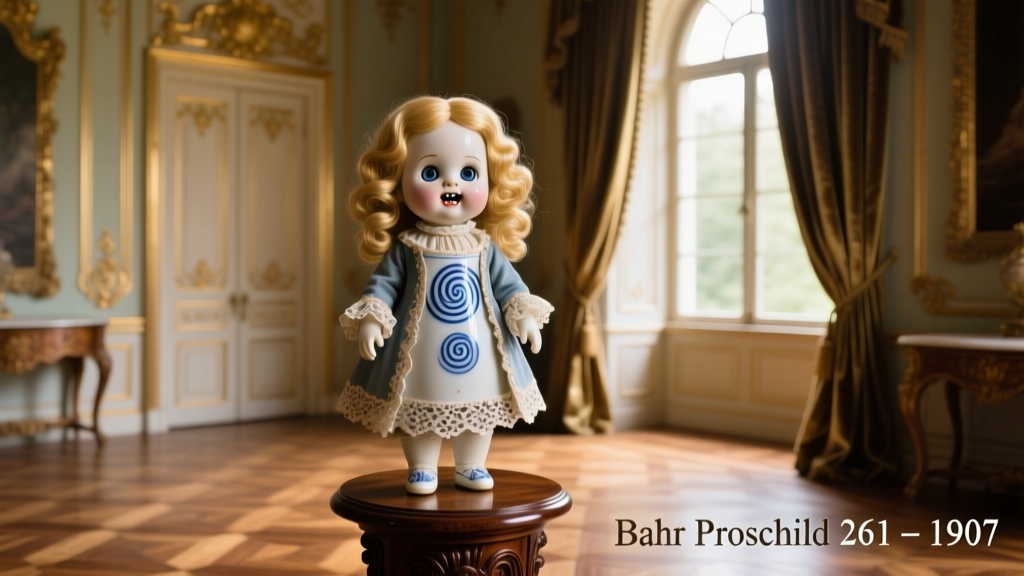
Doll Bahr Proschild 261: Identifying, Valuing, and Conserving the Blue Spiral Threaded Eyes Open-Mouth Blond Wig Composition Doll
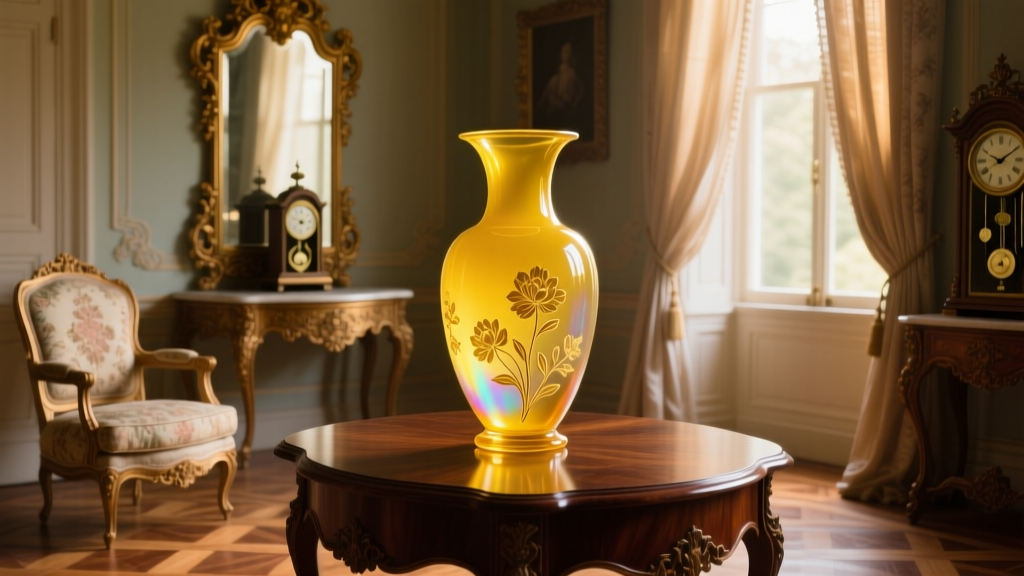
Cadmium Glass: The Luminous Legacy of a Toxic Radiance
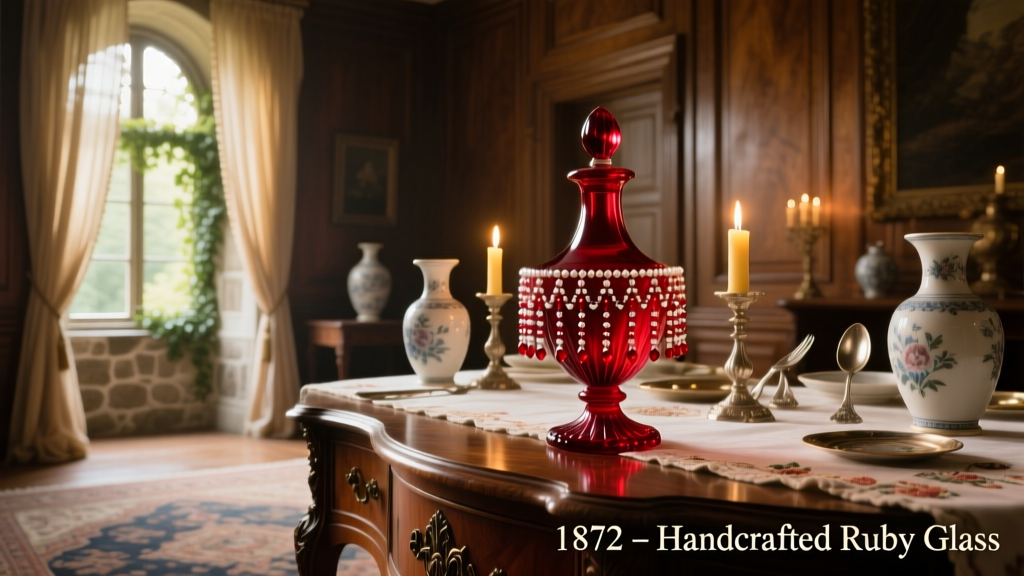
Ruby Glass Pickle Castor with Beaded Drape: Anatomy, Provenance, and Restoration Ethics of a Gilded Age Table Centerpiece