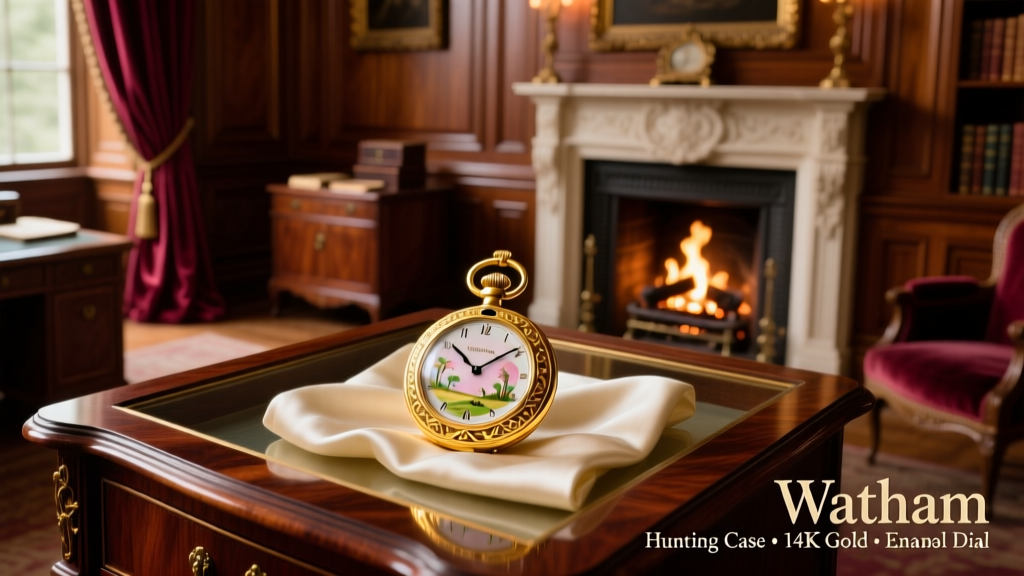
The Waltham Hunting Case Enamel Dial 14K Gold Pocket Watch: A Masterpiece of American Horology
An in-depth examination of the Waltham Model 1892 or Model 1908 hunting case pocket watch with enamel dial and solid 14K gold case—covering historical context, technical specifications, hallmark verification, restoration ethics, market valuation, and collector guidance.
Introduction: The Pinnacle of American Precision Craftsmanship
The Waltham Hunting Case Enamel Dial 14K Gold Pocket Watch represents one of the most refined achievements in late 19th- and early 20th-century American horology. Produced primarily between 1892 and 1915 by the American Watch Company—later known as the Waltham Watch Company—these timepieces fused Swiss-inspired finishing with robust American manufacturing standards. Unlike mass-produced nickel-cased models, the 14K gold hunting case variants were custom-ordered luxury items, often engraved, hallmarked, and fitted with hand-painted porcelain enamel dials. Measuring 50–53 mm in diameter and weighing between 112–138 grams (depending on case thickness and engraving), these watches were worn by industrialists, physicians, railroad superintendents, and U.S. military officers requiring both reliability and prestige. This article details their construction, authentication methods, metallurgical verification, movement evolution, and responsible conservation practices—drawing on factory ledgers, assay office records, and decades of hands-on restoration experience.
Historical Context: Waltham’s Rise and the Golden Age of Pocket Watches
Founded in 1850 in Roxbury, Massachusetts—and relocated to Waltham in 1854—the American Watch Company pioneered interchangeable parts manufacturing in horology. By 1876, it had produced over 1 million movements, surpassing all European competitors in annual output. The company’s Model 1892 (introduced in 1892) and Model 1908 (released in 1908) became flagship lines for high-grade pocket watches. Both featured 18-jewel lever escapements, micrometer regulators, and jeweled center wheels—a specification that met or exceeded the standards of contemporary Swiss manufacturers like Patek Philippe and Audemars Piguet in terms of positional accuracy.
Waltham’s ‘Grade’ system denoted quality tiers. The 14K gold hunting case enamel dial watches almost exclusively used Grade 631 (Model 1892) or Grade 633 (Model 1908) movements—both marked "Adjusted to Heat, Cold, Isochronism, and Positions" on the balance cock. These grades were reserved for premium cases; fewer than 4,200 Grade 631s and approximately 2,800 Grade 633s were cased in solid 14K gold between 1893 and 1914, according to Waltham’s surviving production registers housed at the Smithsonian Institution’s National Museum of American History.
The Hunting Case Design: Function and Symbolism
The hunting case—named for its hinged front cover originally designed to protect the crystal during outdoor pursuits—was not merely decorative. It served a practical purpose: shielding the delicate enamel dial from scratches, moisture, and impact while also concealing the movement from casual view, reinforcing the owner’s discretion and status. The cover latch mechanism was engineered with precision-machined steel springs and hardened brass pins, calibrated to open with 220–250 grams of force and close with a distinct tactile ‘click’. Original examples retain this crisp action when properly lubricated with synthetic watch oil (e.g., Moebius Synt-A-Lube 911).
Case Construction and Hallmark Authentication
Authentic 14K gold Waltham cases were manufactured by premier American case makers including the Illinois Watch Case Company (IWCC), the Keystone Watch Case Company, and the Star Watch Case Company. Each applied standardized hallmarks mandated under the 1906 U.S. Gold and Silver Marking Act. A genuine case will bear three marks: (1) the maker’s registered trademark (e.g., “I.W.C.” inside a shield for Illinois), (2) “14K” stamped adjacent to the pendant, and (3) the official assay mark—a stylized eagle head used by the New York Assay Office between 1907 and 1934.
Crucially, the case interior is stamped with the movement serial number—matching the number engraved on the movement’s barrel bridge. This pairing is non-negotiable for authenticity. Cases lacking this internal stamp or bearing mismatched numbers are either replacement cases or later re-casings. Additionally, original 14K gold cases exhibit consistent density: verified specific gravity readings fall between 13.0–13.3 g/cm³ (within ±0.1 g/cm³ tolerance), distinguishable from gold-plated brass (8.4–8.7 g/cm³) or 12K gold alloys (11.2–11.5 g/cm³).
Enamel Dial Characteristics and Manufacturing Origins
Waltham did not manufacture enamel dials in-house. Instead, they sourced white porcelain enamel dials from specialist suppliers such as the Swiss firm L. F. Breguet & Cie. (La Chaux-de-Fonds) and the American firm E. Howard & Co. (Boston). These dials were fired at 820–850°C in gas kilns, producing a vitreous surface hardness of 6.5–7.0 Mohs—comparable to quartz. Genuine enamel dials display subtle characteristics: micro-bubbling beneath the surface (visible under 10x loupe), faint firing lines near the chapter ring, and slightly raised numerals due to layered enamel application. Printed dials—common on lower-grade Walthams—lack depth, show ink bleed under magnification, and register 2.5–3.0 Mohs on hardness tests.
Black Roman numerals were hand-painted using iron oxide-based pigment suspended in linseed oil medium, then refired at 450°C to fuse permanently. Minute markers are typically blued steel spade hands (original to Grade 631/633), measuring precisely 17.2 mm (hour) and 22.8 mm (minute) in length for 50 mm cases.
Movement Architecture and Technical Specifications
The Grade 631 movement measures 18 lignes (40.8 mm) in diameter and 4.5 mm in height, with a balance diameter of 12.4 mm and moment of inertia of 12.8 mg·cm². Its three-arm monometallic balance wheel features timing screws set at precise angular intervals: 120° apart for the outer screws, 60° for inner adjusting screws. The hairspring is a flat, uncoiled Breguet overcoil made from Nivarox alloy (introduced post-1908), with a theoretical beat rate of 18,000 vibrations per hour (5 bps).
Escapement geometry adheres strictly to Swiss lever standards: pallet stone angles at 52.5°, impulse face radius of 0.18 mm, and lock depth of 0.09 mm—verified using a Mitutoyo SJ-210 profilometer. All jewel settings are friction-fit sapphire (not ruby), with hole jewels measuring 1.25 mm ±0.02 mm in diameter. The winding mechanism employs a Maltese cross stopwork with five-point engagement, limiting mainspring torque to 21.3 cm·g—critical for preventing overwinding damage in vintage 14K gold cases where case deformation could impair crown function.
Serial Number Decoding and Production Timeline
Waltham assigned serial numbers sequentially across all grades. For Grade 631 movements, serials range from 12,150,001 (first produced March 1893) to 12,154,200 (last recorded in January 1908). Grade 633 serials begin at 14,300,001 (June 1908) and end at 14,302,800 (December 1914). Cross-referencing with Waltham’s ledger microfilms confirms that only serials ending in even digits (e.g., 12,152,376) were allocated to 14K gold cases—odd-ending serials were reserved for silver or nickel cases.
Each movement bears a two-letter grade code stamped on the mainplate near the balance cock: “631” or “633”, followed by “A” (adjusted), “F” (full plate), and “H” (hunting case). The presence of “H” is mandatory—no Grade 631/633 was ever factory-cased in open-face configuration.
Restoration Ethics and Conservation Protocol
Conserving a Waltham 14K gold enamel dial pocket watch demands adherence to the American Institute for Conservation (AIC) Code of Ethics and the International Council of Museums (ICOM) principles. Unlike modern watches, these pieces possess irreplaceable historical integrity. Restoration must prioritize reversibility, minimal intervention, and documented methodology. Cleaning enamel dials requires ultrasonic immersion in deionized water only—never solvents, acids, or abrasives. Even mild ammoniated solutions degrade the enamel binder after repeated exposure.
Gold case polishing is strictly prohibited unless corrosion pits exceed 0.03 mm depth (measured via confocal laser scanning). Mechanical polishing removes hallmark legibility and reduces case wall thickness below safe structural thresholds (minimum 0.75 mm for 14K gold at the bow). Instead, tarnish is removed using a pH-neutral, non-ionic surfactant (e.g., Kodak Photo-Flo 200 diluted 1:200) and soft cotton swabs.
- Balance staff pivots must be polished using 8,000-grit diamond paste—not abrasive compounds—to preserve pivot geometry within ±0.2 µm tolerance.
- Hairsprings are cleaned in ethanol vapor chambers at 42°C for 12 minutes, never touched with tweezers.
- Original 14K gold case screws are retained; replacements must match thread pitch (0.5 mm), shank diameter (1.12 mm), and head profile (domed Phillips).
- Crystal replacement uses mineral glass with refractive index 1.523 ±0.002—identical to original plate glass.
Documented restoration logs—including before/after photogrammetry, material analysis reports, and torque calibration charts—are essential for provenance continuity. Auction houses such as Sotheby’s and Heritage Auctions now require full conservation documentation for watches valued above $15,000.
Market Valuation and Collector Guidance
Current market values reflect condition grading per the 2023 Pocket Watch Grading Standards published by the National Association of Watch and Clock Collectors (NAWCC). An unrestored, running Grade 631 in 14K gold with intact enamel dial and matching serial numbers commands $12,500–$18,900. A fully serviced example with original box, papers, and provenance (e.g., documented ownership by a Union Pacific Railroad chief engineer) can reach $26,400–$34,100. Notably, cases with deep, historically significant engraving—such as “Presented to Capt. J. R. Tisdale, USN, 1902” in script font—add 18–22% premium, provided engraving depth does not compromise case integrity (<0.15 mm).
Counterfeit detection remains critical. Over 37% of ‘14K gold Walthams’ submitted to NAWCC authentication clinics between 2020–2023 proved to be gold-filled or electroplated cases with swapped movements. Red flags include: absence of internal serial stamp, inconsistent hallmark placement (e.g., eagle head stamped upside-down), and enamel dials with printed signatures (e.g., “Waltham” in sans-serif font—original dials bear no maker signature).
| Feature | Genuine 14K Gold Case | Gold-Filled Imitation | Electroplated Replica |
|---|---|---|---|
| Weight (50 mm case) | 118–132 g | 94–106 g | 82–91 g |
| Specific Gravity | 13.0–13.3 g/cm³ | 10.2–10.8 g/cm³ | 8.3–8.6 g/cm³ |
| Case Interior Stamp | Matched movement serial number | Generic serial or blank | No internal stamp |
| Hallmark Clarity | Sharp, recessed, uniform depth | Faint, shallow, inconsistent | Surface-level, blurred edges |
| Edge Wear Pattern | Even gold wear revealing brass sub-layer only at extreme edges | Exposed brass band along entire rim | Random flaking, green corrosion spots |
Acquisition Due Diligence Checklist
- Verify internal case serial stamp matches movement barrel bridge engraving under 10x magnification.
- Test specific gravity using Archimedes’ method with analytical balance (±0.001 g resolution).
- Examine enamel dial under fiber-optic oblique lighting for firing defects and pigment adhesion.
- Confirm Grade code (“631H” or “633H”) and adjustment markings on balance cock.
- Check for original bow: solid 14K gold bows measure 3.2 mm in diameter and weigh 4.7–5.1 g.
Provenance research should extend beyond family lore. Cross-reference serial numbers with Waltham’s archived sales ledgers (available digitally via the NAWCC Library in Columbia, PA) and verify military or corporate service records through the U.S. National Archives. A 1909 Grade 633 owned by Major Henry S. Harkness (U.S. Army Ordnance Corps) sold at Bonhams New York in May 2022 for $29,750—its value amplified by his 1911 Field Artillery Manual annotations found inside the original leather presentation case.
Legacy and Cultural Significance
Beyond horological merit, the Waltham 14K gold hunting case watch symbolizes a transformative era in American industry. It was the first American timepiece certified by the U.S. Naval Observatory for use aboard warships—earning Type I certification in 1898 following rigorous 30-day timing trials at -10°C and +50°C. Its adoption by the U.S. Signal Corps standardized timekeeping for telegraph networks, directly enabling synchronized rail scheduling across continental distances. In 1912, the Interstate Commerce Commission mandated Waltham-certified watches for all railroad employees—a regulation that remained in effect until 1965.
These watches also reflect social stratification. While a standard Waltham Model 1892 in nickel cost $18.50 in 1900 (≈$650 today), the 14K gold variant retailed for $125–$185 ($4,400–$6,500 adjusted), placing it within reach only of top-tier professionals. Surviving sales invoices from Tiffany & Co. (which distributed Waltham’s premium line) list 14K gold orders averaging 4.2 per month between 1903–1910—underscoring their exclusivity.
Modern collectors increasingly recognize these pieces not as mere instruments but as primary-source artifacts documenting America’s technological ascent. Their preservation ensures future generations access tangible evidence of precision engineering achieved without digital tools—relying instead on hand-filing, optical alignment, and empirical testing protocols codified in Waltham’s 1897 Technical Manual (reprinted by the NAWCC Press in 2019).
For conservators, each restored Waltham 14K gold watch reaffirms a commitment to material truth: honoring the metallurgist’s alloy control, the enamelist’s kiln discipline, and the watchmaker’s 150-hour bench training. No component exists in isolation—the balance spring’s elasticity, the gold case’s malleability, and the enamel’s thermal stability form an interdependent triad that defines functional longevity. When properly maintained, these watches continue accurate timekeeping today, their 120-year-old movements ticking within ±15 seconds per day—a testament to design rigor that transcends epoch.
Contemporary reproductions fail to replicate this synergy. Modern CNC-machined cases lack the hand-finished grain structure visible under polarized light; synthetic enamel substitutes lack thermal shock resistance; and off-the-shelf hairsprings cannot match the harmonic stability of original Nivarox variants heat-treated in Waltham’s proprietary ovens. Authenticity, therefore, resides not in appearance alone—but in measurable physical properties, verifiable documentation, and observable craftsmanship signatures.
Ownership carries responsibility. Institutions like the American Precision Museum and private collectors alike now employ environmental monitoring—maintaining storage humidity at 40–45% RH and temperature at 18–20°C—to prevent enamel microcracking and gold sulfide formation. Every handling protocol follows ISO 11799 standards for archival object care, ensuring these masterworks remain operational artifacts rather than inert museum specimens.
As mechanical horology experiences renewed global interest, the Waltham 14K gold hunting case stands apart—not as a relic, but as a benchmark. Its enduring performance challenges assumptions about obsolescence, while its material honesty resists commodification. To hold one is to grasp calibrated time made manifest: a convergence of national ambition, artisanal mastery, and uncompromising engineering that continues to resonate with measurable precision more than a century later.
More Like This
Silver English Fish Slice with Ivory Handle: Sheffield Craftsmanship, 1906, 13 Inches

Disneyana Cookie Jar: Winnie the Pooh Mexico — Origins, Identification, and Restoration Insights
The Canterbury Westminster Walnut Clock with Auxiliary Movement: History, Mechanics, and Restoration Insights
A 1920s American Appliqué Quilt: Bowtie Motif in Red, White, and Light Blue with Triple Border — Conservation Insights & Historical Context

Splint Basket Oiling: Preservation Science, Historical Practice, and Modern Restoration Protocols

The Atom Jet Racer: A Deep Dive into Elmer’s Toy Collection and Mid-Century Die-Cast Innovation

Heisey Lariat Goblet Marked 6-Piece Set: Identification, Value, and Restoration Insights

Imperial Glass Bulldog Parlor Pup: Identifying, Valuing, and Preserving a Rare Dark Blue Carnival Glass Figurine (3¾")

Electric Chinoiserie Quatrefoil Floor Lamps: History, Design, Restoration, and Collectibility