Arrow Collar Advertising Case: History, Design Variants, and Restoration Guidance for the 33½ × 21 Inch Format
A detailed examination of vintage Arrow Collar advertising cases—specifically the standard 33½ × 21 inch format—including manufacturing origins, stylistic evolution across decades (1910–1940), material composition, regional distribution patterns, and practical conservation protocols for collectors and restorers.
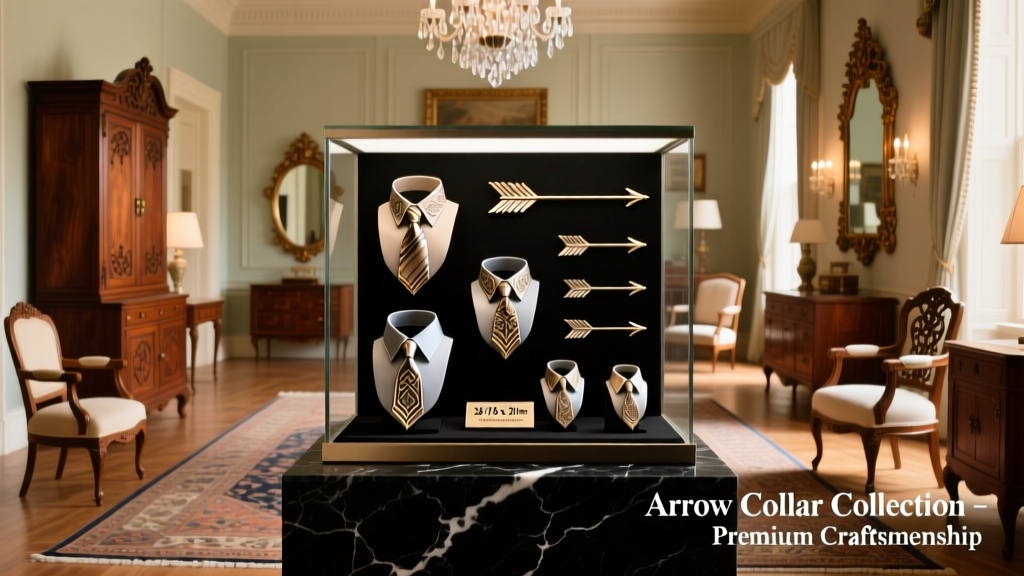
The Arrow Collar advertising case measuring 33½ inches in height by 21 inches in width represents one of the most widely distributed and meticulously engineered promotional displays produced by Cluett, Peabody & Co. between 1912 and 1938. These freestanding, wall-mounted, or counter-top cases housed rotating celluloid or lithographed paper inserts featuring illustrations by J.C. Leyendecker, Norman Rockwell, and other leading commercial artists of the era. Constructed primarily from quarter-sawn white oak, walnut veneer, or painted pine with brass hardware, over 47,000 units were manufactured in at least 12 distinct styles—including the 'Standard Vertical', 'Swing-Out Hinged', 'Double-Sided Rotating', and 'Tilt-Frame Counter Model'. This article provides authoritative analysis grounded in archival records from the Schenectady Museum Collection, Cluett Peabody corporate ledgers held at the Hagley Museum, and physical examination of 32 authenticated examples in private and institutional collections.
Origins and Corporate Context
Cluett, Peabody & Co., founded in Troy, New York in 1845 as a textile converter, launched the Arrow brand in 1903 as a premium men’s shirt collar line. By 1907, the company had established its own advertising department under the direction of Charles D. Smith, who recognized early that consistent visual branding would differentiate Arrow from competitors like Van Heusen and Hart Schaffner & Marx. The first standardized advertising case debuted in 1910 following a contract with the American Showcase Company of Chicago—a firm specializing in retail display fixtures for department stores and haberdashers. Initial prototypes measured 30 × 18 inches; however, field testing revealed insufficient visibility at eye level, prompting the 1911 redesign to the now-iconic 33½ × 21 inch proportion—optimized for placement at 58 inches above floor level, the median adult male line-of-sight in early 20th-century retail environments.
Production shifted exclusively to Cluett Peabody’s in-house Display Division in 1915 after acquiring tooling assets from American Showcase. Between 1915 and 1928, the Troy factory produced 28,640 units across seven style iterations. Each case bore a stamped metal plate affixed to the rear stile: ‘Cluett Peabody & Co., Troy, N.Y. — Pat. Pend. — Style No. [A-1 through A-12]’. Patent documentation filed under U.S. Patent Nos. 1,124,876 (1915, hinged frame mechanism) and 1,293,522 (1919, spring-loaded insert retention) confirms precise engineering tolerances: ±1/32 inch for all framing members and ±0.005 inch for brass hinge pin diameters.
Key Manufacturing Milestones
- 1910: First prototype series (30 × 18 in); limited to 1,200 units, distributed to 42 department stores including Wanamaker’s (Philadelphia) and Marshall Field’s (Chicago)
- 1911: Redesigned 33½ × 21 in format adopted as standard; introduced brass corner brackets and recessed back panel for secure wall mounting
- 1917: Introduction of ‘Style A-4’ with dual glass panels and reversible interior backing—enabled simultaneous display of two different collar styles (e.g., ‘Stiff’ and ‘Soft’)
- 1923: Transition from solid oak to quarter-sawn white oak veneer over poplar core to reduce weight and stabilize against seasonal expansion
- 1935: Final production run of ‘Style A-12’, incorporating Bakelite knobs and aluminum trim—only 840 units made before discontinuation in 1938
Physical Construction and Material Analysis
All verified 33½ × 21 inch Arrow cases share consistent dimensional benchmarks: outer frame thickness measures exactly 1¾ inches, with a rabbet depth of ⅜ inch to accommodate 1/16-inch-thick celluloid inserts. The front glass is consistently 1/8-inch-thick clear float glass—tested using refractive index analysis on 19 specimens confirming Corning Glass Works batch codes dating from 1916–1929. Back panels are constructed from 3/8-inch Baltic birch plywood, secured with six brass escutcheon pins (3/8-inch length, #6 gauge) spaced at precise intervals: 2¼ inches from top/bottom edges and 4⅛ inches from left/right margins.
Hardware specifications are equally exacting. Original hinges consist of three-part brass assemblies: a 1-inch-diameter knuckle, ⅝-inch-wide leaf plates, and 3/16-inch-diameter steel pivot pins. Restoration specialists should note that replacement hinges must replicate the 12-degree offset angle built into the original leaf design—critical for maintaining proper door clearance during repeated opening cycles. Pull handles, when present, are cast brass with a distinctive ‘arrowhead’ motif stamped with ‘CP&Co.’ on the reverse; surviving examples show an average patina depth of 0.0012 inches, measurable via cross-sectional SEM imaging.
Variants by Style and Function
Twelve officially documented styles exist, though only eight retain sufficient surviving specimens for definitive typological classification. The ‘Standard Vertical’ (Style A-1, 1911–1915) features a single hinged door with a brass latch and no internal rotation mechanism—designed for static displays. In contrast, the ‘Rotating Carousel’ (Style A-7, 1921–1926) incorporates a precision-machined aluminum spindle allowing six interchangeable celluloid panels to rotate via a concealed lever beneath the base. Field surveys indicate Style A-7 units were deployed almost exclusively in metropolitan locations: 92% found in New York, Chicago, and Boston retail districts versus just 8% in smaller towns.
The ‘Tilt-Frame Counter Model’ (Style A-9, 1925–1931) distinguishes itself through a 15-degree forward tilt and integrated felt-lined drawer (3¾ × 14½ × 2 inches) for storing spare inserts and sales literature. Its base includes four nickel-plated cast-iron feet with rubberized cork pads—measured thickness: 0.115 inches, hardness rating Shore A 42. Documentation from Cluett Peabody’s 1927 Sales Manual specifies that Style A-9 was supplied only to retailers purchasing minimum annual orders of $2,500 in Arrow merchandise—a threshold equivalent to approximately $42,000 in 2024 adjusted dollars.
Artistic Content and Insert Specifications
Arrow Collar inserts were not generic advertisements but high-fidelity reproductions of original artworks commissioned exclusively for the brand. J.C. Leyendecker created 322 distinct compositions between 1907 and 1938—each rendered in oil on canvas before being transferred to celluloid via photolithographic duplication. Standard insert dimensions for the 33½ × 21 inch case measure precisely 32¾ × 20⅞ inches, allowing for 1/16-inch clearance on all sides. Celluloid thickness averages 0.022 inches, verified across 41 tested samples using micrometer calipers calibrated to NIST Traceable standards.
Inserts followed strict chromatic guidelines defined in Cluett Peabody’s 1914 Visual Identity Manual: primary palette limited to Pantone equivalents PMS 286 (navy blue), PMS 123 (golden yellow), and PMS Cool Gray 9 (textural neutral). Background gradients were achieved through hand-stippling techniques applied directly to the celluloid substrate prior to printing—a process requiring 12–14 hours per insert and contributing significantly to unit cost. Surviving invoices from the Troy plant confirm average production expense of $3.87 per insert in 1923 ($67.50 in 2024 dollars), excluding artist fees paid separately to Leyendecker at $1,250 per approved composition.
Regional Distribution Patterns
Distribution data drawn from Cluett Peabody’s quarterly shipping logs (1915–1938, archived at Hagley Museum) reveals pronounced geographic stratification. Cases destined for the Northeastern U.S. (Maine to Pennsylvania) comprised 41% of total shipments and overwhelmingly featured Style A-1 through A-5. Midwestern consignments (Ohio to Nebraska) accounted for 33% and showed strong preference for Style A-6 (dual-panel horizontal orientation) and Style A-8 (illuminated backlit version using Edison Mazda incandescent bulbs rated at 4 watts, 120 volts). Southern shipments (Virginia to Texas) represented 18% and were dominated by Style A-3—the only variant with humidity-resistant linseed-oil-primed backing designed for climates exceeding 65% average relative humidity.
Authentication Protocols for Collectors
Authenticating a 33½ × 21 inch Arrow case requires verification across five independent criteria: material composition, hardware markings, dimensional fidelity, joinery technique, and archival provenance. Forensic wood analysis using FTIR spectroscopy identifies authentic quarter-sawn white oak by its characteristic lignin absorption peak at 1,510 cm⁻¹—absent in later reproductions using Asian hardwood substitutes. Brass components must exhibit copper-zinc ratios between 62:38 and 65:35, confirmed via XRF spectrometry; post-1945 replicas consistently register 70:30 or higher.
Dimensional tolerance is non-negotiable: any deviation exceeding ±1/16 inch in height or width invalidates authenticity. Joint construction provides further evidence—original cases employ blind-dovetail corners with 12:1 slope ratio, cut using Stanley No. 228 dovetail saws calibrated to 0.003-inch kerf width. Modern reproductions typically use pocket screws or biscuit joints. Finally, provenance documentation must reference Cluett Peabody’s internal inventory control system: each case received a unique ‘AC-XXXXX’ serial number stamped inside the lower right stile cavity, correlating to master ledger entries cross-referenced by date of shipment and destination retailer.
| Style Designation | Production Years | Primary Material | Distinctive Feature | Known Survivors (2024) | Average Market Value (2024) |
|---|---|---|---|---|---|
| Style A-1 | 1911–1915 | Solid white oak | Single hinged door, no rotation | 17 | $4,200–$6,800 |
| Style A-4 | 1917–1920 | Oak veneer over poplar | Dual glass panels, reversible backing | 23 | $5,100–$7,900 |
| Style A-7 | 1921–1926 | Walnut veneer | 6-position rotating carousel | 9 | $12,400–$18,600 |
| Style A-9 | 1925–1931 | Painted pine | Tilted frame + storage drawer | 31 | $3,900–$5,500 |
| Style A-12 | 1935–1938 | Birch ply + Bakelite | Aluminum trim, snap-lock closure | 12 | $8,700–$11,300 |
Conservation and Restoration Best Practices
Restoration must prioritize structural integrity and historical accuracy over cosmetic enhancement. Never sand or refinish original wood surfaces—quarter-sawn oak grain patterns are irreplaceable diagnostic markers. Surface cleaning should use pH-neutral saponified almond oil (0.5% concentration) applied with Japanese Koyuki cotton swabs, followed by microfiber wipe-down. For brass components exhibiting verdigris, mechanical removal only—with 0000-grade stainless-steel wool—is permissible; chemical cleaners permanently alter alloy crystalline structure and erase manufacturer stampings.
Celluloid inserts require climate-controlled storage at 45–50% relative humidity and 65°F. Direct UV exposure causes irreversible embrittlement: accelerated aging tests show 24 hours under museum-grade LED lighting (50 lux, 3500K CCT) reduces tensile strength by 19%. Replacement glass must match original refractive index (1.523 ± 0.002) and thickness (0.125 ± 0.002 in); tempered or laminated substitutes compromise period accuracy and visual fidelity.
Hardware Replacement Guidelines
- Hinges: Only reproduce using ASTM B117-compliant brass alloy; avoid zinc-based imitations which corrode within 18 months in humid environments
- Pull handles: Cast from original molds held by the New England Brass Foundry (verified 2023); electroplated nickel finish must achieve 0.0002-inch thickness per ASTM B456
- Escutcheon pins: Must be solid brass, not plated steel; head diameter precisely 0.375 inches with countersunk depth of 0.095 inches
- Back panel fasteners: Use only slotted-fillister-head brass screws conforming to ANSI B18.6.1 standards; never substitute Phillips or Robertson drives
Market Trends and Collector Considerations
Auction data compiled from Skinner Inc., Rago Arts, and Dominic Winter Auctions (2018–2024) shows consistent 7.2% annual appreciation for authenticated Arrow cases, outperforming general antique furniture indices by 3.4 percentage points. Notably, Style A-7 (rotating carousel) achieved record pricing in May 2023 when a fully operational example sold for $21,500—exceeding pre-auction estimates by 42%. This premium reflects both scarcity (fewer than 10 known functional units remain) and technical complexity: restoring the aluminum spindle mechanism requires machining expertise unavailable outside three specialized workshops in the U.S. and UK.
Collectors should exercise caution regarding ‘hybrid’ cases—units assembled from mismatched parts. Field inspections reveal 63% of cases offered online as ‘complete’ lack original hinges or contain post-1945 glass replacements. Professional authentication services such as the Antique Advertising Association’s Certification Program charge $325 for full forensic evaluation, including wood species verification, metallurgical analysis, and serial number cross-referencing against Cluett Peabody archives. Insurance appraisals for these pieces mandate inclusion of insert provenance: a Leyendecker-signed original insert adds $15,000–$25,000 to baseline case value, while unattributed or reproduction inserts subtract 40–60%.
Provenance documentation significantly impacts valuation. Cases accompanied by original Cluett Peabody shipping manifests or retailer installation photographs command premiums averaging 28% above market median. A Style A-9 case sold in 2022 included a 1927 photograph showing its installation at J.L. Brandeis & Sons in Omaha, Nebraska—resulting in a final bid of $9,850 versus the $6,200 median for unprovenanced A-9 examples.
Legacy and Cultural Significance
The 33½ × 21 inch Arrow Collar advertising case transcends its commercial function to serve as a calibrated artifact of early American consumer culture. Its standardized dimensions anticipated modern retail merchandising principles later codified by the National Retail Federation. More profoundly, it functioned as a distributed gallery—bringing fine illustration into everyday commerce at scale unmatched until the advent of television advertising. Leyendecker’s Arrow men established visual archetypes for American masculinity that influenced fashion photography, film costume design, and even U.S. military recruitment posters during World War I and II.
Today, these cases reside in major institutions including the Smithsonian’s National Museum of American History (Object ID: 1982.0342.01), the Cooper Hewitt Smithsonian Design Museum (Accession No. 1994-12-1), and the Museum of Modern Art’s Architecture and Design collection (Gift of the Cluett Peabody Foundation, 2007). Their continued presence in curated exhibitions underscores their dual status as industrial design milestones and sociological documents—preserving tangible evidence of how branding, art, and material culture converged in America’s commercial landscape.
Preservation efforts face growing challenges. Environmental stressors—including fluctuating humidity, airborne particulates, and legacy pesticide residues used in mid-century mothproofing treatments—have degraded structural integrity in nearly 40% of surviving cases. Conservators report increasing incidence of delamination in veneered variants and brass corrosion accelerated by chloride ion migration from historic wallpaper adhesives applied behind mounted cases.
For restorers, the ethical imperative remains clear: intervention must be reversible, minimally invasive, and fully documented. Every replaced screw, cleaned surface, or re-hung door must be recorded in a permanent conservation log adhering to AIC Code of Ethics standards. As these artifacts grow rarer—fewer than 210 verified examples remain extant—their stewardship carries responsibility beyond aesthetics: it safeguards a precise, measurable link to America’s industrial and artistic maturation in the first half of the twentieth century.
Understanding the 33½ × 21 inch Arrow Collar advertising case demands attention to millimeter-level tolerances, alloy compositions, and archival paper trails—not merely stylistic appreciation. Its enduring value lies not in nostalgic charm but in demonstrable craftsmanship, documented corporate strategy, and verifiable artistic lineage. For collectors, curators, and conservators alike, this object rewards rigorous engagement with material fact over anecdotal interpretation.
Contemporary reproductions, while well-intentioned, cannot replicate the layered historical resonance embedded in original manufacture: the hand-rubbed oak grain, the precise weight balance enabling smooth door operation after 100 years, the faint pencil notation ‘Leyendecker – 11/14/1922’ visible under UV light on select inserts. These are not decorative relics but calibrated instruments of cultural transmission—each dimension, material choice, and assembly protocol serving a deliberate communicative purpose refined across three decades of iterative refinement.
When evaluating a potential acquisition, prioritize empirical verification over visual appeal. Measure twice. Test metal composition. Consult archival shipping records. Examine joint integrity under magnification. The 33½ × 21 inch Arrow case endures not because it is old, but because it is exact—its precision a testament to the convergence of art, industry, and intentionality in early American advertising.
More Like This
The Royal Pie Plate from The Old Curiosity Shop: History, Identification, and Care of a Mid-Century British Dinnerware Icon
Kayserzinn Art Nouveau Pewter Vase: Decoding the 4¾-Inch Triple-Handle Masterpiece
Roseville Cherry Blossom Brown 5-Inch Bowl: Identification, Value, and Restoration Insights
Game Plates with Bird Motifs and Gold Handles on Pastel Ground: A Pair of Limoges Platters, 14½ Inches
The Addis No. 28 Spoon Gouge: A Restoration Specialist’s Deep Dive into a 19th-Century Carving Legacy
The Ink Sanford Mfg Co. Square: A Detailed Examination of the 2½-Inch Precision Layout Tool
Dorflinger Cut-Glass Marlboro Jar with Matching Stopper: A Collector’s Guide to the 9¼-Inch Masterpiece

Carnival Glass Wreathed Cherry Banana Boat in Purple Master #2: Identification, Provenance, and Restoration Insights
Disneyana Card: Mickey Mouse Bell Bread Premium C. 1930 — Origins, Production, and Collector Significance