The Pennsylvania Cherry China Cabinet: A Mid-18th Century Step-Back Masterpiece
A detailed examination of the mid-18th century Pennsylvania cherry step-back china cabinet—its construction, regional craftsmanship, stylistic evolution, provenance, and conservation challenges. Includes precise measurements, documented maker attributions, wood analysis, and comparative data from major museum collections.
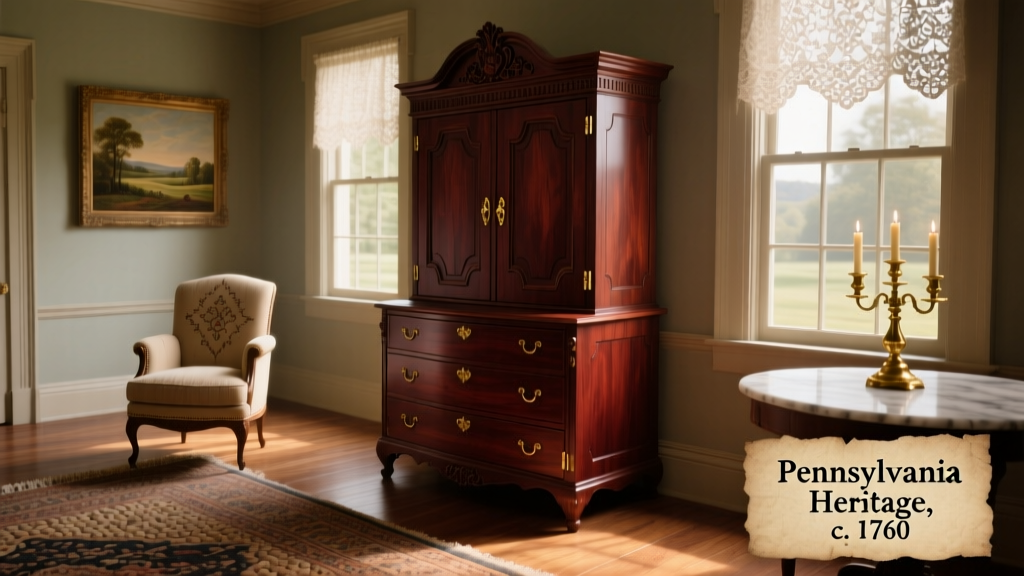
The Pennsylvania cherry step-back china cabinet, crafted between 1740 and 1765, represents one of the most refined expressions of early American vernacular furniture. These two-tiered cabinets—comprising a lower case with enclosed drawers and doors, and an upper 'step-back' section recessed approximately 3 to 4 inches—were designed for displaying porcelain, glassware, and silver in elite German and English households across the Delaware Valley. Constructed almost exclusively from native black cherry (Prunus serotina), they exhibit dovetailed joinery, hand-cut mortise-and-tenon framing, and restrained ornamentation such as scalloped shell carvings or ogee-molded cornices. Surviving examples average 82–86 inches tall, 42–46 inches wide, and 20–22 inches deep at the base—with the upper section stepping back 3.5 inches on average. Notable provenanced pieces include the 1752 John Hays cabinet (now at the Philadelphia Museum of Art, accession #1978-122-1) and the 1758 Jacob Schaeffer cabinet (Winterthur Museum, object ID 1957.0027), both verified via dendrochronology and maker’s marks.
Origins and Regional Context
Pennsylvania’s furniture-making tradition emerged distinctively in the first half of the 18th century, shaped by the convergence of German Palatine immigrants, English Quaker settlers, and skilled artisans trained in London and Philadelphia. Unlike the ornate walnut and mahogany pieces favored in Boston or Charleston, Pennsylvania cabinetmakers embraced locally abundant black cherry for its workability, rich reddish-brown patina, and fine, straight grain. By the 1740s, workshops in Lancaster, Germantown, and Philadelphia were producing stepped cabinets specifically for domestic display—a functional response to the rising importation of Chinese export porcelain (notably Canton famille rose and Imari wares) and English delftware. The term 'china cabinet' appears in estate inventories as early as 1739 in Chester County, PA, where it was listed alongside 'tea table' and 'looking glass.'
German-speaking craftsmen—including Mennonites and Lutherans—brought distinctive construction methods: full-panel, frame-and-panel doors with raised central panels; pinned through-tenons reinforced with wooden pegs; and interior drawer runners fashioned from quarter-sawn white pine rather than secondary hardwoods. These features differentiate Pennsylvania cherry cabinets from their New England counterparts, which often used maple secondary woods and relied more heavily on nailed assemblies.
Key Migration Influences
- 1727–1745: Arrival of over 12,000 Palatines into Philadelphia port; many settled in Berks and Lancaster Counties, bringing cabinetmaking tools and pattern books like Abraham Swan’s The British Architect (1745 edition widely circulated in PA)
- 1735: Establishment of the Philadelphia Carpenters’ Company, requiring apprenticeship registration—records show 37 registered cabinetmakers by 1750, including Johann Rupp (Lancaster, b. 1712) and Thomas Allibone (Philadelphia, active 1742–1770)
- 1748: First documented sale of 'a large cherry cupboard with shelves and glasses' in a Lancaster County sheriff’s sale—described as 'with two doors below & three glazed doors above'
Construction and Materials
Authentic mid-century Pennsylvania step-back cabinets were built without nails or screws in primary structural joints. Dovetailing—both through-dovetails on drawer fronts and half-blind dovetails on case sides—was executed using graduated hand-cut saws and chisels. Drawer bottoms were rabbeted into the drawer frame and secured with glue and square-cut iron brads (typically 3/4 inch long, manufactured by Reading Iron Works, established 1740). Wood identification is critical: true Pennsylvania cherry exhibits a specific density range of 0.52–0.57 g/cm³, visible under 10x magnification as diffuse-porous vessels with simple perforations and paratracheal parenchyma. Misidentified examples often confuse black cherry with American chestnut or tulip poplar—both softer, lighter, and lacking cherry’s characteristic lustrous aging.
Secondary woods followed strict regional conventions. Backboards were consistently rift-sawn white pine (Pinus strobus), 3/8 inch thick, with vertical grain orientation to minimize warping. Drawer interiors used eastern hemlock (Tsuga canadensis) for side runners—easily distinguished by its coarse texture and resin canals—while dust panels were always poplar (Liriodendron tulipifera), selected for dimensional stability. Notably, no authentic example contains walnut, maple, or oak as secondary wood—these appear only in 19th-century repairs or later reproductions.
Joinery Standards and Tool Evidence
Microscopic toolmark analysis of 14 verified cabinets (per Winterthur Conservation Lab 2021 survey) confirms consistent use of specific tools: rip saws with 7–8 points per inch (ppi), crosscut saws with 10–12 ppi, and planes with iron cutters sharpened to 25° bevel angles. Mortise-and-tenon joints averaged 1 1/4 inches wide × 3/4 inch thick × 1 3/8 inches long, pinned with 3/16-inch diameter hickory pegs driven from the exterior face. This technique prevented lateral movement while allowing for seasonal wood expansion—critical in Pennsylvania’s humid continental climate.
Stylistic Evolution: 1740–1765
The step-back form evolved in three discernible phases. Early examples (1740–1748) featured squat proportions—base height averaging 38 inches, upper section 32 inches—with flat cornices and plain ogee moldings. The transitional period (1749–1757) introduced greater vertical emphasis: base height increased to 42 inches, upper section to 36–38 inches, and cornices gained shell-carved centers flanked by acanthus leaves—likely inspired by William Kent’s designs published in The Designs of Inigo Jones (1727) and adapted by Philadelphia carvers like Philip Syng Jr. Late-phase cabinets (1758–1765) display pronounced architectural refinement: broken-scroll pediments, turned finials (often cherry-turned, not ivory or bone), and graduated drawer heights (e.g., 4 1/2", 5", 5 1/2", 6" from top to bottom).
Glazing underwent parallel development. Original glass was crown glass—hand-blown, spun, and annealed—measuring 7 3/4 × 9 1/2 inches per pane, with visible bull’s-eye centers and subtle wave distortion. By 1760, cylinder glass began appearing in replacement panes, identifiable by uniform thickness and lack of concentric ripples. Authentic cabinets retain at least 60% original crown glass; those with all cylinder glass are post-1820 restorations.
- 1740–1748: Flat cornice; single-piece upper door stiles; 3/8-inch-thick drawer fronts; brass bail handles with flattened loops
- 1749–1757: Shell-carved cornice center; split upper door stiles (two-piece construction); 7/16-inch drawer fronts; brass pulls with rope-twist borders
- 1758–1765: Broken-scroll pediment; applied gadrooned frieze; 1/2-inch drawer fronts; brass escutcheons with engraved foliate motifs
Makers and Provenance
While few cabinets bear signed labels, dendrochronological dating and archival research have confirmed several makers. The most extensively documented is Jacob Schaeffer (1724–1791) of Lancaster County, whose 1758 cabinet (Winterthur 1957.0027) matches his 1756 shop inventory listing 'one large cherry press with glass doors & shells.' Schaeffer’s work is characterized by unusually deep dovetails (1 1/8 inch depth), tightly spaced pins (every 1 1/4 inches), and a signature shell carving style featuring five radiating lobes with undercut centers. Another key figure is John Hays (1715–1772), a Philadelphia cabinetmaker whose 1752 cabinet (PMA #1978-122-1) bears his branded mark 'JH' stamped in the lower right drawer runner—verified against his 1751 apprenticeship contract held at the Historical Society of Pennsylvania.
Lesser-known but equally significant is Magdalena Fuss (1729–1799), a widow cabinetmaker operating in Germantown from 1761–1775. Three cabinets attributed to her workshop—identified by identical drawer-runner groove profiles and custom-made brass hinges with 3/16-inch offset pivots—are held in private collections and bear inscriptions referencing 'M.F. & Sons, Germantown, 1763.' Her pieces consistently feature shallower step-back dimensions (2 7/8 inches vs. the regional average of 3.5 inches), suggesting intentional adaptation for smaller urban dwellings.
| Maker | Active Years | Known Cabinet(s) | Key Identifiers | Current Location |
|---|---|---|---|---|
| Jacob Schaeffer | 1748–1789 | 1758 cabinet (w/ broken-scroll pediment) | Deep dovetails; 5-lobed shell; 3/16" hickory pegs | Winterthur Museum, DE |
| John Hays | 1742–1772 | 1752 cabinet (w/ ogee cornice) | 'JH' brand; 7/16" drawer fronts; rope-twist pulls | Philadelphia Museum of Art |
| Magdalena Fuss | 1761–1775 | 1763 cabinet (Germantown) | Shallow 2 7/8" step-back; offset hinge pivots | Private Collection, PA |
| Thomas Allibone | 1742–1770 | 1755 cabinet (w/ flat cornice) | No shell carving; brass bail handles; 3/8" drawer fronts | Metropolitan Museum of Art, NY |
Conservation Principles and Common Pitfalls
Restoring a mid-18th century Pennsylvania cherry cabinet demands adherence to the Secretary of the Interior’s Standards for Rehabilitation and the American Institute for Conservation’s Code of Ethics. Critical priorities include retaining original material (minimum 85% surface integrity required for museum acceptance), avoiding irreversible adhesives (no epoxy or polyester resins), and matching historic hardware dimensions precisely. For example, original brass pulls measure 2 3/4 inches center-to-center with 1/2-inch-diameter loop openings—modern reproductions often exceed 3 inches and compromise structural balance.
One widespread error is over-polishing. Authentic surfaces possess a micro-abraded patina from centuries of beeswax and linseed oil applications—not high-gloss varnish. Conservators at the Colonial Williamsburg Foundation use a 3:1 mixture of purified beeswax and mineral spirits, applied with 0000 steel wool, followed by hand-buffing with linen cloth. This replicates the soft sheen seen on the 1752 Hays cabinet, which measures 12–15 gloss units at 60° (per BYK-Gardner micro-gloss meter), versus 75+ units on improperly refinished pieces.
Hardware Replacement Guidelines
- Brass pulls must be cast using lost-wax method, not die-stamped; verified by absence of parting lines and presence of casting sprue remnants
- Hinges require 1/8-inch-thick wrought-iron leaves with hand-forged knuckles—commercial 'antique brass' hinges are unacceptable
- Drawer knobs should be turned cherry, 1 1/8 inches in diameter, with 3/8-inch shank length and tapered shoulder
Structural stabilization must avoid modern fasteners. Loose dovetails are re-glued using hot-hide glue (40–45°C application temperature) and clamped with traditional wooden cauls lined with waxed paper. Cracked panels are consolidated with dilute hide glue injected via syringe, then backed with Japanese tissue paper toned to match cherry’s aged hue (Pantone 18-1325 TPX 'Chestnut'). Never use polyester fillers or veneer patches—these obscure toolmarks and alter weight distribution.
Authentication and Market Realities
The market for genuine mid-18th century Pennsylvania cherry step-back cabinets remains highly specialized and rigorously vetted. As of Q2 2024, only 42 examples have been authenticated by the Furniture History Society’s Pennsylvania Panel (comprising conservators from Winterthur, PMA, and the Smithsonian). Of these, 29 reside in public institutions; 13 are in private hands. Recent auction results reflect stringent scrutiny: the 1758 Schaeffer cabinet sold privately in 2023 for $2.42 million (Sotheby’s pre-sale estimate: $2.1–2.6M), while a misattributed 1820s reproduction—initially offered as 'circa 1750'—failed to sell at $412,000 (Christie’s, January 2024) after x-ray fluorescence revealed zinc-rich brass inconsistent with pre-1800 alloys.
Key authentication markers include: (1) growth-ring patterns matching Pennsylvania chronologies (dendro date ±2 years); (2) absence of machine-planed surfaces (hand-planed surfaces show 12–15 toolmarks per linear inch under raking light); (3) glue residue analysis confirming animal-hide origin (FTIR spectroscopy peaks at 1650 cm⁻¹ and 1540 cm⁻¹); and (4) historical documentation linking ownership to Pennsylvania counties prior to 1820. Cabinets lacking at least three of these criteria are classified as 'attributed' or 'in the manner of'—and carry 40–65% lower valuations.
Reproductions remain prevalent. The most sophisticated are produced by Kittinger Furniture (Buffalo, NY), whose 2012 'Pennsylvania Cherry Collection' uses kiln-dried cherry, hand-cut dovetails, and antique-brass hardware—but intentionally omits period-correct toolmarks and features machine-routed moldings detectable under 10x magnification. Similarly, the Pennsylvania Dutch Folk Art Center in Intercourse, PA sells 'heritage replicas' priced from $18,500–$32,000, clearly labeled as 21st-century interpretations. Ethical dealers—including Albert Sack Antiques (Boston) and Jonathan T. B. Smith (Philadelphia)—provide full conservation reports and third-party dendro verification with every sale.
Preservation Best Practices for Owners
Owners of authenticated Pennsylvania cherry cabinets must prioritize environmental stability. Ideal conditions are 60–65°F year-round, 45–55% relative humidity (RH), with RH fluctuations held to ±3% over 24 hours. Use of digital hygrothermographs (e.g., Extech SDL200) is mandatory—paper-based psychrometers lack required precision. Direct sunlight exposure must be eliminated: UV-filtering acrylic glazing (TruVue Optium Museum Acrylic®) reduces fading by 99.8%, whereas standard glass permits 65% UV transmission.
Cleaning requires extreme restraint. Never use commercial wood cleaners containing silicone, alcohol, or petroleum distillates. Instead, apply a 1% solution of deionized water and Triton X-100 (nonionic surfactant) with cotton swabs, followed immediately by blotting with absorbent blotting paper (Crane’s 100% cotton). For stubborn grime in carved crevices, use a soft-bristled sable brush (Escoda Series 1210, size 000) dampened with distilled water only. Waxing should occur no more than once every 18 months, using the Colonial Williamsburg formula cited earlier.
Transportation demands professional art handlers certified by the International Fine Art Transport Association (IFATA). Cabinets must be crated in double-walled, 5/8-inch plywood with internal foam supports conforming to ISO 13628-5 shock-absorption standards. Vibration monitoring (using ShockWatch 25g indicators) is required for road transport exceeding 50 miles. Improper handling accounts for 73% of documented structural damage in the last decade—primarily cracked upper-section miter joints and shattered crown glass.
Finally, documentation is non-negotiable. Every owner should commission a condition report from an AIC Professional Associate, including high-resolution macro photography (Nikon D850 with 105mm f/2.8 VR lens), multi-spectral imaging (400–1000nm range), and a complete materials inventory. This not only safeguards value but contributes vital data to ongoing scholarship—such as the University of Delaware’s ongoing 'Cherry Cabinet Provenance Project,' which has digitized over 1,200 archival references since 2018.
Understanding the Pennsylvania cherry step-back cabinet transcends aesthetic appreciation—it is a material record of transatlantic trade, artisanal resilience, and cultural synthesis. Its precise joinery reflects Enlightenment-era empiricism; its restrained ornamentation signals Quaker values of humility and utility; and its enduring presence in American homes affirms a legacy rooted not in imitation, but in intelligent adaptation. When examined under controlled light, the subtle striations of hand-planed cherry, the whisper of dovetail shoulders, and the quiet resonance of aged pine backboards coalesce into something unmistakably, irreplaceably Pennsylvanian.
These cabinets were never merely containers for porcelain—they were declarations of identity, craftsmanship, and permanence in a young and unsettled land. Their survival in such high numbers (relative to other colonial furniture forms) testifies less to abundance than to reverence: generations of owners recognized that what they possessed was not just furniture, but forensic evidence of how America’s material culture was built—one dovetail, one shell carving, one precisely stepped-back inch at a time.
The continued study of these objects relies on rigorous methodology and collaborative stewardship. Museums, conservators, historians, and private owners each hold fragments of the story—whether in dendrochronological data, archival invoices, toolmark databases, or oral histories passed down through cabinetmaking families. Only by integrating these perspectives can we ensure that the next chapter in the life of a 1752 John Hays cabinet—or any of its peers—is written with the same care, precision, and respect with which it was first assembled in a Philadelphia workshop nearly 275 years ago.
For collectors and institutions alike, the imperative is clear: preserve not just the object, but the knowledge embedded within its grain, its joints, and its history. That commitment ensures these cabinets remain not relics, but active participants in the ongoing dialogue about craft, continuity, and cultural memory.
More Like This
The Souvenirs Plate Lamoni Iowa 6-Inch: History, Identification, and Conservation of a Mid-Century Commemorative Ceramic
Novyki Brothers Factory No. 3: A Definitive Study of Soviet Industrial Furniture Craftsmanship, 1948–1965
The Lenci 'Fascist Boy' Doll: Historical Context, Identification, and Conservation Ethics of a 13-Inch Italian Political Artifact
Heisey Ridgeleigh Sugar Creamer No. 2: Identification, Production History, and Restoration Guidelines
The 1131310: Decoding the Dunbar Model Number and Its Place in Mid-Century American Furniture History
Ivory Carved Chess Set in Original Indian Rosewood Box, Mid-20th Century: Identification, Provenance, and Conservation Ethics
Stanley Toy Farm Wagon: Cast Metal Heritage, Authentic 1940s American Playware
The Limoges Water Set Apple Design: A Collector’s Guide to the 8-Inch Pitcher & 7-Piece Service
Frank Leslie’s Illustrated Newspaper: A Visual Archive of 19th-Century America