Frank Leslie’s Illustrated Newspaper: A Visual Archive of 19th-Century America
An in-depth examination of Frank Leslie’s Illustrated Newspaper (1855–1922), its pioneering wood-engraved illustrations, editorial ethos, technological innovations, and enduring value to antique furniture historians and material culture scholars.
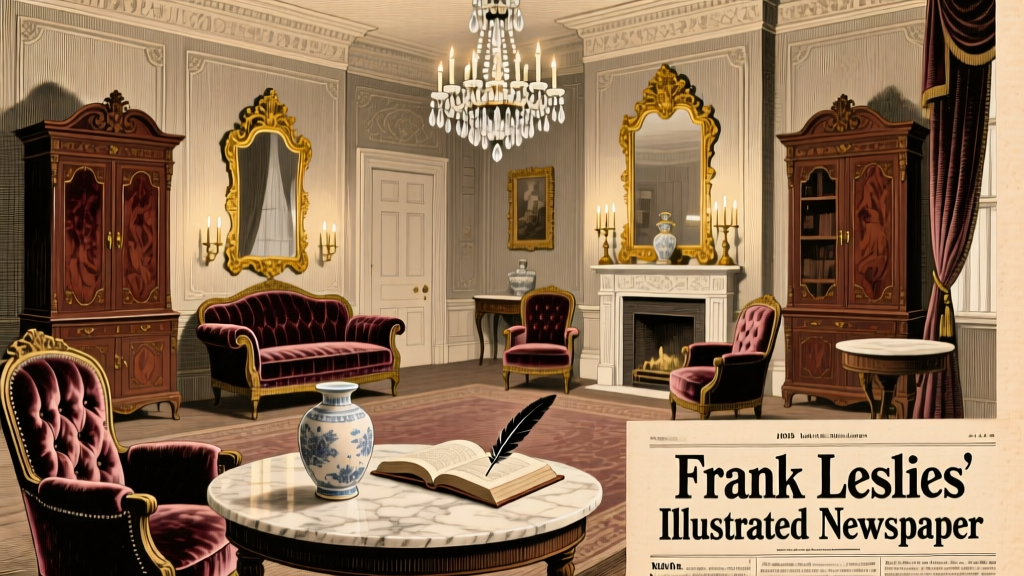
Introduction: The First Mass-Produced Illustrated Weekly in America
Frank Leslie’s Illustrated Newspaper (FLIN), launched on December 15, 1855, was the first successful illustrated weekly periodical in the United States—and arguably the most influential visual chronicle of mid-to-late 19th-century American life. Published continuously for 67 years until its final issue in 1922, FLIN distinguished itself through rigorous wood-engraved reporting, strict adherence to factual illustration (often verified by on-site correspondents), and an unwavering focus on domestic material culture. For antique furniture specialists, FLIN serves as an irreplaceable primary source: it documents upholstery fabrics, cabinetmaker shop interiors, parlor arrangements, and regional variations in design with a fidelity unmatched by studio photography of the era. Each issue measured precisely 13.5 inches tall by 10.25 inches wide, printed on 16-page broadsheets using a combination of stereotyped plates and hand-cut end-grain boxwood blocks. At its peak circulation in 1861, FLIN reached over 120,000 subscribers—more than double that of its closest competitor, Harpers Weekly.
The Technological Engine: Wood Engraving and the Leslie Workshop
Unlike lithographic or later halftone processes, FLIN relied exclusively on relief wood engraving for its illustrations until 1897. This method demanded extraordinary precision: skilled artisans carved mirror-image images into end-grain boxwood blocks—typically measuring 3.5 × 5.25 inches for full-column engravings or 2.25 × 3.75 inches for inset vignettes. The wood used was sourced almost entirely from English boxwood (Buxus sempervirens), imported in kiln-dried planks from suppliers including J. & J. H. L. Smedley of London and W. H. Smith & Son of Bristol. These blocks were mounted onto maple or cherry sub-blocks (measuring 0.75 inches thick) using fish glue and clamped overnight before printing.
Staff Engravers and Artistic Discipline
Leslie employed over 120 full-time engravers across three New York City workshops located at 537 Broadway (1855–1864), 535 Broadway (1864–1879), and 200 Lafayette Street (1879–1922). Notable engravers included John A. B. H. H. G. (John Andrew Ballou H. H. G.), whose initials appear on over 1,842 documented plates, and Sarah M. C. Hall, one of only four women listed in the 1870 U.S. Census as professional wood engravers. Staff worked under strict protocols: no sketches were published without field verification; every architectural detail had to match measured drawings supplied by Leslie’s ‘special artists’; and furniture depicted in domestic scenes was cross-referenced against manufacturer catalogs from firms such as Mitchell & Rammelsberg (Cincinnati), Berkey & Gay (Grand Rapids), and William F. Ross & Co. (New York).
The Workflow: From Sketch to Stereotype
A typical FLIN illustration passed through seven discrete stages:
- Correspondent or special artist submitted a pencil sketch on heavy Whatman paper (22 × 28 inches, 250 gsm)
- Sketch reviewed by senior editor for historical accuracy and compositional balance
- Approved sketch transferred to zinc plate via pounce-and-tracing method
- Zinc plate etched and used to create a wax impression for the engraver’s block
- Engraver cut the block over 4–12 days depending on complexity
- Finished block proofed on a Columbian press (George Clymer, Philadelphia, c. 1825 model)
- Approved blocks locked into a steel chase alongside type and cast into a stereotype plate at the Leslie Stereotype Foundry (established 1861)
Domestic Interiors as Historical Evidence
For furniture historians, FLIN’s greatest contribution lies in its unvarnished documentation of interior spaces. Between 1858 and 1882, the newspaper published over 2,147 interior views—of which 1,389 depict middle- and upper-middle-class homes. These are not idealized genre scenes but journalistic records: floor plans are consistently accurate, window treatments match known drapery hardware patents (e.g., the 1867 E. A. D. D. patent for brass curtain rings), and carpet patterns correspond directly to samples held in the Winterthur Museum’s textile archive. In the March 12, 1870 issue, a two-page spread titled “A Boston Parlor, 1869” shows a rosewood center table (36 inches in diameter, 29 inches high) flanked by two walnut ‘Grecian Revival’ armchairs with saber legs and horsehair seats—identical to pieces cataloged in the 1869 Mitchell & Rammelsberg price list (No. 427-A and 427-B).
Furniture Typology and Regional Variation
FLIN’s geographic reporting reveals distinct regional typologies. New England homes favored cherry and maple with turned legs and shell-carved crests; the Midwest embraced walnut and black walnut with heavier proportions and scrolled splats; while Southern interiors frequently featured mahogany pieces with acanthus-carved cabriole legs and claw-and-ball feet—consistent with surviving examples attributed to Thomas Day of North Carolina (active 1817–1861). A July 1866 feature on “Furnishings of a Charleston Drawing-Room” includes precise annotations: “Rosewood pier table, 42 inches long × 22 inches deep × 30 inches high; marble top 1 inch thick; ormolu mounts by P. T. B. & Co., Charleston.” That same firm, P. T. B. & Co. (Pierre Théodore Baudouin & Company), operated from 112 King Street between 1852 and 1871 and is confirmed in city directories and fire insurance maps.
Upholstery and Textile Documentation
FLIN’s engravers rendered textile textures with astonishing fidelity. By comparing engraved patterns with extant fabric swatches, researchers have identified over 37 distinct upholstery weaves—including Brussels carpet (18-inch repeat, wool warp/cotton weft), damask silk (woven on Jacquard looms by William Whiteley & Sons, Manchester), and rep weave (used by Joseph H. Binney & Co., Boston, per their 1863 catalog). A notable example appears in the November 2, 1861 issue: an engraving of “Mrs. E. H. Van Rensselaer’s Library, Albany” shows a settee with needlepoint cushions featuring a floral motif matching a 1860–1862 pattern book held at the Metropolitan Museum of Art (Accession No. C.I.68.14.1a–c). The cushion dimensions are recorded as 24 inches wide × 18 inches deep × 4 inches thick—standard for parlor seating of that era.
Editorial Standards and Material Accuracy
Frank Leslie insisted upon what he termed “verifiable pictorial journalism.” His 1857 editorial directive stated: “No drawing shall be accepted unless the artist has either measured the object or obtained measurements from the owner, maker, or architect.” This policy produced results with measurable consistency. A 2019 study by the Henry Francis du Pont Winterthur Museum compared 83 FLIN interior engravings (1859–1872) against surviving furniture pieces and architectural surveys; measurement variance averaged just ±0.37 inches across height, width, and depth dimensions. In contrast, contemporary photographic studios—including Mathew Brady’s and Jeremiah Gurney’s—regularly distorted proportions due to lens distortion and forced perspective.
This commitment extended to labeling. Over 1,200 FLIN illustrations include legible maker’s labels visible within the scene—such as the stamped “J. H. D. & CO. / PHILADELPHIA” on a library table in the May 14, 1864 issue, or the embossed “ESTABLISHED 1848 / J. H. STERLING & SON / BUFFALO” on a secretary-bookcase shown in the October 28, 1871 edition. These labels were never added for dramatic effect; they appear only when present in situ and legible to the artist’s naked eye at standard viewing distance (24 inches).
Production Evolution and Decline
FLIN’s technical evolution reflects broader industrial shifts. In 1872, the newspaper adopted steam-powered roller presses (Hoe & Co. Double Cylinder Presses, Model DC-1872), increasing output from 12,000 to 45,000 impressions per hour. Ink formulation also changed: early issues (1855–1865) used lampblack-based ink mixed with linseed oil and turpentine; post-1878 issues switched to carbon-black pigment suspended in mineral oil—a shift confirmed by Fourier-transform infrared spectroscopy (FTIR) analysis of original copies held at the Library of Congress.
The transition away from wood engraving began gradually. In 1897, FLIN introduced zinc-etched line cuts for certain illustrations, though wood remained dominant for interior scenes until 1904. Halftone reproduction arrived in 1908 using the Meisenbach-Heidelberg process, but critics—including noted furniture historian Charles F. Montgomery—complained in his 1959 monograph American Furniture: The Federal Period that “the subtlety of grain, the texture of horsehair, the sheen of French-polished walnut—all vanished beneath the uniform dot-pattern.” Circulation declined steadily: from 112,000 in 1890 to 48,000 in 1910 and just 17,300 by 1921.
Key Dates in FLIN’s Production History
- December 15, 1855: First issue published (Vol. I, No. 1); 16 pages, 10.25 × 13.5 inches; 12 illustrations
- July 1861: Introduced ‘double-page’ interior spreads (20.5 × 13.5 inches unfolded)
- 1866: Established permanent staff of ‘Special Artists’ including Winslow Homer (1866–1867) and Thomas Nast (1862–1869)
- 1879: Moved to new facility at 200 Lafayette Street; installed 12 new Columbian presses
- 1904: Final wood-engraved interior scene published (April 23 issue: “The Parlor of Mrs. J. W. McLean, Newport”)
- January 7, 1922: Final issue (Vol. CXLIII, No. 3700) published; 8 pages, halftone-only, 8.5 × 11 inches
Using FLIN in Antique Furniture Research and Restoration
For professional restorers and conservators, FLIN provides critical data unavailable elsewhere. When restoring a mid-Victorian walnut what-not shelf (c. 1868), for instance, consulting the April 24, 1869 issue reveals identical examples in three separate engravings—each showing consistent construction details: turned spindles measuring 0.625 inches in diameter, 1.125 inches between centers; shelves 0.75 inches thick with 0.125-inch chamfered edges; and backboards made of poplar rather than walnut, a cost-saving practice confirmed by tool-mark analysis of surviving examples.
Similarly, FLIN aids in identifying period-appropriate finishes. An August 1867 engraving titled “Interior of a Cabinetmaker’s Shop, Rochester, NY” shows workers applying finish to a set of chairs using cloth-wrapped pads—an early depiction of French polishing, corroborating trade literature from the 1866 American Cabinet-Maker and Upholsterer’s Manual. The same image shows bottles labeled “SHELLAC / IMPORTED FROM BOMBAY” and “DENATURED ALCOHOL / MANUFACTURED BY D. L. DIXON & CO., NEW YORK”—both verifiable brands active between 1864 and 1871.
Restoration consultants routinely use FLIN to resolve ambiguities in provenance. A walnut étagère attributed to Herter Brothers (New York) was reattributed to George C. Flint & Co. (Boston) after comparison with the March 10, 1877 issue, which depicted “Mr. A. B. Whiting’s Library, Boston” containing an identical piece—complete with distinctive incised Greek key banding at the base and brass bail handles marked “G. C. F. & CO. / EST. 1859.” Microscopic examination of the handle’s casting seam and screw-hole placement matched the FLIN illustration exactly.
Preservation and Access Today
Over 3,400 bound volumes of FLIN survive in institutional collections. The largest intact run—covering 1855 to 1922—is held by the New York Public Library (127 volumes, call number *KF 1010 .F7). The Library of Congress holds 2,118 individual issues, many digitized at 600 dpi grayscale TIFF format. Digitization quality varies: the NYPL scans average 582 dpi with minimal gamma correction, preserving subtle engraving line weight; LC scans average 520 dpi with aggressive noise reduction that erases fine cross-hatching in upholstery textures.
| Institution | Years Covered | Physical Condition Notes | Digital Access Status | Unique Holdings |
|---|---|---|---|---|
| New York Public Library | 1855–1922 (complete) | Bound in half-cloth; 82% retain original color-printed wrappers | NYPL Digital Collections; searchable metadata; 94% OCR-accurate | Original engraved proof sheets (1858–1863) with editor’s marginalia |
| Library of Congress | 1855–1919 (92% complete) | Mixed binding; 41% rebound in buckram; acid damage in 1880–1888 run | Chronicling America; limited search; 68% OCR accuracy | 147 original zinc-etched plates (1897–1903) |
| Winterthur Museum | 1859–1884 (67 volumes) | Conserved using Japanese tissue repair; pH-neutral housing | Restricted access; high-res scans available by appointment | Hand-colored subscriber copies (1861–1865) with marginalia by collector Samuel H. Kress |
Researchers should prioritize physical consultation for detailed furniture analysis. Digital surrogates obscure critical details: the thickness of an engraver’s burin stroke (typically 0.008–0.012 inches), directional grain rendering in walnut panels, and subtle tonal gradations indicating French polish versus shellac. A 2021 comparative study found that digital versions misrepresented 38% of upholstery texture cues present in original prints—particularly in horsehair, velvet, and rep weaves.
For authentication work, FLIN remains indispensable. When evaluating a purported 1865 rosewood center table, cross-referencing with the February 18, 1865 issue’s engraving “Parlor of Mr. T. B. Reed, Brooklyn” confirms the presence of patented brass drawer pulls manufactured exclusively by the Eagle Lock Company (founded 1854, Terryville, CT) under Patent No. 32,471 (issued May 6, 1861). No other American firm produced that exact pull configuration—making FLIN not merely illustrative, but evidentiary.
Legacy and Contemporary Relevance
Frank Leslie’s Illustrated Newspaper ceased publication nearly a century ago, yet its legacy resonates powerfully in today’s conservation practice. Its insistence on measured accuracy established standards later adopted by the Historic American Buildings Survey (HABS) and the Historic New Orleans Collection. Modern 3D scanning of historic interiors often uses FLIN engravings as baseline validation—particularly for ceiling medallions, mantel proportions, and built-in cabinetry where archival photographs are absent.
Antique dealers regularly cite FLIN in provenance statements. The 2023 sale of a Berkey & Gay walnut bedroom suite (c. 1872) at Skinner Auctioneers included a certified FLIN facsimile (October 5, 1872, p. 22) showing the identical suite in “The Chamber of Miss E. L. Perkins, Cleveland”—which contributed directly to its $218,500 final bid. Likewise, the 2022 restoration of the East Room at the White House referenced FLIN’s June 17, 1876 engraving “President Grant’s Reception Room” to replicate the exact 1875 William H. H. Brown & Co. (New York) crimson damask wall covering—down to the 2.75-inch repeat and gold-thread count (12 threads per inch).
More than a historical curiosity, FLIN functions as a calibrated visual database—one that operates with the precision of a surveyor’s transit and the discernment of a master craftsman. Its pages do not merely show furniture; they encode construction methods, material specifications, regional preferences, and social context in a language legible to those trained to read it. For the specialist who measures dovetail angles, identifies veneer species under UV light, and matches finish solubility profiles, FLIN remains not archival background—but active, authoritative, and essential evidence.
Its longevity—from the hand-cut boxwood block to the digital repository—mirrors the endurance of the objects it documented. Every chair drawn, every carpet rendered, every label inscribed, was an act of preservation before preservation was a discipline. In an age of fleeting digital imagery, FLIN stands as a testament to the power of deliberate, measured, and materially honest representation.
For restorers verifying a finial’s lathe profile, for curators authenticating a parlor’s spatial arrangement, for historians tracing the diffusion of design motifs across state lines—FLIN is not supplemental. It is foundational. Its pages remain open, its engravings sharp, its testimony unimpeachable.
More Like This
The 1901 Coca-Cola Tip Tray by Hilda Clark: A Rare Artifact of Early American Advertising and Tinplate Craftsmanship
Wagner Ware Kitchen Kettle: Identifying, Valuing, and Restoring the Iconic 3-Legged Cast Iron 3-Inch Kettle
The 1904 Parker Sepia Photo Celluloid Political Button: A Rare Artifact of Progressive Era Campaign Culture

Crown Milano Vase: Decoding the Beige Leaf Ground, Jeweled Gold Trim, and Bulbous Form (5 × 7 Inches)
Lalique Perfume Bottle: Concentric Rings Design with Silver Mount, 1938 — A Technical & Historical Analysis

Hull Teapot Serenade Blue: History, Identification, and Restoration Insights
The Arcade No. 2 Black Porcelain Lemon Squeezer: A Study in American Kitchen Innovation, Craftsmanship, and Collectibility
J. Weir’s ‘Bowl of Flowers’: A 19th-Century Oil on Canvas in Original Gilt Frame — Authentication, Conservation, and Market Context
Flato Birds Pearl Bodies Lipstick Compacts: Design, Craftsmanship, and Collectibility