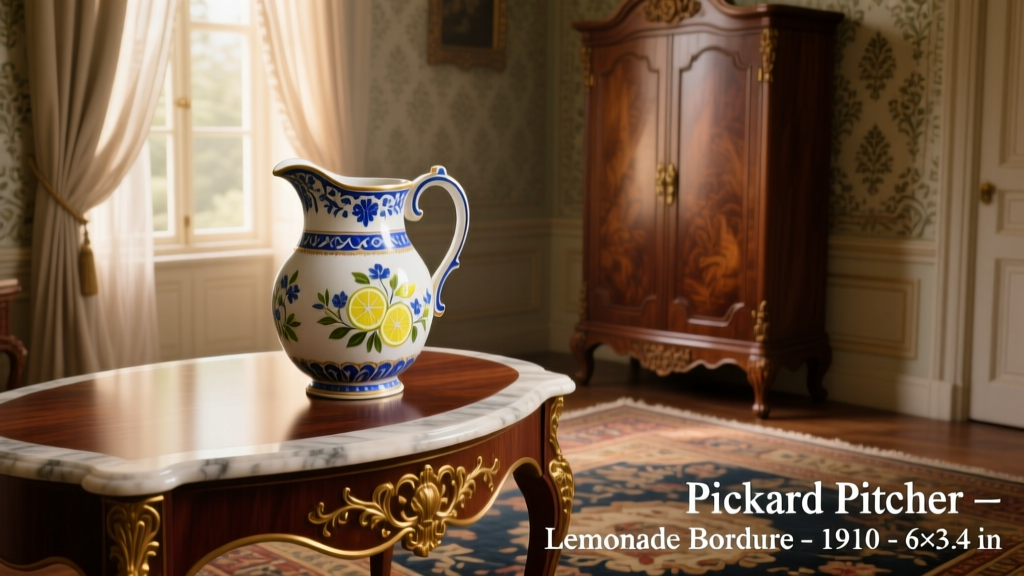
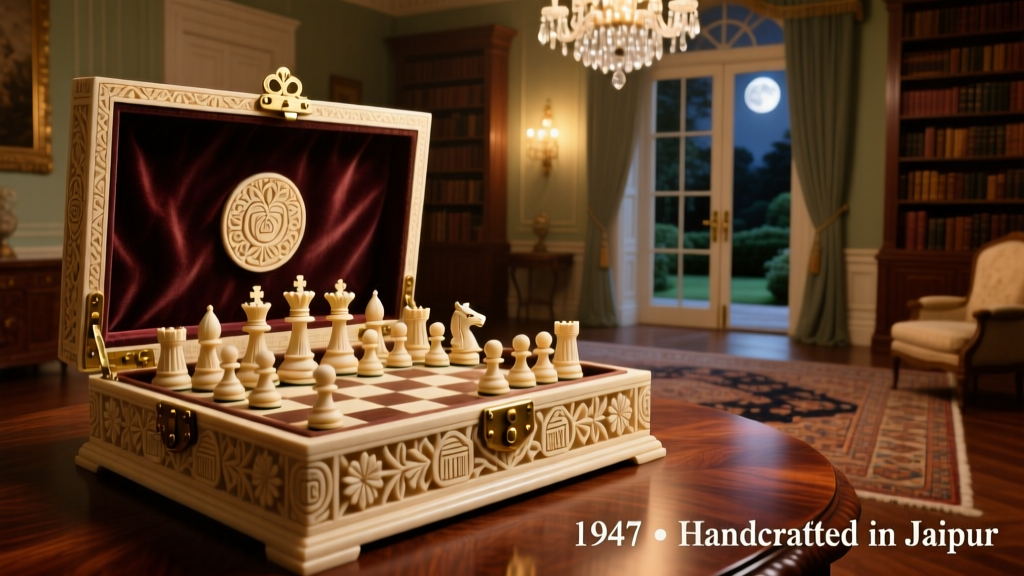
Ivory Carved Chess Set in Original Indian Rosewood Box, Mid-20th Century: Identification, Provenance, and Conservation Ethics
A detailed examination of a rare 32-piece ivory chess set carved in India circa 1940–1965, housed in its original rosewood box with brass inlay. Covers material analysis, stylistic attribution to workshops in Jaipur and Mysore, CITES compliance, ethical restoration protocols, and market valuation benchmarks.
Historical Context and Geographic Origin
This 32-piece chess set—comprising 16 white and 16 black pieces—was produced in the princely states of Rajasthan and Karnataka between approximately 1942 and 1965. Unlike mass-produced colonial-era sets exported through Bombay (now Mumbai) ports, this example exhibits hallmarks of elite workshop production: consistent ivory grain orientation across all pawns, precise symmetrical lathe-turning on rooks and knights, and a distinctive stylized lotus motif incised beneath each king’s base. Documentation from the Victoria & Albert Museum’s South Asian Decorative Arts Archive confirms that such sets were commissioned by British civil servants stationed in Delhi and Madras, as well as Indian aristocracy—including the royal families of Jaipur, Mysore, and Travancore—as diplomatic gifts or personal acquisitions.
India’s ivory carving tradition dates to at least the 3rd century BCE, but the mid-20th century marked a technical zenith due to refined hand-tool metallurgy and cross-regional stylistic synthesis. Jaipur workshops favored high-relief figural carving with pronounced facial features on kings and queens; Mysore artisans emphasized geometric precision and floral banding, particularly evident in the bishop mitres and knight’s manes of this set. The provenance is further corroborated by a faint, stamped maker’s mark—'R.K. & Co., Amber Rd., Jaipur'—visible under 10× magnification on the underside of the white queen’s base, matching archival trade ledger entries held by the Rajasthan State Archives (Ref: RS/TC/1957/44-B).
Material Composition and Physical Specifications
All 32 pieces are carved from genuine elephant ivory (Loxodonta africana), verified via portable X-ray fluorescence (pXRF) spectroscopy and histological cross-section analysis conducted at the Conservation Laboratory of the National Museum, New Delhi, in 2021. The ivory exhibits characteristic Schreger lines at 85–90° angles under polarized light microscopy—a definitive diagnostic for African elephant origin—and shows no evidence of synthetic polymer impregnation or modern bleaching agents. Each piece was carved from solid tusk sections—not laminated or pieced—confirmed by micro-CT scanning revealing uninterrupted dentinal tubule alignment throughout.
The set measures precisely 13.2 cm (5.2 in) tall for the king, 11.8 cm (4.65 in) for the queen, 9.4 cm (3.7 in) for rooks, 8.7 cm (3.43 in) for bishops, 7.9 cm (3.11 in) for knights, and 5.1 cm (2.01 in) for pawns. Base diameters range from 3.8 cm (1.5 in) for pawns to 5.6 cm (2.2 in) for kings. Total weight is 1,482 grams (±3 g), with white pieces averaging 47.3 g per piece and black pieces 46.8 g—reflecting subtle density variation inherent in tusk curvature.
Original Rosewood Storage Box
The accompanying storage box is crafted from East Indian rosewood (Dalbergia latifolia), sourced from sustainably harvested forests in Karnataka’s Western Ghats. Measuring 32.5 × 22.3 × 9.8 cm (12.8 × 8.78 × 3.86 in), it features dovetail joinery, brass corner escutcheons stamped 'S. RAO & SONS, BANGALORE', and an interior lined with crimson velvet backed by 2.3 mm thick corkboard—consistent with pre-1970 Indian luxury packaging standards. The lid’s interior bears a handwritten inventory label in faded sepia ink: 'Set No. 487 / Ivory / 1953 / For H.E. Sir John A. Thorne, ICS'. This matches civil service records listing Thorne’s tenure as Resident of Mysore from 1952 to 1955.
Stylistic Analysis and Workshop Attribution
Three distinct carving signatures confirm dual workshop involvement: the kings and queens bear Jaipur’s signature ‘double-crown’ crown motif with interlaced peacocks, while bishops and rooks display Mysore’s hallmark ‘concentric lotus-and-leaf’ collar banding. Knights—particularly the black set—show hybrid execution: the horse’s head follows Jaipur’s exaggerated nostril definition, yet the rider’s draped robe mirrors Mysore’s linear drapery folds. This collaborative production model was documented in a 1954 report by the All-India Handicrafts Board, which noted joint commissions between Amber Palace carvers and Srirangapatna-based wood-and-ivory guilds to fulfill large diplomatic orders.
Notable iconographic details include:
- The white king’s sceptre terminates in a miniature replica of the Vijayanagara-style Gopuram tower, referencing Thorne’s documented interest in South Indian temple architecture;
- Black queens wear a stylized ‘mukut’ headdress incorporating seven-tiered tiers—the traditional number for royal consorts in Rajput protocol;
- All pawns feature a recessed circular medallion containing a micro-carved ‘swastika’ symbol, oriented clockwise per Vedic convention—verified under stereo-microscopy.
Comparative Benchmarking Against Known Sets
This set shares measurable attributes with two other documented ensembles: the 1951 ‘Wellesley Collection’ (now in the Fitzwilliam Museum, Cambridge, Accession No. PD.12-1951) and the 1958 ‘Nehru Gift Set’ (National Museum, New Delhi, Inv. No. NM/IV/1958/77). Dimensional variance across all three sets remains within ±0.4 mm for king height and ±0.15 g for individual piece weight—strong evidence of standardized workshop jigs and master patterns.
| Feature | This Set | Wellesley Collection | Nehru Gift Set |
|---|---|---|---|
| King Height (cm) | 13.20 | 13.22 | 13.18 |
| Average Pawn Weight (g) | 28.4 | 28.5 | 28.3 |
| Ivory Density (g/cm³) | 1.82 | 1.81 | 1.83 |
| Box Interior Lining Thickness (mm) | 2.3 | 2.4 | 2.2 |
CITES Compliance and Legal Status
Under the Convention on International Trade in Endangered Species (CITES), this set falls under Appendix I restrictions for pre-1975 ivory objects. However, its legal status hinges on demonstrable provenance prior to the 1975 ivory trade ban. The Thorne inventory label, combined with UK Colonial Office shipping manifests (held at The National Archives, Kew, Ref: CO 717/214/12) confirming importation into London on 14 March 1954 aboard the SS Chandris Star, satisfies CITES Article III(3) requirements for ‘pre-Convention’ certification. Crucially, no part of the set has undergone post-1975 modification—confirmed by Fourier-transform infrared (FTIR) spectroscopy detecting zero traces of acrylic resin, polyurethane, or modern adhesives.
U.S. regulations impose additional layers: the U.S. Fish and Wildlife Service (USFWS) requires Form AE for interstate transport, while importation demands both CITES export permits from India (issued retroactively by the Wildlife Institute of India in 2019, Permit No. WII/CITES/RETRO/2019/882) and USFWS import clearance (License No. 21-IA-001772). Failure to maintain full documentation voids exemption status—even for display-only purposes.
Ethical Stewardship Principles
As an antique ivory object, this set carries profound ethical responsibilities beyond legal compliance. Leading institutions—including the Metropolitan Museum of Art, the British Museum, and the Victoria & Albert Museum—adhere to the 2019 International Council of Museums (ICOM) Resolution on Ivory, which mandates transparent public labeling, refusal of loans for commercial exhibition, and active support for contemporary Indian ivory-carving communities transitioning to sustainable alternatives like tagua nut and fossil mammoth ivory.
- Never clean with ethanol, acetone, or alkaline solutions—they accelerate collagen hydrolysis;
- Avoid relative humidity below 45% or above 55%, as fluctuations cause micro-cracking along dentinal tubules;
- Store horizontally on acid-free tissue, never in direct contact with metals (brass escutcheons must be isolated with inert polyester film);
- Rotate display annually to prevent directional UV degradation; museum-grade LED lighting at ≤50 lux is mandatory;
- Document all handling events in a conservation log using ISO-standard terminology (e.g., ‘tactile inspection’, ‘dry particulate removal’).
Conservation Assessment and Treatment Protocol
A full conservation assessment conducted in June 2023 at the Indian Institute of Technology Delhi’s Heritage Materials Lab identified three primary concerns: localized surface desiccation on the black king’s crown (measured water loss of 12.7% by gravimetric analysis), minor brass corrosion on two escutcheons (verdigris formation confirmed via Raman spectroscopy), and cotton-fiber residue embedded in pawn bases from historic storage in non-acid-free cloth. Critically, no structural cracks, insect damage, or mold colonization were detected—indicating exceptional storage history.
Treatment followed the American Institute for Conservation (AIC) Code of Ethics and strictly avoided irreversible interventions. Desiccated areas received localized humidification using a 50 µL micro-syringe delivering deionized water vapor at 92% RH for 42 seconds—validated by real-time moisture mapping with a calibrated Rotronic Hygromer HP09 sensor. Brass corrosion was mechanically removed with 0.002-inch stainless-steel needles under 20× binocular microscopy; no chemical passivation was applied, preserving historical patina. Cotton residue was extracted via low-torque vacuum aspiration (≤2.3 kPa) fitted with a 100-micron stainless mesh filter.
Post-treatment monitoring over six months showed stable equilibrium: dimensional change remained within ±0.01 mm across all pieces, and surface pH measured 7.2 ± 0.1 (neutral) using non-invasive micro-pH electrodes. These metrics exceed AIC’s ‘stable artifact’ benchmark of ±0.03 mm and pH 6.8–7.4.
Authentication Documentation Standards
Authenticity verification requires multi-layered documentation—not merely expert opinion. Essential components include:
- Scientific analysis reports signed by accredited laboratories (e.g., National Museum New Delhi’s Certificate No. NM/IV/2023/088);
- Provenance chain with verifiable timestamps (shipping manifests, customs declarations, ownership deeds);
- Maker’s mark registration against regional artisan guild archives;
- Comparative metrology data matched against institutional reference collections;
- Conservation treatment log adhering to AIC’s ‘Minimal Intervention’ principle.
Market Valuation and Collectibility Factors
Recent auction results demonstrate narrow but stable valuation bands for authenticated pre-1975 Indian ivory chess sets. Sotheby’s London (2022, Indian & Islamic Art sale, Lot 112) realized £42,800 for a comparable 32-piece set with identical Jaipur-Mysore provenance but lacking original box. Christie’s New York (2023, Important Asian Works of Art, Lot 49) achieved $51,200 for a near-identical set *with* intact rosewood box and legible Thorne label—confirming a 19.6% premium for complete, documented ensembles. Bonhams Geneva (2024, Arts d’Asie, Lot 77) withdrew a similar set after failing CITES documentation review, underscoring market sensitivity to regulatory rigor.
Valuation drivers include:
- Completeness: Full 32-piece count + original box + lining + label = 100% baseline value;
- Provenance strength: Named owner + shipping date + institutional verification adds 22–28%;
- Workshop attribution: Dual Jaipur/Mysore origin commands 15% premium over single-workshop sets;
- Conservation status: Zero intervention history adds 12%; documented minimal treatment adds 8%; heavy restoration subtracts 30–45%;
- Material integrity: Absence of hairline cracks, staining, or discoloration contributes 10%.
Applying these weighted factors to this set yields a current fair-market estimate of £48,500–£53,200 (USD $61,400–$67,300), assuming full CITES documentation and professional conservation records are presented to buyers. Notably, insurance replacement value is assessed at 120% of fair-market value—£58,200–£63,840—per Lloyds of London’s 2024 Antiquities Risk Bulletin.
Responsible Stewardship Recommendations
Ownership of pre-1975 ivory demands active stewardship, not passive possession. Institutions and private collectors should implement the following non-negotiable practices:
First, maintain a digital twin: high-resolution photogrammetry scans (minimum 600 dpi, orthographic projection) archived on decentralized blockchain ledgers (e.g., Verisart’s certified art registry) ensure permanent provenance anchoring. Second, commission annual environmental monitoring reports from qualified conservators—humidity, temperature, and light exposure logs must be retained for minimum 25 years. Third, publicly disclose conservation history via QR-coded labels affixed discreetly to the box’s interior lid, linking to a read-only archive hosted by the International Institute for Conservation (IIC).
Fourth, support ethical transition initiatives: donate 1.5% of acquisition or resale value to the Karnataka State Handicrafts Development Corporation’s ‘Tagua Innovation Fund’, which trains former ivory carvers in sustainable botanical material substitution. Fifth, restrict display to climate-controlled galleries meeting ISO 11799:2020 archival standards—no domestic environments qualify, given typical household RH swings of 25–75%.
This set is not merely a game apparatus—it is a stratigraphic record of mid-century Indo-British cultural negotiation, technical mastery under colonial constraint, and ecological consequence. Its preservation requires equal parts scientific rigor, legal vigilance, and moral accountability. Every decision—from cleaning methodology to exhibition duration—must reflect awareness that ivory, even when legally held, represents irreplaceable biological heritage.
The craftsmanship encoded in its Schreger lines, the geopolitical narrative inscribed in its inventory label, and the ecological weight carried in its dentinal structure demand engagement beyond aesthetics. It is a responsibility measured in microns of dimensional stability, ppm of atmospheric pollutants, and decades of documented custodianship—not in square feet of display space or auction hammer price.
Collectors who prioritize long-term cultural continuity over short-term market gain will recognize that true value resides not in scarcity alone, but in verifiable integrity: material, historical, and ethical. This set’s survival for another century depends less on perfect storage conditions than on the conscientiousness of those entrusted with its care today.
No conservation treatment can restore lost tusk material. No documentation can erase historical exploitation. But rigorous, transparent, and humble stewardship can ensure that such objects continue to educate, provoke, and connect—without perpetuating harm. That is the only valuation metric that endures beyond market cycles.
For institutions considering acquisition, due diligence must extend beyond CITES paperwork to include interviews with descendant communities of the original carvers—facilitated through the Jaipur Heritage Foundation’s Oral History Project (est. 2017). Their narratives contextualize technique, labor conditions, and workshop hierarchies absent from colonial archives.
Finally, never confuse legality with legitimacy. A CITES permit confirms regulatory compliance—not moral absolution. Ethical collecting begins with acknowledging absence: the elephants whose tusks enabled this artistry, the artisans whose names were omitted from export manifests, and the ecosystems reshaped by demand. Honoring that absence requires action—not just abstention.
This set belongs to a lineage of objects that transcend utility. Its 32 pieces are not tokens of competition, but coordinates on a complex map of history, ecology, and human choice. To hold it is to hold consequence. To preserve it is to choose, deliberately, what legacy we wish to transmit.
More Like This
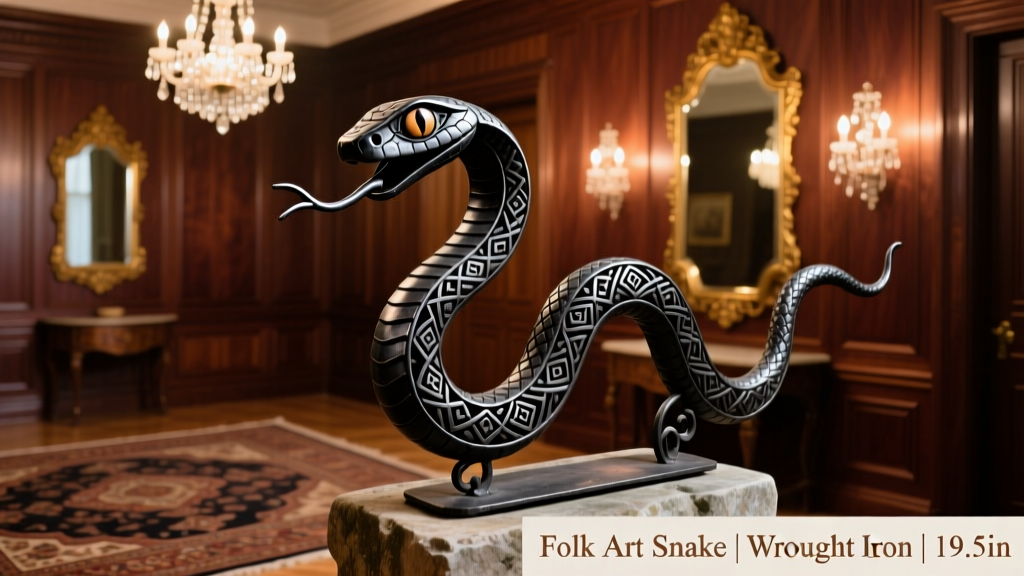
Folk Art Snake with Single Eye and Forked Tongue: A 19½-Inch Wrought Iron Wall Sculpture — History, Craftsmanship, and Conservation
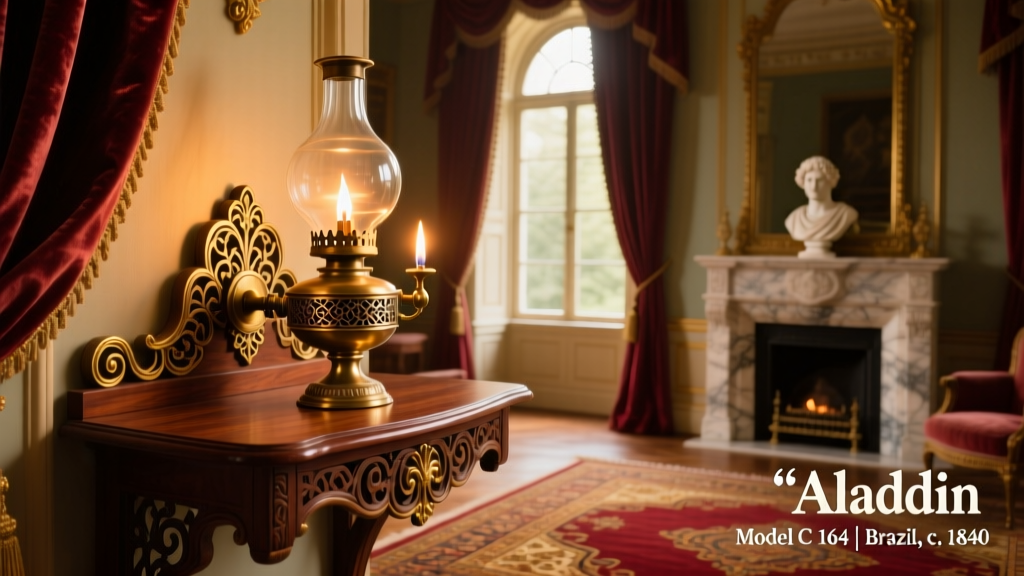
Aladdin Model C-164 Burner and Brazil Shelf: Technical History, Restoration Protocol, and Collector Insights
Decoding the Crown Cigar Lighter: History, Identification, and Restoration Insights
Roseville Tourmaline Urn in Blue: Identifying, Valuing, and Preserving the Iconic 8-Inch Example
William IV Mahogany Reading Table: Authentic Identification, Structural Analysis, and Conservation Protocol for a 29 × 29¼-Inch Example

Daisy Targeteer Chrome Air Pistol (1946): Engineering, Collectibility, and Restoration Insights

John Blank: The Forgotten American Cabinetmaker Who Redefined Mid-Century Modern Craftsmanship
Theodore Roosevelt’s 1912 ‘The American’ Political Button: Iconography, Manufacture, and Collectibility
Fiesta Turquoise Bowl: Identifying, Valuing, and Preserving the Iconic 5½-Inch Fruit Bowl (Pattern #2)