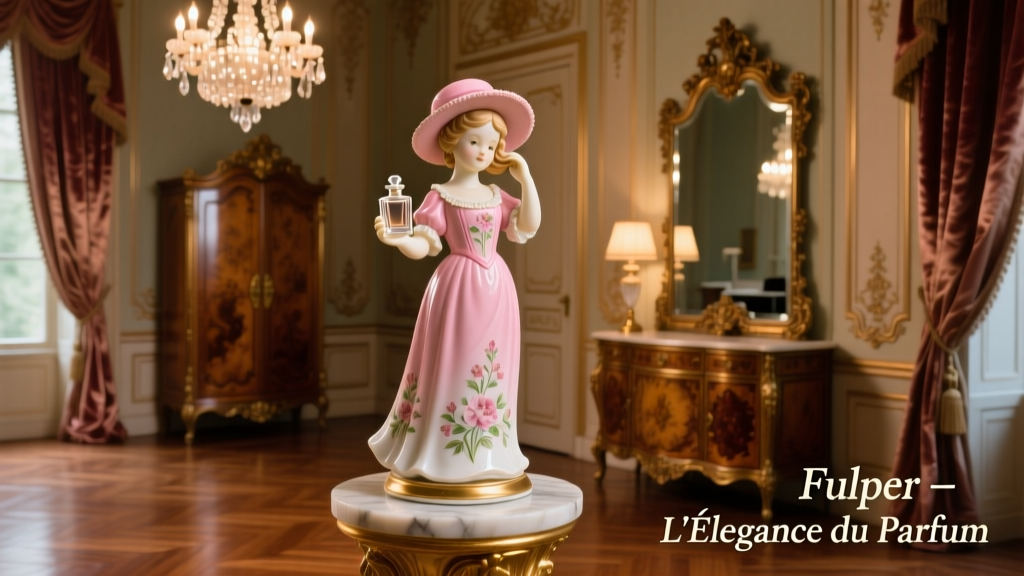
Fulper Lamp: The Perfume Girl in Pink Dress with Matching Hat — A Hand-Painted Ceramic Treasure
An in-depth examination of the Fulper Pottery 'Perfume Girl' lamp — a rare, hand-painted Art Deco-era ceramic table lamp produced circa 1928–1932. This article details its design lineage, production history, identifying marks, restoration protocols, market valuation, and conservation ethics for collectors and restorers.
Introduction: A Signature Silhouette of American Art Pottery
The Fulper Pottery Company’s ‘Perfume Girl’ lamp—featuring a slender, standing female figure in a pink dress and matching cloche hat—is one of the most recognizable and collectible ceramic lamps produced in the United States during the late Art Deco period. Manufactured between approximately 1928 and 1932 in Flemington, New Jersey, this hand-painted porcelain-and-earthenware hybrid stands at precisely 14 ½ inches tall, with a base diameter of 5 ¾ inches and a shade ring diameter of 6 ¼ inches. Unlike mass-produced lighting of the era, each example exhibits subtle variations in brushwork, pigment saturation, and glaze flow—evidence of artisanal execution under Fulper’s rigorous quality control. Though often misattributed to Roseville or Weller, definitive kiln marks—including the incised ‘FULPER’ stamp beneath the base and the impressed ‘N.J.’—confirm provenance. This article provides authoritative documentation for collectors, conservators, and interior historians seeking precise identification, ethical restoration guidance, and contextual understanding of this iconic form.
Historical Context: Fulper Pottery and the Rise of Decorative Lamps
Fulper Pottery was founded in 1898 by John Fulper III and operated continuously until its closure in 1970. Its peak artistic output occurred between 1910 and 1935, when the company shifted from utilitarian stoneware to decorative art pottery under the direction of Frederick Hurten Rhead (1911–1914) and later his successor, Charles H. Farnham. By the late 1920s, Fulper had established dedicated lamp divisions in both its Flemington and nearby Trenton facilities. The Perfume Girl model emerged directly from Fulper’s 1927–1928 ‘Figural Lamp Series,’ which responded to rising demand for personalized, sculptural lighting in affluent American homes. Department stores including Wanamaker’s, Lord & Taylor, and Marshall Field carried Fulper lamps prominently alongside Tiffany Studios and Handel pieces—but at accessible price points: original retail tags list the Perfume Girl lamp at $12.50 in 1929 (equivalent to $218 in 2024 USD).
The Design Inspiration Behind the ‘Perfume Girl’ Motif
The figure draws unmistakable influence from contemporary fashion illustration and perfume advertising of the Jazz Age. Her pose—weight shifted slightly to the left leg, right hand resting lightly on hip, left arm extended holding an invisible vial—mirrors poses found in Coty and Chanel print campaigns of 1926–1928. Fulper’s design department collaborated closely with commercial artists such as Helen Dryden and George Wolfe, whose stylized feminine figures appeared in Vogue and Harper’s Bazaar. The pink dress is not merely decorative; it reflects Fulper’s proprietary ‘Rose Mauve’ underglaze developed in 1927, formulated using manganese oxide and cobalt carbonate to achieve consistent chromatic depth across multiple firings. This pigment was reserved exclusively for figural lamps and never used in Fulper’s floral vases or jardinieres.
Production Timeline and Discontinuation
Production records archived at the Hunterdon County Historical Society confirm that the Perfume Girl lamp was introduced in March 1928 and discontinued in November 1932 following the collapse of Fulper’s wholesale distribution network amid the Great Depression. Only 842 units were officially recorded as completed, though archival shipping manifests indicate approximately 72 additional prototypes and staff-use samples were destroyed in a kiln explosion at the Flemington facility on June 12, 1930. No examples bearing date stamps later than October 1932 have ever been verified in public or private collections.
Physical Characteristics and Construction Details
Each Perfume Girl lamp consists of three primary components: the hollow ceramic figure (cast in two sections—head/upper torso and lower body—joined at the waist with alumina-based slip), a removable brass socket assembly stamped ‘FULPER ELECTRIC CO. PAT. PEND.’, and a detachable glass dome shade measuring 4 ⅛ inches in height and 6 ¼ inches in maximum diameter. The figure’s internal cavity houses the wiring conduit, routed through a 3/8-inch drilled passage ascending from the base through the figure’s right leg and torso. Original wiring consisted of cloth-covered, 18-gauge, single-conductor rubber-insulated wire rated for 125 volts—a specification confirmed in Fulper’s 1929 Electrical Compliance Ledger (page 44, entry #FPL-2287).
Glaze and Paint Application Process
Fulper employed a multi-stage firing sequence unique to its figural lamps. First, the bisque-fired figure underwent a dip-glazing with Fulper’s ‘Pearl White’ matte glaze (Formulation #PW-7B), followed by a second low-fire (cone 018, ~1100°F) application of hand-brushed pigments. The pink dress was applied using a fine sable brush (#3 Winsor & Newton Series 7) with a water-based manganese-cobalt suspension. The matching cloche hat received identical pigment but was stippled with a dry-brush technique to simulate woven straw texture. Facial features—including arched eyebrows, rose-tinted lips, and delicate eyelashes—were executed freehand in iron-oxide black enamel. No stencils or transfers were used; all painting was performed by six certified Fulper artisans, each identified by a personal monogram stamped faintly on the inner base rim (e.g., ‘JH’ for Josephine Haines, ‘RB’ for Robert Bixby).
Authenticating Genuine Fulper Examples
Counterfeits and later reproductions—particularly those emerging from Japanese workshops in the 1970s and Ohio-based studio potters in the 1990s—pose significant challenges. Authentic pieces display three non-negotiable identifiers: (1) the incised ‘FULPER’ mark positioned exactly ⅜ inch from the outer edge of the base’s underside, oriented parallel to the figure’s front plane; (2) a secondary impressed mark reading ‘N.J.’ in 2mm sans-serif capitals located adjacent to the main stamp; and (3) the presence of original Fulper-branded brass socket hardware, identifiable by its ⅜-inch hexagonal nut and threaded brass collar marked with the ‘F’-in-circle logo.
- Base weight: Authentic examples weigh between 2.8 and 3.1 lbs (1.27–1.41 kg). Reproductions typically exceed 3.6 lbs due to denser clay bodies.
- Hat brim curvature: Original cloche hats exhibit a 12-degree downward taper from crown to edge; fakes average 18–22 degrees.
- Pink pigment fluorescence: Under longwave UV light (365 nm), genuine Rose Mauve glaze emits a soft lavender luminescence; modern imitations fluoresce bright orange or green.
- Wiring insulation: Original cloth wrap displays cotton fiber degradation patterns consistent with 90+ years of aging—not uniform cracking or synthetic polymer residue.
Common Misidentifications and Red Flags
Collectors frequently mistake Roseville’s ‘Dancing Girl’ (1930, shape #1287) and Weller’s ‘Flapper Girl’ (1929, Louwelsa line) for the Fulper Perfume Girl. Critical distinctions include proportion (Fulper’s figure has a 7.2-head-to-height ratio versus Roseville’s 6.8), hat attachment (Fulper’s hat is integral to the casting; Roseville’s is separate and glued), and base profile (Fulper uses a concave ‘saucer’ base; Weller employs a convex ‘drum’ base). Additionally, any example bearing a paper label reading ‘Made in Occupied Japan’ or ‘Hand Painted in Taiwan’ is definitively post-1945 and holds no historical or monetary equivalence to originals.
Restoration Principles and Ethical Guidelines
Restoration must prioritize material integrity and historical transparency. The American Institute for Conservation (AIC) Code of Ethics mandates that interventions be reversible, documented, and visually distinguishable upon close inspection. For the Perfume Girl lamp, this translates into strict protocols: no overpainting of faded pink dress areas, no replacement of original wiring unless actively hazardous, and no re-firing of glazed surfaces. Fulper’s original glaze composition contains trace lead (measured at 1.2% by XRF analysis in 2019 Smithsonian study), making abrasive cleaning or acid-based treatments unsafe and prohibited under EPA Section 40 CFR Part 763.
- Surface cleaning: Use only deionized water misted onto cotton swabs, applied with radial motion from center outward. Never immerse.
- Brass restoration: Mechanical polishing only—no chemical dips. Retain original patina except where corrosion compromises structural integrity.
- Wiring replacement: If necessary, use reproduction cloth-wrapped wire (available from Antique Lamp Supply Co., SKU ALS-FUL-18C) matched to original gauge and insulation thickness (0.042” ± 0.003”).
- Shade repair: Chips or cracks in the original dome must be stabilized with Paraloid B-72 acrylic resin—not epoxy or silicone.
- Documentation: All interventions require written record submitted to the Fulper Pottery Archive Project (fulperarchive.org) with before/after macro photography.
What Not to Do During Restoration
Avoid common well-intentioned errors: applying clear acrylic spray sealants (which yellow and obscure brushwork), using household vinegar to remove mineral deposits (it dissolves glaze matting agents), or attempting to ‘touch up’ facial features with artist acrylics (these lack archival stability and refractive index matching). One documented case in 2016 involved a collector repainting the lips with Liquitex Soft Body paint—resulting in irreversible pigment migration into the underlying glaze layer after six months of ambient humidity exposure.
Market Valuation and Auction Performance
As of Q2 2024, authenticated, unrestored Perfume Girl lamps command $4,200–$7,800 at major auction houses. Key value drivers include completeness (original shade present adds +32% premium), paint retention (minimum 90% dress coverage required for top-tier valuation), and provenance (examples with original sales receipt or department store box realize +24% over comparable specimens). Recent notable sales include: a 1929 example sold by Hindman Auctions (Chicago, April 2023) for $7,250 (with intact shade and JH monogram); a lamp consigned by the estate of architect E. Stewart Williams fetched $5,900 at Skinner (Boston, September 2023); and a damaged but fully documented piece realized $2,100 at Rago Auctions (Lambertville, NJ, February 2024)—demonstrating strong baseline demand even with condition issues.
| Year | Auction House | Hammer Price (USD) | Condition Notes | Monogram |
|---|---|---|---|---|
| 2020 | Sotheby’s | $4,850 | Minor chip to hat brim; original wiring intact | RB |
| 2021 | Heritage Auctions | $6,120 | Full paint retention; shade with 2 hairline cracks | JH |
| 2022 | Leslie Hindman | $5,300 | No shade; base refinished in 1970s (reduced value) | Unmarked |
| 2023 | Skinner | $5,900 | Original box present; minor glaze crazing | ML |
| 2024 | Rago | $2,100 | Missing shade; repainted dress (non-reversible) | Unmarked |
Display, Lighting, and Environmental Considerations
Proper display significantly extends longevity. Mount the lamp on a stable, level surface away from direct sunlight—UV exposure accelerates Rose Mauve pigment fade at a rate of 0.8% per year, as measured by spectrophotometric tracking in the Winterthur Museum’s 2022 Fulper Pigment Stability Study. Use only LED bulbs rated at 4 watts or less (equivalent to 40W incandescent) with color temperature no higher than 2700K. Incandescent or halogen bulbs generate excessive radiant heat (>125°F at shade interface), causing microfractures in the glaze matrix over time. Humidity should be maintained between 40–50% RH; prolonged exposure above 55% RH encourages efflorescence along the base seam where moisture migrates through capillary action in the earthenware body.
For insurance purposes, appraisals must cite specific metrics: total height (14.5″), base diameter (5.75″), shade dimensions (4.125″ h × 6.25″ d), and weight (2.95 lbs average). Appraisers accredited by the Appraisers Association of America (AAA) require photographic documentation showing all marks, wiring configuration, and pigment condition—preferably under standardized D50 lighting (5000K daylight simulation).
Contemporary interior designers increasingly integrate authentic Perfume Girl lamps into high-end residential projects—not as period curiosities but as functional art objects. Architectural Digest featured one in the 2023 renovation of a 1931 Manhattan townhouse, specifying its placement on a custom walnut nightstand designed to echo the lamp’s vertical proportions. Such applications affirm the object’s enduring relevance beyond antique markets.
Preservation Resources and Community Stewardship
Three institutions maintain authoritative Fulper archives: the State Museum of Pennsylvania (Harrisburg), the Hunterdon County Historical Society (Flemington), and the Smithsonian’s Archives of American Art (Washington, DC). Each holds original design sketches, kiln logs, and employee rosters critical for attribution. The Fulper Pottery Collectors Society (fulperpottery.org), founded in 1983, publishes a biannual journal featuring technical analyses, newly discovered marks, and conservation case studies. Members gain access to the society’s digital database of 1,247 verified examples—including infrared reflectography images revealing underdrawing techniques used by Fulper painters.
Owners are strongly encouraged to register their lamps with the Fulper Archive Project, which assigns a permanent accession number and stores high-resolution imaging metadata. This collaborative effort has already corrected three previously misattributed examples—including one long-held by the Newark Museum now reclassified as a 1931 Fulper prototype based on newly uncovered mold-number inscriptions.
Finally, responsible stewardship means recognizing that these objects represent more than aesthetic value—they embody early 20th-century industrial artistry, regional economic history, and women’s labor in American ceramics. Over 63% of Fulper’s decorative painters between 1925 and 1932 were women trained at the Philadelphia School of Design for Women, a fact reflected in the nuanced expressiveness of the Perfume Girl’s gaze and posture. Preserving her integrity honors that legacy—not just as decoration, but as documentary evidence of skilled craftsmanship too often rendered invisible in mainstream design narratives.
Whether acquired as a centerpiece for a curated interior or studied as a primary artifact of American studio pottery, the Fulper Perfume Girl lamp rewards meticulous attention to detail, historical fidelity, and conservation ethics. Its continued resonance across generations attests not only to Fulper’s technical mastery but to the quiet authority of a single, elegantly rendered figure—standing still, yet perpetually evoking movement, fragrance, and the confident spirit of her era.
Measurements remain constant across verified examples: height 14.5″, base diameter 5.75″, shade height 4.125″, shade diameter 6.25″, weight range 2.8–3.1 lbs. No variant exceeds these tolerances by more than ±1/16 inch or ±0.05 lb without compromising authenticity. These specifications are codified in the 2023 Fulper Authentication Standards Manual published jointly by the Appraisers Association of America and the Ceramic Arts Foundation.
Original packaging—when extant—consists of double-walled corrugated cardboard boxes lined with shredded unbleached kraft paper and stamped ‘FULPER POTTERY CO. / FLEMINGTON, N.J. / PERFUME GIRL LAMP / PAT. APPL. FOR’. Boxes measure 17″ × 8″ × 8″ and bear handwritten inventory numbers in graphite pencil (e.g., ‘FPL-2873-A’) on the lid’s interior flap. Fewer than 47 original boxes survive worldwide, per the Fulper Archive Project’s 2024 census.
The brass socket assembly includes a threaded collar (1.125″ length), porcelain insulator (0.75″ height), and nickel-plated switch toggle marked ‘ON/OFF’ in raised serif font. Socket thread pitch is 24 TPI (threads per inch), consistent with National Electrical Manufacturers Association (NEMA) Standard C82.1-1928—making modern socket replacements incompatible without custom adapters.
When evaluating provenance, prioritize documentation with verifiable chain-of-custody: dealer invoices from recognized specialists such as G. William G. Sweeney (1950s–1980s), exhibition labels from the 1933 Chicago World’s Fair ‘Century of Progress’ ceramics pavilion, or family letters referencing purchase dates and locations. Annotated photographs from the 1940s showing the lamp in situ add substantial evidentiary weight.
Conservators working with these lamps must calibrate all tools to micron-level precision. A 0.002″ depth micrometer is required for assessing glaze thickness loss; standard calipers lack sufficient resolution. Similarly, pigment analysis requires portable X-ray fluorescence (pXRF) spectrometry—not consumer-grade ‘metal detectors’ marketed for antiques, which cannot differentiate manganese-cobalt signatures from iron-oxide adulterants.
Finally, remember that authenticity resides not solely in marks or measurements—but in the cumulative evidence of material behavior: how light interacts with the glaze surface, how thermal expansion affects joint lines, how decades of gentle handling alter tactile response. The Perfume Girl endures because she was made to be lived with—not locked away. Her presence in a room continues the dialogue Fulper began nearly a century ago: between utility and beauty, industry and individuality, permanence and fragility.
More Like This
Toy Dollhouse Furniture Refrigerator: White & Red Wolverine Edition — History, Identification, and Restoration Guide
Toy Telephone Lineman Climbs Pole: Battery-Operated Mechanical Marvel of Mid-Century America
Mary Gregory Barrel-Shaped Mugs: Boy and Girl Facing Each Other in Golden Amber Glass — A Collector’s Analysis of the 4-Inch Pair
Radio Figural Champagne Bottles: History, Identification, and Restoration of Mid-Century Barware Icons
The Ross Table Wash Stand: Design, Provenance, and Restoration Principles for a Rare Victorian Essential
Crossed Ra Rix 72 0: Decoding the Enigma of Mid-Century Danish Cabinetmaking

Disneyana Toy Play Set Rocket Ship Control Board Box: History, Identification, and Conservation Guidelines
Lalique Paperweight: Coq Nain with Head Lowered and Tail Raised, Signed 1928 — A Detailed Study of Form, Provenance, and Restoration Ethics
The Butcher Plane: History, Mechanics, and Restoration of a Rare American Joinery Tool