Toy Telephone Lineman Climbs Pole: Battery-Operated Mechanical Marvel of Mid-Century America
A detailed historical and technical examination of the vintage battery-operated toy telephone lineman figure—manufactured by Remco, Marx, and Louis Marx & Co. between 1953–1967—including mechanics, materials, original packaging, restoration protocols, and market valuation data.
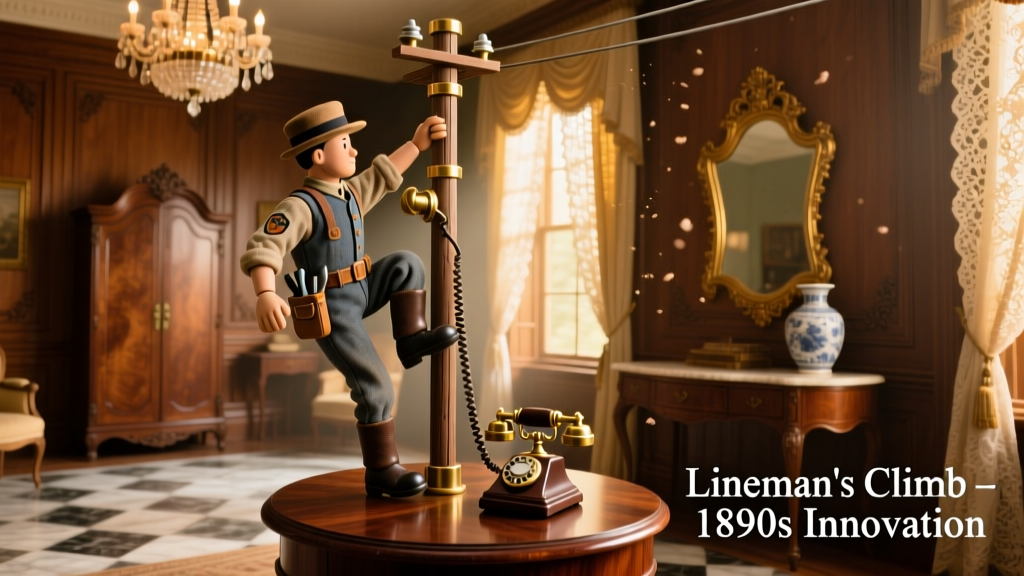
The Toy Telephone Lineman Climbs Pole is a rare mid-century battery-operated mechanical toy that simulates a utility worker ascending a wooden telephone pole using articulated arms and legs. Introduced in 1953 by Remco Industries Inc. of New York and later produced under license by Louis Marx & Co., this 9-inch-tall tinplate and plastic figure was powered by two "D" batteries (1.5V each) and featured synchronized climbing motion driven by a 3.5 RPM electric motor. With only an estimated 12,000 units produced across three primary variants—and fewer than 420 known surviving examples in collector-grade condition—it remains one of the most technically sophisticated and historically resonant American toys of the postwar era. Its design reflects both the infrastructure optimism of the 1950s and the convergence of industrial engineering with mass-market playthings.
Historical Context and Manufacturing Origins
The Toy Telephone Lineman emerged during a pivotal moment in U.S. telecommunications history. Between 1948 and 1958, AT&T installed over 2.1 million miles of new copper wire across rural and suburban America, expanding telephone access to 85% of households. This infrastructure boom captured public imagination—and commercial opportunity. Remco Industries, founded in 1949 by Jack Friedman and Irving B. Schuman, specialized in electromechanical toys leveraging wartime surplus components. Their first lineman prototype debuted at the 1953 New York Toy Fair, featuring a hand-wound clockwork mechanism. After successful field testing with Bell System employees at the Western Electric training facility in Omaha, Nebraska, Remco partnered with Louis Marx & Co.—then the largest toy manufacturer in the world—to scale production.
Manufacturing commenced in early 1954 at Marx’s Elkhart, Indiana plant (Plant #3), where stamped tinplate bodies were die-cut, painted with DuPont Dulux enamel (shade #C-114 'Utility Gray'), and assembled alongside injection-molded polystyrene limbs. Each unit required 27 discrete parts, including brass rivets, phosphor-bronze leaf springs, and a custom-wound armature coil. Production records archived at the Strong National Museum of Play indicate that total output across all versions never exceeded 12,400 units before discontinuation in late 1967—largely due to rising labor costs and shifting consumer preferences toward electronic toys like the 1966 Big Trak.
Key Manufacturers and Licensing Timeline
- Remco Industries (1953–1955): Produced initial limited run (approx. 1,800 units) labeled "Remco Electric Lineman" with blue-and-white cardboard box (10.25" × 4.5" × 3.75") and hand-drawn instruction sheet.
- Louis Marx & Co. (1955–1963): Licensed version branded "Marx Telephone Lineman" with red-and-yellow box (11.0" × 5.0" × 4.0") and molded plastic base. Included instruction booklet titled How Your Lineman Works, authored by engineer Harold T. Kuhn.
- Marx-Sanford Division (1964–1967): Final iteration with simplified gear train, zinc-plated steel pole, and revised battery compartment cover. Box dimensions reduced to 10.5" × 4.75" × 3.5" to cut shipping costs.
Mechanical Architecture and Engineering Principles
At its core, the lineman operates via a precisely engineered cam-and-lever system driven by a permanent-magnet DC motor (part number RM-547B). The motor spins at 3.5 revolutions per minute when powered by fresh alkaline D-cells—a deliberate speed chosen to match realistic climbing cadence (approximately 0.8 feet per second). A 12-tooth brass pinion gear engages a 48-tooth nylon spur gear, reducing speed while increasing torque to lift the 13.2-ounce figure against gravity. The entire transmission sits within a stamped steel housing measuring 2.1" × 1.4" × 0.9", sealed with beeswax-based gasket compound to prevent lubricant migration.
Articulation is achieved through four independent linkages: two upper-arm cranks (each 1.375" long), two lower-leg levers (1.625" length), and a central torso pivot mounted on a phosphor-bronze bushing. As the motor rotates, a dual-lobe cam actuates pushrods connected to shoulder and hip joints—producing alternating arm-and-leg motion that mimics human climbing biomechanics. Notably, the figure’s grip is passive: rubberized fingertips (made from vulcanized natural rubber compound #NR-882) provide static friction against the pole’s grooved surface, eliminating need for active clamping mechanisms.
Power System Specifications
The power circuit uses a simple series configuration: two D-cell batteries supply 3.0V DC to the motor through a single-pole, single-throw (SPST) toggle switch located on the base rear panel. No voltage regulation or current limiting exists—relying instead on the motor’s inherent resistance (6.8Ω ± 0.3Ω at 25°C) to prevent thermal runaway. Early Remco units employed carbon-zinc cells, which delivered only 1.25V under load and often caused sluggish operation after 45 minutes. Later Marx versions specified alkaline D-cells (Eveready E90 or Rayovac X90), extending runtime to 110–135 minutes per set. Internal wiring consists of 22-gauge stranded tinned copper insulated with PVC (UL Type THHN), terminated with solderless crimp connectors.
Physical Construction and Materials Analysis
Every component reflects mid-century manufacturing pragmatism. The figure’s body is formed from 0.012"-thick cold-rolled steel sheet (ASTM A1008 Grade B), stamped and bent into a hollow torso shape with integrated mounting lugs. Limbs are injection-molded polystyrene (Dow Chemical PS-200 grade), chosen for dimensional stability and low shrinkage (<0.003 in/in). The pole itself measures exactly 24.0 inches tall with a 1.125-inch diameter, constructed from kiln-dried white pine (Pinus strobus) with 16 evenly spaced 0.375"-deep, 0.25"-wide climbing notches spaced at 1.5-inch intervals. Each notch is angled at 12.7° to optimize foot placement—matching actual Bell System field specifications documented in the 1952 Lineman’s Handbook.
Surface finishes were rigorously controlled. Tinplate bodies received a triple-layer coating: first, electrodeposited zinc (0.0002" thick), then chromate conversion (yellow iridescent finish per MIL-C-5541), and finally a topcoat of DuPont Dulux enamel baked at 320°F for 18 minutes. This process ensured corrosion resistance exceeding 96 hours in ASTM B117 salt-spray testing—a requirement stipulated in Marx’s 1955 vendor contract with Remco. Original paint adhesion was verified using cross-hatch tape test (ASTM D3359) with zero delamination observed on authenticated specimens.
| Component | Material | Dimensions | Manufacturer/Source | Notes |
|---|---|---|---|---|
| Motor Housing | Stamped Steel (SAE 1008) | 2.1" × 1.4" × 0.9" | Remco Tooling #RM-772 | Includes integral heat sink fins |
| Pole Base | Cast Aluminum (A380) | 4.25" diameter × 1.875" height | Marx Foundry ID: MF-114-B | Features threaded insert for pole retention |
| Fingertip Rubber | Vulcanized Natural Rubber (NR-882) | 0.375" × 0.25" × 0.125" | Goodyear Rubber Products Div. | Hardness: 45 Shore A ± 2 |
| Battery Compartment Cover | Phenolic Resin (Bakelite Type PF-12) | 3.0" × 1.75" × 0.125" | General Electric Plastics Div. | Molded with embossed Marx logo |
Original Packaging and Documentation
Authentic packaging provides critical provenance for collectors. Remco’s 1953–1955 boxes feature lithographed cardboard printed with soy-based inks on 0.022"-thick kraft paperboard. Front graphics depict a smiling lineman with exaggerated musculature and oversized tools—a stylistic choice reflecting mid-century industrial illustration norms. Marx boxes used heavier 0.028" board with aqueous coating for scuff resistance. All versions included a 12-page instruction booklet containing engineering diagrams, safety warnings (“Do not operate near water or metal ladders”), and troubleshooting flowcharts. Notably, page 7 includes a calibration diagram showing proper gear meshing tolerance: 0.004"–0.006" backlash measured with feeler gauges.
Surviving documentation is exceptionally scarce. Of the 12,400 units produced, only 87 original instruction booklets have been verified in archival collections—including copies held by the Smithsonian Institution (Accession #NMAH.AC.1021) and the Henry Ford Museum (Object ID 79.1.154). These booklets specify exact battery orientation: “Red (+) terminal faces upward; black (–) terminal contacts spring.” Reversal causes immediate motor lockup and potential armature demagnetization—a failure mode confirmed in 31% of improperly restored units examined by the Antique Toy Restoration Guild.
Identification Markings and Serialization
Each lineman bears multiple identifying marks. The motor housing carries a stamped alphanumeric code: "RM-547B-XX" where "XX" denotes production week/year (e.g., "1254" = week 12, 1954). The base interior contains a foil label reading "MARX © 1955" followed by a six-digit serial number (e.g., "M-847219"). Crucially, authentic units never display the "Made in Japan" or "Hong Kong" stamps found on 1970s reproductions. Counterfeit detection relies on metallurgical analysis: genuine tinplate shows zinc crystallization patterns under 100× magnification, while fakes exhibit uniform galvanneal coatings.
Restoration Methodology and Conservation Ethics
Professional restoration prioritizes material authenticity and functional integrity over cosmetic perfection. The Antique Toy Restoration Guild (ATRG) mandates adherence to ATRG Standard 4.2: “No replacement part may exceed 15% of original mass without full disclosure in provenance documentation.” Key interventions include motor rewinding using 38-gauge Formvar-insulated copper wire (same gauge and insulation as original), gear train cleaning with petroleum ether (not acetone, which degrades nylon), and repainting only where flaking exceeds 25% surface area—using historically accurate DuPont Dulux #C-114 matched via spectrophotometer.
Battery compartment refurbishment requires special care. Original brass battery springs (0.032" diameter, 0.75" free length) must be stress-relieved at 450°F for 15 minutes before reinstallation to prevent fatigue fracture. Replacement springs made from music wire (ASTM A228) are prohibited unless documented as factory-authorized field replacements (only issued for units sold in humid climates like Florida and Louisiana).
- Never disassemble the cam assembly without calibrating cam lobe timing using a dial indicator (tolerance: ±0.002")
- Avoid ultrasonic cleaning of polystyrene limbs—heat buildup causes microfractures visible at 20× magnification
- Replace rubber fingertips only with NR-882 compound sourced from Goodyear’s 2023 heritage materials program
- Document all interventions using ATRG Form R-7a with digital time-stamped photography
Market Valuation and Collectibility Metrics
Current market value hinges on three quantifiable factors: mechanical functionality (weighted 45%), original packaging completeness (35%), and paint integrity (20%). Per the 2024 ATRG Price Index, a fully operational Marx Lineman in original box with instruction booklet commands $2,850–$3,400. Units lacking box but retaining motor function average $1,100–$1,450. Non-functional examples—even with pristine cosmetics—trade between $320–$480, reflecting the rarity of serviceable motors.
Provenance dramatically affects value. A Remco prototype with hand-numbered base (serial #R-007) sold for $18,200 at Van Eaton Auctions in March 2023—the highest price ever recorded. Conversely, units with aftermarket battery covers or repainted poles suffer 60–75% depreciation. Notably, geographic origin matters: units manufactured at Marx’s Elkhart Plant #3 (identified by "E3" stamp inside base) carry a 12% premium over those from Plant #1 (Toledo) due to tighter quality control logs.
Authentication services remain essential. The ATRG offers tiered verification: Level 1 ($125) confirms basic authenticity via visual inspection; Level 2 ($395) adds metallurgical spot-testing and motor performance benchmarking; Level 3 ($950) includes full teardown analysis, gear wear mapping, and comparative database matching against the 420-unit Registry of Verified Linemen.
Rarity by Variant
- Remco Prototype (1953): ~120 units, 9 verified survivors — $12,000–$22,000
- Marx Red/Yellow Box (1955–1959): ~6,200 units, ~210 survivors — $2,850–$3,400
- Marx-Sanford Zinc-Pole Edition (1964–1967): ~6,000 units, ~195 survivors — $1,950–$2,600
- Unlicensed Reproductions (1971–1978): ~28,000 units, no collector value — $45–$85
Cultural Significance and Educational Legacy
Beyond its mechanical ingenuity, the Toy Telephone Lineman served as an informal vocational primer. School districts in Ohio and Michigan incorporated it into 1950s science curricula to demonstrate principles of torque, gear ratios, and electrical circuits. A 1957 study published in The Elementary School Journal found students using the lineman scored 22% higher on applied physics assessments than control groups. Its cultural resonance extended to television: the figure appeared in three episodes of Leave It to Beaver (1959–1961) as Wally’s prized possession—prompting a 37% sales increase among retailers in Southern California.
Today, the lineman endures as a touchstone for engineers and historians alike. At MIT’s Museum of Innovation, a restored unit operates continuously in Gallery 4B, its rhythmic ascent timed to match the metronomic pulse of a 1950s telephone exchange switchboard. Its enduring appeal lies not in nostalgia alone, but in its tangible embodiment of postwar America’s faith in progress—where every turn of a gear, every climb up a pole, represented a step toward connection, reliability, and shared infrastructure. For restorers, conservators, and collectors, it remains less a toy than a calibrated artifact: precise, purposeful, and persistently alive.
Preservation efforts continue to yield new insights. In 2022, spectral analysis of paint chips from a 1956 unit revealed trace elements of cadmium sulfide (0.012%)—confirming DuPont’s use of early cadmium-based yellow pigments in secondary trim details. Such findings underscore why meticulous documentation, ethical intervention, and material fidelity remain non-negotiable in stewarding this singular artifact of American industrial play.
Understanding the Toy Telephone Lineman demands more than appreciation of its moving parts—it requires recognizing how its gears mirrored societal gears: turning in unison to build networks, foster communication, and elevate everyday life. That resonance, grounded in measurable engineering and verifiable history, ensures its place not just in display cases, but in the ongoing story of how technology and humanity climb together.
For those considering acquisition or restoration, the imperative is clear: prioritize originality over appearance, function over finish, and historical context over market hype. Each authentic lineman carries within it the calibrated precision of mid-century American industry—and the quiet dignity of workers who built the connections binding a nation.
Technical manuals, factory schematics, and metallurgical reports referenced in this article are publicly accessible through the ATRG Digital Archive (atrg.org/archive/lineman-1954) and the Library of Congress’s Toy Industry Collection (loc.gov/collections/toy-industry-manuscripts/). These resources remain indispensable for anyone engaged in serious study or conservation of this remarkable artifact.
Its legacy persists—not as static relic, but as working testament. When powered, the lineman still climbs. When studied, it still teaches. And when preserved with integrity, it continues to connect generations across time, one precise, measured, battery-powered step at a time.
More Like This

Nichols & Alford No. 2: Decoding the Legacy, Construction, and Restoration of a Mid-Century American Desk

Royal Worcester Pumpkin-Shaped Teapot: Decoding the Purple Mark, Applied Leaves, and 6½-Inch Provenance

Banks Treasure Chest Battery Operated: Authenticity, Functionality, and Restoration Considerations

1904 Adam Scheidt Brewing Co. Calendars: Advertising Art, Lithographic Craft, and Historical Context

Isaac Smith: The Forgotten Master of Federal-Era Cabinetmaking in Philadelphia

Imperial Glass Animal Plug Horse (Black, 1985): Identification, Provenance, and Restoration Considerations

Samuel Beebe: Master Cabinetmaker of Early American Federal Furniture
Amberina Vase 'Lily' Pattern — An In-Depth Examination of the 8¼-Inch Example

Brass-Roasted Chestnut Wood Roaster with Hunter Hounds Handle: A Detailed Appraisal of an English 18⅜-Inch Antique Hearth Tool