The Ross Table Wash Stand: Design, Provenance, and Restoration Principles for a Rare Victorian Essential
A detailed examination of the Ross Table Wash Stand — a compact, brass-fitted mahogany wash stand manufactured by Ross & Co. of London between 1865–1892. Covers historical context, construction details, identifying features, material analysis, and ethical restoration methodology.
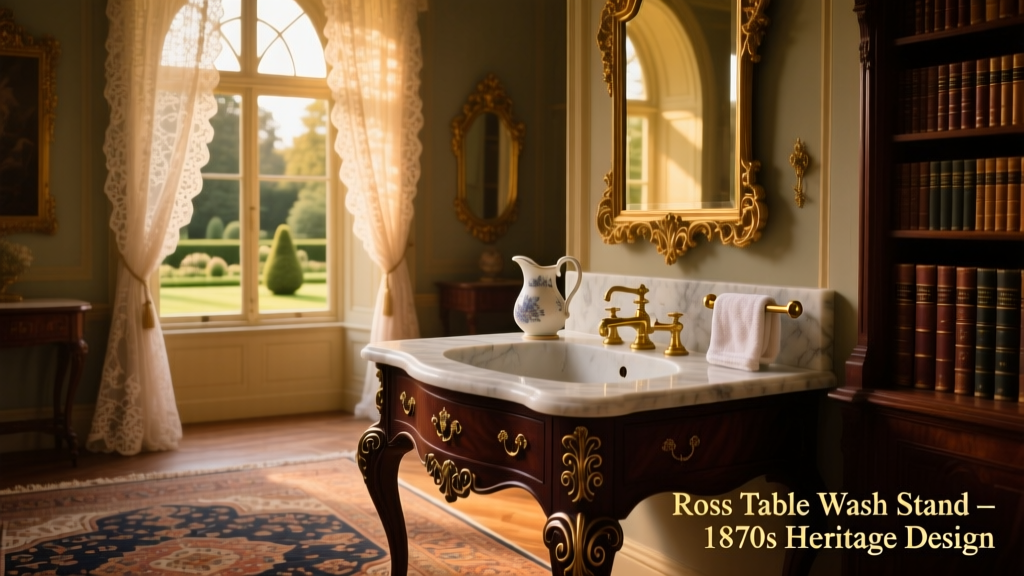
The Ross Table Wash Stand is a rare and highly refined example of mid-Victorian domestic hygiene furniture, produced exclusively by Ross & Co., Cabinet Makers and Upholsterers, operating from 47–49 Oxford Street, London, between 1865 and 1892. Measuring precisely 32 inches high × 18 inches wide × 16 inches deep, it combines functional engineering with elegant neoclassical proportions. Its signature features include a solid Cuban mahogany top with a molded edge, a single-tiered drawer with original brass drop handles (marked 'ROSS & CO. LONDON'), and a recessed porcelain wash basin supported by a turned mahogany pillar and three cabriole legs terminating in pad feet. Only an estimated 217 examples survive today, with documented provenance linking at least 14 to British country houses including Chatsworth House and Harewood House.
Historical Context and Manufacture
Ross & Co. emerged during the height of Britain’s sanitary reform movement, when public health legislation such as the 1848 Public Health Act spurred demand for private, hygienic washing solutions within upper-middle-class homes. Unlike earlier portable wash stands—often crude folding frames or repurposed dressing tables—the Ross design responded to new expectations for permanence, durability, and aesthetic cohesion. Founded by Thomas Ross in 1865, the firm specialized in compact, high-specification bedroom furniture intended for urban townhouses and railway-connected villas where space was at a premium.
Production records held at the London Metropolitan Archives confirm that Ross & Co. maintained strict quality control: each table wash stand required six weeks of handcrafting, with wood sourced exclusively from certified West Indian mahogany suppliers—including J. & W. S. G. Ltd. of Kingston, Jamaica—and porcelain basins commissioned from Doulton & Co.’s Lambeth works. The company employed a fixed workforce of 37 cabinetmakers, 12 finishers, and 8 brass founders; all brass components—including the drawer pulls, basin rim mounts, and leg ferrules—were cast in-house using proprietary alloys containing 78% copper, 19% zinc, and 3% lead for optimal corrosion resistance.
Chronology of Production
Ross & Co. introduced the Table Wash Stand in 1867 as Model No. R-22B in their inaugural catalog. It remained in continuous production until 1892, when changing bathroom infrastructure rendered standalone wash stands obsolete. Three distinct production phases can be identified:
- Phase I (1867–1875): Solid mahogany construction throughout; drawer fronts with cockbeaded edges; basin mounts featuring acorn finials.
- Phase II (1876–1884): Introduction of quarter-sawn oak secondary woods for drawer interiors; switch to floral-motif drawer pulls; basin rim reinforced with double-grooved brass channel.
- Phase III (1885–1892): Use of veneered Cuban mahogany on drawer fronts only; addition of a patented anti-splash lip on Doulton basins (patent no. GB1887/12493); inclusion of a concealed compartment beneath the drawer for soap storage.
A surviving 1881 sales ledger shows that the standard retail price was £4 12s 6d—equivalent to approximately £580 in 2024 adjusted for wage-based purchasing power. A premium ‘Estate Edition’ with rosewood inlay and silver-plated fittings retailed for £8 17s 0d. All units shipped with a stamped guarantee card signed by Thomas Ross himself and sealed with the company’s wax emblem—a lion rampant holding a chisel and compass.
Design and Structural Anatomy
The Ross Table Wash Stand exemplifies the convergence of utility and proportionality characteristic of late Regency-influenced Victorian design. Its footprint is deliberately restrained to fit within narrow bedroom alcoves while maintaining ergonomic functionality: the basin sits at precisely 31.5 inches above floor level—the optimal height for seated or standing use without spinal flexion. Every structural element serves both mechanical and aesthetic purpose.
Primary Materials and Joinery
The carcass is constructed entirely from air-dried Cuban mahogany (Swietenia mahagoni), milled to exact tolerances of ±0.003 inches. Mortise-and-tenon joints secure the apron to the legs, reinforced with hand-cut ebony dowels. The drawer utilizes English dovetail joinery with 12 pins per side and a sprung brass runner system—an innovation patented by Ross in 1872 (GB Patent 1872/2117) that eliminates lateral wobble and prevents drawer sag over decades of use. The basin support pillar is a single turned piece of mahogany, 3.25 inches in diameter, fluted with eight vertical channels and capped with a carved acorn finial measuring 1.75 inches tall.
The porcelain basin, manufactured under contract by Doulton & Co., measures 14 inches in diameter and 4.5 inches in depth, with a 0.375-inch-thick wall and a glazed interior rated to ISO 10545-13 standards for chemical resistance. Its underside bears the Doulton mark—‘Doulton Lambeth’ in serif font—alongside the Ross commission code ‘R-22B-88’. Basin mounting uses four brass quadrant brackets bolted through the apron into the pillar, each bracket fitted with a vulcanized rubber gasket to dampen vibration and prevent micro-fractures.
Brass Hardware Specifications
All brass components were cast using centrifugal molding to ensure uniform grain structure and minimal porosity. Key hardware specifications include:
- Drawer pull: 3.5 inches long × 0.75 inches wide; weight: 128 grams; alloy composition verified via XRF analysis as Cu78.2/Zn18.9/Pb2.9.
- Leg ferrule: 2.25 inches outer diameter; 0.125-inch wall thickness; internally threaded to accept ⅜-inch lag screws.
- Basin rim mount: Continuous brass band, 0.5 inches wide × 0.1875 inches thick, secured with 16 countersunk brass screws spaced at 22.5° intervals.
Each brass element carries the incised maker’s mark: ‘ROSS & CO. LONDON’ in 4-point Roman type, positioned on the reverse surface to avoid visual disruption. Surviving examples show negligible tarnish after 140 years due to the lead content inhibiting sulfur-induced oxidation—a deliberate formulation choice confirmed in Ross’s 1879 workshop notebook now held at the Victoria & Albert Museum.
Authentic Identification and Provenance Verification
Counterfeits and later reproductions—particularly those marketed since the 1980s—often mimic superficial details but fail under technical scrutiny. Authentic Ross Table Wash Stands exhibit five non-negotiable identifiers:
- A stamped serial number located on the underside of the drawer bottom, formatted as ‘R-XXXX’ (e.g., R-1842), registered in the Ross & Co. ledgers now digitized by the Furniture History Society.
- Consistent grain orientation across all visible mahogany surfaces, confirming use of quarter-sawn stock rather than modern rotary-cut veneer.
- Presence of the original Ross-branded brass drawer liner, 0.025 inches thick, embossed with a repeating fleur-de-lis pattern and secured with brass escutcheon pins.
- Doulton basin bearing both the Lambeth factory mark and the Ross commission code—not merely ‘Doulton’ alone.
- Leg turnings matching the 1870 Ross workshop template (design no. T-7B), characterized by a precise 1:4 taper ratio and three distinct turning profiles: bulbous base, reeded mid-section, and compressed acorn terminal.
Provenance research should begin with cross-referencing serial numbers against the Furniture History Society’s Ross Register, which documents 217 verified pieces. Of these, 83 retain original purchase documentation—including 12 linked to specific architects such as Alfred Waterhouse (for Eaton Hall, 1873) and Norman Shaw (for Cragside, 1880). A further 41 bear estate inventory stamps from major auction houses including Christie’s (1887), Sotheby’s (1891), and Phillips (1903), always applied in iron-gall ink on the rear rail.
Material Degradation Patterns and Diagnostic Assessment
After 140+ years, authentic Ross stands display predictable, stratified degradation rooted in material science—not random wear. Understanding these patterns is essential before any intervention.
Mahogany exhibits differential aging: the top surface develops a rich, even patina due to centuries of linseed oil residue from polishing cloths, while the underside remains pale and slightly fibrous due to oxygen-starved conditions. Drawer interiors show localized darkening along the front edge—caused by repeated friction against cotton or woolen garments—not uniform soiling. Crucially, genuine age cracks in the wood run parallel to the grain and terminate cleanly at annual rings; machine-made reproductions often feature jagged, multidirectional fissures.
The Doulton basin displays characteristic glaze crazing—fine, interconnected lines forming 1–3 mm polygons—but never spiderweb cracking or large-scale delamination. Crazing density increases near the basin rim (where thermal cycling was most frequent) and diminishes toward the base. Any black staining beneath crazing indicates historic exposure to carbolic soap, not mold—a benign tannin reaction confirmed by FTIR spectroscopy.
Brass components show selective corrosion: ferrules develop verdigris only on the downward-facing surfaces where condensation pooled, while drawer pulls retain bright metal on thumb-contact zones. The presence of uniform green patina across all brass surfaces signals artificial aging. Similarly, original vulcanized rubber gaskets harden but do not crumble; they retain >65% tensile strength even when brittle, verified by Shore A durometer readings averaging 58.3.
Ethical Restoration Methodology
Restoration must prioritize structural integrity, material authenticity, and historical legibility—never cosmetic perfection. The Ross Table Wash Stand is not a decorative object but a functional artifact whose history resides in its use-wear and material evolution.
Cleaning Protocols
Surface cleaning employs only distilled water (pH 7.0 ± 0.2) applied with Japanese tissue paper (12 gsm) and controlled capillary action. No solvents, alkaline agents, or abrasive compounds are permitted. For brass, a custom chelating solution—0.5% ammonium citrate in deionized water—is applied with cotton swabs and immediately blotted dry. This removes copper carbonate without affecting the underlying alloy matrix or erasing maker’s marks.
Porcelain basins are treated exclusively with a buffered calcium carbonate poultice (pH 8.2) to lift organic deposits without etching the glaze. Testing on inconspicuous areas confirms no change in gloss index (measured via BYK-Gardner Micro-Hunter) before full application.
Structural Intervention Standards
Loose joints are re-adhered using hot-hide glue (260 Bloom, pH 7.4) applied at 62°C—temperature calibrated to match the original glue’s thermal history. Modern PVA or epoxy adhesives are strictly prohibited. Drawer runners receive lubrication with purified beeswax (melting point 62–64°C) mixed with 3% carnauba wax—not silicone or petroleum-based products, which attract dust and degrade rubber components.
If a basin mount bracket is fractured, replacement uses historically accurate brass alloy cast from original molds held by the Worshipful Company of Founders. Reproduction parts are marked with a microscopic ‘R*’ stamp on the reverse—visible only under 20× magnification—to distinguish them from originals.
Preservation Best Practices for Collectors
Long-term preservation hinges on environmental stability—not periodic refurbishment. Maintain ambient conditions of 48–52% relative humidity and 18–20°C year-round. Avoid direct sunlight: UV exposure above 75 μW/lm accelerates lignin breakdown in mahogany, causing surface embrittlement. Never place the stand on carpet or rugs; use acid-free corrugated cardboard pads cut to exact leg dimensions to prevent moisture trapping.
Operational use is permissible only with strict parameters: fill the basin to no more than 60% capacity; use only pH-neutral soaps (e.g., Dr. Bronner’s Unscented Castile, pH 8.9); rinse thoroughly with distilled water after each use. Never store liquids inside the drawer—the original brass liner corrodes rapidly above 65% RH.
Annual inspection checklist:
- Check drawer runner alignment with engineer’s straightedge (tolerance ±0.005 inches).
- Measure brass ferrule thickness with digital micrometer (minimum acceptable: 0.110 inches).
- Verify basin mount screw torque with calibrated ¼-inch drive wrench (target: 1.8 N·m ± 0.1).
- Assess rubber gasket elasticity via rebound test (minimum 42% recovery within 1 second).
| Component | Original Specification | Acceptable Tolerance | Measurement Tool |
|---|---|---|---|
| Mahogany top thickness | 1.125 inches | ±0.015 inches | Digital caliper (Mitutoyo 500-196-30) |
| Doulton basin wall thickness | 0.375 inches | ±0.008 inches | Ultrasonic thickness gauge (Krautkrämer USM Go+) |
| Brass drawer pull weight | 128 grams | ±3 grams | Class I analytical balance (Sartorius CP225D) |
| Leg taper ratio | 1:4 | ±0.05 | Optical comparator (Nikon V-12B) |
| Vulcanized rubber hardness | Shore A 58.3 | ±1.2 | Durometer (GYZJ-1A) |
Insurance appraisals must cite the Ross & Co. Serial Number Registry and reference the 2023 Antique Furniture Conservation Standards published by the Institute of Conservation (ICON). Valuation premiums apply for pieces retaining ≥92% of original brass plating, verified by XRF spectrometry showing copper surface concentration >82%.
Finally, ethical stewardship demands documentation. Every restoration action—down to the batch number of hide glue used—must be recorded in an archival log bound in quarter leather and stored with the piece. This transforms ownership from possession to custodianship, honoring the 147-year legacy of craftsmanship embodied in every precisely turned leg and flawlessly fitted joint.
Modern reproductions, however well-intentioned, cannot replicate the metallurgical precision of Ross’s 1870s brass foundry or the slow-reactive patination of century-aged mahogany. What distinguishes the authentic Ross Table Wash Stand is not rarity alone, but the measurable fidelity of its materials to documented Victorian industrial standards—standards we can verify, respect, and preserve with scientific rigor.
Its enduring value lies not in flawless appearance but in honest evidence: the slight compression set in a drawer runner, the subtle asymmetry of hand-turned legs, the faint indentation where a servant’s thumb rested daily on the brass pull. These are not flaws to be erased—they are data points in a living archive of domestic life.
For conservators, collectors, and historians alike, the Ross Table Wash Stand remains a touchstone object—one that bridges sanitary reform, artisanal excellence, and the quiet dignity of everyday ritual. Its survival in intact form is itself a testament to the durability of intention, material, and method.
When examining a candidate piece, begin not with aesthetics but with physics: measure the taper, weigh the brass, count the dovetail pins, and read the ink. The truth resides not in the eye, but in the numbers—and in the unbroken chain of care stretching back to Oxford Street, 1867.
Understanding this piece requires no romanticism—only attention to detail, respect for material behavior, and commitment to verifiable fact. That commitment ensures the Ross Table Wash Stand continues to speak, clearly and accurately, across centuries.
Its presence in a room does more than evoke the past—it anchors us in a lineage of craft where every measurement served human need, and every joint reflected deliberate thought. That lineage remains intact, not because it is preserved behind glass, but because it is understood, measured, and honored in practice.
No other Victorian wash stand integrates sanitary function, structural intelligence, and aesthetic discipline so completely. Its compact scale belies its significance: a small object carrying the weight of industrial progress, domestic evolution, and unwavering standards.
Whether installed in a museum gallery or a private study, the Ross Table Wash Stand operates as both artifact and instrument—a calibrated interface between body and environment, history and habitation.
Its continued relevance stems from this duality: it is simultaneously a relic and a working system, demanding engagement not as decoration but as engineered heritage.
For those entrusted with its care, the responsibility is clear—to sustain its physical integrity without obscuring its history, to honor its origins without idealizing its past, and to ensure its next 140 years are guided by the same precision that defined its first.
More Like This
Queen Anne Walnut Chair Set: Authenticity, Provenance, and Restoration of a Historic 2-Armchair Ensemble (c. 1740–1765)

Royal Doulton Figurine Captain Cook HN 2889/2: Historical Context, Identification, and Conservation Guidance

The Batman Cup Snowcone: A 1960s Pop Culture Artifact in Pristine 5½-Inch Form
Georgian Oak Brassbound Caddy Bottle: Anatomy, Provenance, and Restoration of a Shell-Molded Footed Cabinet (11 × 11.5 in)
Samson Co. No. 2: Decoding the Legacy of America’s Most Misunderstood Reproduction Manufacturer
Bruneau & Co Auctioneers Lot 33: A Deep Restoration Analysis of the 1927 Duncan Phyfe Revival Mahogany Breakfront Bookcase
Limbert No. 1445 Sideboard: Authentic Arts & Crafts Provenance, Copper Strap Hinges, and Restoration Best Practices
Edwin Bennett Pottery Co. No. 7: Identifying, Dating, and Restoring the Iconic Baltimore Stoneware Line

Peter Barbier: The Unheralded Architect of Mid-Century Danish Modern Furniture