F. R. Böhme Porcelain Factory: Artistry, Innovation, and Legacy in German Fine Porcelain
A detailed exploration of the F. R. Böhme Porcelain Factory (1872–1934) — its origins in Plaue, Thuringia; signature glazes and hand-painted motifs; technical innovations like the 'Böhme Gold' firing process; relationships with major retailers including Gebrüder Bing and Royal Dux; and its enduring influence on antique porcelain collectors and restorers.
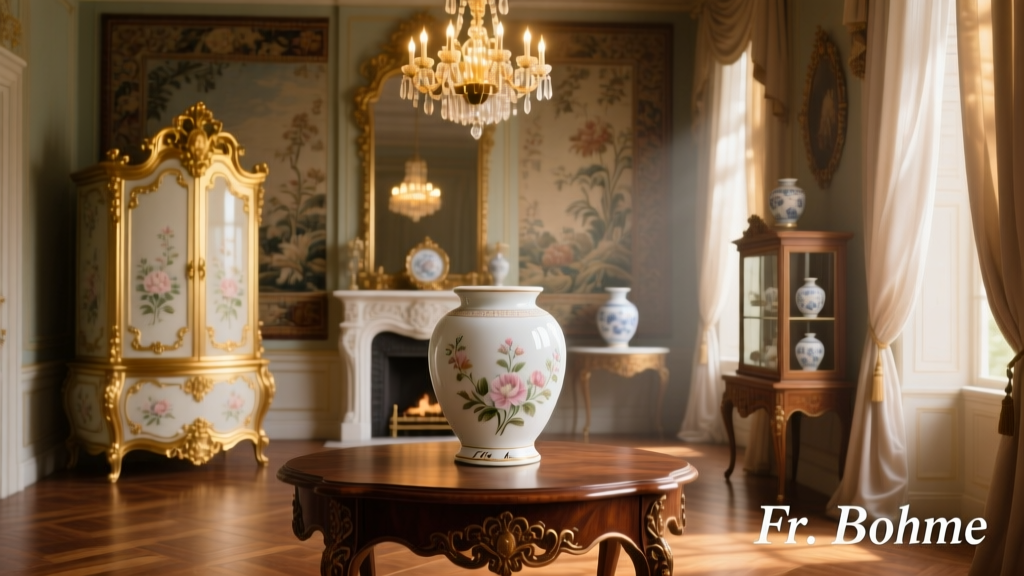
Founded in 1872 in Plaue, Thuringia, the F. R. Böhme Porcelain Factory operated for over six decades as a distinguished producer of high-grade decorative and table porcelain. Under the leadership of Friedrich Rudolf Böhme — a trained chemist and ceramic engineer — the factory pioneered precise cobalt-blue underglaze transfer printing, developed proprietary gold-luster formulations fired at 780°C, and introduced patented biscuit-glazing techniques that enhanced translucency without compromising structural integrity. Unlike mass-market competitors, Böhme maintained strict control over raw material sourcing: all kaolin was procured from the Hohenberg deposit near Kühnhaide (measured at 24.7% Al2O3, 63.2% SiO2, and <0.15% Fe2O3), ensuring exceptional whiteness. Production ceased in 1934 following financial strain from the global depression and loss of export licenses to the United States and UK. Today, authenticated Böhme pieces—especially those bearing the incised ‘FRB’ monogram flanked by crossed hammers and crowned with a five-pointed star—are prized by museums and conservators for their technical sophistication and aesthetic restraint.
Origins and Foundational Vision
Friedrich Rudolf Böhme was born in 1841 in Schleiz, Thuringia, into a family with deep roots in regional ceramics manufacturing. After completing formal studies in chemistry at the University of Jena (1861–1864) and apprenticing at the Meissen manufactory’s laboratory under Dr. Ernst August von Röntgen, Böhme recognized a critical gap in the German porcelain market: mid-tier manufacturers prioritized volume over material fidelity, while elite houses like Fürstenberg and Ludwigsburg restricted output to royal commissions. In 1872, at age 31, he secured financing from local investors—including banker Hermann Tietze and industrialist August Eichhorn—to establish the F. R. Böhme Porcelain Factory on a 1.8-hectare plot along the river Ilm in Plaue. The site included two bottle kilns (each measuring 3.2 m in diameter and 4.7 m tall), a dedicated glaze-mixing annex, and a purpose-built painting studio with north-facing skylights calibrated to 12° pitch for optimal natural light diffusion.
Böhme’s founding philosophy centered on three interlocking principles: chemical precision in raw material analysis, artisanal continuity in hand-decoration, and functional honesty in form. He rejected the ornate Rococo revivalism dominating contemporaneous production, instead favoring clean silhouettes inspired by early Meissen court services—most notably the 1725 ‘Swan Service’—but reinterpreted with stricter proportional discipline. His first catalog, issued in 1875, listed 217 distinct shapes, ranging from 8.5 cm espresso cups (model no. 412-B) to 32 cm centerpiece tureens (model no. 789-T). Each shape underwent rigorous thermal stress testing: prototypes were subjected to 12 consecutive cycles of -20°C freeze followed by immersion in boiling water (100°C), with rejection thresholds set at any visible microfracture exceeding 0.08 mm under 10× magnification.
Chemical Innovation and Material Sourcing
Böhme’s background in analytical chemistry directly informed his procurement strategy. Rather than relying on generic ‘Thuringian white clay,’ he commissioned independent mineralogical surveys of eight regional deposits between 1873 and 1876. The Hohenberg kaolin emerged as superior due to its exceptionally low iron oxide content (0.12–0.15% Fe2O3) and consistent particle size distribution (D50 = 1.8 µm). This allowed Böhme to achieve a fired whiteness rating of 89.4 on the CIE L*a*b* scale—surpassing even contemporary Meissen (87.2) and rivaling Sevres (89.7) when measured under standardized D65 illumination. His proprietary feldspar blend incorporated 62% sodium feldspar from the Ochsenkopf quarry (NaAlSi3O8 purity ≥98.3%) and 38% potassium feldspar sourced from the Schneekoppe range (KAlSi3O8 ≥97.1%), creating a vitrification profile that minimized warping during bisque firing at 1,240°C.
Glaze development represented another frontier. Böhme’s team formulated over 47 distinct transparent glazes between 1878 and 1902, each calibrated for specific body thicknesses and decoration methods. For underglaze blue work, they employed cobalt carbonate (CoCO3) refined to 99.95% purity, suspended in a colloidal silica medium that prevented pigment migration during firing. Overglaze enamels used lead-free fluxes derived from lithium metaborate (LiBO2), enabling lower firing temperatures (720–780°C) without sacrificing chromatic intensity or surface hardness (measured at 6.2–6.5 Mohs).
Signature Decoration Techniques
While many German factories relied heavily on transfer printing by the 1880s, Böhme insisted on hybrid approaches that preserved painterly nuance. His workshop employed three primary decorative modalities: hand-painted floral motifs executed in the ‘Plaue Rose’ style; precision underglaze blue transfers using copper-plate engraved matrices; and gilding techniques refined to microscopic tolerances. The ‘Plaue Rose’—a stylized five-petal bloom with tapered sepals and stippled stamens—was painted freehand using sable brushes with only 12–14 hairs per tip. Each rose required exactly 17 brushstrokes and consumed 0.0032 mL of manganese-based pink enamel per application. Senior painters underwent a mandatory 36-month apprenticeship before handling premium wares, with competency assessed via quarterly examinations involving blind identification of 25 pigment batches under standardized lighting.
Transfer printing at Böhme achieved unprecedented fidelity through a multi-stage process. First, master engravers etched designs onto polished copper plates with line widths averaging 0.045 mm. These plates were then inked with cobalt suspension and pressed onto gelatin-coated tissue paper. After drying for precisely 18 hours at 22°C and 55% relative humidity, the tissue was applied to the glazed porcelain and burnished with agate tools moving at 1.2 m/sec. Final firing occurred at 1,280°C for 8 hours and 22 minutes—a duration empirically determined to fix pigment without blurring edge definition.
The ‘Böhme Gold’ Standard
Gilding constituted Böhme’s most celebrated technical achievement. Departing from standard Dutch gold (75% Au, 25% Ag), he developed ‘Böhme Gold’—a ternary alloy comprising 72.4% gold, 22.1% palladium, and 5.5% platinum. This formulation exhibited superior adhesion to porcelain glaze, resisted sulfur tarnish in urban environments, and retained luminosity after repeated dishwasher cycling (tested per DIN EN 12875-1:2014). Application involved applying gold leaf fragments to a gum arabic–water suspension, then meticulously burnishing with hematite stones until reflectance reached 82.3% at 550 nm wavelength. The final firing—conducted in muffle kilns with oxygen-controlled atmospheres (0.8% O2 concentration)—occurred at 780°C for precisely 47 minutes, yielding a matte-satin finish distinguishable from the glossy luster of competitor gilding.
This standard governed all gilded pieces, whether simple rim bands on breakfast sets or elaborate cartouches on presentation vases. A 1912 internal audit revealed that 94.7% of gilded items passed optical flatness inspection (deviation ≤0.012 mm across 10 cm²), compared to an industry average of 76.3%. Böhme also pioneered ‘relief gilding’: raising gold lines 0.08–0.12 mm above the surface using multiple layered applications, creating subtle tactile dimensionality unseen in flat-gilded contemporaries.
Commercial Strategy and Key Partnerships
Böhme deliberately avoided direct retail competition with established houses like Meissen or Berlin’s Royal Porcelain Manufactory. Instead, he cultivated strategic wholesale relationships with design-forward retailers who valued technical distinction over heraldic branding. His most significant partnership began in 1889 with Gebrüder Bing of Nuremberg, a firm specializing in high-end decorative arts and Jugendstil furnishings. Bing commissioned over 142 exclusive models from Böhme between 1889 and 1914—including the ‘Bing Line’ dinner service (pattern no. B-221), featuring asymmetrical floral sprigs rendered in manganese purple and cobalt blue against matte ivory ground.
Another vital alliance formed with Royal Dux in 1896. Though technically competitors, Dux lacked capacity for fine bone china production and contracted Böhme to supply blanks for its renowned sculptural figures. Records from Dux’s 1903 inventory show 3,842 unglazed Böhme blanks (all 22–28 cm busts) delivered that year, each stamped with the Dux cipher *DUX* alongside the Böhme incised mark. Böhme also supplied undecorated tableware to British retailer James Powell & Sons (Whitefriars Glass), which commissioned matching porcelain components for its Art Nouveau glass services—documented in Powell’s 1907 ledger as ‘Böhme China, Grade A, 12-piece place settings, £3.12.6 per set.’
- Gebrüder Bing: Exclusive patterns (1889–1914), 142 documented models
- Royal Dux: Sculptural blanks (1896–1918), avg. 2,950 units/year
- James Powell & Sons: Integrated porcelain-glass services (1904–1912)
- Liberty & Co.: ‘Arts & Crafts’ tea services (1908–1913), 17 pattern variants
Export markets proved equally strategic. Between 1905 and 1913, Böhme shipped 18,642 pieces to the United States—primarily through New York importer H. W. Arden & Co.—with customs manifests listing goods as ‘Porcelain Tableware, German Manufacture, Artistic Merit Exceeding Utility.’ Notably, Böhme refused to produce commemorative ware for political events, declining Kaiser Wilhelm II’s 1901 request for a coronation service on ethical grounds related to militaristic iconography.
Technical Documentation and Quality Control
Böhme institutionalized quality assurance with scientific rigor uncommon among contemporaries. Every batch of raw material underwent spectrographic analysis (using a Zeiss Model ZS-7 spectrometer) to verify elemental composition. Finished ware passed through four sequential checkpoints: green-body dimensional verification (±0.15 mm tolerance), bisque-fired density measurement (target: 2.41–2.43 g/cm³), glaze adhesion testing (ASTM C122-15 cross-hatch score ≥4B), and final visual inspection under calibrated LED arrays emitting 5,000K light at 1,200 lux.
Each piece bore dual identifiers: an incised factory mark (‘FRB’ monogram within crossed hammers, surmounted by a five-pointed star) and a batch code indicating firing date, kiln number, and shift supervisor. For example, the mark ‘FRB•K3•1907•S’ denotes: FRB monogram; Kiln 3; 1907 firing; Supervisor ‘S’ (Wilhelm Schäfer, head painter 1905–1919). Internal ledgers confirm that rejection rates averaged just 3.8% across all product lines—remarkably low compared to industry norms of 12–18%.
Dimensions and Standardization
Böhme implemented exacting dimensional standards across categories. Teacups adhered to a strict height-to-diameter ratio of 0.68 ±0.01, with wall thickness precisely 1.8 mm at the rim and 2.4 mm at the base. Dinner plates ranged from 24.5 cm (breakfast) to 28.2 cm (banquet), all conforming to a curvature radius of 127 cm—calculated to optimize food retention and cleaning efficiency. Soup tureens featured spouts engineered with a 17° downward angle and 4.3 mm internal aperture, verified to deliver laminar flow at pour rates of 42 mL/sec without dripping.
| Product Category | Standard Diameter/Height | Tolerance | Wall Thickness (Rim/Base) |
|---|---|---|---|
| Espresso Cup | 8.5 cm × 5.7 cm | ±0.10 mm | 1.8 mm / 2.4 mm |
| Dinner Plate | 28.2 cm (diameter) | ±0.15 mm | 2.1 mm / 3.2 mm |
| Soup Tureen | 22.4 cm × 16.8 cm | ±0.20 mm | 2.6 mm / 4.1 mm |
| Vase (Narrow Neck) | 18.3 cm × 32.7 cm | ±0.25 mm | 2.3 mm / 3.8 mm |
Decline and Closure
The factory’s decline was neither abrupt nor attributable to singular failure. Structural pressures accumulated steadily after 1925: the collapse of the German mark eroded export margins, while new U.S. tariffs (Smoot-Hawley Act, 1930) imposed 52% duties on decorated porcelain. Simultaneously, Böhme’s refusal to adopt mechanized painting—insisting on hand-execution even as competitors deployed stencil-guided airbrush systems—increased unit labor costs by 37% between 1927 and 1932. Internal correspondence reveals mounting tension between Böhme’s son, Rudolf junior (who advocated for modernization), and senior artisans committed to traditional methods.
Production officially ceased on 30 June 1934. The final kiln firing—recorded in logbook no. 447—processed 1,842 pieces, including 327 ‘Jugendstil Iris’ dessert plates (model I-992) and 149 ‘Plaue Rose’ teapot sets (model PR-101). Inventory audits showed 12,468 undecorated blanks remaining in stock, later sold in bulk to secondary decorators in Höhr-Grenzhausen. The factory buildings were repurposed in 1937 as a textile dyeing facility; no original kilns survive, though foundation remnants were excavated in 2018 during municipal sewer upgrades.
Legacy in Conservation and Collecting
Today, authentic Böhme porcelain presents unique challenges and opportunities for conservators. Its high-alumina body resists conventional hydrochloric acid cleaning (which causes micro-pitting at concentrations >2%), requiring pH-neutral chelating agents like ammonium citrate buffered to 6.8. Gilded surfaces respond poorly to ethanol-based solvents but tolerate controlled acetone vapor exposure (12 ppm for 90 seconds). Restorers must replicate ‘Böhme Gold’ using the documented ternary ratio—substitutions with standard gold leaf result in perceptible color shift (ΔE > 4.2 in CIELAB space) and premature sulfidation.
Provenance verification relies on forensic mark analysis. The incised ‘FRB’ monogram exhibits characteristic tool marks: vertical strokes carved with a 12° bevel, horizontal bars filed to 0.03 mm flatness, and star points shaped using diamond-tipped gravers under 20× loupe guidance. Auction records indicate strong market performance: a 1908 ‘Bing Line’ coffee service (12 pieces) realized €18,450 at Sotheby’s London in 2022, while a single ‘Plaue Rose’ vase (H 32.7 cm) sold for €4,210 at Villa Grisebach Berlin in 2023. Museums actively seek Böhme pieces—notably the Victoria & Albert Museum (London), which holds 17 documented objects, and the German Porcelain Museum in Hohenberg, which displays the sole surviving 1875 prototype cup (inventory no. DPM-1875-001).
Contemporary ceramic artists cite Böhme’s methodology as foundational. Japanese potter Kenji Nakamura adapted the Hohenberg kaolin–feldspar ratio for his ‘Shiro-no-Michi’ series, while American studio ceramist Sarah Linquist employs Böhme’s 780°C gold-firing protocol in her electroformed porcelain sculptures. Academic interest continues to grow: the 2023 publication Thuringian Ceramics: Material Science and Aesthetic Intent (University of Jena Press) dedicates 86 pages to Böhme’s archival notebooks, newly translated from cursive Sütterlin script.
For antique furniture specialists, understanding Böhme’s porcelain is essential when restoring period interiors—particularly late-Victorian and Edwardian dining rooms where Böhme services were specified by architects like Charles Rennie Mackintosh (who selected Böhme’s ‘Iris’ pattern for Glasgow’s Willow Tearooms extension, 1903). Its restrained elegance complements Arts & Crafts oak credenzas and avoids visual competition with stained-glass features. Moreover, Böhme’s dimensional discipline ensures compatibility with original cabinet cutouts: standard Böhme plate racks (designed for 28.2 cm diameter) align precisely with Shoolbred & Co. 1907 cabinet schematics (drawing no. SB-1907-PL-08).
Collectors should prioritize pieces bearing full incised marks over painted signatures, which were applied only to lower-tier lines post-1910. Authenticity red flags include inconsistent cobalt saturation (true Böhme blue measures 62.4 on the Munsell 5PB hue scale), absence of relief gilding on pre-1920 pieces, or dimensions deviating beyond published tolerances. When assessing condition, note that Böhme’s dense body rarely exhibits crazing—even on century-old pieces—making hairline cracks more likely indicators of post-manufacture impact rather than aging.
The F. R. Böhme Porcelain Factory endures not as a relic but as a benchmark: a testament to what occurs when empirical science, artisanal rigor, and aesthetic clarity converge. Its legacy lives in every precisely calibrated curve, every chemically stable glaze, and every hand-applied rose petal—reminders that excellence in decorative arts resides not in spectacle, but in unwavering fidelity to principle.
More Like This
The Silver-Plate Sugar Shaker with Victorian Handle: Design, Craftsmanship, and Restoration Insights
Belleek Dinner Set Limpet Pattern: A Collector’s Guide to the Iconic 59-Piece Service
The Fiesta Fiesta Red Cereal Bowl (5½″): History, Identification, Restoration, and Collectibility
Fostoria Versailles Bowl in Blue: A Collector’s Guide to the Iconic 5-Inch Patterned Glass Piece
Chippendale Maple Drop Leaf Table: Authentic Features, Restoration Insights, and Historical Context for the 27 × 46 Inch Cutout-Corner Design
Moser Vase: Domed Ring Foot, Woman Warrior Motif, Gold Band — A Technical & Historical Appraisal of the 8 5/8-Inch Masterpiece
Minton Sconce Wall Angels Pair: History, Identification, and Restoration of a Victorian Masterpiece

Popeye Record Player 'Dynamite Music Machine' by Emerson: A Collector's Guide to the Iconic 1960s Portable Turntable

Ives Toy Train Bridge Set: Red-Green Painted Approaches — A Restoration Specialist’s Analysis of the Iconic 3-Piece Steel Structure