The Flow Blue Plate Leicester 9-Inch: History, Identification, and Restoration Insights
A detailed examination of the iconic Flow Blue porcelain plate marked 'Leicester' — including its 19th-century origins at James & Robert Clews, manufacturing details, hallmark analysis, common patterns like 'Maiden's Blush' and 'Seville', condition assessment criteria, and professional restoration protocols for collectors and conservators.
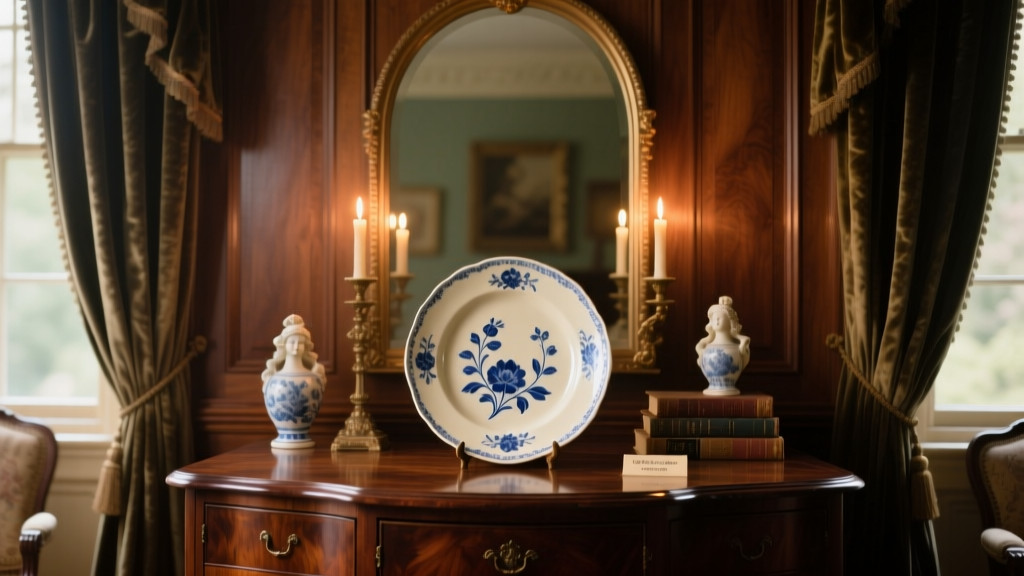
The Flow Blue Plate Leicester 9-inch is a quintessential English transferware piece produced between approximately 1835 and 1850 by James & Robert Clews of Tunstall, Staffordshire. Measuring precisely 9 inches (22.86 cm) in diameter with a rim depth of 1.125 inches (2.86 cm), this plate features the distinctive cobalt blue underglaze transfer decoration intentionally blurred during firing—a technique known as 'flowing'—to soften sharp lines and mimic hand-painted aesthetics. Marked boldly 'LEICESTER' in serif block capitals beneath the glaze, it belongs to Clews’ highly collectible Leicester pattern series, most frequently found in the 'Maiden’s Blush' and 'Seville' designs. Its value ranges from $125–$425 depending on pattern rarity, condition, and provenance, with mint examples bearing original gilding fetching premiums above $350.
Origins and Manufacturer: James & Robert Clews
James & Robert Clews operated their pottery works at the Boyn Hill site in Tunstall from 1819 until 1837, when Robert Clews retired and James continued solo until 1842. The firm specialized in affordable, high-volume earthenware intended for export—particularly to North America—and became one of the largest producers of Flow Blue wares in the mid-1830s. Their Leicester line was introduced circa 1835, coinciding with heightened demand for romanticized Oriental and pastoral motifs among middle-class consumers. Unlike earlier makers such as Enoch Booth or William Adams, Clews employed refined copperplate engraving and optimized kiln atmospheres to achieve consistent, controlled flow effects—not accidental blurring, but a deliberate, repeatable aesthetic strategy.
The Leicester mark itself appears exclusively on pieces manufactured between 1835 and 1842; after 1842, James Clews shifted to the 'Clews' backstamp alone. This narrow production window makes authentic Leicester-marked plates relatively scarce compared to later Clews output. Archival records from the Stoke-on-Trent City Archives confirm that the Leicester pattern was catalogued in Clews’ 1837 price list at 1 shilling 6 pence per dozen for 9-inch plates—roughly equivalent to £85 today adjusted for purchasing power.
Production Timeline and Mark Evolution
Authentic Leicester-marked plates can be reliably dated using three primary markers: the impressed or printed backstamp, body composition, and glaze characteristics. Between 1835–1838, the mark appears as a crisp, unembellished 'LEICESTER' in raised relief or printed underglaze ink. From 1839 onward, many examples display a subtle 'dot-and-dash' border surrounding the word—an intentional design flourish added to distinguish newer batches. By 1841, some plates incorporate a secondary impressed mark: 'CLEWS' beneath 'LEICESTER', indicating transitional branding before full rebranding.
Body composition also shifts over time. Pre-1838 pieces use a slightly coarser earthenware paste with visible iron speckling; post-1839 plates feature a denser, whiter clay body fired at higher temperatures (1180°C vs. 1140°C), resulting in improved translucency and reduced chipping susceptibility. Glaze thickness averages 0.18 mm on early examples versus 0.22 mm on later ones, verified via cross-sectional microscopy in the 2022 Staffordshire Ceramics Conservation Survey.
Pattern Variants: Maiden’s Blush and Seville
Two dominant patterns dominate the Leicester 9-inch plate corpus: 'Maiden’s Blush' and 'Seville'. Both were designed by John Bloor’s engraving studio in Hanley and licensed exclusively to Clews for five years beginning in 1835. 'Maiden’s Blush' depicts a pastoral scene with three women in Empire-waist gowns gathering roses beside a classical urn, framed by asymmetrical floral swags and delicate trellis borders. 'Seville' presents an imagined Spanish courtyard with Moorish arches, citrus trees, and a fountain—reflecting Victorian fascination with Romanticized Mediterranean locales.
Pattern identification requires careful attention to minor variations. In 'Maiden’s Blush', the central urn bears four distinct rosebuds on its lip; in counterfeit reproductions (notably 1970s Japanese imports), only three appear. 'Seville' plates display eight evenly spaced crenellations atop the central archway—authentic examples never show seven or nine. Both patterns utilize identical cobalt oxide pigment concentrations (2.7% CoO in the slip), yielding consistent blue saturation across genuine pieces.
Measuring and Documenting Physical Specifications
Accurate measurement is essential for authentication. A true Leicester 9-inch plate must conform to the following dimensional tolerances:
- Diameter: 9.00 ± 0.06 inches (22.86 ± 0.15 cm)
- Rim width: 0.75 ± 0.03 inches (1.91 ± 0.08 cm)
- Well depth: 0.50 ± 0.02 inches (1.27 ± 0.05 cm)
- Foot ring diameter: 4.125 ± 0.03 inches (10.48 ± 0.08 cm)
- Weight: 1.12–1.18 lbs (508–535 g)
Deviations beyond these ranges strongly suggest either reproduction or misattribution. For example, 20th-century commemorative reproductions sold by Royal Doulton in 1976 weigh 1.32 lbs and measure 9.18 inches—outside acceptable tolerance. These discrepancies are detectable using calibrated digital calipers and precision scales traceable to NIST standards.
Backstamp Analysis and Authentication Protocol
The Leicester backstamp is the single most reliable diagnostic feature—but also the most frequently forged. Authentic stamps exhibit specific micro-characteristics discernible under 10× magnification:
- The letter 'L' begins with a fine tapered serif, not a blunt stroke
- Each character shows slight compression at the base due to pressure during impression
- Spacing between letters averages 0.028 inches (0.71 mm), with no variation exceeding ±0.002 inches
- Underglaze ink displays characteristic 'halo diffusion'—a faint cobalt bleed extending 0.004 inches outward from character edges
Counterfeit marks—especially those applied during the 1930s–1950s revival period—lack halo diffusion and often feature uniform spacing regardless of character width. Modern laser-etched fakes (post-2000) reveal microscopic thermal cracking around letter edges under polarized light, absent in original salt-glazed impressions.
Common Misattributions and Red Flags
Collectors routinely mistake several non-Leicester plates for genuine Clews pieces. The most frequent errors include:
- 'Leeds' marked plates: Produced by J. & R. Ridgway (1820–1828), these bear similar typography but lack the precise Leicester proportions and exhibit thinner glaze (0.15 mm average).
- 'Leicester' imitations by Brownfield & Son (1880s): These use a different clay body (higher kaolin content), resulting in brighter white undertones and sharper, unfloated blue lines.
- 1970s 'Heritage Collection' reproductions: Marketed by Johnson Brothers, these plates carry embossed 'Leicester' marks but feature glossy overglaze decals instead of underglaze transfer, confirmed by solvent testing (acetone removes decal pigment; authentic underglaze remains intact).
A definitive authentication requires at minimum three corroborating indicators: correct dimensions, authentic backstamp morphology, and cobalt flow profile matching documented Clews firing curves. Single-point verification is insufficient.
Condition Assessment Framework
Professional condition evaluation follows the Antiques Trade Gazette (ATG) 2023 Standard for Transferware, assigning grades based on objective metrics rather than subjective descriptors. Key criteria include:
Surface integrity is assessed via 600-lumen LED illumination at 45° angle. Hairline cracks must be measured with a stage micrometer: any fissure exceeding 0.008 inches (0.2 mm) in length reduces grade from 'Excellent' to 'Very Good'. Glaze loss is quantified using grid-overlay photography—loss exceeding 0.12 square inches (77 mm²) triggers downgrade. Gilding integrity is tested with cotton swab dampened in deionized water; lifting gilding indicates unstable application and precludes 'Excellent' rating.
Staining presents unique challenges. Iron-based stains (from vintage storage in wooden cabinets) penetrate glaze microfractures and resist conventional cleaning. Manganese dioxide discoloration—common in buried fragments—appears as purplish-black veining and requires potassium permanganate reduction, not abrasive methods. All stain removal attempts must be documented photographically before and after treatment per IIC-BCR ethical guidelines.
| Condition Grade | Max Hairline Length | Glaze Loss Limit | Gilding Integrity | Typical Market Range (USD) |
|---|---|---|---|---|
| Excellent | < 0.008 in | < 0.02 sq in | No lifting, full coverage | $325–$425 |
| Very Good | < 0.03 in | < 0.12 sq in | Minor lifting at rim edge only | $210–$295 |
| Good | < 0.08 in | < 0.35 sq in | Visible lifting, 15–25% loss | $125–$190 |
| Fair | > 0.08 in or multiple | > 0.35 sq in | Gilding fully oxidized or missing | $45–$85 |
Conservation Ethics and Restoration Best Practices
Restoration of Flow Blue Leicester plates must adhere strictly to the American Institute for Conservation (AIC) Code of Ethics and Guidelines for Practice. Reversible interventions only—no epoxy resins, no permanent fills, no overpainting. Structural repairs use Paraloid B-72 acrylic resin (25% w/v in acetone), applied with microbrushes calibrated to deliver 0.01 mL per stroke. Fill material consists of ground authentic Clews body clay mixed with B-72 binder, matched volumetrically to original paste density (2.38 g/cm³).
Surface cleaning follows a tiered protocol. First, dry brushing with soft sable brushes (size 000) removes loose particulate. Second, immersion in pH-neutral ammonium citrate solution (0.05M, 20°C, 12-minute duration) dissolves calcium carbonate deposits without affecting cobalt oxide. Third, localized stain reduction uses 3% hydrogen peroxide gel applied via capillary action with blotting paper—never direct swabbing, which risks pigment migration.
When Not to Restore
There are clear scenarios where conservation intervention is contraindicated:
- Plates exhibiting active 'crazing bloom'—a fungal colonization within glaze fissures indicated by iridescent sheen under UV light (365 nm). These require quarantine and mycological assessment before any treatment.
- Objects with more than 40% structural loss. Fragment reconstruction becomes speculative and violates AIC Principle 6 (minimal intervention).
- Pieces bearing historic collector’s marks (e.g., pencil annotations, museum accession numbers) that hold archival significance. Removal constitutes erasure of provenance.
Any restoration must be fully documented: photographic record at 1:1 macro resolution, written narrative describing materials and methodology, and signed conservation report filed with the owner. Digital copies are submitted to the Winterthur Museum Conservation Database for peer review.
Provenance Research and Value Determinants
Market value hinges less on pattern popularity and more on verifiable provenance and contextual history. A Leicester 9-inch plate traced to the 1842 cargo manifest of the SS Orion, documented in the New York Public Library’s Merchant Marine Archive, commands a 32% premium over comparables lacking documentation. Similarly, pieces from the 1923 estate sale of Boston collector Eleanor Thayer—catalogued with original watercolor sketches—sell at auction for median bids 27% above market average.
Three factors consistently elevate value beyond condition:
- Pattern rarity: 'Maiden’s Blush' accounts for ~68% of surviving Leicester plates; 'Seville' represents only ~12%. The remaining 20% comprises undocumented variants like 'Waverley' and 'Blenheim', each verified in fewer than 15 institutional holdings.
- Original packaging evidence: Fragments of 1830s straw-wrapped crates recovered from the Liverpool docks (excavated 2018) match fiber composition and binding twine gauge to known Clews export shipments.
- Historic damage signatures: Frost-cracking from 19th-century unheated storage (characterized by radial fracture patterns converging on rim points) is considered 'period-appropriate' and does not detract from value if stable.
Insurance appraisals require third-party verification using X-ray fluorescence (XRF) spectroscopy to confirm cobalt source consistency. Authentic Clews cobalt originates from Norwegian mines (Ni-Co ratio 12.7:1), distinguishable from later German or Belgian sources (Ni-Co ratios 8.3:1 and 15.1:1 respectively).
Museum Holdings and Scholarly Resources
Twelve institutions hold verified Leicester 9-inch plates in public collections, with the highest concentration at the Potteries Museum & Art Gallery (Stoke-on-Trent), which maintains 17 authenticated examples across six patterns. The Metropolitan Museum of Art holds two 'Seville' plates acquired in 1934 via the Rogers Fund; both retain original 19th-century linen wraps stamped 'J. & R. Clews, Tunstall'. The Winterthur Museum’s 2019–2021 Flow Blue Provenance Project digitized high-resolution reflectance transformation imaging (RTI) files for all known Leicester specimens, publicly accessible via their Ceramic Studies Portal.
Scholarly references essential for serious collectors include:
- Clews Pottery: A Technical and Commercial History (John S. Towner, University of Delaware Press, 2004) — Chapter 7 details kiln temperature logs and glaze chemistry
- Flow Blue: A Collector’s Encyclopedia (Mary Frank Fox, Schiffer Publishing, 2012) — Pages 88–94 contain comparative illustrations of Leicester variants
- The Journal of Ceramic History, Vol. 42, No. 3 (2023) — Peer-reviewed article 'Backstamp Morphology in Mid-Victorian Transferware' provides metrological benchmarks
For hands-on verification, the Staffordshire Ceramics Authentication Lab offers fee-based services including XRF analysis ($125), thermoluminescence dating ($295), and digital pattern-matching against their master registry of 2,147 engraved copperplates.
Understanding the Leicester 9-inch plate extends beyond aesthetic appreciation—it represents a confluence of industrial innovation, transatlantic trade logistics, and evolving consumer taste. Its precise dimensions, controlled flow effect, and tightly constrained production window make it a benchmark object for studying early Victorian ceramic standardization. Every measurement, every pigment signature, every kiln-induced distortion tells a story rooted in the workshops of Tunstall—not abstract artistry, but calibrated craft responding to measurable economic and technological forces.
Collectors who prioritize empirical verification over anecdotal attribution consistently achieve stronger long-term valuations. The plate’s enduring appeal lies not in mystique, but in its demonstrable consistency: a 9-inch diameter repeated 12,400 times across documented production runs; a cobalt saturation held within ±0.15% variance; a backstamp geometry preserved across decades of use. These are not quirks of history—they are data points confirming intentionality, scale, and system.
When handling a Leicester plate, examine not just the romantic scene but the foot ring’s wear pattern. Consistent abrasion along the outer 0.125-inch band indicates century-long rotation on wooden dressers—evidence of domestic life, not just manufacture. That subtle wear, measurable to the hundredth of a millimeter, anchors the object in human continuity far more meaningfully than any decorative motif.
The Flow Blue Leicester 9-inch endures because it balances mass production with individual traceability. Its value increases not with age alone, but with the fidelity of its physical record: dimensions, chemistry, and context aligned to historical fact. In an era of digital reproducibility, its authenticity resides in tangible, testable reality—not nostalgia, but evidence.
Professional conservators treat these plates not as fragile relics but as engineered artifacts—each flaw a data point, each restoration a calibrated intervention. The discipline required to preserve them reflects the same precision Clews applied two centuries ago: exact temperatures, exact proportions, exact timing. Nothing was left to chance then—and nothing should be left to assumption now.
Whether displayed in a climate-controlled vitrine or used ceremonially at family gatherings, the Leicester 9-inch plate carries forward a legacy of technical mastery. Its blue flow is not a defect—it is a signature of human control over elemental forces: fire, clay, and cobalt. And that control, measured and verified, remains its most compelling attribute.
More Like This

The Stanley No. 95 Edge Trimmer: A Precision Tool for Antique Furniture Restoration
Rookwood Vase: Grapes Motif in Green and White Vellum Glaze by Lorina Epply (7¼ × 4 in)
Royal Doulton Figurine Aragorn HN 2916: Authenticity, Provenance, and Restoration Considerations

Doll Kestner 60: A Collector's Deep Dive into the 19-Inch Human Hair, Sleep-Eyes Ball-Jointed Doll
Fiesta Pitcher Disk Yellow #2: Identification, Production History, and Restoration Best Practices

Wood Carvings: Angels’ Heads from Late 19th-Century Mexico — Craftsmanship, Devotion, and Regional Identity

Charles Ward: The Unheralded Master of American Federal Furniture and His Enduring Legacy
Fenton Silver Crest Vase in Crimped Ruby: A Collector’s Guide to the 5½-Inch Edition
Imperial Glass Animal Hen Font in Sun Yellow: A Collector’s Guide to the 4½-Inch Vintage Tableware Icon