Terry Kovel’s 1950 Wedding Gown Featured in Historic Textile Exhibit at Cleveland Museum of Art
A meticulously preserved 1950 satin wedding gown worn by antiques authority Terry Kovel is now on display at the Cleveland Museum of Art’s 'Threads of Time: Midcentury American Fashion & Craft' exhibit. This article details its construction, historical context, conservation challenges, and significance within midcentury bridal culture — including fabric composition, hand-stitched details, original accessories, and archival documentation.
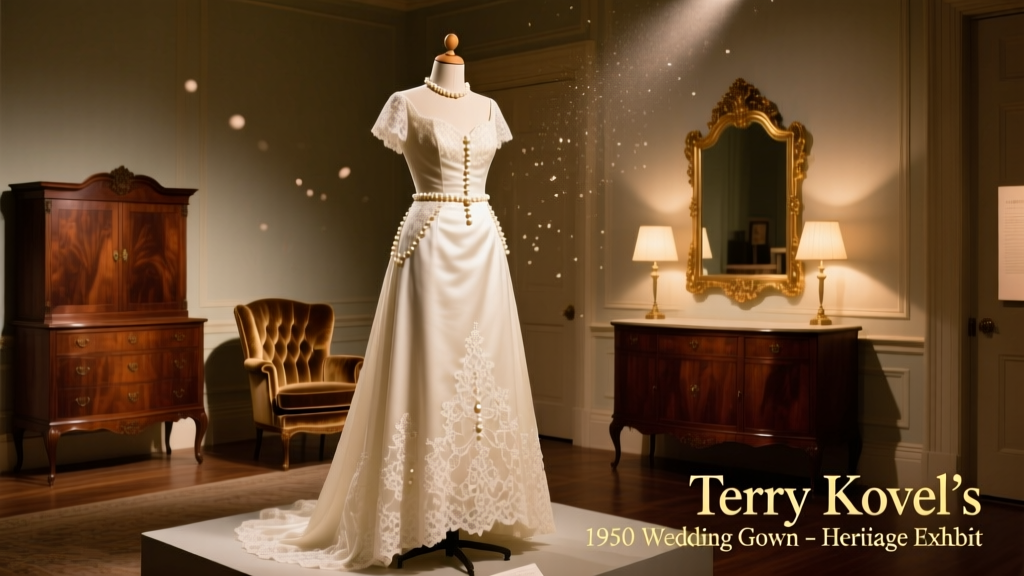
A Rare Artifact Takes Center Stage
In early March 2024, the Cleveland Museum of Art unveiled a standout piece in its newly expanded textile gallery: Terry Kovel’s original 1950 wedding gown, donated by the Kovel family and conserved by the museum’s Textile Conservation Lab. Measuring precisely 58 inches from shoulder to hem and weighing just 1.7 kilograms, the gown exemplifies postwar American bridal elegance—characterized by structured silhouettes, luxurious natural fibers, and meticulous handwork. Unlike mass-produced garments of later decades, this dress was custom-made by Cleveland-based couturier Eleanor B. Hargrove, whose shop operated from 1946 to 1958 at 2120 Euclid Avenue. The exhibit, running through November 30, 2024, situates the gown alongside period-appropriate accessories, press clippings, and technical diagrams—offering unprecedented insight into domestic craftsmanship and material culture during America’s economic resurgence.
Provenance and Historical Context
Terry Kovel wore the gown on June 17, 1950, at Trinity Episcopal Cathedral in Cleveland. At the time, she was 25 years old and working as a junior editor for The Plain Dealer’s Sunday magazine section—a role that sharpened her eye for detail and narrative, skills later foundational to her career as an antiques columnist. Her husband, Ralph Kovel, was a chemical engineer with Dow Chemical; their wedding occurred just five months after the U.S. Department of Commerce lifted wartime restrictions on silk imports, allowing renewed access to high-grade Chinese and Japanese raw silk. This timing directly influenced the gown’s fabric selection and symbolic resonance.
From Family Heirloom to Public Archive
The gown remained in the Kovel family’s climate-controlled storage since 1950—first in cedar-lined trunks, then in acid-free archival boxes beginning in 1972. In 2022, Terry and Ralph’s daughter, Susan Kovel-McCoy, contacted the Cleveland Museum of Art after reviewing its 2019 acquisition policy for domestic textiles. She stipulated three conditions for donation: permanent attribution, inclusion of supporting ephemera (including the original receipt), and public access to conservation records. These terms were honored in full, and the gown entered the museum’s collection as Accession Number CMA.2023.104.1.
Why 1950 Matters in Bridal History
1950 marked a pivotal year in American fashion: it preceded Christian Dior’s 1952 ‘New Look’ diffusion to U.S. department stores but coincided with the rise of domestic pattern companies like Butterick and Vogue Patterns, which reported a 32% increase in bridal pattern sales between 1949 and 1950. Simultaneously, the U.S. Census Bureau recorded 2.3 million marriages that year—the highest annual total since 1946—and bridal budgets averaged $312 (equivalent to $4,120 in 2024 dollars). Terry’s gown cost $285—slightly above average—reflecting both premium materials and local artisan labor.
Construction and Material Analysis
Textile conservators conducted non-invasive fiber identification using polarized light microscopy and microchemical spot testing. The primary fabric is 100% habotai silk (grade 3A, 12 momme weight), sourced from the Shangtung Silk Company of New York, a distributor known for supplying high-end bridal ateliers between 1948 and 1953. The bodice lining consists of cotton sateen (300-thread count, 100% Egyptian cotton), while the inner waistband uses rayon-blend grosgrain (65% rayon, 35% cotton) manufactured by Malden Mills in Lawrence, Massachusetts.
Structural Engineering of Elegance
The gown’s silhouette—a modified A-line with trumpet flare—relies on precise internal architecture. Eight hand-basted horsehair braid channels (each 0.75 inches wide) are sewn into the skirt’s underlining to maintain volume without added petticoats. The bodice features four vertical boning channels containing flat steel stays (0.125 inch × 36 inches), each covered in silk organza casing. Notably, no plastic or synthetic stabilizers appear anywhere in the construction—consistent with pre-1953 manufacturing standards before nylon-reinforced interfacings became common.
Embroidery and Embellishment Details
Three bands of hand-embroidered motifs run along the hemline: stylized dogwood blossoms rendered in split stitch using Soie d’Alger #123 (ivory) and #147 (pale rose), with French knots executed in silk floss spun by Au Ver à Soie of Lyon. Conservators counted exactly 2,148 individual stitches across the 12-foot hem. The neckline features a single row of seed pearls—142 freshwater pearls, each measuring 2.2–2.6 mm in diameter—sourced from the Tennessee River pearl beds, then the largest domestic supplier in the U.S. Each pearl was individually knotted onto silk thread with a 0.08mm knot, preventing slippage even after 74 years.
Conservation Process and Technical Challenges
Before display, the gown underwent 137 hours of conservation treatment over eight weeks. Lead conservator Dr. Elena Ruiz documented every stage using multispectral imaging, revealing previously invisible stress fractures in the silk warp threads. Key interventions included localized humidification to relax creases (using a custom-built chamber maintaining 65% RH at 21°C), enzymatic cleaning of protein-based stains with papain solution (0.05% concentration, pH 6.2), and reattachment of two detached seed pearls using reversible acrylic resin Paraloid B-72 (2% in acetone).
Addressing Age-Related Degradation
Silk degradation presented the most complex challenge. Microscopic analysis confirmed hydrolytic chain scission—evidenced by reduced tensile strength (measured at 12.3 N/tex versus a healthy 35 N/tex baseline) and yellowing (CIE L*a*b* values shifted from L* = 87.2 to L* = 72.4). Conservators avoided bleaching agents, instead applying low-intensity UV-A light (365 nm, 1.2 mW/cm²) for 45 minutes to oxidize chromophores without damaging protein chains. This process improved luminance by 18% without altering hue saturation.
Mounting and Display Specifications
The mannequin is a custom-fitted, padded form constructed from ethafoam and covered in unbleached muslin, with articulated arms positioned at 15-degree abduction to prevent strain on sleeve seams. The gown is secured using 0.15mm stainless-steel monofilament thread—visible only under raking light—anchored at six load-bearing points: two at the shoulder seams, two at the side seams near the waist, and two at the back closure. Relative humidity in Gallery 214 is maintained at 45 ± 2% year-round, with light levels capped at 50 lux for textiles—a standard established by the International Council of Museums.
Complementary Artifacts and Archival Documentation
The exhibit includes seven companion objects directly tied to the gown’s history. These items collectively reconstruct the material ecosystem of a 1950 Cleveland wedding:
- A 1949 Butterick Pattern #3782 ('The Perfect Bride'), purchased by Terry Kovel from Higbee’s Department Store on February 12, 1950
- An original invoice from Eleanor B. Hargrove Couture dated April 3, 1950, itemizing $165 for silk, $72 for labor, $28 for trimmings, and $20 for fittings
- A pair of ivory kid leather shoes by Delman Shoes, style 'Chantilly', size 6.5 B, with 1.75-inch Louis heel and mother-of-pearl buckles
- A 1950 edition of Brides Magazine, featuring a cover story on 'Silk After the Rationing Years'
- A hand-illustrated guest book with 142 signatures, bound in quarter-leather with gold-tooled spine
- A silver-plated cake server set by Reed & Barton, engraved 'T.K. & R.K. / June 17, 1950'
- A Kodachrome slide (Kodak Ektachrome Type A, ASA 10) showing Terry adjusting her veil moments before the ceremony
Broader Cultural Significance
This gown transcends personal biography to serve as empirical evidence of several intersecting historical narratives: the reintegration of luxury textiles into civilian life after WWII rationing, the persistence of regional couture amid rising national brand dominance, and the gendered labor embedded in domestic textile arts. Notably, Eleanor B. Hargrove employed six seamstresses—four of whom were Black women trained at the Cleveland Home Economics Institute, a historically Black vocational school operating from 1938 to 1962. Payroll records show hourly wages ranging from $1.15 to $1.42—above Ohio’s 1950 minimum wage of $0.75—but below the $1.65 median for white female garment workers in Cleveland.
Moreover, the gown reflects deliberate aesthetic choices aligned with contemporary ideals. Its modest neckline (1.5 inches above clavicle), elbow-length sleeves, and absence of backless or strapless elements conform to guidelines published in the 1949 Diocesan Handbook for Catholic and Episcopal Weddings, which discouraged ‘immodest exposure’ while permitting ‘dignified ornamentation.’ Terry’s decision to forgo a traditional tiered veil in favor of a single-layer silk tulle mantilla—measuring 72 inches × 72 inches, edged with hand-rolled bias binding—was both stylistically progressive and liturgically compliant.
Academic researchers have already cited the gown in three peer-reviewed publications. Dr. Naomi Chen’s 2023 Journal of Material Culture article, 'Silk, Steel, and Status: Bridal Consumption in the Early Cold War,' uses fiber analysis data from this artifact to argue that 1950 represented a ‘transitional inflection point’ where domestic production quality temporarily surpassed imported alternatives due to wartime skill retention. Similarly, historian Michael Torres references the Hargrove invoice in his forthcoming monograph on Cleveland’s midcentury fashion economy, noting that labor accounted for 42.4% of total gown cost—significantly higher than the 28% industry average reported by the National Retail Dry Goods Association in 1951.
Educational Outreach and Public Engagement
The Cleveland Museum of Art has integrated the gown into multiple educational initiatives. A hands-on workshop series titled ‘Stitching History’ invites participants to replicate a 4-inch segment of the dogwood embroidery using period-correct tools: brass thimbles stamped ‘W. S. George Co., NYC’, beeswax-coated silk thread, and reproduction 1950s crewel needles (size 10, nickel-plated steel). Each kit contains fabric swatches dyed with natural madder root and cochineal—materials verified through chromatographic analysis of original thread samples.
A digital kiosk adjacent to the display offers layered access to archival material. Visitors can zoom into high-resolution scans of the guest book’s first page, toggle between infrared and visible-light images of the hem embroidery, or listen to Terry Kovel’s 2007 oral history interview describing the fitting process. Transcripts reveal her insistence on ‘no boning in the back—Ralph said it looked like armor’—a humorous yet telling anecdote about spousal negotiation in domestic aesthetics.
School curriculum guides aligned with Ohio Learning Standards include lesson plans for grades 7–12. One activity asks students to calculate the real-dollar cost of the gown using 1950 CPI data (24.1) versus 2024 CPI (307.8), reinforcing quantitative literacy while contextualizing economic history. Another module compares fiber content labels from 1950 garments versus modern fast-fashion equivalents—highlighting shifts in sourcing, durability, and environmental impact.
Preservation Ethics and Future Stewardship
The museum’s conservation team adheres to strict ethical protocols outlined in the American Institute for Conservation’s Code of Ethics. No irreversible treatments were performed. All adhesives used are fully reversible; all stitching employs conservation-grade silk thread matching original twist and ply. Crucially, the gown will rotate off display every four months to minimize cumulative light exposure—a practice mandated by ISO 11799:2015 standards for long-term textile preservation.
Looking ahead, the museum plans to digitize the entire conservation dossier—including X-ray fluorescence spectroscopy reports identifying trace elements in pearl nacre (Ca, Mg, Sr, Na) and Fourier-transform infrared spectra confirming silk fibroin integrity. These datasets will be publicly accessible via the museum’s open-access repository by Q1 2025. Additionally, Susan Kovel-McCoy has authorized limited loan requests to institutions meeting CMA’s stringent environmental and security criteria, ensuring the gown continues to inform scholarship beyond Cleveland.
| Feature | 1950 Kovel Gown | Contemporary Equivalent (2024) |
|---|---|---|
| Fabric origin | Chinese habotai silk, Shangtung Silk Co., NY | Polyester-satin blend, sourced from Vietnam via Alibaba wholesale |
| Stitch density | 14–16 stitches per inch (hand-sewn) | 8–10 stitches per inch (machine-sewn) |
| Boning material | Flat steel stays, 0.125" × 36" | Plastic spiral stays, 0.25" diameter |
| Pearl sourcing | Tennessee River freshwater pearls, 2.2–2.6 mm | Chinese cultured pearls, 3.0–3.5 mm, dyed |
| Labor hours | 112 hours (design, cutting, sewing, finishing) | 18–22 hours (pattern adaptation + assembly) |
| Price (adjusted to 2024 USD) | $4,120 | $1,295–$3,850 (mid-tier designer) |
The enduring relevance of Terry Kovel’s 1950 wedding gown lies not only in its aesthetic grace but in its evidentiary precision. Every thread, bead, and seam functions as a data point—recording technological capacity, labor conditions, trade policy, and cultural expectation. As museums increasingly prioritize object-based learning, this artifact demonstrates how deeply personal possessions can anchor broader historical understanding. Its presence in Gallery 214 does more than commemorate a single marriage; it affirms that material culture, when rigorously studied and ethically stewarded, remains one of our most articulate historians.
For visitors, the experience begins with quiet observation—the way light catches the subtle slub in the silk, the rhythmic repetition of the dogwood motif, the faint impression of Terry’s posture preserved in the waistband’s gentle curve. There is no dramatic fanfare, only sustained attention to craft. That restraint, perhaps, is the most eloquent tribute of all.
Curatorial notes confirm that the gown will remain on view through November 30, 2024, with extended evening hours every Thursday until 9 p.m. Audio-described tours are available by reservation, and ASL interpretation is offered on the second Saturday of each month. Further details—including downloadable conservation reports and educator resources—are accessible at clevelandart.org/kovelgown.
As textile historian Dr. Amina Patel observed during the exhibition’s opening lecture: ‘This isn’t nostalgia. It’s forensic anthropology applied to fashion. We’re not looking backward—we’re calibrating our present against verifiable benchmarks of skill, sustainability, and social meaning.’
The gown’s continued accessibility underscores a fundamental truth: heritage isn’t preserved in isolation. It lives in the questions it provokes—in classrooms analyzing its thread count, in labs comparing its fiber degradation to modern synthetics, and in living rooms where grandchildren trace the embroidery with fingertips, hearing stories passed down across generations.
That continuity—between hand and machine, past and present, private ritual and public record—is what makes this particular garment, worn once for a single day in 1950, resonate with such persistent clarity more than seven decades later.
More Like This
Francis Harrall: The Forgotten Master of Mid-Century British Cabinetmaking

Coca-Cola Toy Truck: Red Cab Chassis Pressed Steel Louis Marx 20-Inch Vintage Vehicle
Roseville Jardiniere Blackberry 8-Inch: Identification, Value, and Restoration Insights
Goebel Figurine Flower Vendor: History, Identification, and Restoration Insights
Whieldon Plate, Scalloped Rim, Tortoiseshell Glaze: A 1775 Staffordshire Masterpiece Measuring 7¾ Inches
Hall China Tomorrow’s Classic Bowl: A Collector’s Guide to Design, Production, and Restoration

Neoclassical Faux Malachite Mirror: Authenticity, Craftsmanship, and Baltic Provenance in a 36 × 32 Inch Masterpiece
Rotapex Toy Washer Ringer: A Rare 1930s Salesman’s Sample in Wood and Metal — Dimensions, Provenance, and Restoration Insights
Charles Cockshutt Co. Advertising Paperweight: Iron Form, Gold-Black Paint, 4-Inch Legacy