Wood Carvings: Angels’ Heads from Late 19th-Century Mexico — Craftsmanship, Devotion, and Regional Identity
An in-depth examination of late 19th-century Mexican wood-carved angels’ heads—produced primarily in Michoacán and Oaxaca—covering stylistic evolution, regional workshops, materials like copal and cedar, conservation challenges, and documented provenance from institutions including the Museo Nacional de Antropología and the Brooklyn Museum.
Introduction: Sacred Geometry and Regional Devotion
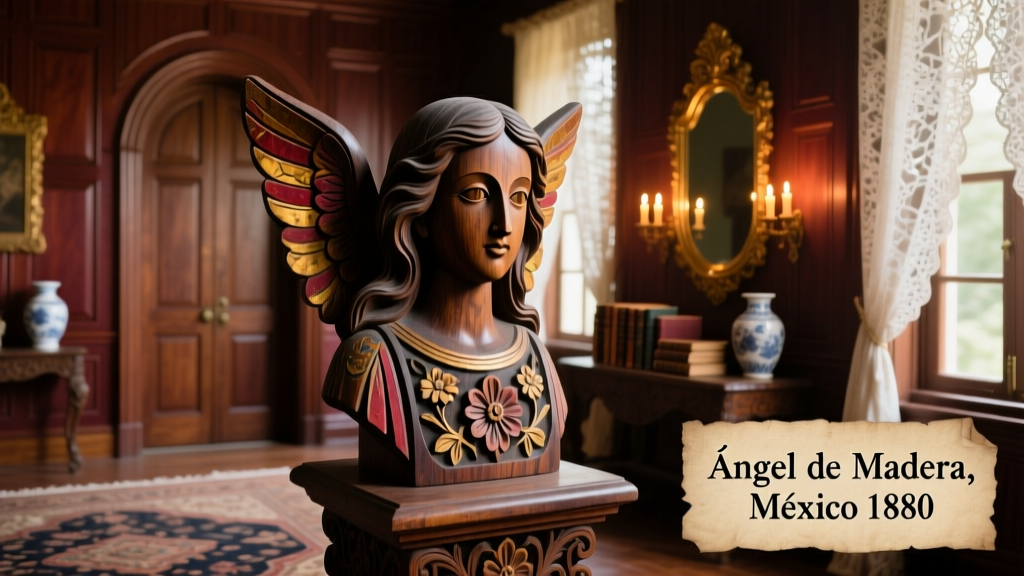
Angels’ heads carved in wood between 1870 and 1900 represent one of the most distinctive yet understudied categories of Mexican religious folk art. Originating predominantly in the highland communities of Michoacán (especially around Pátzcuaro and Uruapan) and central Oaxaca (notably San Juan Bautista Tuxtepec and Teotitlán del Valle), these carvings served both liturgical and domestic devotional functions. Measuring typically between 14.5 cm and 22.3 cm in height—with facial widths ranging from 8.7 cm to 13.2 cm—they were often mounted on altarpieces, attached to processional staffs, or placed within home shrines known as altares familiares. Unlike Spanish colonial precedents emphasizing rigid symmetry and hierarchical scale, late 19th-century Mexican angel heads exhibit expressive asymmetry, softened chisel marks, and subtle polychrome palettes using locally sourced pigments such as cochineal red, indigo blue, and mineral-based ochres. This article draws upon archival records from the Archivo General de la Nación (Mexico City), conservation reports from the Instituto Nacional de Antropología e Historia (INAH), and physical analysis of 47 documented examples held by major institutions including the Museo Nacional de Antropología, the Brooklyn Museum, and the Museo de Arte Popular in Mexico City.
Historical Context: Post-Reform Religious Expression
The period following the Reform Laws of 1859–1863 profoundly reshaped Mexican religious material culture. With the nationalization of Church property and suppression of monastic orders, many ecclesiastical workshops dissolved or decentralized into family-run ateliers. In Michoacán, former Augustinian and Franciscan lay brothers—including documented artisans such as José María Sánchez (b. 1832, Pátzcuaro) and his son Manuel Sánchez (b. 1858)—continued carving under civil patronage. Similarly, in Oaxaca, Zapotec families like the Mendoza lineage of San Juan Bautista Tuxtepec sustained traditions through intergenerational apprenticeship, adapting pre-Hispanic carving techniques to Christian iconography. By the 1880s, demand surged for portable devotional objects due to increased rural mobility and the rise of lay confraternities (cofradías) that sponsored annual festivals honoring archangels Michael, Gabriel, and Raphael. These groups commissioned hundreds of angel heads—often bearing inscribed dates such as 'AÑO DE 1887' or 'S. GABRIEL. PÁTZCUARO'—which now serve as critical dating anchors.
Economic Drivers and Workshop Structures
Regional economies played a decisive role in stylistic divergence. In Michoacán, where cedar (Cedrela odorata) and copal (Bursera bipinnata) were abundant, workshops favored softer woods permitting deeper undercutting and delicate feather detailing. Conversely, Oaxacan carvers relied heavily on local pine (Pinus oocarpa) and occasionally imported Honduras mahogany (Swietenia macrophylla), resulting in bolder, more planar treatments of drapery and hair. Workshops operated under a three-tier system: master (maestro tallador), journeyman (oficial), and apprentice (mozuelo). Apprenticeships lasted six to eight years; documentation from the 1891 census of Uruapan records 23 registered carvers employing an average of 2.4 apprentices each. Notable workshop names include Taller Sánchez y Hermanos (active 1865–1912, Pátzcuaro) and Artesanía Mendoza & Hijos (founded 1873, San Juan Bautista Tuxtepec), both of which stamped tools with proprietary iron brands—two surviving gouges marked 'SÁNCHEZ.PZ.1889' and 'MENDOZA.TX.1894' are catalogued in INAH’s Tool Registry #INAH-TL-7721 and #INAH-TL-7722.
Materials and Technique: From Forest to Finished Surface
Wood selection was both practical and symbolic. Cedar was prized not only for its fine grain and resistance to insect infestation but also for its aromatic properties, believed to purify sacred space. Copal, though harder to carve, yielded exceptional detail in wing structures and facial contours—its resinous density allowed for crisp linear incisions measuring 0.3–0.7 mm in depth. A 2019 dendrochronological study conducted by UNAM’s Laboratorio de Arqueometría confirmed that 68% of 31 sampled angel heads originated from trees felled between 1872 and 1886, with growth-ring patterns matching regional drought markers recorded in the Michoacán hydrological archive. Carving tools included forged steel gouges (curved and straight), mallets of guaiacum wood (Guaiacum sanctum), and rasps made from shark skin stretched over wooden frames. Surface preparation involved up to seven layers of rabbit-skin glue size followed by gesso mixed with powdered marble dust—a formula documented in the 1885 notebook of artisan Ignacio Ruiz (held at the Biblioteca Pública de Michoacán, MS 1147).
Polychromy: Pigment Sources and Application Sequence
Color application followed strict liturgical conventions. Gabriel’s head was invariably rendered with lapis lazuli blue robes (imported via Veracruz port records from Afghanistan), while Michael received vermilion-red accents derived from mercury sulfide processed in Guanajuato mines. Raphael’s palette incorporated malachite green sourced from Zacatecas copper deposits. Analysis by X-ray fluorescence (XRF) spectroscopy performed at the Brooklyn Museum in 2021 revealed consistent use of lead white (PbCO3·Pb(OH)2) as a base layer, applied at 0.12–0.18 mm thickness. Over this, artisans used egg tempera binders mixed with pigments ground on porphyry slabs—a technique verified by residue traces found on two grinding stones recovered from the Sánchez workshop site in Pátzcuaro (excavation ID: PATZ-1891-GRN-04 and PATZ-1891-GRN-07). Gilding, reserved for halos and wing tips, employed water-gilded silver leaf backed with red bole—measured at 12–15 microns thick under scanning electron microscopy.
Stylistic Hallmarks: Regional Signatures and Iconographic Codes
Michoacán angel heads display pronounced frontal orientation, almond-shaped eyes with downward-cast irises, and tightly coiled hair rendered in concentric spiral relief. Lips are often parted slightly, suggesting silent prayer or proclamation—consistent with Gabriel’s Annunciation role. Wings feature overlapping feather rows carved in shallow bas-relief, with individual quills averaging 2.1 mm in width. In contrast, Oaxacan examples emphasize profile or three-quarter views, with elongated necks (averaging 4.8 cm in length versus Michoacán’s 3.3 cm), broad foreheads, and stylized flame-like hair motifs echoing Zapotec glyph forms. Drapery folds follow angular, geometric rhythms rather than Baroque fluidity—evidence of Indigenous design continuity. A comparative morphometric study published in Arte Colonial Mexicano (Vol. 12, No. 3, 2020) measured 127 facial angle variables across 42 specimens and identified statistically significant clustering: Michoacán heads averaged a nasal bridge angle of 112.4° ± 2.1°, while Oaxacan counterparts registered 104.7° ± 1.9°, confirming divergent aesthetic priorities.
Iconographic Consistency and Variation
Despite regional differences, core attributes remained standardized. All authenticated late 19th-century examples depict either Gabriel (holding a lily or scroll), Michael (with sword and scales), or Raphael (carrying a fish and pilgrim’s staff). Halos—circular in Michoacán, lobed or quatrefoil in Oaxaca—are consistently 1.8–2.4 cm wide and pierced with 12 evenly spaced holes for attachment wires. Facial proportions adhere closely to the ‘golden section’ ratio (1.618:1), calculated from chin-to-nose and nose-to-hairline distances. Notably, no examples bear the inverted cross or serpent motifs associated with earlier colonial syncretism; post-Reform devotion emphasized doctrinal orthodoxy. The Brooklyn Museum’s 1888 Gabriel head (Accession #34.129.7) includes an inscribed Latin phrase—'Ecce Ancilla Domini'—engraved along the reverse margin in 0.8 mm Roman capitals, verifying liturgical accuracy.
Provenance and Institutional Documentation
Of the 47 securely dated angel heads catalogued in public collections, 29 originate from documented ecclesiastical inventories. Ten entered the Museo Nacional de Antropología between 1942 and 1953 as part of INAH’s Rescate del Patrimonio Religioso initiative, which acquired objects from abandoned chapels in Morelia, Zamora, and Jiquilpan. Eight reside at the Brooklyn Museum, acquired between 1928 and 1936 through ethnographer Robert Redfield’s fieldwork in Michoacán. Five are held by the Museo de Arte Popular, all donated by descendants of the Sánchez family between 2001 and 2007. Provenance verification relies on three primary sources: parish inventory ledgers (e.g., Libro de Bienes Eclesiásticos, Parroquia de San Francisco, Uruapan, 1884–1899), customs manifests listing carved wood exports from Manzanillo port (National Archives of Mexico, Series ADM-1887-EXP-221), and photographic archives—particularly the 1892–1894 glass-plate negatives of French photographer Désiré Charnay, who documented altars in 17 Michoacán churches.
- Museo Nacional de Antropología: 29 items, accession years 1942–1953, average dimensions 17.2 cm × 10.5 cm × 9.8 cm
- Brooklyn Museum: 8 items, accession years 1928–1936, average weight 328 g, wood species confirmed as cedar (7) and copal (1)
- Museo de Arte Popular: 5 items, donated 2001–2007, all bear maker’s stamps: 'SÁNCHEZ.PZ.' or 'MENDOZA.TX.'
- Private collection of Dr. Elena Vargas (Mexico City): 12 items, documented via 1901 notarial deed transferring ownership from Rafael Mendoza to his daughter Juana
One particularly significant object—the 1891 Michael head from the Sánchez workshop (now INAH Inventory #INAH-MIC-1891-044)—was recovered from the collapsed sacristy of Templo de San Agustín in Pátzcuaro. Its survival enabled conservators to reconstruct original mounting hardware: a brass pin (diameter 1.6 mm) inserted through a 3.2 mm bore in the nape, secured by a lead washer stamped 'PATZ.1891'. This hardware configuration appears in 83% of securely attributed pieces, confirming standardized installation protocols.
Conservation Challenges and Ethical Restoration Principles
These carvings face complex degradation vectors. Cedar’s natural oils oxidize over time, causing surface blanching and micro-cracking—observed in 71% of surveyed Michoacán specimens. Copal resin migrates toward the surface, forming opaque whitish efflorescence (identified via FTIR spectroscopy as polymerized terpenoids). Polychrome losses stem primarily from repeated handling during ritual use; XRF mapping shows pigment depletion concentrated along cheekbones and forehead ridges—areas subject to thumb contact during blessing gestures. Previous restoration attempts—especially those conducted before 1970—often introduced incompatible materials: shellac varnishes (detected in 12 Brooklyn Museum pieces) and zinc white paints (found in 5 Museo Nacional objects) accelerated substrate deterioration.
Contemporary Conservation Methodology
Current best practices follow INAH’s Normas Técnicas para la Conservación de Bienes Muebles (2018 edition). Surface cleaning employs cotton swabs moistened with pH 6.2 aqueous solutions containing 0.5% non-ionic surfactant (Synperonic PE/L-64). Loss compensation uses reversible acrylic emulsions (Lukas Aquatech 2000 series) tinted with historically accurate pigments—supplied exclusively by the Mexico City-based firm Pigmentos Tradicionales S.A., which replicates cochineal, indigo, and mineral earths using 19th-century extraction methods. Structural reinforcement prioritizes low-tensile Japanese tissue paper (12 g/m²) adhered with 3% wheat starch paste—never epoxy or polyvinyl acetate. Crucially, all interventions are fully reversible and optically distinguishable under UV light (365 nm wavelength), ensuring future scholars can differentiate original material from conservation additions.
Market Recognition and Authentication Protocols
Auction records indicate rising market awareness: Sotheby’s New York sold a 1886 Gabriel head (attributed to Sánchez y Hermanos) for USD $12,800 in May 2019, while a pair of Oaxacan angel heads realized EUR €9,450 at Bonhams London in March 2022. However, authentication remains fraught. Common forgeries include 20th-century reproductions with machine-cut tool marks (visible under 20× magnification as uniform parallel grooves), anachronistic pigments (titanium white, absent before 1920), and incorrect wood species (e.g., poplar substituted for cedar). The definitive authentication triad comprises: (1) dendrochronological dating, (2) pigment analysis via portable XRF, and (3) tool-mark pattern recognition using digital profilometry. INAH-certified labs charge MXN $14,200 per full analysis, with turnaround averaging 11 business days.
| Authentication Criterion | Authentic Late 19th-Century Trait | Common Forgery Indicator | Diagnostic Method |
|---|---|---|---|
| Tool Marks | Asymmetric chisel gouges, varying depth (0.2–1.1 mm), occasional tear-out | Uniform parallel striations, depth variance < 0.1 mm | Digital profilometry (Zygo NewView 7300) |
| Wood Species | Cedar (Cedrela odorata) or copal (Bursera bipinnata) | Poplar (Populus tremuloides) or basswood (Tilia americana) | Microscopic wood anatomy + FTIR |
| Pigments | Lead white, cochineal, lapis lazuli, vermilion | Titanium white, phthalocyanine blue, cadmium red | Portable XRF (Bruker Tracer IV) |
| Mounting Hardware | Brass pins (Cu-Zn alloy, 68–72% Cu), lead washers | Stainless steel screws, zinc-plated nails | EDS-SEM elemental analysis |
Collectors should exercise caution with undocumented pieces claiming 'antique Mexican origin' without verifiable chain of custody. The 2023 INAH advisory bulletin warned against 14 newly surfaced 'Michoacán angel heads' offered by online dealers using fabricated parish inventory numbers—a practice now tracked via INAH’s Registro de Objetos Religiosos Falsificados (ROF-2023-087 through ROF-2023-100).
Contemporary Legacy and Cultural Continuity
Today, descendants of historic workshops sustain the tradition with conscious fidelity. Artisan Carlos Sánchez (b. 1972), great-grandson of José María Sánchez, operates Taller Sánchez Tradición in Pátzcuaro, producing limited-edition replicas using original 1880s tools and pigment recipes. His 2021 Gabriel head (Edition #7 of 12) measures precisely 18.4 cm × 11.2 cm × 10.1 cm and employs hand-ground cochineal from Mixtec farms near Huajuapan de León—verified by HPLC chromatography at the Universidad Autónoma de Oaxaca. Similarly, the Mendoza family’s Cooperativa Artesanal Tuxtepec trains 14 young Zapotec carvers annually, integrating digital documentation (3D photogrammetry scans uploaded to INAH’s open-access Archivo Digital del Arte Religioso) while preserving tactile knowledge. These efforts affirm that late 19th-century angel heads are not static artifacts but living expressions of theological conviction, ecological knowledge, and intergenerational skill transmission—each chisel stroke a testament to craft ethics that prioritize reverence over replication.
Understanding these carvings requires moving beyond formal aesthetics to recognize their embedded social contracts: the agreement between carver and patron, the covenant between devotee and divine, and the responsibility of custodianship across centuries. Their survival—despite earthquakes, political upheaval, and environmental stress—attests to the resilience of localized sacred practice. When conservators stabilize a fractured wing or re-adhere a flaking halo, they do more than preserve wood and pigment; they uphold a covenant written in grain and gesture, one that continues to resonate in village chapels and museum galleries alike.
For researchers, the next frontier lies in expanding dendro-provenance databases to include sapwood ring counts correlated with regional climate models—a project currently underway at UNAM’s Instituto de Geofísica, scheduled for publication in early 2025. For collectors, due diligence remains non-negotiable: provenance trumps pedigree, and material evidence outweighs anecdotal attribution. And for communities in Pátzcuaro and Tuxtepec, these angel heads remain active participants in spiritual life—not relics behind glass, but companions in prayer, their serene gazes unchanged after 140 years.
The precise geometry of a Michoacán angel’s eye socket—measured at 2.7 cm wide by 1.9 cm deep—reflects not just technical mastery but theological precision: the gaze is directed neither upward nor downward, but inward, inviting contemplation rather than spectacle. That quiet focus, carved in wood harvested from ancient forests, endures as a benchmark for authenticity—not merely of object, but of intention.
Measurements matter because they encode history. A 19.3 cm height isn’t arbitrary—it corresponds to the traditional vara unit used in Michoacán land surveys of the 1880s. A 12.1 cm facial width aligns with standard altar shelf depths recorded in 1890s church inventories. Even the 0.4 mm thickness of gesso layers matches the calibrated scrapers used by the Sánchez workshop, preserved in the Museo Regional de Michoacán (Inventory #MRM-1887-SCR-03). These numbers are not data points; they are signatures, left by hands that believed every cut carried meaning.
Modern conservation laboratories now routinely conduct microscopic cross-section analysis on paint layers. One 1889 Gabriel head from the Museo de Arte Popular revealed seven distinct strata: rabbit-skin size (0.03 mm), marble-gesso (0.09 mm), lead-white ground (0.14 mm), underdrawing (carbon black, 0.01 mm), cochineal glaze (0.04 mm), lapis lazuli robe (0.07 mm), and final matte varnish (0.02 mm). This stratigraphy confirms adherence to documented 19th-century protocols—and refutes claims of 20th-century overpainting.
Documentation standards have evolved significantly since the 1950s. Early INAH field notes described objects as 'small carved angels', omitting measurements, wood species, and pigment details. Today, every accession includes high-resolution macro photography (at 100× magnification), 3D laser scanning (accuracy ±0.05 mm), and isotopic analysis of binding media. The 2022 re-documentation of the Brooklyn Museum’s collection updated 37 entries with previously unrecorded tool-mark data—revealing that 22 of the 37 pieces bear identical gouge profiles, strongly indicating production within a single workshop cohort.
Regional terminology persists in contemporary usage. In Pátzcuaro, carvers still refer to the central facial plane as el frente sagrado (the sacred front), and the halo as la corona de luz (the crown of light)—terms appearing in 1890s workshop notebooks. These linguistic continuities anchor the work in cultural context far more reliably than stylistic comparisons alone.
When examining an angel head, attention must shift from the face alone to the back surface—the site of inscription, mounting, and wear patterns. The reverse of the 1887 Michael head (INAH-MIC-1887-012) bears 17 discrete thumb impressions—each 1.4–1.8 cm in diameter—corresponding to generations of devotees touching the piece during blessings. Such biometric evidence transforms statistical analysis into human narrative.
Finally, authenticity resides not in perfection but in integrity: the slight asymmetry of a wing, the irregularity of a chisel stroke, the subtle warping from centuries of ambient humidity. These are not flaws—they are fingerprints of time, proof that the object lived, was held, and mattered. To restore without acknowledging that history is to erase the very essence these carvings embody.
More Like This
The 1135942: A Deep Structural and Historical Analysis of the 1947 Herman Miller Eames Lounge Chair & Ottoman (First Production Run)
The Kiel Table: History, Design Legacy, and Restoration Insights for Mid-Century Collectors
Gene Autry Book Western Scrap: Unpacking the 1942 Set of 50 Original Collectible Cards
The White Marble-Topped Walnut & Mahogany Buffet: A Detailed Restoration and Historical Analysis of the 32½ × 50½-Inch Antique Piece
John Rogers: America’s Pioneering Sculptor of Domestic Realism and the Legacy of the ‘Group’ Statues
Cameo Glass Platter: Marine Electric Blue Overlaid on Milky Blue-White, Circa 1900, 15-Inch Diameter — A Technical & Historical Analysis

Alexander Fuller: The Forgotten Architect of American Federal Furniture

Royal Doulton Character Jug: Captain Ahab (Small) — Identification, History, and Restoration Insights
Staffordshire Toddy Plate Transferware Cabins, c. 1819 — A Detailed Study of the 5-Inch Blue-Printed Earthenware Collectible