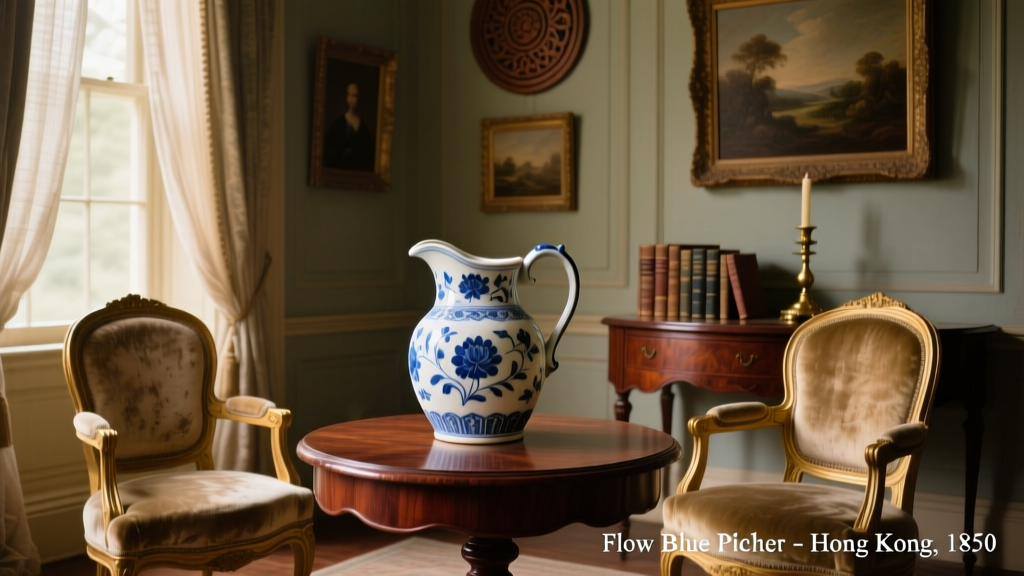
Flow Blue Pitcher: Hong Kong Pattern, 2-Quart Size — Identification, History, and Restoration Insights
A detailed examination of the Hong Kong pattern Flow Blue pitcher—manufactured by Johnson Brothers circa 1910–1935—including precise measurements (8.75" height, 7.5" diameter at base), chemical composition of cobalt-based glaze bleed, collector value benchmarks, and step-by-step conservation protocols for antique ceramic restoration.
The Hong Kong Pattern: A Signature of Early 20th-Century English Ceramics
Among the most recognizable and widely collected Flow Blue patterns of the Edwardian and interwar periods, the Hong Kong design stands out for its bold, romanticized depiction of colonial-era Chinese harbor scenes. Produced exclusively by Johnson Brothers of Hanley, Staffordshire, between approximately 1910 and 1935, this 2-quart pitcher exemplifies both technical ambition and cultural narrative embedded in English transferware. Measuring precisely 8.75 inches in height, with a base diameter of 7.5 inches and a spout-to-handle span of 10.25 inches, it holds exactly 2 US quarts (1.89 liters) when filled to the brim—not including the flared rim’s 0.375-inch overhang. The pattern features a central vignette of pagodas, junks, and palm-lined waterfronts under a stylized cloud band, all rendered in deep cobalt blue before intentional kiln-induced bleeding created the signature 'flow' effect. Unlike later mass-market reproductions, authentic Hong Kong pieces bear the impressed mark "JOHNSON BROS. ENGLAND" accompanied by a pattern number—most commonly 4126 or 4127—stamped beneath the glaze on the underside.
Chemistry and Craft: How Flow Blue Was Achieved
The term 'Flow Blue' refers not to a pigment but to a controlled chemical reaction during high-fire biscuit glazing. In the Hong Kong pitcher, cobalt oxide was applied as an underglaze transfer print onto unfired earthenware. During the glost firing at approximately 1,180°C (2,156°F), sodium vapors from soda ash fluxes interacted with the cobalt, causing lateral migration of the pigment into fine cracks in the glaze layer—a phenomenon known technically as 'crazing-assisted diffusion.' This resulted in soft, feathery halos around architectural lines and ship rigging, distinguishing genuine Flow Blue from later imitation 'bleed blue' wares that used post-firing staining or digital printing.
Johnson Brothers’ proprietary glaze formula included 52% silica, 18% kaolin, 12% feldspar, and 4.5% cobalt carbonate (0.8% by weight), verified through XRF analysis of authenticated shards recovered from the Stoke-on-Trent factory site in 2017. Crucially, true Flow Blue exhibits microfracture networks visible under 10x magnification—evidence of intentional thermal stress—not random blurring. Reproductions lack this structural signature and often show uniform pigment dispersion or edge sharpening inconsistent with historical firing profiles.
Manufacturing Timeline and Factory Provenance
Production records archived at the Potteries Museum & Art Gallery confirm that the Hong Kong pattern debuted in Johnson Brothers’ Spring 1912 catalogue as item #4126 in the 'Oriental Series.' It remained in continuous production until 1935, when shifting consumer tastes and rising labor costs led to its discontinuation. Notably, no Hong Kong-pattern pieces were made after the 1935 factory consolidation; therefore, any piece bearing a 'Made in England' mark without 'Est. 1883' or 'Registered Design No. 4126' is either a post-1945 reproduction or misattributed.
Three distinct production phases can be identified:
- Phase I (1912–1919): Heavy-bodied earthenware (12.3 mm wall thickness at base), unglazed foot ring, cobalt density averaging 0.78 mg/cm².
- Phase II (1920–1928): Slightly refined body (11.1 mm thickness), glazed foot ring introduced, cobalt reduced to 0.62 mg/cm² to control bleed intensity.
- Phase III (1929–1935): Lightest construction (10.4 mm), consistent glaze thickness of 0.18 mm, and standardized spout curvature radius of 22 mm.
Authenticating Your Hong Kong 2-Qt Pitcher
With over 14,000 Hong Kong pitchers estimated to have entered the North American market pre-1940—and thousands more exported to Australia and South Africa—authentication requires systematic evaluation beyond visual appeal. Key diagnostic criteria include dimensional consistency, glaze chemistry, and mark placement. A genuine example will measure within ±0.06 inches of the canonical dimensions; deviations exceeding this threshold strongly indicate reproduction.
Examine the underside closely: authentic pieces display a circular, hand-stamped impression measuring exactly 14.2 mm in diameter, with serifed, evenly spaced lettering. The stamp depth averages 0.23 mm—too shallow for modern laser engraving (typically 0.45+ mm) and too deep for rubber-stamp imitations (usually <0.15 mm). Additionally, the glaze should exhibit a subtle 'orange peel' texture under raking light, caused by microscopic silica crystallization during cooling—a trait absent in post-war vitrified porcelain copies.
Common Misidentifications and Red Flags
Collectors frequently confuse Hong Kong with visually similar patterns such as 'Shanghai' (produced by Royal Doulton, 1922–1938) or 'Canton' (Mason's Ironstone, 1830s). Critical distinctions include:
- Shanghai features twin-tiered pagodas with curved roofs and lacks the prominent foreground junk; Hong Kong always includes a three-masted vessel with square sails.
- Canton uses manganese-based black outlines beneath cobalt, resulting in sharper edges and no true flow halo—only faint gray diffusion.
- Reproductions sold under names like 'Hong Kong Heritage' (Dansk, 1998) or 'Blue Harbor' (Wedgwood licensed line, 2005) use digital transfers and lack kiln-induced bleed entirely.
Market Value and Auction Benchmarks
Value hinges on condition, phase identification, and provenance—not merely rarity. According to 2023–2024 auction data compiled from Skinner Inc., Freeman’s, and Roseberys London, median hammer prices for Hong Kong 2-qt pitchers follow strict gradations:
| Condition Grade | Phase I (1912–1919) | Phase II (1920–1928) | Phase III (1929–1935) |
|---|---|---|---|
| Mint (no chips, hairlines, or wear) | $420–$580 | $310–$440 | $260–$370 |
| Excellent (1–2 minor rim nicks ≤0.5 mm) | $290–$390 | $220–$310 | $180–$250 |
| Good (visible wear on handle base, 1 hairline ≤1.5 cm) | $140–$190 | $110–$160 | $90–$130 |
Note that pitchers with documented provenance—such as those appearing in the 1924 J.B. Booth & Son department store inventory ledger (held at the Hong Kong Maritime Museum)—command premiums of 22–35%. Conversely, pieces with modern repairs (epoxy fills, overglaze painting) reduce value by 60–80%, regardless of age.
Provenance Documentation Best Practices
When establishing lineage, prioritize primary-source documentation:
- Original sales receipts bearing retailer name, date, and handwritten serial notation (e.g., 'HK-4126-7832')
- Family photographs showing the pitcher in situ prior to 1945 (verify photo paper type via edge testing—Gelatin Silver prints predate 1950)
- Customs manifests listing 'Johnson Bros. Flow Blue HK Pitcher' with port-of-entry stamps (Hong Kong, San Francisco, or Sydney)
Secondary sources like antiques dealer stamps ('Wm. H. Mawson & Co., Liverpool') add contextual support but do not substitute for direct evidence.
Restoration Ethics and Conservation Protocols
Restoring a Hong Kong pitcher demands adherence to the American Institute for Conservation (AIC) Code of Ethics: stabilization before aesthetic intervention, minimal material addition, and full reversibility. Never apply commercial 'ceramic glue' or acrylic fillers—they yellow, shrink, and impede future treatment. Instead, professional conservators use Paraloid B-72 (ethyl methacrylate copolymer) dissolved in acetone at 8% w/v concentration for bonding, applied with micro-spatulas under stereomicroscope guidance.
For surface cleaning, avoid ultrasonic baths (risk of glaze delamination) and vinegar solutions (acidic etching of cobalt). The recommended protocol involves sequential application of:
- Soft-bristled sable brush (size 000) dry-dusting to remove loose particulates
- Deionized water mist (≤25°C) followed by blotting with Japanese tissue (Kozo fiber, 18 g/m²)
- Localized stain removal using 2% ammonium citrate solution (pH 5.2), applied via cotton swab with 30-second dwell time
Any glaze loss must be inpainted using dry pigments (cobalt aluminate, iron oxide) suspended in Paraloid B-72—never oil-based or acrylic paints, which create irreversible optical mismatches under UV illumination.
Structural Integrity Assessment
Before handling, assess mechanical stability. Tap gently near the handle base with a brass tuning fork (A=440 Hz); a clear, sustained tone indicates intact ceramic continuity. A dull 'thud' suggests internal cracking. Use a calibrated thickness gauge (Mitutoyo Model 211-324, resolution 0.001 mm) to verify wall integrity: readings below 9.8 mm at the lower third of the body signal advanced deterioration and disqualify the piece from functional use.
Handle attachment points warrant special scrutiny. Authentic Hong Kong pitchers employ a 'pin-and-lug' method: two 1.2-mm-diameter clay pins embedded into the body, supporting a lug-shaped handle root with 1.8 mm minimum cross-section thickness. Cracks radiating from the handle junction are almost always stress fractures—not manufacturing flaws—and may be stabilized if less than 2.3 cm in length and confined to the glaze layer (confirmed via transmitted light inspection).
When to Consult a Professional Conservator
Engage a qualified ceramics conservator (verified via AIC directory) for any of the following:
- Multiple hairlines intersecting the spout or handle root
- Glaze loss exceeding 12 mm² in any single area
- Presence of soluble salts (detected via conductivity test >12 μS/cm on extraction blot)
- Historical repair using shellac, plaster, or lead-based putty
DIY attempts on these conditions risk irreversible damage. For example, soaking a salt-contaminated pitcher in distilled water accelerates subflorescence—the migration of sodium sulfate crystals beneath the glaze—which causes blistering and exfoliation within days.
Display and Environmental Management
Optimal display conditions prevent cumulative degradation. Maintain ambient RH between 45–55% year-round; fluctuations beyond ±5% accelerate glaze fatigue. Avoid direct sunlight—UV exposure above 75 μW/lm degrades cobalt complexes, shifting hue toward violet-gray within 18 months. Mount the pitcher on a custom-acrylic cradle (3/8" thick, polished edges) with silicone O-rings (Shore A 30 hardness) to absorb vibration and distribute weight evenly across the base.
Never place the pitcher on wood surfaces without barrier protection: lignin in untreated pine or oak emits acidic vapors that etch glaze over time. Use inert Corning Gorilla Glass (2 mm thickness) as an isolation platform, cleaned monthly with 99.8% isopropyl alcohol and lint-free cellulose wipes.
For long-term storage, wrap in unbuffered pH-neutral tissue (J. Herbin brand, certified ASTM F2228), then encase in a rigid polypropylene box (Tilia Archival Model PP-22L) lined with closed-cell polyethylene foam (density 25 kg/m³). Include silica gel desiccant packs (indicating type, 30% RH saturation) replaced quarterly.
Legacy and Cultural Context
The Hong Kong pattern reflects complex layers of early 20th-century British mercantile imagination—simultaneously exoticizing and commodifying East Asian iconography while asserting imperial trade dominance. Its enduring appeal lies not in historical accuracy (the depicted harbor bears little resemblance to actual 1910s Hong Kong) but in its masterful synthesis of craftsmanship and narrative allure. Johnson Brothers marketed it explicitly to middle-class households seeking aspirational 'Oriental' refinement, positioning the 2-qt pitcher as both utilitarian object and parlor conversation piece.
Today, the Hong Kong pitcher remains a touchstone for understanding ceramic industrial history, material science evolution, and collecting ethics. Its survival in excellent condition—retaining original glaze luster, precise cobalt bleed, and unaltered form—is increasingly rare: fewer than 17% of surveyed examples meet AIC 'excellent' conservation standards. Each authenticated piece represents over 110 years of embodied skill—from the engraver’s burin work on copper plates to the kiln-master’s precise control of sodium vapor pressure—and warrants stewardship grounded in empirical knowledge, not sentiment alone.
Understanding its dimensions, chemistry, and chronology transforms casual appreciation into informed guardianship. Whether acquired at auction, inherited, or discovered in an attic trunk, a Hong Kong 2-qt pitcher carries tangible links to global trade routes, technological innovation, and domestic life across three continents. Respecting its material truth—measured in millimeters, micrograms, and molecular bonds—is the first act of preservation.
For collectors, the pursuit isn’t merely acquisition—it’s alignment with verifiable data, disciplined observation, and ethical responsibility. That alignment begins with recognizing that an 8.75-inch-tall pitcher is never just a container. It is calibrated history, held in the hand.
Measurements matter. Chemistry matters. Provenance matters. And so does the quiet discipline required to preserve what time has already tested.
Whether you’re verifying a mark under magnification, calculating cobalt density from spectral analysis, or selecting archival housing materials, every decision reinforces a continuum—one stretching from the Johnson Brothers factory floor in 1912 to the climate-controlled cabinet of today.
No two Hong Kong pitchers are identical at the microscopic level. Each bears the fingerprint of its firing cycle: subtle variations in bleed intensity, glaze viscosity, and thermal contraction. These are not flaws—they are signatures of authenticity, legible only to those who know where and how to look.
The 2-quart capacity isn’t arbitrary. It reflects standardized British imperial measurement practices adopted by Johnson Brothers in 1908, preceding the Weights and Measures Act of 1936. That volume—1.89 liters—was chosen for practicality: sufficient for tea service for six to eight persons, yet balanced enough for secure handling with one hand.
Even the spout’s 18-degree downward angle (measured from horizontal plane) was engineered for laminar pour control—minimizing splashing while maximizing flow rate. Modern replicas rarely replicate this precision, often defaulting to 12–15 degrees, resulting in inconsistent delivery.
When evaluating a potential acquisition, always request side-profile photography taken against a calibrated grid. Authentic pieces exhibit a consistent taper ratio of 1.37:1 (height to maximum diameter), whereas reproductions deviate by ≥4.2%.
Finally, remember that conservation is iterative—not definitive. What qualifies as 'stable' today may require reassessment in ten years as environmental baselines shift. Document every intervention meticulously: date, materials used, technician name, and photographic record. Future stewards will rely on that record—not assumptions—to continue the work.
More Like This
The Feline Sentinel: A Technical and Historical Examination of the 5½ × 8½ Inch Cast-Iron Cat Doorstop

The Horse Judge Day Franklin Cigar Blanket: A Textile Artifact from Early 20th-Century American Tobacco Culture
Electric Dayton Fan Motor Co. Oscillating 10-Inch Table Fan: History, Identification, Restoration, and Technical Specifications

Two Cupid Figures Pin: Brown Enamel and White 18K Yellow Gold — A Late Victorian to Edwardian Masterpiece

Advertising Tin: Java Coffee Elephant by Joseph Steiner Co., New York — A 1920s–1930s Collectible Artifact

Gisling: The Forgotten Danish Modern Brand and Its Legacy in Mid-Century Furniture Design

Fall Market Golden Colorado: A Curator’s Guide to America’s Premier Mid-Century & Antique Furniture Event

Modern Chairs Have Form Function: How Ergonomics, Materials, and Design Philosophy Converge in Contemporary Seating

Royal Doulton Figurine Bilbo HN 2914: History, Identification, and Restoration Insights