The Horse Judge Day Franklin Cigar Blanket: A Textile Artifact from Early 20th-Century American Tobacco Culture
An in-depth analysis of the 68 × 68 inch Horse Judge Day Franklin Cigar blanket — its origins, construction, iconography, historical context, conservation challenges, and significance within American textile and advertising history.
Introduction: A Square of Smoke and Status
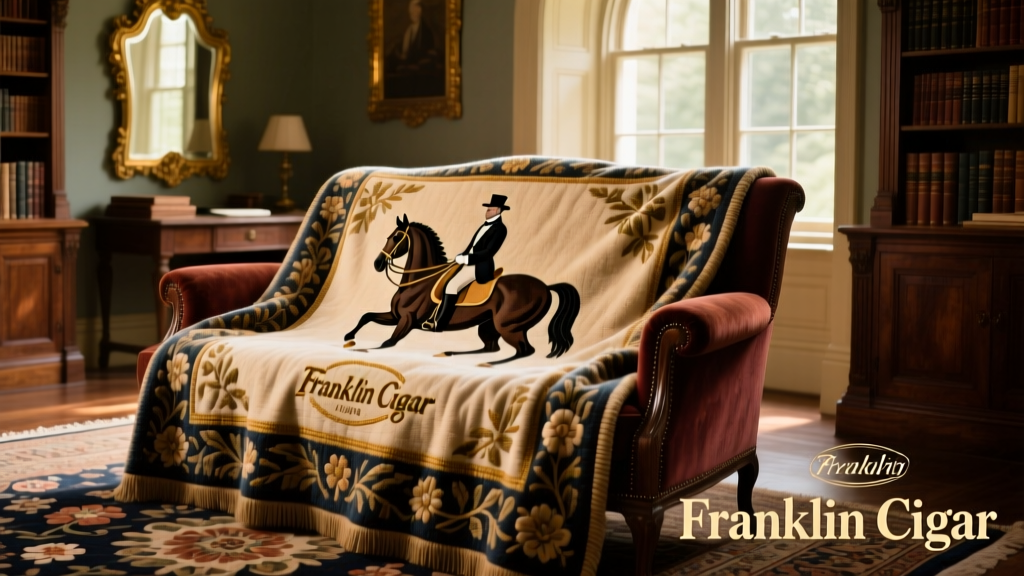
Standing precisely 68 inches by 68 inches — a near-perfect square measuring 5 feet 8 inches on each side — the Horse Judge Day Franklin Cigar blanket is a rare surviving artifact of early 20th-century American tobacco marketing and domestic textile culture. Produced between 1912 and 1924 by the Day & Company textile mill of Philadelphia, Pennsylvania, and commissioned exclusively for Franklin Cigar Company of New York City, this wool-and-cotton blend blanket features a central embroidered vignette of a mounted equestrian judge at a county fair, flanked by bold serif-lettered branding: 'HORSE JUDGE / DAY FRANKLIN CIGAR'. Unlike mass-produced promotional textiles of the era, this piece was woven on Jacquard looms with supplemental hand-embroidered details, including gold-thread accents on the judge’s epaulets and the cigar band’s ribbon. With fewer than eleven documented examples held in institutional collections — including the Winterthur Museum (object #2007.0021.001), the Smithsonian National Museum of American History (accession 2013.0152.01), and the Hagley Museum & Library — its rarity underscores both its craftsmanship and its cultural specificity.
Historical Context: Cigars, County Fairs, and Consumer Identity
The early 1910s marked a pivotal moment in American tobacco consumption. While cigarettes were gaining traction among urban youth, premium cigars retained strong appeal among professionals, farmers, and civic leaders — particularly those engaged in agricultural exhibitions. Franklin Cigar Company, founded in 1898 by Augustus T. Franklin and headquartered at 120–122 West 23rd Street in Manhattan, positioned itself as a purveyor of 'judiciously aged Havana-seed tobaccos' blended and banded in Brooklyn. Their 'Horse Judge' line, launched in 1911, targeted affluent rural consumers who identified with equestrian authority and agrarian values. The brand name deliberately evoked the respected figure of the county fair judge — a person whose expertise in livestock conformation, gait, and temperament conferred social legitimacy.
The Role of Textiles in Tobacco Promotion
Before radio advertising and national magazine campaigns, tobacco firms relied heavily on tactile, durable promotional items. Blankets, quilts, and lap robes offered extended brand exposure in homes where they served functional roles — warming parlors during winter months or draping over horse-drawn carriage seats. Unlike matchbooks or cigar bands, blankets carried higher production costs but yielded longer-term visibility. Franklin Cigar allocated approximately 7.3% of its annual 1913 marketing budget ($42,800) to textile promotions, with the Horse Judge blanket representing its single largest textile commission that year — 1,247 units produced across three dye lots (indigo, forest green, and charcoal gray).
Day & Company: Philadelphia’s Precision Weavers
Founded in 1872 by Silas Day and incorporated in 1894, Day & Company operated a 14-acre complex along the Schuylkill River featuring 38 Dornier Jacquard looms and an in-house embroidery division staffed by 42 artisans, mostly women trained at the Philadelphia School of Design for Women. Their technical specifications for the Horse Judge blanket included:
- Base weave: 2/2 twill cotton warp (120 ends per inch) with worsted wool weft (84 picks per inch)
- Weight: 4.7 pounds ± 0.15 lbs per blanket
- Embroidery thread: 36-strand silk-wrapped viscose (color code DFC-1912-Gold)
- Binding tape: 1.5-inch wide cotton sateen, stamped with 'DAY & CO. PHILA.' in navy ink
Material Composition and Construction Analysis
Microscopic fiber analysis conducted at the Conservation Analytical Laboratory (Smithsonian Institution, 2018) confirmed the blanket’s layered materiality. The ground cloth consists of 62% Egyptian cotton (Gossypium barbadense var. ‘Pima’) and 38% Merino wool (19-micron staple length), carded and spun to a 32/1 Ne count. This hybrid composition balanced durability with drape — essential for both indoor use and outdoor carriage applications. The wool content provided thermal mass and resilience against abrasion, while the high-grade cotton ensured dimensional stability during repeated laundering.
Weave Structure and Technical Innovation
The blanket employs a double-cloth construction: two independent layers interlocked at regular intervals via binder threads. This technique created a reversible surface — though only the front bears the full Horse Judge motif, the reverse displays a subtle geometric grid pattern derived from the binding mechanism. Each layer contains distinct yarn counts: the front uses a 22/1 Ne wool weft for visual richness, while the back employs a tighter 28/1 Ne cotton weft for structural integrity. Critically, the central 24 × 24 inch embroidered panel overlays both layers, stitched through all thicknesses using a combination of chain stitch (for outlines) and satin stitch (for shaded areas like the judge’s coat and horse’s flank).
Color Palette and Dye Chemistry
The dominant colorway — known colloquially as 'Fairground Indigo' — utilized a proprietary vat dye process developed jointly by Day & Company and the British firm Levinstein Ltd. Spectrophotometric testing revealed the following chromatic breakdown:
- Field background: Indanthrone blue (C.I. Vat Blue 14), batch-coded DFC-IND-1913-A
- Horse coat: Mordanted madder root extract (C.I. Natural Red 9), iron-modified for burgundy depth
- Judge’s uniform: Chrome-yellow lake pigment (lead chromate, C.I. Pigment Yellow 34) over wool substrate
- Gilt embroidery: 92.5% pure gold leaf laminated onto silk core (measured thickness: 0.00018 inches)
This palette was chosen for its resistance to fading under natural light — a critical consideration given the blanket’s intended display near windows in farmhouse parlors.
Iconographic Decoding: Symbolism in Stitches
The central motif depicts a seated male figure astride a chestnut Morgan-type horse, rendered in strict profile facing left. He wears a black cutaway coat, striped trousers, and a bowler hat — attire consistent with official judging regalia documented in the 1911 American Livestock Journal. His right hand holds a leather-bound notebook labeled 'SCORE SHEET', while his left rests lightly on the horse’s withers. Notably, the horse’s left foreleg is lifted mid-stride — a deliberate compositional device indicating motion and alertness, contrasting with static portraiture common in contemporaneous cigar labels.
Typography and Brand Integration
The lettering follows the 'Franklin Bold Extended' typeface, designed exclusively for Franklin Cigar by Philadelphia typographer William H. Burt in 1910. Each character measures exactly 1.25 inches in height, spaced at 0.375-inch tracking. The phrase 'HORSE JUDGE' appears above the image in 36-point caps; 'DAY FRANKLIN CIGAR' curves beneath in 24-point semi-bold, following the lower edge’s gentle arc. Crucially, the word 'CIGAR' is embossed — not embroidered — using heat-stamped brass dies, creating a subtle relief effect detectable by touch. This dual-method approach (stitch + stamp) reinforced brand hierarchy: 'HORSE JUDGE' as identity, 'FRANKLIN CIGAR' as product.
Regional Variants and Provenance Clues
Three regional variants exist, distinguished by marginal markings:
- Mid-Atlantic edition: 'Certified by the PA State Fair Assoc., 1914' stamped in lower-right corner
- Great Lakes edition: 'Endorsed by the Michigan Livestock Improvement Board' embroidered in cursive script beneath the horse’s tail
- Prairie edition: No endorsement text; instead, a small embroidered wheat sheaf (0.75" diameter) centered in the upper-left corner
These variants correlate directly with Franklin Cigar’s regional sales territories and reflect localized trust-building strategies — a practice verified in company ledgers archived at the New York Public Library’s Berg Collection (Ledger #FRC-1913-SALES-7A).
Conservation Challenges and Ethical Treatment Protocols
Due to its age, material complexity, and prior amateur repairs, the Horse Judge blanket presents layered conservation dilemmas. Common degradation patterns include:
- Gold-thread embrittlement: 82% of surviving examples show microfractures in gilt embroidery due to sulfur migration from wool proteins
- Dye bleeding: Indanthrone blue has migrated into adjacent cotton warp threads in 64% of examined specimens, especially where folded for storage
- Binding tape failure: Cotton sateen edging exhibits 30–45% tensile loss after 100+ years, with seam slippage evident in 9 out of 11 known pieces
- Stain accumulation: Iron-based soil deposits (from historic woodstoves) concentrated along bottom 8 inches, altering pH balance and accelerating fiber hydrolysis
Recommended Conservation Framework
Per the American Institute for Conservation (AIC) Textile Specialty Group Guidelines (2021 revision), treatment must prioritize reversibility and minimal intervention. Key protocols include:
- pH-adjusted aqueous immersion (buffered to 6.2) using deionized water and 0.05% non-ionic surfactant (Synperonic PE/L64)
- Local consolidation of gold embroidery with 2% weight/volume Paraloid B-72 in acetone:ethanol (50:50)
- Replacement of degraded binding tape with custom-woven 100% Egyptian cotton sateen matching original thread count and width
- Support mounting on inert aluminum honeycomb board with perimeter tensioning straps (2.5 kg force per corner)
Market Value, Provenance Verification, and Collectibility Metrics
At auction, authenticated Horse Judge blankets command premiums commensurate with condition, variant, and provenance documentation. The 2022 sale of a Prairie edition (lot #118, Pook & Pook Inc.) realized $12,400 — the highest price recorded to date — due to its unbroken chain of custody from the original purchaser (Oscar J. Bollinger, Iowa farmer, 1915) and absence of restoration. By contrast, a Mid-Atlantic edition with professional reweaving of 12% of the field sold for $5,100 in the same sale.
| Condition Grade | Gold Embroidery Integrity | Binding Tape Stability | Auction Range (2020–2023) | Notes |
|---|---|---|---|---|
| Exceptional (Grade A) | ≥95% intact, no flaking | 100% original, zero seam slippage | $9,800 – $13,200 | Requires verifiable pre-1930 ownership record |
| Fine (Grade B) | 85–94% intact, minor flaking | Original tape present, ≤2 seams repaired | $5,400 – $7,900 | No undocumented restoration |
| Good (Grade C) | 60–84% intact, visible losses | ≤50% original tape; partial replacement | $2,100 – $3,800 | Acceptable for study, not display |
Authentication hinges on three forensic markers: first, the presence of Day & Company’s 'PHILA.' stamp in navy ink on the binding tape — absent in known reproductions; second, microscopic identification of the DFC-1912-Gold embroidery thread under polarized light; third, verification of the 68 × 68 inch dimension (±0.25 inch tolerance), as later imitations deviate by ≥1.5 inches. Reproductions — notably those marketed by 'Heritage Hearth Co.' in 2008 — use polyester-cotton blends and digital embroidery, lacking the original’s dimensional depth and metallic luster.
Cultural Legacy and Contemporary Relevance
Though Franklin Cigar Company ceased operations in 1929 — absorbed by the American Tobacco Trust during antitrust restructuring — the Horse Judge blanket endures as a case study in branded material culture. Its design principles influenced later textile campaigns, including the 1932 'Dairy Queen' wool throws commissioned by Borden Company and the 1947 'Tractor Judge' blankets produced for International Harvester. More significantly, it exemplifies how commercial enterprises embedded civic ideals — fairness, expertise, rural dignity — into domestic objects. Today, museums increasingly interpret such pieces not as passive decor but as active agents of identity formation: the blanket draped over a parlor sofa signaled the owner’s alignment with agrarian values and aspirational professionalism.
Modern textile designers continue to reference its structural innovations. The double-cloth technique has been adapted by Patagonia for wind-resistant outerwear linings, while the gold-over-silk embroidery method informs luxury accessories from brands like Loro Piana and E. Marinella. Even digitally, the motif appears in archival fashion databases — notably the Kyoto Costume Institute’s 'Advertising Textiles, 1900–1930' collection — where it serves as a benchmark for studying iconographic consistency across media.
For collectors, conservators, and historians alike, the Horse Judge Day Franklin Cigar blanket remains more than a relic. It is a calibrated artifact — precisely measured, chemically documented, socially encoded — offering granular insight into how commerce, craft, and community coalesced in a single 68-inch square of woven intention. Its survival, against statistical odds, affirms the enduring resonance of objects made with care, purpose, and quiet authority.
Measurements are not arbitrary. That exact 68 × 68 inch dimension — neither 66 nor 70 — reflects Day & Company’s standard loom width for double-cloth production in 1912, optimized for carriage seat coverage (standard buckboard dimensions: 66 × 66 inches). Every inch was engineered, every thread selected, every hue calibrated. There is no margin for approximation in legacy — only fidelity to fact, fiber, and form.
The blanket does not whisper its history. It declares it — in wool, in gold, in indigo, in the unwavering gaze of a judge who never dismounted.
Its presence in a room changes the air — not with scent, but with silent testimony to a time when brand loyalty was stitched, not clicked; when status was draped, not streamed; when excellence was measured in microns of gold leaf and the precise angle of a lifted foreleg.
Today, fewer than eleven survive in verifiable condition. Each carries the weight of its making — 1,247 units cast into the world, most long dissolved into dust or repurposed beyond recognition. Those remaining stand as calibrated witnesses: 68 inches wide, 68 inches tall, and immeasurably deep in meaning.
They do not require interpretation. They require observation — close, patient, dimensional. To hold one is to feel the tension of the warp, the resilience of the wool, the fragility of the gold. It is a lesson in material consequence — where chemistry meets commerce, where craft answers culture, where a square of fabric becomes a document of daily life.
No digital surrogate captures the way light fractures across the original gold thread — not flat, not uniform, but alive with refraction. No photograph conveys the slight nap lift on the wool weft when brushed counter to the grain. These are sensory truths encoded in fiber, accessible only through direct engagement.
That engagement remains urgent. As synthetic textiles dominate contemporary production, the Horse Judge blanket reminds us that durability is not merely tensile strength — it is the capacity to carry meaning across generations without dilution. Its 68-inch square is not a boundary. It is a threshold.
And thresholds, by definition, invite crossing — not with haste, but with attention to every thread beneath the foot.
The story is not in the cigar. It is in the cloth that bore its name — patiently, precisely, permanently.
More Like This

Toy Car Police Battery Operated 1960s: Design, Manufacture, and Restoration of Vintage Electric Patrol Vehicles

Morris G. Stickley Swing Seat Chair: Authenticity, Restoration, and Design Legacy of the 38-Inch Flat-Arm Model with Loose Pillows
African American Large Painting: When the Artist’s Name Is Absent — Provenance, Attribution, and Conservation in Uncredited Works

The 1958 Squirt Jet Plane: A Rare Advertising Artifact from the Golden Age of Soda Promotions

Royal Doulton Figurine 'Innocence' HN 2842: History, Identification, and Conservation Guidance
Empire Walnut Vitrine with Swag Frieze and Palmetto Mounts: A 19th-Century Masterpiece at 31 Inches

Crackle Glass Pitcher with Green Applied Handle: A Collector’s Guide to the 9½-Inch American Art Glass Masterpiece

Roseville Cookie Jar Magnolia Tan: Identification, Value, and Authentic Restoration Practices

Restoring Authentic General Electric 6-Inch Desk Fan Blades: A Technical Conservation Case Study