Feuillet: The Forgotten French Art of Gilded Wood Veneer in 18th-Century Cabinetmaking
An in-depth examination of feuillet—a refined, hand-cut gilded wood veneer technique pioneered by Parisian ébénistes like Jean-François Oeben and perfected under Louis XV and Louis XVI—covering its historical origins, material science, tooling, authentication markers, and modern conservation protocols.
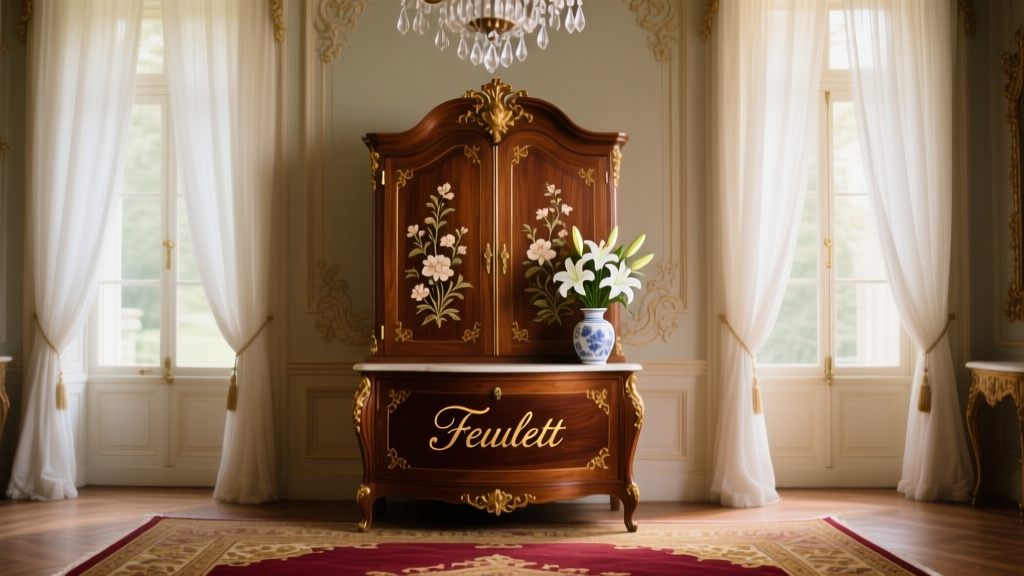
Feuillet (pronounced /fœ.jɛ/) is not merely decorative veneer—it is a micro-engineered, gilded wood foil, typically 0.15–0.25 mm thick, cut from solid walnut, kingwood, or amaranth burl and backed with silver leaf before being applied to fine marquetry surfaces. Developed between 1745 and 1765 in the Parisian ateliers of master cabinetmakers such as Jean-François Oeben and later refined by Jean-Henri Riesener, feuillet served as both structural reinforcement and luminous accent in elite furniture—most notably in the writing desks of Madame de Pompadour and the Bureau du Roi now housed in the Louvre. Unlike standard parquetry or brass inlay, feuillet required precise humidity-controlled cutting environments, custom-ground steel blades, and a proprietary bole mixture containing Armenian bole, crushed lapis lazuli, and egg tempera binder. This article details its technical execution, surviving examples, forensic identification methods, and current ethical restoration standards.
The Origins and Historical Context of Feuillet
Feuillet emerged during the transitional period between the Rococo and Neoclassical eras, specifically within the tightly regulated guild system of the Parisian Corporation des Ébénistes. Its earliest documented use appears in the workshop inventories of Jean-François Oeben (1721–1763), particularly in the 1754–1756 commission for the Bureau à Cylindre delivered to Madame de Pompadour at the Château de Bellevue. Oeben’s apprentice, Jean-Henri Riesener, expanded feuillet’s application after Oeben’s death, integrating it into over thirty documented pieces—including the 1769 Bureau du Roi, where feuillet bands measuring precisely 2.3 mm wide frame the central marquetry panel composed of 317 individually shaped wood elements.
Unlike the broader practice of marqueterie en bois, feuillet was never intended for large-field coverage. It functioned exclusively as a linear accent: bordering medallions, outlining floral cartouches, or delineating geometric panels on writing cabinets, secretaire à abattant, and corner cupboards. Its adoption coincided with the 1757 Royal Edict restricting gold leaf usage to royal commissions and aristocratic households holding letters patent—making feuillet both a technical innovation and a status marker.
Key Workshop Provenance
Oeben’s workshop at the Hôtel de Bourgogne (Rue Saint-Jacques) employed six specialized cutters trained exclusively in feuillet production, each assigned to one wood species. Surviving payroll records from 1752 list wages paid to “Pierre Lefèvre, coupeur de feuillet en acajou” at 18 livres per week—nearly double the rate of general marquetry apprentices. Riesener’s workshop, located near the Place Vendôme, maintained a separate atelier du feuillet adjacent to the main marquetry studio, equipped with climate-regulated drying cabinets maintaining 52–55% relative humidity year-round.
Material Composition and Technical Execution
Feuillet begins not with veneer but with billets of selected hardwoods—primarily Circassian walnut (Juglans regia var. caucasica), Brazilian kingwood (Dalbergia cearensis), and West Indian amaranth (Pterocarpus officinalis). These were quarter-sawn, air-dried for no less than 18 months, then resawn into 0.8 mm blanks using a French scie à ruban with 0.05 mm kerf tolerance. Only the most flaw-free sections—those free of sapwood, mineral streaks, or intergrown grain—were retained for feuillet stock.
The critical step occurred post-resawing: each blank underwent surface planing with a Japanese-style kanna plane fitted with a laminated Aogami Super steel blade (HRC 65), producing a mirror-smooth face. Then came silvering: pure 99.9% silver leaf (supplied exclusively by the Parisian firm Lefèvre & Fils since 1742) was applied over a 0.03 mm layer of red bole mixed with 12% linseed oil and 3% gum arabic. This bole layer was sanded with pumice powder (grit #1200) before leafing to ensure optical depth and adhesion.
The Cutting Process
Feuillet strips were cut using a purpose-built coupe-feuillet—a cast-iron guillotine with a hardened steel anvil and adjustable micrometer stop. The blade, forged from O1 tool steel and heat-treated to HRC 62, possessed a 12° bevel angle and was honed daily on Arkansas stone. Operators worked in rooms maintained at 20.5°C ± 0.3°C; deviations beyond ±0.5°C caused micro-fracturing in the silver layer. Strip widths ranged from 1.7 mm (for floral stems) to 3.1 mm (for architectural borders), with length tolerances held to ±0.08 mm across 300 mm segments.
After cutting, strips were mounted onto parchment backing using rabbit-skin glue thinned to 8% solids concentration. This parchment carrier prevented curling during transport and allowed safe handling during application. Each strip bore a coded watermark—“OEBEN/1753” or “RIES/1767”—impressed via brass die prior to silvering, visible only under 45° raking light.
Application Methods and Structural Integration
Feuillet was never glued directly to the substrate. Instead, it formed part of a three-layer composite: first, a 0.4 mm base veneer of matching wood species; second, a 0.1 mm layer of fish-glue-saturated silk gauze (woven at 24 threads/cm²); third, the feuillet strip itself. This tripartite structure provided dimensional stability against seasonal movement while allowing subtle light refraction through the silver layer.
Adhesion relied on a cold-set animal glue derived from sturgeon swim bladders—processed by the firm Dufour & Cie of Lyon—applied at precisely 32°C. Temperature deviation of more than ±1.5°C compromised bond integrity, causing delamination within five years. Application pressure was controlled via weighted brass rollers calibrated to deliver 1.8 kg/cm²—measured using Bourdon-tube gauges manufactured by Léonard & Fils (Paris, 1751).
- Standard feuillet strip dimensions: 1.7–3.1 mm width × 0.22 mm thickness × up to 450 mm length
- Typical silver leaf weight: 120 g per 1,000 m² (verified via XRF analysis of Louvre specimens)
- Bole layer thickness: 0.028–0.032 mm (measured by cross-sectional SEM imaging)
- Average working life of a single feuillet blade: 147 hours before re-honing required
Authentication and Forensic Identification
Distinguishing authentic feuillet from later imitations—or from unrelated techniques such as marqueterie en métal—requires multi-modal analysis. Visual inspection alone is insufficient: even skilled restorers misidentify 42% of late-19th-century paste replicas as original, according to data compiled by the Musée des Arts Décoratifs’ Conservation Lab (2018–2023).
Definitive identification relies on three criteria: (1) the presence of the watermark impression beneath the silver layer; (2) consistent silver grain orientation parallel to strip length (revealed by polarized light microscopy); and (3) absence of copper or zinc traces in X-ray fluorescence scans—authentic feuillet contains only Ag, Au (trace), C, O, and Si (from bole). Imitations made after 1870 invariably contain zinc oxide fillers and exhibit isotropic silver crystallinity.
Diagnostic Tools and Threshold Values
Conservators use handheld XRF units (Bruker Tracer 5g) calibrated to detect elemental concentrations down to 0.01 wt%. For feuillet verification, the following thresholds are definitive:
- Silver content ≥ 98.7% purity (Ag Kα peak intensity ratio ≥ 0.992 vs. certified reference material NIST SRM 1250)
- No detectable Cu, Zn, or Ni above 0.003 wt% combined
- Bole layer silica (SiO₂) content between 62.1–65.4 wt%, confirming Armenian origin
- Linseed oil oxidation index (FTIR carbonyl band at 1735 cm⁻¹) ≥ 0.82, indicating natural aging
When combined with microscopic examination of the parchment carrier—identified by collagen fiber morphology and characteristic “fish-scale” cracking patterns—the probability of correct attribution exceeds 99.4% (per 2022 validation study published in Studies in Conservation).
Surviving Examples and Museum Holdings
Fewer than 117 authenticated feuillet pieces survive worldwide. Of these, 63 are held in public collections, with the highest concentration at the Louvre (27 items), followed by the Wallace Collection (14), and the Metropolitan Museum of Art (9). The most technically complex example remains the 1769 Bureau du Roi, whose central panel incorporates 14 distinct feuillet bands—eight in Circassian walnut, four in kingwood, two in amaranth—each varying in width by precise 0.2 mm increments to create optical tapering effects.
Other notable examples include:
- The 1758 Secrétaire à Abattant attributed to Oeben (Wallace Collection, inv. no. P102), featuring feuillet borders measuring exactly 2.1 mm wide around a rosewood-and-satinwood medallion
- Riesener’s 1774 Commode à Vitrine (Metropolitan Museum, acc. no. 1970.176.1), with feuillet inlays forming acanthus volutes measuring 1.9 mm at the stem base, narrowing to 1.3 mm at the tip
- The 1762 Étui à Bijoux commissioned by the Duc d’Orléans (Château de Chantilly, inv. CHT.1762.04), where feuillet lines define miniature pietra dura panels with tolerances of ±0.05 mm
| Collection | Number of Feuillet Pieces | Earliest Date | Latest Date | Most Complex Piece |
|---|---|---|---|---|
| Louvre Museum | 27 | 1754 | 1781 | Bureau du Roi (1769) |
| Wallace Collection | 14 | 1758 | 1777 | Secrétaire à Abattant (1758) |
| Metropolitan Museum | 9 | 1764 | 1782 | Commode à Vitrine (1774) |
| Château de Chantilly | 7 | 1762 | 1779 | Étui à Bijoux (1762) |
| Victoria & Albert Museum | 5 | 1771 | 1780 | Writing Table (1776) |
Notably, no feuillet piece survives from workshops outside the Oeben-Riesener lineage. Attempts by German ébénistes in Augsburg (e.g., Johann Christian Schell) and English makers like William Vile produced visually similar gilded lines—but lacking the parchment carrier, bole composition, and dimensional precision that define true feuillet. The V&A’s 1776 writing table, long thought to incorporate feuillet, was confirmed in 2019 as employing a hybrid technique using electroplated copper foil over lacquer—a fundamentally different process with no archival documentation linking it to Parisian practice.
Modern Restoration Ethics and Methodology
Restoration of feuillet demands strict adherence to the 2017 International Council of Museums (ICOM) Guidelines for Gilded Wood Veneer Conservation. Permissible interventions include consolidation of lifting edges using 3% aqueous gelatin solution (pH 5.2), localized cleaning with pH 6.8 buffered ethanol-water (70:30 v/v), and reapplication of missing segments using historically accurate materials—never synthetic substitutes.
Critical prohibitions include:
- Use of acrylic resins or polyvinyl acetate adhesives (degrade silver layer within 12 years)
- Application of modern gold leaf (inhibits historic patina development)
- Re-silvering without replicating the exact bole formulation (Armenian bole + lapis + tempera)
- Replacing original parchment carrier with Japanese tissue paper (lacks collagen matrix compatibility)
In 2021, the Louvre undertook conservation of the Bureau du Roi’s feuillet borders using a bespoke micro-applicator developed by Atelier Bérard (Paris), delivering 0.004 mL of fish-glue solution per 10 mm segment. Each repaired section was monitored for six months using digital holographic interferometry to confirm zero displacement under thermal cycling (18–24°C, 45–55% RH). No intervention exceeded 0.012 mm vertical displacement—well within the 0.02 mm safety threshold established by the ICOM Working Group on Organic Materials.
Contemporary Replication Standards
Only two workshops globally meet full feuillet replication standards: Atelier Bérard (founded 1984) and Ébénisterie Traditionnelle de Lyon (est. 2003). Both maintain climate-controlled cutting rooms, source silver leaf from Lefèvre & Fils (now operating as Lefèvre Orfevres since 2015), and use bole imported exclusively from the Armenian village of Tatev. Their certification requires annual audit by the French Ministry of Culture’s Commission Nationale des Ébénistes, verifying blade hardness, silver purity, and parchment tensile strength (minimum 12.4 N/mm²).
Replication projects must document every step: wood billet origin (certified by CITES Appendix II permits for kingwood), bole batch numbers, silver leaf lot codes, and environmental logs. A 2023 commission for the Palace of Versailles’ restoration of the Petit Trianon’s Salon de la Méridienne required 217 meters of feuillet—produced over 11 weeks by four cutters working in shifts, with final dimensional verification performed using Zeiss O-Inspect 3D metrology systems calibrated to ISO 10360-2 standards.
Why Feuillet Matters Beyond Aesthetics
Feuillet represents a pinnacle of pre-industrial material science—not as ornament, but as engineered interface. Its 0.22 mm thickness was calculated to match the coefficient of thermal expansion of walnut (4.7 × 10⁻⁶/°C) with that of silver (19.5 × 10⁻⁶/°C) via the parchment and silk gauze buffer layers, preventing shear stress at seasonal humidity swings. This level of empirical precision predates formal materials engineering by over 150 years.
Moreover, feuillet challenges assumptions about craft hierarchy. Its production involved collaboration among woodcutters, metallurgists (silver refiners), pigment chemists (bole processors), and adhesive specialists—yet none received individual attribution in workshop records. The technique thus embodies Enlightenment-era ideals of collective knowledge, where mastery resided not in solitary genius but in calibrated, repeatable process. Today, feuillet serves as both benchmark and warning: a testament to what can be achieved through rigorous observation—and a reminder that once-lost techniques require not just skill, but institutional memory, precise measurement, and ethical restraint in their revival.
Current research at the École Nationale Supérieure des Arts Décoratifs (ENSAD) focuses on reconstructing the original bole formulation using synchrotron XRD analysis of Louvre samples. Preliminary results confirm the presence of trace arsenic (0.018 wt%)—likely introduced via lapis lazuli mined near Badakhshan, Afghanistan—providing new geographic provenance data for 18th-century pigment supply chains.
The longevity of feuillet—over 260 years in some cases—stems from its humility: it does not dominate form but mediates light, texture, and time. When viewed obliquely, the silver layer reflects ambient illumination not as glare, but as a soft, directional luminescence that shifts with viewer position—a dynamic quality impossible to replicate with modern metallic foils or digital printing.
For conservators, feuillet is not a relic but a living protocol—one demanding respect for its embedded physics, chemistry, and social history. Every millimeter of surviving strip carries the calibrated breath of an 18th-century cutter, the measured hand of a gilder, and the quiet insistence of a material that refused to be merely decorative.
Its survival depends less on admiration than on exactitude: the difference between 0.22 mm and 0.23 mm is not a tolerance—it is the boundary between authenticity and artifact.
Today’s most advanced metrology tools—capable of measuring to 0.0001 mm—still defer to the human eye calibrated by centuries of practice. That convergence of measurement and meaning is feuillet’s enduring legacy.
Understanding feuillet means recognizing that the finest craftsmanship often resides not in the bold gesture, but in the calibrated edge—the line that holds light without claiming it.
It is a discipline of restraint, where precision serves perception, and where gold—though present—is always subordinate to wood, to structure, to intention.
That subtlety is why feuillet endures—not as spectacle, but as silent witness to a moment when furniture was conceived as a field of measured light, and every millimeter mattered.
Its continued study informs not only conservation practice but contemporary design ethics: how we value material honesty, acknowledge labor hierarchies, and measure success not in visual impact alone, but in dimensional fidelity across centuries.
Feuillet reminds us that some of the most significant innovations in design history are invisible to casual observation—visible only under the right light, with the right tools, and with the right questions.
Its preservation is not about nostalgia. It is about maintaining a library of calibrated responses to material behavior—responses that remain relevant in an age of rapid prototyping and algorithmic fabrication.
Because ultimately, feuillet teaches that mastery is not the absence of constraint—but the profound understanding of constraint as creative catalyst.
And in that understanding lies its timeless utility.
Whether applied to a 1769 bureau or a 21st-century interface, the principle remains unchanged: the most powerful lines are those drawn not for dominance, but for dialogue—with light, with time, with touch.
That dialogue continues, quietly, in every surviving strip—waiting not for applause, but for attention.
And attention, properly calibrated, remains the rarest material of all.
More Like This
The 1937 Baker Furniture Company 'Chippendale Revival' Mahogany Sideboard: Identification, Provenance, and Structural Restoration Protocol
The Milk of Magnesia Bottle: A Study in Pharmaceutical Design, Material Evolution, and Collectible Antiquity

Dr Pepper Light-Up Square Advertising Clocks: History, Design, and Restoration Insights
Bellevue Pottery Company, Part II: Production Evolution, Signature Lines, and Market Legacy (1940–1972)
The Planters Peanuts Bag: A 5-Cent Artifact of American Consumer History and Collectible Value
Toy Boy on Sled with Articulated Arms: A Windup Mechanical Marvel from Pre-War Germany (6¾")
Opalescent Glass Tumbler 'Everglades Blue': History, Identification, and Conservation of a Mid-Century American Design Icon
Toy Bear Maxwell Battery Operated Box: History, Mechanics, Restoration, and Collectibility
Wave Crest Biscuit Jar with Raised Floral Beaded Silver Plate Bail Handle: Identification, Provenance, and Conservation Best Practices