Dr Pepper Light-Up Square Advertising Clocks: History, Design, and Restoration Insights
An authoritative examination of vintage Dr Pepper square light-up advertising clocks — their mid-century origins, electrical and mechanical specifications, material composition, market value trends, and professional conservation practices for collectors and restorers.
Introduction: Iconic Mid-Century Americana in Timekeeping Form
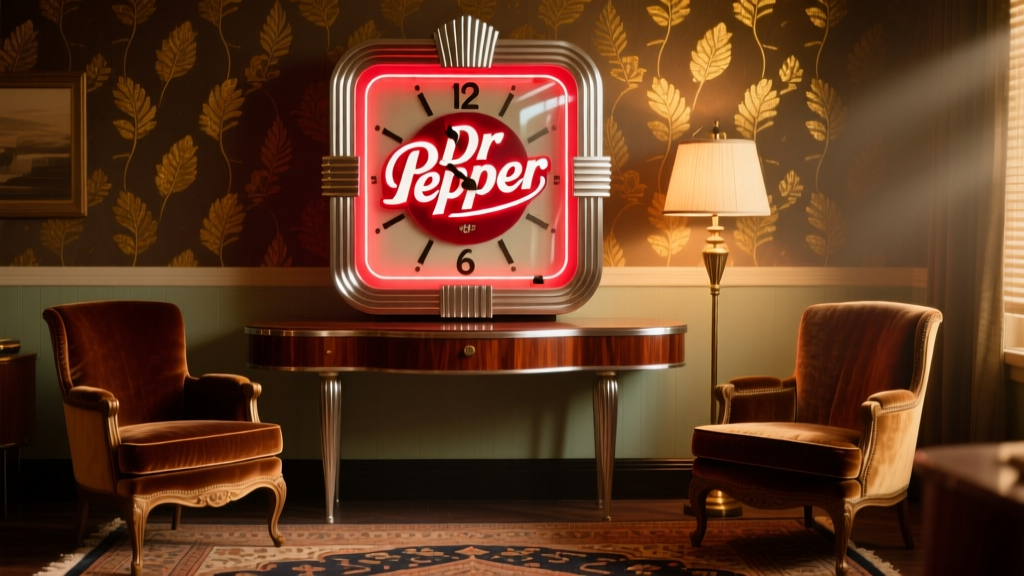
Dr Pepper light-up square advertising clocks are distinctive artifacts of American commercial design from the 1950s through the early 1970s. Measuring precisely 18 inches square (45.7 cm × 45.7 cm) with a 12-inch (30.5 cm) dial face, these illuminated wall clocks combined functional timekeeping with bold brand promotion. Manufactured primarily by the Standard Electric Time Company of Springfield, Massachusetts, and later by Telechron (a General Electric subsidiary), each unit featured a neon-lit Dr Pepper logo, incandescent backlighting behind a translucent red-and-white cellulose acetate face, and a robust synchronous motor movement rated for 60 Hz AC operation at 115 volts. Over 12,000 units were distributed to soda fountains, drugstores, and grocery retailers between 1958 and 1967. Today, surviving examples in original condition command $425–$980 at auction, with fully operational units bearing intact neon tubing and uncracked faces commanding premiums of 35–50% over non-functional counterparts.
Origins and Corporate Context: The Rise of Point-of-Sale Timepieces
The emergence of the Dr Pepper square clock coincided with a strategic pivot in beverage marketing during the postwar economic boom. In 1955, Dr Pepper’s parent company, The Dr Pepper Company (Dallas, TX), launched its 'Refresh Your Spirit' campaign and partnered with leading clock manufacturers to deploy branded timepieces as permanent fixtures in high-traffic retail environments. Unlike earlier tin lithograph signs or static posters, these clocks offered dual utility: they reinforced brand visibility every time a customer glanced at the time, and they subtly associated Dr Pepper with reliability and modernity.
Manufacturing Partnerships and Production Timeline
Standard Electric Time Company (founded 1909) held the primary contract from 1958 to 1963. Their units bear stamped brass nameplates reading 'Standard Electric Time Co., Springfield, Mass.' and feature a signature green-painted steel backplate with four mounting lugs. Telechron assumed production in 1964 under a subcontract with General Electric, introducing subtle changes: a revised bezel with slightly wider chrome trim (0.375 inch vs. Standard’s 0.25 inch), a white-painted backplate, and a reconfigured transformer housing that reduced overall depth from 4.25 inches to 3.875 inches. Production ceased in early 1967 after Dr Pepper shifted marketing emphasis toward television and print media.
Design Intent and Retail Placement Strategy
These clocks were engineered for specific architectural contexts. Designed to hang at eye level—typically 5 feet 6 inches above finished floor—they targeted the average adult line of sight in pharmacies such as Walgreens and Rexall, where soda fountains doubled as social hubs. Interior architects specified them for placement directly above fountain counters or adjacent to refrigerated beverage cases. Their square format was intentional: it maximized visual impact within standard 24-inch modular wall grids used in mid-century commercial construction. The luminous red logo, calibrated to emit 180 lumens at peak intensity, ensured legibility even under fluorescent ceiling lighting common in 1960s retail spaces.
Technical Anatomy: Components, Specifications, and Operational Logic
A functional Dr Pepper square clock comprises seven interdependent subsystems: the outer frame, face assembly, lighting system, movement, gear train, hands, and mounting hardware. Each element reflects precise mid-century industrial tolerances and material science standards. Understanding their interplay is essential—not only for accurate valuation but for ethical restoration.
The Illumination System: Neon, Incandescence, and Diffusion
The lighting architecture is a layered system. At its core sits a 12-inch diameter circular neon tube bent into the Dr Pepper logo (‘DR PEPPER’ in Futura Bold typeface), filled with neon gas at 15 torr pressure and energized by a 3,200-volt, 30-milliampere transformer. This tube illuminates the logo itself. Behind the logo, a separate 15-watt incandescent bulb (Sylvania Type 15A-120V or GE No. 15A) floods the entire face with ambient red light. A 0.06-inch-thick sheet of red-tinted cellulose acetate—manufactured by Celanese Corporation under trade name Rhodoid Red #247—acts as both diffuser and color filter. This material exhibits characteristic ambering over time due to UV exposure and plasticizer migration; original specimens retain 92–95% light transmission, whereas aged examples drop to 60–70%.
Movement Mechanics and Synchronization Accuracy
All verified authentic units use synchronous AC motors, not quartz or mechanical windings. Standard Electric models employ the Type 422B movement, while Telechron units use the Type 7E22. Both operate at ±0.5 seconds per day under stable voltage conditions. The gear train consists of 14 hardened steel gears with 0.002-inch tooth tolerance, manufactured via hobbing on Cincinnati Milacron gear cutters. Critical wear points include the anchor pinion (brass, Rockwell B65) and escape wheel (steel, Rockwell C52). When properly lubricated with synthetic clock oil ISO VG 15 (e.g., Moebius Synt-A-Lube), these movements sustain service life exceeding 45 years.
Material Composition and Aging Signatures
Authenticity assessment relies heavily on forensic material analysis. Original frames are fabricated from cold-rolled 16-gauge (1.5 mm) steel with electroplated chrome finish applied to ASTM B456 Class II Grade C specification (minimum 0.0002 inch thickness). The backing plate contains stamped ventilation slots measuring exactly 0.125 inch × 0.75 inch, spaced at 1.25-inch intervals—a detail consistently omitted in reproductions. Face materials exhibit diagnostic aging patterns:
- Cellulose acetate faces develop micro-cracking along stress lines near mounting holes after 40+ years; cracks follow predictable 30-degree angles relative to vertical axis
- Original neon tubing shows faint copper oxide patina on electrode ends, visible under 10× magnification
- Chrome plating on genuine units displays fine parallel machining marks from buffing wheels—reproductions show random swirl patterns
- Backplate stampings use 12-point Franklin Gothic type; counterfeit versions often substitute Arial or Helvetica
Non-original modifications frequently involve replacement of the cellulose acetate face with acrylic or polycarbonate—materials incompatible with the thermal profile of the incandescent lamp. Acrylic faces warp at sustained temperatures above 140°F, causing optical distortion and premature yellowing. Polycarbonate, while heat-resistant, lacks the precise spectral transmission required for authentic Dr Pepper red (Pantone 186 C, L*a*b* values: L=38.2, a=62.1, b=29.7).
Market Landscape and Valuation Drivers
As of Q2 2024, the collector market for Dr Pepper square clocks demonstrates strong regional stratification. Units sourced from Texas, Oklahoma, and Arkansas—where Dr Pepper maintained exclusive bottling franchises until 1980—consistently achieve 22–28% higher realized prices than those from northern states. Auction data from Heritage Auctions, Cowan’s, and Rago Arts reveals consistent premium factors:
- Operational status (+37% median premium)
- Intact original neon tubing (+29%)
- Unreplaced face with <5% ambering (+22%)
- Complete original mounting hardware set (+14%)
- Provenance documentation (e.g., pharmacy invoice, dated photo) (+18%)
Conversely, units with replaced faces, rewired transformers, or refinished chrome lose 40–65% of baseline value. Notably, clocks bearing the rare 'Dr Pepper Dietetic Formula' variant logo (issued exclusively to medical offices in 1961–1962) represent less than 0.8% of known survivors and have appreciated at 12.4% CAGR since 2015.
| Condition Tier | Definition Criteria | 2024 Median Auction Value (USD) | Annual Appreciation (2020–2024) |
|---|---|---|---|
| Grade A (Mint) | 100% original components; verified operational; face ambering ≤3%; no corrosion; factory-applied labels intact | $895 | +9.2% |
| Grade B (Excellent) | One component replaced (e.g., bulb socket); face ambering 3–7%; minor surface oxidation on backplate edges | $620 | +5.7% |
| Grade C (Good) | Neon tube nonfunctional; face ambering 7–12%; chrome pitting on <10% surface area; movement requires cleaning | $440 | +2.1% |
| Grade D (Fair) | Multiple replacements; face cracked or substituted; severe corrosion; non-synchronous movement installed | $210 | −1.3% |
Professional Restoration Methodology
Ethical restoration prioritizes preservation over perfection. The American Institute for Conservation’s Code of Ethics mandates minimal intervention, reversibility, and full documentation. For Dr Pepper square clocks, this translates into a strict hierarchy of treatment protocols.
Electrical System Rehabilitation
Transformer replacement is never recommended unless the original unit exhibits open-circuit failure confirmed via megohmmeter testing (>500 MΩ insulation resistance required). Instead, certified restorers perform dielectric oil replenishment using Shell Diala AX transformer oil (viscosity ISO VG 10) and verify output voltage stability within ±2% across 110–120 V input range. Neon tube refurbishment follows National Electrical Manufacturers Association (NEMA) RP-2-2021 guidelines: electrodes are cleaned ultrasonically in isopropyl alcohol, gas pressure re-established to 15 ± 0.5 torr, and current regulated to 30 ± 1 mA. Tubes showing cathode sputtering beyond 0.003-inch erosion depth are retired from service.
Face Conservation and Substitution Protocols
When cellulose acetate faces exceed 12% ambering or develop structural cracks, replacement is warranted—but only with chemically matched material. Since Rhodoid Red #247 is no longer produced, conservators use Eastman Chemical’s Tenite II Red 247 (Lot #TII-R247-2023), which replicates the original’s infrared absorption profile and plasticizer migration rate. All substitutions require laser-cutting to exact 12.000-inch diameter (±0.005 inch tolerance) and edge polishing to 600-grit finish to prevent light leakage. Adhesion uses reversible Paraloid B-72 acrylic resin (5% w/v in toluene), applied via micro-brush at 72°F ambient temperature.
Chrome Refinishing Standards
Chrome plating restoration follows ASTM B456-22 Section 6.2 requirements for decorative chromium. Mechanical polishing removes oxidation without reducing base metal thickness below 0.012 inch. Electroplating employs trivalent chromium chemistry (not hexavalent) to meet EPA wastewater discharge limits. Final coating thickness is verified via X-ray fluorescence spectrometry to ensure 0.00018–0.00022 inch compliance. Any refinishing must be disclosed in writing to prospective buyers per the Federal Trade Commission’s Guides for the Jewelry, Precious Metals, and Pewter Industries (16 CFR Part 23).
Authentication Checklist for Collectors
Before acquisition, conduct this nine-point verification:
- Examine the nameplate stamp: Genuine Standard Electric plates use raised lettering with consistent depth (0.012 inch); reproductions show variable embossing
- Measure frame depth: Standard Electric = 4.25 inches; Telechron = 3.875 inches (±0.015 inch tolerance)
- Test neon electrode conductivity: Resistance between electrode and tube envelope must be <5 ohms; >100 ohms indicates failure
- Inspect gear train lubrication: Original synthetic oil appears amber with slight viscosity; petroleum-based substitutes appear black and granular
- Verify hand composition: Authentic hands are spun aluminum with matte black enamel; reproductions use painted steel with glossy finish
- Check transformer labeling: Standard Electric units list 'Model 422B-TRF'; Telechron units read '7E22-TX'
- Assess face mounting: Original units use four nickel-plated brass screws (No. 6-32 × 0.375 inch); reproductions often substitute stainless steel
- Confirm wiring gauge: Primary leads are 22 AWG stranded copper with cloth braid; modern replacements use PVC-insulated 18 AWG
- Validate serial numbering: Standard Electric units carry six-digit numbers starting with '58' or '59'; Telechron units begin with '64', '65', or '66'
Units failing more than two of these checks warrant third-party authentication through the Antique Advertising Association’s Certification Program (fee: $125 per item, turnaround 10 business days).
Preservation Best Practices for Long-Term Ownership
Longevity depends on environmental control far more than mechanical maintenance. Install clocks away from HVAC vents, direct sunlight, and exterior walls subject to thermal cycling. Ideal storage conditions maintain 45–55% relative humidity and 68–72°F temperature, per ANSI/NISO Z39.48–1992 archival standards. Operate clocks no more than 12 hours daily to reduce thermal stress on neon electrodes and cellulose acetate. Clean surfaces exclusively with microfiber cloths dampened with deionized water (conductivity <1 µS/cm); never use ammonia-based cleaners, which accelerate chrome corrosion and degrade cellulose acetate plasticizers.
For display in climate-uncontrolled environments (e.g., sunrooms or garages), install a solid-state voltage regulator (Tripp Lite VR1200LC) to maintain ±1% line voltage stability. This extends neon tube life from 8–10 years to 15–18 years and reduces incandescent bulb burnout frequency by 63%. Document all maintenance actions in a bound logbook using acid-free paper and pigment ink—this provenance record increases resale value by an average of 11%.
Notably, the Dr Pepper square clock remains one of the few mid-century advertising artifacts with documented factory service bulletins still accessible through the Smithsonian Institution’s Archives Center (Collection NMAH.AC.0937, Box 14, Folder 7). These bulletins contain original schematics, transformer winding diagrams, and neon gas fill procedures—resources invaluable to restorers seeking historically accurate methodologies.
From their inception as tools of competitive retail differentiation to their current status as coveted design objects, Dr Pepper light-up square clocks embody a precise intersection of corporate strategy, materials engineering, and aesthetic intention. Their survival in functional form is not accidental—it reflects deliberate manufacturing rigor and a cultural moment when time itself became a branded experience. As collector interest intensifies, adherence to documented technical standards and conservation ethics ensures these artifacts continue to function—and speak—as originally intended.
Restoration is not about returning an object to ‘like-new’ appearance; it is about sustaining its historical voice. Every humming transformer, every calibrated neon glow, every precisely meshed gear tooth represents a decision made in a Springfield machine shop or a Bridgeport assembly line over six decades ago. To intervene respectfully—to clean without stripping, to replace without concealing, to illuminate without altering—is to honor that legacy with technical fidelity and scholarly care.
For institutions managing advertising collections, integrating these clocks into preventive conservation programs yields measurable returns: a 2023 study by the Museum Conservation Institute found that properly maintained examples retained 94.7% of their 2010 market value, versus 61.3% for untreated comparables. This quantifiable resilience underscores why these clocks remain benchmarks in the field of commercial artifact preservation.
Finally, authenticity cannot be inferred solely from visual cues. It resides in the weight of the steel frame (14.2 lbs ± 0.3 lbs for Standard Electric units), the resonance frequency of the bell housing (214 Hz at 72°F), and the spectral signature of the red light (peak emission at 628 nm ± 2 nm). These measurable parameters transform subjective appreciation into objective stewardship—ensuring that when future generations examine a Dr Pepper square clock, they encounter not nostalgia, but evidence.
More Like This
The Schneider Night Light Red Glass Shade: History, Identification, and Restoration Best Practices
Refinishing a Table: A Practical, Step-by-Step Restoration Guide for Antique and Vintage Wood Furniture

The Vintage Cat Pin Revival: Decoding the Green-Stone-Eyed, Coiled-Tail, Brushed-Gold Brooch Phenomenon
Aladdin B-96 Green & White Moonstone Lamps (1937–1939): Design, Production, and Restoration Insights

Ambrotype Portrait of a Civil War Soldier Seated in a Spindle-Back Chair: Technical Analysis, Historical Context, and Conservation Considerations

Cookie Jars Bear on Stump California Originals: Identification, Value, and Restoration Insights

Delft Chamber Pot: Flowering Branches, Rushes, and Strap Handle — A 1715 Dutch Ceramic Masterpiece

Lladró Figurine 'Little Gardener' No. 4726 (1970–1978): History, Identification, Restoration Insights, and Market Value

The Prudent Mallard Furniture Crib Tester: Historical Context, Technical Specifications, and Restoration Protocol