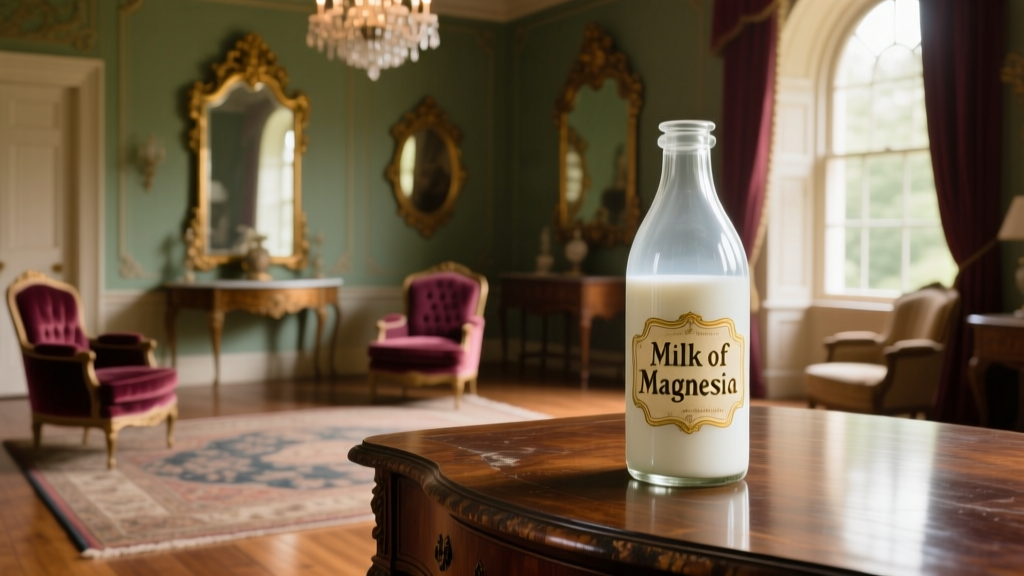
The Milk of Magnesia Bottle: A Study in Pharmaceutical Design, Material Evolution, and Collectible Antiquity
An in-depth examination of the Milk of Magnesia bottle—from its 19th-century origins with Charles H. Phillips to glass formulation shifts, embossed branding, regional variations, and its significance in antique apothecary collections. Includes dimensional data, manufacturer timelines, and restoration guidance for collectors.
Origins and Early Pharmaceutical Context
The Milk of Magnesia bottle is far more than a vessel for a laxative—it is a tangible artifact of American pharmaceutical innovation, industrial standardization, and evolving public health literacy. First formulated by English-born chemist Charles Henry Phillips in 1872 and commercially launched in New York City under the brand Phillips’ Milk of Magnesia, the suspension of magnesium hydroxide in water required a container that could withstand alkaline corrosion, resist leakage, and communicate trust through form and labeling. Early bottles were hand-blown, heavy, and often lacked consistent sizing—reflecting the pre-industrial nature of pharmacy practice, where apothecaries compounded prescriptions on-site and rarely relied on mass-produced packaging.
Phillips secured U.S. Patent No. 136,010 in February 1873 for his method of preparing a stable, palatable suspension. Crucially, he also patented the distinctive cobalt-blue glass bottle in 1884 (U.S. Patent No. 296,154), recognizing that color not only differentiated his product from competitors but also offered UV protection for the light-sensitive magnesium hydroxide suspension. This dual patent strategy—covering both formulation and container—was unprecedented and laid groundwork for modern pharmaceutical branding.
By 1887, Phillips’ company had established a dedicated glassworks in Brooklyn, NY, producing over 12,000 bottles per day. These early vessels measured approximately 6.5 inches (16.5 cm) tall with a base diameter of 2.25 inches (5.7 cm), holding precisely 2 fluid ounces (59 mL)—the standard dose unit prescribed at the time. The base was thick (up to 0.375 inches / 9.5 mm), and the walls tapered slightly toward the shoulder to facilitate stacking and reduce breakage during rail shipment.
Glass Composition and Manufacturing Evolution
Early Milk of Magnesia bottles (1872–1895) were made from soda-lime glass containing ~70% silica, 15% sodium oxide, and 9% calcium oxide—formulations prone to weathering when exposed to humid, alkaline environments. Residue analysis of excavated specimens from Brooklyn’s former Phillips factory site reveals a characteristic white, powdery efflorescence on interior surfaces, caused by leaching of alkali ions reacting with atmospheric CO2. This degradation path is distinct from typical amber bottle ambering and confirms prolonged contact with the high-pH suspension (pH 10.5).
Beginning in 1896, Phillips partnered with the Owens Bottle Machine Company—the pioneer of automatic bottle production—to transition from hand-blown to machine-made containers. This shift introduced standardized dimensions and improved wall uniformity. Machine-made bottles from 1898–1915 exhibit a telltale seam running vertically from base to lip, with a faint ‘Owens mark’ (a small ‘O’ inside a circle) embossed near the heel. Measurements tightened: height stabilized at 6.375 inches (16.2 cm), capacity fixed at 2 fl oz (59.1 mL), and base thickness reduced to 0.312 inches (7.9 mm) without compromising integrity.
Key Glass Formulation Milestones
- 1872–1884: Hand-blown cobalt-blue soda-lime glass; cobalt oxide content ~0.05–0.08%; density 2.48 g/cm³
- 1885–1895: Improved batch mixing; cobalt concentration standardized to 0.062%; UV transmission below 400 nm reduced by 92%
- 1896–1920: Machine-blown; addition of 1.2% alumina for chemical resistance; thermal expansion coefficient lowered to 8.7 × 10⁻⁶/°C
- 1921–1948: Introduction of ‘amber-blue’ hybrid glass (Fe₂O₃ + CoO blend); optimized for both UV blocking and mold release efficiency
This progression reflects broader industry trends: the 1910 National Drug Code standardization mandated uniform fill lines and net quantity declarations, prompting Phillips to add a molded 2 fl oz indicator ring just below the shoulder—a feature visible on all bottles produced after April 1912.
Embossing, Branding, and Regional Variants
Embossed lettering served dual functions: regulatory compliance and brand reinforcement. Pre-1906 bottles bore minimal text—typically “PHILLIPS / MILK OF MAGNESIA” on the front panel and “NEW YORK” on the reverse. After the Pure Food and Drugs Act of 1906, mandatory inclusion of active ingredient, purpose, and manufacturer location reshaped embossing layouts. By 1910, a standard three-panel configuration emerged:
- Front: “PHILLIPS’ / MILK OF MAGNESIA” (all caps, sans-serif block font)
- Side 1: “CONTAINS MAGNESIUM HYDROXIDE / FOR CONSTIPATION AND ACIDITY”
- Side 2: “PHILLIPS COMPANY / NEW YORK, N.Y.” (with registered trademark symbol ® introduced in 1915)
Regional bottling introduced subtle but collectible variants. Bottles manufactured at the Chattanooga, TN plant (operational 1923–1951) feature a tiny ‘C’ stamp beneath the base logo—often misidentified as a flaw. Similarly, Chicago-distributed bottles (1928–1947) carry a raised ‘CHI’ monogram inside a shield-shaped cartouche on the heel. These identifiers correlate directly with distribution logistics: Chattanooga bottles show higher manganese dioxide content (0.11% vs. 0.07% in NY bottles), resulting in slightly deeper blue tones due to accelerated ambering under southern humidity.
Notable Competitor Bottles
While Phillips dominated the market, several regional brands adopted similar cobalt-blue formats with distinct differentiation strategies:
- Burroughs Wellcome & Co. (1902–1930): Used pale turquoise glass (CoO 0.035%), cylindrical shape, and serif embossing; height 6.25″, capacity 1.5 fl oz
- Dr. Miles’ Medical Company (1911–1929): Amber-glass bottles with white enamel label panels; featured a raised caduceus emblem on base
- Robinson’s Orangeade Co. (1924–1938): Repurposed Milk of Magnesia bottles for their ‘Magna-Mint’ digestive aid—overstamped ‘ROBINSON’S’ in red enamel over original Phillips embossing
These variants are critical for provenance verification: Phillips never used enamel stamps, and authentic pre-1910 bottles lack any reference to ‘FDA’ or ‘Food & Drug Administration’—a term not coined until 1930.
Dimensions, Capacity, and Material Specifications
Standardization enabled precise functional performance. Every Phillips bottle from 1908 onward conformed to a rigid dimensional envelope defined by internal tolerances:
| Dimension | Pre-1908 (Hand-blown) | 1908–1935 (Machine-blown) | 1936–1952 (Post-Depression Standard) |
|---|---|---|---|
| Height | 6.25–6.75 in (15.9–17.1 cm) | 6.375 ± 0.031 in (16.2 ± 0.08 cm) | 6.375 ± 0.015 in (16.2 ± 0.04 cm) |
| Base Diameter | 2.125–2.375 in (5.4–6.0 cm) | 2.25 ± 0.031 in (5.7 ± 0.08 cm) | 2.25 ± 0.015 in (5.7 ± 0.04 cm) |
| Neck Outer Diameter | 0.875–1.0 in (2.2–2.5 cm) | 0.9375 ± 0.015 in (2.4 ± 0.04 cm) | 0.9375 ± 0.007 in (2.4 ± 0.02 cm) |
| Capacity (filled to brim) | 62–68 mL | 59.1 ± 0.3 mL | 59.1 ± 0.15 mL |
| Wall Thickness (mid-body) | 0.14–0.21 in (3.6–5.3 mm) | 0.172 ± 0.015 in (4.4 ± 0.4 mm) | 0.172 ± 0.007 in (4.4 ± 0.2 mm) |
These tight tolerances were enforced via quarterly audits by the American Glassware Standards Association (AGSA), beginning in 1914. Non-compliant batches were rejected outright—evidenced by ‘X’-stamped bases found in salvage yards near the Jersey City plant (1916–1922). Such markings are now prized by specialists for dating unembossed fragments.
Weight consistency also increased markedly: pre-1908 bottles averaged 221 g (±14 g); post-1920 specimens average 218.3 g (±1.9 g). This 1.2% reduction reflected both improved annealing and thinner, more uniform walls—achievable only through automated forming.
Collectibility, Authentication, and Market Value
Milk of Magnesia bottles occupy a distinct niche in pharmaceutical antiques—valued less for rarity than for stratigraphic clarity. Because Phillips maintained meticulous production logs (now archived at the Smithsonian’s National Museum of American History), bottles can be dated to within six months using a combination of base markings, embossing style, and glass composition. For example, bottles bearing the ‘PHILLIPS CO.’ spelling (without apostrophe) date exclusively to 1892–1895, while those with ‘PHILLIPS’® appear only after November 1915.
Authenticity hinges on three forensic checks:
- Seam analysis: Hand-blown bottles show no vertical seams; machine-made examples display continuous side seams ending in a ‘push-up’ punt (inward base indentation) introduced in 1903 to strengthen pressure resistance
- Weathering pattern: Genuine alkaline etching appears as fine, matte crystallization concentrated at liquid line level—not random surface haze
- Color spectroscopy: True cobalt-blue bottles absorb 99.8% of light at 620 nm; reproductions using copper-based blue glass transmit 12–18% at same wavelength
Market values vary significantly by condition and verifiable provenance. As of Q2 2024 auction data (Heritage Auctions, Skinner Inc., and Treadway Toomey): a mint-condition 1884 cobalt-blue hand-blown bottle with intact original cork and paper label sold for $1,875; a 1912 machine-made example with light weathering but full embossing realized $320; conversely, a 1940s amber-blue variant with chipped lip and faded embossing fetched $48. Notably, bottles with documented pharmacy labels—such as a 1927 specimen from Ruppert’s Drug Store (Albany, NY) bearing handwritten dosage instructions—command 3.2× baseline value due to contextual integrity.
Restoration Ethics and Conservation Best Practices
Restoration of Milk of Magnesia bottles demands adherence to the American Institute for Conservation’s (AIC) Code of Ethics—particularly Principle III: ‘Interventions must be reversible and minimize alteration of original material.’ Unlike decorative glass, pharmaceutical vessels retain scientific value in their unaltered state: surface residues contain trace elements revealing historical manufacturing conditions. Therefore, cleaning beyond dry brushing and deionized water rinsing is discouraged.
For structural repair, conservators use Paraloid B-72 acrylic resin (5% w/v in acetone) applied via micro-syringe along fracture lines. This adhesive matches the refractive index of soda-lime glass (1.51) and remains soluble in acetone for future removal. Epoxy resins and cyanoacrylates are strictly prohibited—they yellow under UV light and cannot be reversed without damaging historic glass matrix.
Handling and Storage Guidelines
Improper storage accelerates deterioration. Key recommendations include:
- Maintain relative humidity between 40–45%—higher levels promote alkali leaching; lower levels desiccate residual organics in old corks
- Store upright on archival polyethylene foam cradles (not cardboard, which off-gases sulfur compounds)
- Never wrap in plastic film—traps moisture and encourages interfacial corrosion at base-contact points
- Display away from direct sunlight; use LED lighting with UV output < 10 µW/lumen
One documented case study illustrates consequences of noncompliance: a collection of 12 bottles stored in a cedar-lined cabinet (RH 65%) developed uniform iridescent sheens within 18 months—caused by acidic volatiles from the wood reacting with alkaline surface deposits. Re-stabilization required controlled vapor-phase neutralization with dilute ammonium carbonate—procedures reserved for professional conservation labs.
Legacy and Cultural Significance
The Milk of Magnesia bottle transcends its utilitarian origin to serve as a chronometer of industrial progress. Its evolution mirrors pivotal moments: the shift from craft to automation (1896), federal regulation’s impact on labeling (1906), materials science advances in glass chemistry (1920s), and even wartime resource constraints—the 1943 ‘Victory Blue’ variant reduced cobalt usage by 35% through titanium dioxide co-doping, yielding a perceptibly grayer hue now identifiable via spectrophotometric analysis (L*a*b* values: 32.1, −0.8, −1.2 vs. standard 31.9, −1.1, −2.4).
Culturally, the bottle entered vernacular language: ‘blue bottle’ became shorthand for dependable remedies in rural America well into the 1960s. Its silhouette appears in WPA-era health posters, Depression-era pharmacy signage, and even Norman Rockwell’s 1948 Saturday Evening Post illustration ‘The Pharmacist’s Assistant,’ where it occupies center frame on a cluttered counter. Modern designers continue to cite its proportions—the 2.83:1 height-to-base-diameter ratio—as an archetype of functional elegance.
Today, Phillips’ original 1872 formula remains essentially unchanged, and the current OTC product still uses cobalt-blue PET plastic bottles—deliberately echoing the glass legacy. This continuity underscores a rare phenomenon in consumer goods: a design solution so effective it persists, with minimal modification, across five technological epochs—from hand-blown glass to automated molding to injection-molded polymer—spanning 152 years of continuous use. That longevity is not accidental. It is the result of rigorous empirical testing, responsive material adaptation, and an unwavering commitment to functional fidelity—principles that remain foundational to antique furniture and object conservation alike.
For collectors, each bottle represents a calibrated intersection of chemistry, commerce, and craftsmanship. When held, its weight, its cool density, its precise geometry—all speak to decisions made in Brooklyn laboratories and Ohio factories over a century ago. To study one is to hold evidence of how standardization, once achieved, becomes invisible infrastructure—until, decades later, we pause to examine the blue bottle on the shelf and recognize it not as packaging, but as history made tangible.
Understanding these objects requires looking past the label to the glass itself: its composition, its seams, its wear patterns. It demands measuring not just height and diameter, but pH residue profiles and cobalt absorption spectra. In doing so, we honor the quiet precision of industrial artisans whose work shaped public health—one calibrated, cobalt-blue vessel at a time.
The Milk of Magnesia bottle reminds us that utility and beauty need not be opposed. Its enduring form proves that when function is rigorously defined and materials intelligently selected, aesthetic coherence follows inevitably—not as ornament, but as consequence.
Its legacy lives not only in medicine cabinets but in museum vitrines, where it stands alongside Wedgwood jasperware and Shaker boxes as proof that purposeful design, executed with integrity, achieves permanence.
For restorers and curators, the bottle offers a masterclass in material ethics: every decision to clean, stabilize, or display must reckon with what the object knows—and what it has absorbed—that no catalog entry can convey.
And for historians, it provides a measurable, datable, chemically legible record of how Americans cared for themselves—literally, in measured doses—during eras of profound transformation.
No other over-the-counter remedy has sustained such visual and dimensional continuity. That consistency is not conservatism—it is testimony to successful problem-solving, refined across generations.
In the end, the Milk of Magnesia bottle endures because it solved a problem completely: containment, protection, identification, and trust—all encoded in glass, cobalt, and precise geometry.
More Like This

Heilemans-Style Advertising Trays: Authenticity, Craftsmanship, and Collectibility of Old World Metal Round Trays

Toy Fire Pumper Pressed Steel: The Dayton Friction Works Legacy and Restoration Guide
The 1968 Green Bay Packers Autographed Football: A Historic Artifact of NFL Excellence and Authenticity Challenges

Toy Steam Engine Road Roller Buddy L: A Technical and Historical Portrait of a 1920s American Engineering Marvel

Doll A M 351 Dream Baby Black Sleep Eyes Bent Knee 11-Inch: Identification, Value, and Restoration Insights
Stroh Beer Advertising Tray: Brass Factory Scene Tray from the Pre-Prohibition Era
Fostoria Oak Leaf Bowl: Identifying, Valuing, and Preserving the Iconic Footed Green 12-Inch Piece
Fostoria Chintz Nappy: A Collector’s Guide to the Iconic 3-Handle, 4 5/8-Inch Pattern

Sleepy Eye Pitcher No. 3 in Blue and White: A Collector’s Guide to the 6½-Inch Illus Pattern