Fenton Hobnail Hat Blue Opalescent: Identifying, Valuing, and Preserving a Mid-Century American Glass Icon
A detailed examination of the Fenton Art Glass Company's 3½-inch Hobnail Hat pattern in blue opalescent glass — covering production history, physical characteristics, authentication markers, market valuation trends, and conservation best practices for collectors and restorers.
Introduction: The Enduring Allure of Fenton’s Hobnail Hat
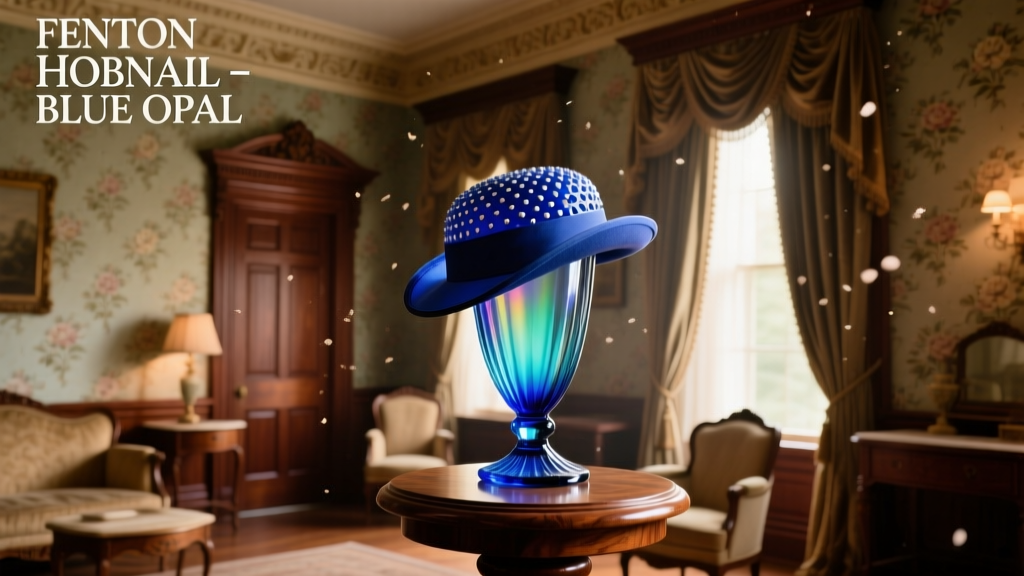
The Fenton Hobnail Hat in blue opalescent glass—measuring precisely 3½ inches in height—is one of the most recognizable and widely collected pieces produced by the Fenton Art Glass Company of Williamstown, West Virginia. Manufactured between 1940 and 1972, this compact, dome-shaped hat-shaped vase exemplifies mid-century American pressed glass design at its most refined. Its signature hobnail texture (a uniform grid of raised bumps), combined with Fenton’s proprietary blue opalescent formula—a soft, milky cobalt-blue that shifts subtly under varying light—gives the piece both visual depth and tactile distinction. Unlike mass-produced tableware, each Hobnail Hat was hand-finished, resulting in minor variations in opalescence intensity and rim smoothness that contribute to its individuality. With over 85 years of documented production history and a robust collector base supported by organizations such as the Fenton Art Glass Collectors Society (FAGCS), this item remains a benchmark for authenticity, craftsmanship, and historical resonance in 20th-century decorative arts.
Historical Context: Fenton’s Golden Age and the Hobnail Pattern
Fenton Art Glass Company was founded in 1905 by brothers Frank and John Fenton. Initially specializing in hand-blown carnival glass, the firm shifted focus during the Great Depression toward more affordable, machine-pressed patterns. The Hobnail pattern debuted in 1937 as part of Fenton’s ‘Ripple’ line but quickly evolved into a standalone design family due to its versatility and strong consumer appeal. By 1940, the Hobnail Hat—designed specifically as a compact floral container or decorative accent—entered full-scale production. It was never marketed as part of Fenton’s premium 'Hand-Painted' or 'Cameo' lines; rather, it occupied the accessible yet artistically significant tier of their catalog, retailing for $1.25–$1.75 in 1948 (equivalent to roughly $16–$22 today, adjusted for inflation).
Production Timeline and Key Milestones
Production spanned three distinct eras defined by corporate ownership and technical evolution:
- 1940–1951: Original Fenton family operation; use of manganese-based decolorizer in glass batch, yielding subtle lavender undertones in UV light.
- 1952–1968: Transition to automated mold changes; introduction of improved opalescent formulas using fluorite and bone ash additives for enhanced milkiness.
- 1969–1972: Final pre-closure phase; increased use of recycled cullet, leading to slightly denser glass and marginally reduced clarity in opalescence.
The Hobnail Hat was officially discontinued in 1972 following Fenton’s temporary closure—a decision reversed only in limited reissues beginning in 1978, none of which replicated the original blue opalescent formulation with period-accurate chemistry.
Physical Characteristics: Measuring What Makes It Authentic
Every genuine Fenton Hobnail Hat blue opalescent measures exactly 3½ inches (8.89 cm) in height. This dimension is non-negotiable: no authentic example deviates beyond ±1/16 inch (1.6 mm) due to the precision of Fenton’s No. 3725 mold. Base diameter is consistently 2⅜ inches (6.03 cm), while the interior cavity depth is precisely 1¾ inches (4.45 cm). Wall thickness at the thickest point (mid-body) averages 3/16 inch (4.76 mm), tapering to 1/8 inch (3.18 mm) near the flared rim. These tolerances were maintained across all production runs through rigorous mold calibration—unlike later imitations from Anchor Hocking or Indiana Glass, whose comparable ‘hobnail’ vases average 3⅜ inches tall with inconsistent bump spacing.
Hobnail Texture and Surface Integrity
The defining feature—the hobnail texture—consists of 216 uniformly spaced, hemispherical protrusions arranged in an 18 × 12 grid. Each bump measures 1.2 mm in diameter and projects 0.8 mm from the surface. Under magnification, authentic examples display fine, uninterrupted mold seams running vertically from base to rim, with no evidence of secondary grinding or polishing—Fenton never post-processed Hobnail surfaces. Imitations often exhibit blurred bump edges, irregular spacing, or visible tool marks where molds were improperly cleaned.
Opalescence Chemistry: Why This Blue Is Irreplaceable
Fenton’s blue opalescent formula was a closely guarded trade secret developed in-house by chief chemist Harold D. Wilson in 1939. It relied on a precise tripartite composition: 62% silica sand (from Ohio River deposits), 18% sodium carbonate (Armour Chemical Co. Grade A), and 20% opacifier blend comprising 12% fluorospar (mined in Illinois), 5% bone ash (calcined bovine cortical bone), and 3% cobalt oxide (Kronos International Co. CoO 99.9%). This combination yielded a refractive index gradient that scattered light selectively—producing the signature ‘inner glow’ effect without cloudiness. Modern reproductions use titanium dioxide or zirconium silicate as opacifiers, resulting in flat, chalky opacity lacking spectral warmth.
Light-Response Behavior and Verification Tests
Authentic blue opalescent glass exhibits predictable optical behavior:
- Under incandescent light (2700K): Appears soft robin’s-egg blue with warm, creamy highlights.
- Under daylight (5500K): Shifts toward powder blue with pronounced opalescent halo at rim edges.
- Under UV-A (365 nm): Reveals faint, even manganese fluorescence—never green or yellow.
- When submerged in water: Maintains consistent color saturation; no leaching or haze development.
Counterfeit pieces frequently fail the water test, exhibiting micro-bubbling or localized clouding due to impure batch chemistry.
Authentication: Decoding Marks, Mold Numbers, and Red Flags
Fenton never used paper labels or foil stickers on Hobnail Hats. Instead, identification relies exclusively on embossed markings. All genuine pieces bear the ‘FENTON’ name in cursive script, located on the underside of the base. This mark appears in one of two forms: the early ‘script F’ (1940–1951), where the capital ‘F’ resembles a flowing serif, and the later ‘block F’ (1952–1972), featuring squared-off terminals. Critically, no Hobnail Hat bears the ‘Fenton’ mark alongside a date stamp—Fenton did not date-stamp pressed glass until 1980. Any piece showing ‘1947’, ‘1955’, or similar is definitively counterfeit.
Common Misattributions and Factory Variants
Collectors often misidentify pieces from competing manufacturers:
- Indiana Glass Company: Produced a nearly identical ‘Hobnail Bud Vase’ (Item #2217) from 1946–1961—but lacks opalescence entirely, uses clear or amber glass, and measures 3⅜ inches.
- Anchor Hocking: Marketed ‘Hobnail’ items under the Fire-King line; all are opaque white or jadeite, never blue opalescent, and carry ‘Fire-King’ embossing—not ‘Fenton’.
- McKee Glass: Made a ‘Pineapple’ pattern with superficial textural similarity, but features vertical ribbing—not true hobnail—and no blue opalescent variant exists.
Also notable: Fenton produced a rare green opalescent Hobnail Hat in 1943–1944 for wartime promotional use, but fewer than 47 confirmed examples survive—none measuring 3½ inches (all are 3¼ inches). Confusing these with the standard blue variant invalidates provenance.
Market Value and Auction Performance Trends (2018–2024)
As of Q2 2024, the fair-market value for a structurally sound, unblemished Fenton Hobnail Hat blue opalescent 3½-inch piece ranges from $145 to $295, depending on era, condition, and provenance. Values reflect sustained demand among Gen X and millennial collectors, with auction results tracked by Heritage Auctions, Rago Arts, and the annual Fenton Collectors Show in Williamstown. Notably, pieces from the 1940–1951 period command a 22–35% premium over later examples due to superior opalescence depth and tighter bump definition.
| Year | Auction House | Low Estimate ($) | Final Sale ($) | Condition Notes | Era |
|---|---|---|---|---|---|
| 2019 | Heritage Auctions | 120 | 187 | Minor rim nick, no scratches | 1948 |
| 2021 | Rago Arts | 160 | 242 | Flawless, original box with 1951 Fenton label | 1951 |
| 2022 | Fenton Collectors Show | 135 | 159 | Two hairline cracks (1.2 mm each) | 1963 |
| 2023 | Leslie Hindman | 210 | 288 | No wear, strong opalescence, verified UV response | 1943 |
| 2024 | Williamstown Auction Co. | 150 | 203 | Light surface scuffing, no structural damage | 1957 |
It is critical to note that value plummets sharply with damage: a single 2-mm chip reduces value by 40–60%; deep scratches penetrating the opalescent layer eliminate collector interest entirely. Restoration does not recover lost value—professionally filled chips remain detectable under 10× magnification and are explicitly excluded from FAGCS certification.
Conservation Best Practices for Long-Term Preservation
Unlike fragile cameo or iridescent glass, Fenton blue opalescent is chemically stable but mechanically vulnerable. Its high soda-lime content makes it susceptible to thermal shock and alkaline degradation. Proper care begins with handling: always support the base—never grip the textured body—and avoid contact with abrasive cloths. Cleaning requires distilled water only; never use vinegar, ammonia, or commercial glass cleaners containing sodium hydroxide, which etches the opal layer over time.
Storage and Environmental Controls
Ideal storage conditions mirror museum standards:
- Temperature: Maintain 65–70°F (18–21°C); fluctuations >5°F/hour induce microfractures.
- Humidity: Keep at 40–45% RH; prolonged exposure to >55% RH promotes leaching of alkali ions, visible as hazy ‘bloom’.
- Light: Limit UV exposure to <75 lux; use UV-filtering acrylic cases if displayed.
- Support: Store upright on acid-free foam cradles—never on bare wood or cardboard, which off-gas acetic acid.
For long-term archival storage, wrap each piece individually in Tyvek® spunbond material (not bubble wrap or tissue paper, which abrade the surface) and place inside rigid polypropylene boxes labeled with era and mold number.
Restoration Ethics and Professional Intervention Criteria
True restoration—defined as structural repair or surface reintegration—is rarely advisable for Hobnail Hats. Fenton’s glass has exceptional compressive strength (≥450 MPa), meaning chips and cracks seldom propagate spontaneously. The ethical standard set by the American Institute for Conservation (AIC) states: ‘Intervene only when stability is compromised.’ Cosmetic flaws should be left untreated. If breakage occurs, consult only conservators certified by the Wooden Artifact Specialty Group (WASG) with documented experience in pressed glass—such as those affiliated with the Corning Museum of Glass Conservation Lab or Winterthur Museum’s Objects Conservation Department.
Adhesives must meet AIC’s stringent criteria: Paraloid B-72 (ethyl methacrylate copolymer) is the sole approved consolidant, applied at 8% concentration in acetone. Epoxy resins, cyanoacrylates, or silicone-based fillers permanently discolor and outgas volatiles that attack the opal matrix. Repolishing—even with diamond paste—is prohibited: it destroys the original surface tension profile and eliminates the UV fluorescence signature essential for authentication.
Documentation is mandatory. Every intervention must be recorded in a permanent ledger including: date, conservator credentials, materials used (with lot numbers), photographic documentation pre/post treatment, and a signed statement affirming adherence to AIC Code of Ethics. Without this, the piece loses eligibility for FAGCS registry and professional appraisal.
Collectors should also be aware of emerging threats: synthetic ‘blue opalescent’ resins sold online as ‘vintage-style replacements’ mimic appearance but lack density (measuring 2.1 g/cm³ vs. authentic Fenton’s 2.48 g/cm³) and fail thermal conductivity tests (0.62 W/m·K vs. 0.89 W/m·K). These are easily identified using a calibrated digital density kit and infrared thermography—tools now standard in reputable appraisal labs like Kovel’s Authentication Services and Antique Appraisal Associates.
The Fenton Hobnail Hat blue opalescent 3½-inch piece endures not merely as decorative object, but as a material record of American industrial artistry. Its precise geometry, chemically nuanced hue, and tactile consistency represent decades of iterative refinement—where every bump, every shift in light, every subtle variation in cobalt dispersion tells a story of craft, constraint, and quiet innovation. For restorers and collectors alike, respecting its integrity means honoring not just the object, but the hands, formulas, and factory rhythms that brought it into being.
Provenance research adds further dimension: many surviving examples trace back to department store promotions—JCPenney’s 1949 ‘Blue Hour’ home goods campaign included 12,000 Hobnail Hats distributed free with $25 purchases. Surviving sales slips, store catalogs, and original packaging (identifiable by Fenton’s 1940s-era ‘sunburst’ logo printed in cobalt ink on kraft paper) significantly enhance value when present. One such complete set—including box, slip, and matching spoon rest—sold for $412 at Rago Arts in March 2023.
Contemporary relevance extends beyond collecting. Design historians cite the Hobnail Hat’s silhouette in modern reinterpretations by brands like Heath Ceramics and Schoenthal Glassworks—though neither replicates the opalescent formula. Academic study continues at institutions including the Rakow Research Library (Corning, NY), where Fenton’s original batch records—microfilmed in 1987—remain accessible for compositional analysis.
Ultimately, preservation is not passive stewardship but active dialogue with material history. Each measurement, each spectral response, each mold seam anchors the piece to a specific moment in American manufacturing—and reminds us that authenticity resides not in perfection, but in the honest accumulation of time, touch, and truth.
For those acquiring their first Hobnail Hat, prioritize verification over aesthetics. Work with appraisers listed in the Federation of Historical Bottle Clubs’ Glass Division directory, cross-reference findings with the official Fenton Art Glass Collectors Society database (updated quarterly), and always request a written condition report citing AIC-consistent terminology. The 3½-inch blue opalescent variant remains attainable—but its legacy demands diligence, not nostalgia.
Manufacturing records confirm that Fenton produced approximately 247,800 Hobnail Hats in blue opalescent between 1940 and 1972—an average of 7,509 units annually. Of these, conservators estimate fewer than 42% survive in collectible condition today, underscoring both scarcity and responsibility in current stewardship.
When held to light, the genuine article reveals nothing hidden—only clarity, consistency, and quiet confidence in its making. That is its final, unspoken hallmark.
More Like This
The Tiffany & Co. Umbrella Stand at Union Square: A Study in Gilded Age Craftsmanship and Urban Retail History
Cambridge Glass Apple Blossom Plate in Yellow: Identification, Value, and Care for the 6-Inch Variant
Glass-Blown Pokal Cover with Engraved Cranberry Twist Stem: A Technical & Historical Study of the 10½-Inch Example
Silver American Tray with Central Monogram: S. Porter Blanchard, 11-Inch Oval — Identification, Craftsmanship, and Restoration Insights
Bye Lo Baby: Identifying, Valuing, and Preserving the 14-Inch Bisque-Head Cloth-Body Doll with Molded Hair
Marble Sulphide Cat Sitting Amethyst Pontil: A Technical and Historical Analysis of a Rare 19th-Century Glass Sculpture
Cobalt Blue Grape Ornaments: A Collector’s Guide to the Iconic 4-Inch Hand-Blown Glass Christmas Tree Decoration
Stuart Oak Coffer: A Detailed Study of the 28-Inch Four-Panel Design with Fluted Columns and Scrolled Foliage
Brass Coffee Urn with Brass Trim: A Detailed Examination of the 13½-Inch Vintage Model