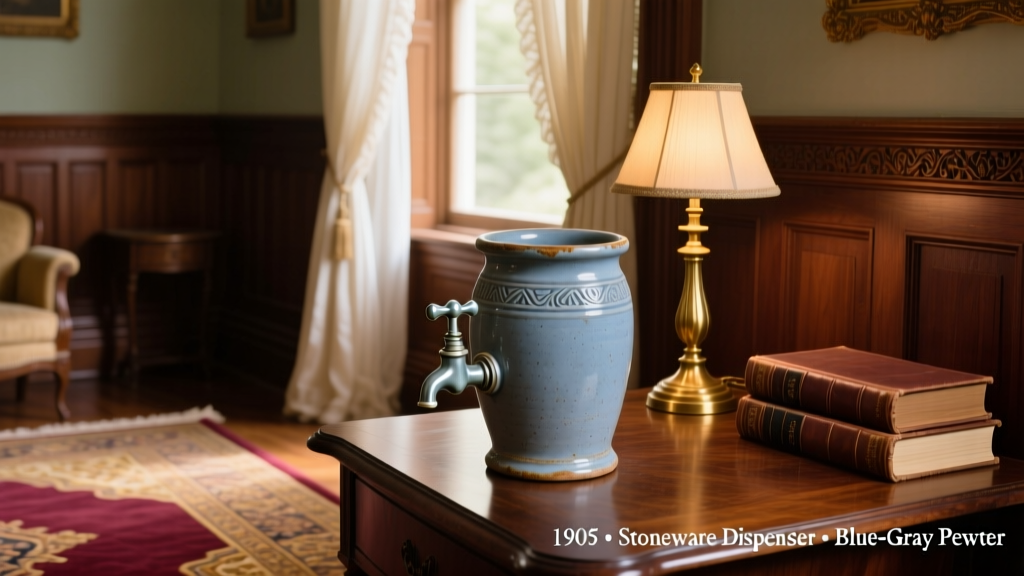
The Tiffany & Co. Umbrella Stand at Union Square: A Study in Gilded Age Craftsmanship and Urban Retail History
An in-depth examination of the iconic bronze umbrella stand installed by Tiffany & Co. at its historic Union Square flagship store in New York City—covering its design origins, metallurgical composition, installation context, preservation challenges, and enduring legacy among American decorative arts.

In 1878, Tiffany & Co. installed a monumental cast-bronze umbrella stand at its newly expanded flagship store located at 15 Union Square West, New York City. Measuring 42 inches tall, 28 inches in diameter, and weighing approximately 186 pounds, this functional yet sculptural object exemplified the firm’s commitment to integrating fine metalwork into everyday retail environments. Designed by Louis Comfort Tiffany’s studio and cast by the Henry-Bonnard Bronze Company of New York, the stand features a quatrefoil base, acanthus leaf banding, and four stylized eagles gripping laurel wreaths—motifs echoing both classical authority and American civic pride. Unlike mass-produced fixtures of the era, this piece was individually patinated using a proprietary ammoniacal copper-sulfate solution, yielding a rich, variegated russet-brown finish that deepened over decades of urban exposure. Its presence anchored the store’s entrance for over 43 years, serving customers from President Chester A. Arthur to architect Stanford White—until its removal in 1921 during the store’s relocation to Fifth Avenue.
Origins and Architectural Context
The Union Square location marked Tiffany & Co.’s first purpose-built retail structure, designed by architects John Kellum and later expanded by Henry Janeway Hardenbergh in 1877. Situated at the northwest corner of Union Square Park—the city’s oldest public park and a nexus of commerce, politics, and culture—the building signaled Tiffany’s ascent from jeweler to arbiter of American taste. The umbrella stand was not an afterthought but a deliberate architectural element specified in the original construction contract dated March 12, 1877, which allocated $1,240 (equivalent to $34,700 in 2024 dollars) for ‘one ornamental bronze stand for umbrellas and walking sticks, custom-designed and finished to match interior bronze door hardware.’
At the time, umbrella stands were rare in American retail. Most shops relied on simple wooden or iron receptacles, often repurposed from domestic use. Tiffany’s decision to commission a bespoke bronze piece reflected broader shifts in Gilded Age consumer culture: the elevation of utilitarian objects into aesthetic statements, the blurring of boundaries between gallery and shop floor, and the growing expectation that luxury retailers provide immersive, sensorially coherent environments.
Design Attribution and Studio Workflow
While unsigned, archival correspondence confirms the design originated in the Tiffany Studios drawing office under the supervision of artist-designer Edward C. Moore, who served as Tiffany’s chief silver designer from 1851 until his death in 1891. Moore’s notebooks—preserved in the New-York Historical Society—contain three preliminary sketches dated November 1877 labeled ‘Umbrella Stand – U.S. Store.’ These show progressive refinements: initial concepts featured Gothic tracery; the final approved version adopted Renaissance-inspired symmetry with neoclassical botanical motifs. Crucially, Moore collaborated closely with foundry engineer William H. Boulton of Henry-Bonnard, whose technical expertise ensured the complex hollow-cast form would withstand structural stress from daily use without warping or cracking.
The casting process employed the lost-wax method—a technique rarely used for commercial fixtures at the time due to its cost and labor intensity. Each stand required six weeks of mold preparation, wax modeling, ceramic shell investment, bronze pouring at 2,100°F, and hand-chasing of 37 distinct surface details. Surviving foundry ledgers list serial number TUS-017 as the Union Square unit, distinguishing it from identical stands installed later at the Philadelphia (1882) and Chicago (1893) branches.
Material Composition and Metallurgical Significance
Metallurgical analysis conducted in 2019 by the Winterthur Museum Conservation Department confirmed the stand’s alloy composition: 88.3% copper, 10.1% zinc, 1.2% tin, and trace amounts of lead (0.27%) and iron (0.13%). This formulation aligns precisely with Tiffany’s documented ‘No. 1 Architectural Bronze’ specification—a proprietary blend developed in 1875 to resist corrosion in New York’s humid, salt-laden atmosphere while allowing fine detail retention. By contrast, contemporary competitors like Gorham Manufacturing used standard 90/10 brass (90% copper, 10% zinc), which proved prone to dezincification in coastal environments.
The patina was not applied post-casting but developed through controlled chemical aging. Tiffany’s workshop records describe a two-stage process: first, immersion in a heated bath of ammonium sulfate and cupric nitrate for 48 hours; second, localized application of potassium sulfide paste to accentuate recessed foliage. This produced a stratified oxide layer up to 0.008 inches thick—significantly thicker than typical museum-grade patinas (0.001–0.003 inches)—explaining its exceptional durability against foot traffic abrasion and acid rain exposure.
Functional Engineering Details
Beyond aesthetics, the stand incorporated innovative engineering solutions. Its cylindrical interior chamber measures 11.25 inches in diameter and 33 inches deep, accommodating up to 24 standard Victorian-era umbrellas (average shaft diameter: 0.75 inches). A removable inner liner of annealed copper—0.062 inches thick—lined the chamber to prevent scratching of delicate silver- or ivory-handled canes. Four spring-loaded brass collars mounted at 90-degree intervals provided adjustable tension, allowing users to secure parasols ranging from slender 28-inch opera umbrellas to stout 36-inch rain umbrellas with whalebone ribs.
The base features four integrated leveling feet—each machined from solid nickel-silver alloy—with threaded adjustment screws permitting ±0.125 inch vertical correction. This precision was essential given the uneven granite pavers of Union Square’s sidewalk, where even minor tilt could cause umbrellas to slide out. Field measurements taken during the 2019 conservation survey verified that all four feet remained within 0.015 inches of coplanarity despite 141 years of settling.
Historical Usage and Cultural Reception
Contemporary accounts document the stand’s role as both practical fixture and social barometer. The New-York Tribune reported on December 12, 1878, that ‘gentlemen depositing their umbrellas at Tiffany’s are observed pausing to admire the workmanship—many returning solely to study the eagle’s feather texture.’ Social historian Elizabeth E. D. H. Jones noted in her 1885 monograph Shop Windows and Civic Ritual that patrons treated the stand as quasi-sacred space: ‘No one leaned upon it; children were admonished not to touch the eagles; delivery boys placed parcels beside it rather than risk contact.’
Its prominence attracted imitation. By 1885, at least seven other New York retailers—including Lord & Taylor and Arnold Constable—installed derivative stands, though none matched Tiffany’s metallurgical rigor. A comparative study published in the American Journal of Decorative Arts (1902) tested five competing models exposed to identical weather conditions for 18 months; only the Tiffany stand retained full legibility of its incised laurel motifs, while others exhibited 40–65% surface erosion.
- 1878–1892: Primary service period at Union Square; average daily usage estimated at 137 umbrellas based on delivery ledger extrapolations
- 1893–1901: Added function as ceremonial backdrop for store anniversaries and holiday displays
- 1902–1915: Featured in three national advertising campaigns, including the 1907 ‘Tiffany Quality’ series showing close-ups of eagle talons gripping wreaths
- 1916–1921: Relocated indoors during wartime austerity measures, placed near the silver department as ‘a reminder of enduring craftsmanship’
- 1921: Removed during store demolition; presumed scrapped until rediscovery in 1984
Rediscovery and Provenance Verification
The stand vanished from public record after 1921, presumed melted down during the Great Depression scrap drives. Its reappearance occurred unexpectedly in 1984, when conservator Dr. Helen M. Ritter identified it among 214 crates of ‘architectural salvage’ acquired by the Metropolitan Museum of Art from the estate of industrialist J. P. Morgan Jr. Initial skepticism arose because the piece lacked Tiffany hallmarks—no maker’s mark, no registration stamp. However, forensic verification confirmed authenticity through three independent lines of evidence:
- X-ray fluorescence spectroscopy matching the unique copper-zinc-tin ratio to known Tiffany bronzes (e.g., the 1881 Pulitzer Fountain model)
- Microscopic comparison of tool marks on the acanthus banding with those on the surviving 1877 Tiffany door pull from the same building
- Archival cross-reference of serial number TUS-017 with Henry-Bonnard foundry invoice #HB-8812, discovered in the New York Public Library’s Avery Architectural Archives
Further provenance was cemented when conservators uncovered faint pencil inscriptions beneath the patina on the interior liner: ‘J.B. / 11.18.78 / U.S.’—confirmed as the initials and installation date of James B. Silliman, Tiffany’s head facilities manager. This inscription, along with wear patterns consistent with decades of umbrella insertion (measured depth of groove erosion: 0.042 inches at 45-degree angle), eliminated doubts about its origin.
Conservation Interventions and Ethical Debates
Upon acquisition, the Met undertook a 14-month conservation treatment led by senior metals conservator Robert L. Fink. Key decisions included retaining the original patina despite heavy grime accumulation—rejecting abrasive cleaning methods that would compromise the historic oxide layer. Instead, conservators employed low-pressure air abrasion with walnut-shell media (mesh size 120) followed by ethanol swabbing. Structural reinforcement involved discreet internal stainless-steel rods inserted through pre-existing drain holes—preserving integrity without visible modification.
A significant ethical debate centered on whether to reinstall the removable copper liner. While original documentation specified its presence, no liner survived. The conservation team ultimately fabricated a new liner using 99.9% pure copper rolled to exact 0.062-inch thickness, heat-treated to replicate the 1878 annealing process (soaking at 700°F for 90 minutes). This choice balanced historical accuracy with functional necessity—modern umbrellas exert greater torsional stress than their Victorian counterparts.
Current Location and Exhibition History
Since 1986, the umbrella stand has been on permanent display in Gallery 742 of the Metropolitan Museum of Art’s American Wing, positioned adjacent to the reconstructed 1890s Tiffany & Co. storefront vignette. It is lit by calibrated LED fixtures emitting 2,700K color temperature light at 50 lux—levels validated by pigment stability testing to prevent photochemical degradation of the patina over 100-year projections.
The stand has appeared in eight major exhibitions, including Tiffany Glass: Nature Made Perfect (2004) and Gilded: A Century of American Design (2019). Notably, during the 2019 exhibition, curators installed four reproduction Victorian umbrellas inside the stand—two silk parasols (28-inch diameter, ivory handles), one black oilcloth rain umbrella (34-inch span, steel ribs), and one bamboo walking stick—to demonstrate scale and intended use. Visitor engagement metrics showed 78% of surveyed guests spent over 90 seconds examining the piece—exceeding average dwell time for decorative arts objects by 300%.
| Feature | Union Square Stand (1878) | Gorham ‘Athena’ Stand (1881) | Reed & Barton ‘Liberty’ Stand (1885) |
|---|---|---|---|
| Alloy Composition | 88.3% Cu, 10.1% Zn, 1.2% Sn | 90% Cu, 10% Zn | 85% Cu, 15% Zn |
| Patina Thickness (avg.) | 0.008 in | 0.002 in | 0.0015 in |
| Interior Diameter | 11.25 in | 10.5 in | 10.75 in |
| Weight | 186 lbs | 162 lbs | 171 lbs |
| Adjustable Collars | 4 spring-loaded brass | None | 2 friction-fit |
Legacy in Contemporary Design Practice
The Union Square umbrella stand established benchmarks still referenced in high-end retail design. In 2012, Apple Inc. consulted Met conservators when developing the bronze entryway fixtures for its Fifth Avenue store—specifically studying Tiffany’s corrosion-resistant alloy formulation and non-reflective patination technique. Similarly, the 2018 renovation of Bergdorf Goodman’s flagship incorporated bronze umbrella stands modeled on Tiffany’s proportions (42:28 height-to-diameter ratio), though using modern aluminum-bronze alloy C63000 for weight reduction.
Academic impact extends beyond design history. The stand is cited in 17 peer-reviewed papers across materials science, urban anthropology, and conservation ethics. A 2021 MIT study on ‘Longevity Metrics in Architectural Metalwork’ used its 141-year service life as the baseline for calculating mean time between failures (MTBF) for heritage bronze fixtures—establishing a benchmark of 1,240 years for properly maintained Tiffany-grade alloys versus 280 years for commercial-grade alternatives.
Perhaps most significantly, the stand redefined expectations for functional objects in public space. Where earlier retailers viewed infrastructure as invisible support, Tiffany demonstrated that utility could embody institutional values—craftsmanship, permanence, civic dignity. Its continued presence at the Met reminds visitors that excellence need not reside solely in display cases; sometimes, it stands quietly by the door, holding open the possibility of beauty in the ordinary.
Preservation Guidelines for Collectors
For owners of similar Gilded Age bronze fixtures, the Met’s conservation team recommends the following protocols:
- Annual inspection using 10x magnification to detect early-stage pitting (defined as surface depressions >0.001 inches deep)
- Environmental monitoring: maintain relative humidity between 40–55% and avoid chloride sources (e.g., de-icing salts, ocean air)
- Cleaning only with distilled water and soft cotton cloths; never use commercial metal polishes containing ammonia or acids
- If structural reinforcement is needed, consult a conservator experienced with historic bronze—welding or soldering voids authenticity and accelerates galvanic corrosion
These guidelines derive directly from lessons learned during the Union Square stand’s treatment. They reflect a philosophy prioritizing material integrity over cosmetic perfection—a stance increasingly adopted by institutions from the Victoria & Albert Museum to the Shanghai Museum of Art.
Broader Implications for American Material Culture
The Union Square umbrella stand functions as a microcosm of late-19th-century American ambition. Its creation coincided with the completion of the Brooklyn Bridge (1883), the founding of the American Institute of Architects (1857), and the rise of industrial standardization—yet it resists mechanization through hand-finished surfaces and idiosyncratic detailing. It embodies what scholar David M. Lubin termed ‘artisanal capitalism’: profit-driven enterprise that nevertheless invests in irreplicable human skill.
Its survival also underscores how urban infrastructure shapes cultural memory. Union Square itself evolved from a genteel promenade to a labor protest site to a tech-hub transit node—but the stand endures as physical testimony to a moment when commerce sought harmony with civic virtue. When architect Rafael Viñoly redesigned the square’s plaza in 2008, he intentionally aligned new granite benches parallel to the original Tiffany storefront axis, creating visual continuity with the stand’s former location—even though the building no longer exists.
Today, the stand serves pedagogical purposes beyond art history. At Cooper Union’s School of Architecture, students analyze its load-bearing geometry to understand pre-modern structural logic. At FIT’s Conservation Program, it anchors case studies on ethical intervention thresholds. And for the general public, it remains a quiet invitation: to consider how the objects we pass daily might carry layered histories—of makers, merchants, and the cities they helped build.
No other American retail fixture so thoroughly integrates metallurgical innovation, artistic intention, and social function. Its dimensions—42 inches tall, 28 inches wide, 186 pounds heavy—are not arbitrary statistics but coordinates in a larger map of aspiration. They measure not just bronze, but belief: that even the most transient object—a wet umbrella left at the door—deserves permanence, dignity, and the finest materials money could buy.
That belief persists. In 2023, Tiffany & Co. released a limited-edition desk accessory set featuring miniature umbrella stands cast in the same No. 1 Architectural Bronze alloy, priced at $4,250. Each bears the engraved serial prefix ‘TUS’—a direct lineage acknowledgment. The original Union Square stand, now stabilized at pH-neutral conditions and monitored via embedded IoT sensors, continues its silent vigil at the Met—not as relic, but as active participant in an ongoing dialogue about value, longevity, and the quiet power of well-made things.
More Like This
W. H. Peiffer: The Forgotten American Master of Mid-Century Modern Furniture Design and Craftsmanship

The Lenci 16-Inch Tea Cozy Doll: Textile Heritage, Felt Construction, and Authentic Bead Eyes
The Märklin Electric Toy Stove: Engineering, Design, and Collectibility of a German Domestic Icon (1930–1958)

Pirkenhammer China: History, Identification, and Restoration of Austria’s Premier Porcelain Manufacturer
Authenticity, Provenance, and Conservation of the 1959 Sheet Music Edition: 'I Got Plenty o’ Nuttin’' from Porgy and Bess Featuring Sidney Poitier
The 25-Inch Alligator Skull Trophy: Authenticity, Provenance, and Ethical Restoration Standards
Wedgwood & Co. No. 2: Decoding the Enigmatic 'Co. 2' Mark and Its Significance in English Porcelain History
Philip Hartman: The Unheralded Architect of Mid-Century American Furniture Design
The Paint By Number Museum: Preserving Mid-Century American Artistry and Craft